
Haitian American Congresswoman Salutes TPS Ruling As Little Haiti Prays

News Americas, FORT LAUDERDALE, FL, Weds. Feb. 4, 2026: Haitians in Miami’s Little Haiti gathered in prayer Tuesday night, giving thanks after a federal judge blocked the termination of Temporary Protected Status, (TPS),for Haitians – a move hailed by Haitian American leaders as a critical lifeline for immigrant families.

Haitian American Congresswoman, Sheila Cherfilus-McCormick, praised the ruling, which halts the potential removal of more than 350,000 Haitians living and working in the United States.

“This is a major win for South Florida and for our strong immigrant communities,” Cherfilus-McCormick said in a statement. “This decision confirms what we all know to be true: our nation cannot be at its greatest without Haitian immigrants, who contribute close to $3.4 billion annually to our economy.”

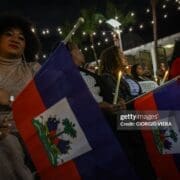
People attend a candlelight vigil for Haitians living in the US under the Temporary Protected Status (TPS) immigration program in Miami, Florida on February 3, 2026. Late on February 2, federal judge Ana C. Reyes of the Federal District Court in Washington, blocked the Trump administration from ending TPS for an estimated 350,000 Haitian immigrants. The status, which offers protection from deportation and work authorization, was set to expire on Feb. 3. (Photo by Giorgio Viera / AFP via Getty Images)

At the prayer vigil held at the Little Haiti Cultural Complex, a small but emotional crowd lit candles and prayed for stability, protection, and the opportunity to continue building their lives in the United States.

The ruling allows more than 350,000 Haitian immigrants nationwide — including an estimated 158,000 in Florida — to remain in the country and continue working, at least temporarily. For many families, the decision brought a measure of relief, tempered by ongoing uncertainty about the future.

“The past five years, what Haiti’s been dealing with — we are not ready,” said Fabiola Barthelemy, a Haitian American who has lived in the U.S. for decades, speaking to CBS News. “The crisis is real. Children are being raped and gangs are still active. Sending people back is like a death sentence to me.”

Although Barthelemy is a U.S. citizen, many members of her family are not. Her daughter, Elizabeth Barthelemy, said the prospect of her relatives being forced to return to Haiti is devastating.

“It would make me feel mad, frustrated, sad and depressed,” she told CBS Miami. “My cousins are like my family. I would go with them.”

Community leaders and elected officials echoed those concerns, stressing that TPS recipients are law-abiding, contributing members of society — not criminals.

On Monday, U.S. District Judge Ana Reyes temporarily blocked the Trump administration’s move to end TPS for Haitians nationwide.

Local officials say the decision offers critical breathing room but does not guarantee a permanent solution.

As of Tuesday night, the U.S. Citizenship and Immigration Services website had not yet been updated to reflect the ruling and continued to list TPS protections for Haitians as ending on Feb. 3rd.

RELATED: US Terminates Somalians Temporary Protected Status

Stella Jean Brings Haiti’s History And Pride To The 2026 Winter Olympics

News Americas, NEW YORK, NY, Weds. Feb. 4, 2026: After crafting the widely praised opening ceremony outfits for Team Haiti at the 2024 Paris Summer Olympics, Haitian-Italian designer Stella Jean is once again partnering with the island nation — this time to design its uniforms for the 2026 Milan–Cortina Winter Olympics.

Haitian-Italian designer Stella Jean is once again partnering with the island nation — this time to design its uniforms for the 2026 Milan–Cortina Winter Olympics.

Team Haiti’s Winter Olympics delegation may be small, but its cultural footprint is anything but. The 2026 team includes just two athletes — Richardson Viano, 23, and Stevenson Savart, 25 — yet Jean is ensuring their uniforms carry the weight of Haitian history, identity, and global presence.

In an interview with the Associated Press, Jean revealed that her original designs featured an image of Toussaint Louverture, the former enslaved general who led the revolution that established the world’s first Black republic in 1804.

“We have a commitment and a responsibility to convey a message,” Jean said. “There are many messages in this uniform. There is a bit of Haiti’s history, there is a representation of one of the fathers of the nation — Toussaint Louverture — a man feared by the most powerful on earth, such as Napoleon.”

However, the International Olympic Committee flagged the image as a violation of Olympic rules prohibiting political, religious, or racial propaganda at Olympic venues, forcing Jean and her team to rework the design.

“Rules are rules and must be respected, and that is what we have done,” Jean explained.

Drawing inspiration from a painting by Haitian artist Edouard Duval-Carrié, which depicts Louverture riding a red horse, Jean collaborated with Italian artisans to reinterpret the imagery without the historical figure. The final uniforms feature a striking red riderless horse set against a tropical backdrop, with the word “Haiti” emblazoned across the top.

Jean also designed a women’s look for Team Haiti, incorporating the traditional Haitian tignon — a headwrap historically imposed on enslaved women to cover their hair, now reclaimed as a symbol of resilience and cultural pride.

“For us, it is important that this horse — his horse, the general’s horse — remains,” Jean said. “It is the symbol of Haiti’s presence at the Olympics. In just a few meters of fabric, we must concentrate history and meaning. This is not about stylistic exercise.”

Haiti’s ambassador to Italy, Gandy Thomas, underscored the broader significance of the moment.

“Haiti’s presence at the Winter Olympics is a symbol — a statement, not a coincidence,” Thomas said. “We may not be a winter country, but we are a nation that refuses to be confined by expectation. Absence is the most dangerous form of erasing.”

Viano, who made history as Haiti’s first-ever Winter Olympian at the 2022 Beijing Games, echoed that sentiment, noting that participation on the global sports stage helps counter persistent negative narratives about the Caribbean nation.

The moment also comes amid heightened global attention on Haitians abroad. Just days before Haiti’s Winter Olympics appearance, a federal judge blocked an effort to end Temporary Protected Status (TPS) for roughly 350,000 Haitian immigrants living in the United States — a decision celebrated across diaspora communities.

Together, Jean’s designs and Team Haiti’s Olympic presence stand as a reminder that representation — on fabric, on snow, and on the world stage — remains a powerful form of resistance.

RELATED: Haitian American Congresswoman Salutes TPS Ruling As Little Haiti Prays