
Does This Caribbean Resort Expansion Signal A Shift From Tourism Destination To Global Wealth Hub?

By NAN Business Editor

News Americas, NASSAU, Bahamas, Tues. Feb. 17, 2026: When Baha Mar broke ground on its more than $700 million beachfront expansion on Nassau’s Cable Beach recently, the announcement was framed as a tourism milestone. The project will add 345 guest rooms, 77 branded luxury residences, and thousands of jobs. But beneath the ceremonial shovels and economic optimism lies a deeper question: Is the Caribbean quietly evolving from a tourism destination into a global wealth hub?

Baha Mar has officially broken ground on a new beachfront resort and branded residences on Cable Beach, marking a more than $700 million expansion that will add 345 guest rooms and 77 luxury residences to the country’s premier integrated resort destination.

For decades, the Caribbean’s economic identity has been anchored in hospitality. Resorts brought visitors, jobs, and foreign exchange. Yet today’s mega-developments increasingly reflect something more complex. The inclusion of branded luxury residences alongside hotel rooms signals a structural shift. These are not merely places to visit. They are places to own, invest, and store wealth.

This distinction matters.

Branded residences have become one of the fastest-growing segments of global real estate. Buyers are typically ultra-high-net-worth individuals seeking lifestyle, security, and jurisdictional diversification. By integrating residences into resort ecosystems, developers are transforming Caribbean properties into hybrid assets – part hotel, part private enclave, part global wealth infrastructure.

The Baha Mar expansion fits squarely within this model. Designed by internationally renowned architectural firm Foster + Partners, the project is positioned not just as a hotel, but as a premium residential and investment destination. Owners gain access to an established ecosystem that includes the Caribbean’s largest casino, luxury retail, championship golf, and more than 45 restaurants and lounges.

This model aligns with a broader global trend: the migration of capital into lifestyle jurisdictions.

In an era defined by geopolitical uncertainty, rising taxes in traditional wealth centers, and increasing interest in residency and citizenship mobility, wealthy individuals are diversifying geographically. The Caribbean, with its political stability, proximity to North America, and established financial frameworks, has emerged as a preferred destination.

The Bahamas, in particular, has strengthened its position through infrastructure investment, financial services sophistication, and its appeal as both a tourism and financial jurisdiction.

Bahamas Prime Minister Philip Davis underscored the significance of the expansion, describing the investment as a signal of confidence in the country’s economic future. “It is a signal to the world that our economy is steady, our tourism sector is growing, and our country is moving in the right direction,” he said.

Yet, the implications extend beyond tourism metrics.

Luxury developments increasingly function as anchors for broader economic ecosystems. They generate construction employment, permanent hospitality jobs, and demand for local suppliers—from farmers and fishermen to logistics providers and professional services. Baha Mar alone already employs more than 5,300 Bahamians, with an additional 1,400 positions expected once the new expansion is complete.

But perhaps more importantly, such developments reshape how the Caribbean is perceived globally.

Historically marketed primarily as a leisure destination, the region is now also being positioned as a place of long-term presence. Ownership, not just visitation, is becoming central. This transition enhances economic resilience by diversifying revenue streams beyond seasonal tourism cycles.

It also reflects the Caribbean’s integration into global capital flows.

Wealth today is increasingly mobile. Investors seek jurisdictions that offer quality of life, asset protection, and global accessibility. High-end resort developments provide precisely that intersection. They offer physical assets tied to globally recognized brands, located in politically stable environments, and embedded within service ecosystems designed for international clientele.

The Caribbean’s appeal is reinforced by geography itself. Located between North and South America, and accessible from major global financial centers, the region occupies a strategic position that combines lifestyle with connectivity.

Critically, this evolution does not eliminate tourism. Rather, it elevates it.

Tourism remains the foundation. But layered atop it is a new economic dimension—one centered on ownership, capital preservation, and global residency patterns. The resort becomes not just a destination, but a node within the architecture of global wealth.

For countries like The Bahamas, this shift offers opportunity – but also responsibility. Managing growth sustainably, ensuring local participation, and balancing foreign investment with national interests will determine how fully the region benefits.

What is clear is that the Caribbean’s economic narrative is expanding.

As cranes rise above Cable Beach and branded residences take shape alongside hotel towers, the message extends beyond Nassau. The Caribbean is no longer simply a place the world visits.

It is increasingly a place the world invests in, lives in, and anchors wealth within.
RELATED: The Caribbean’s Middle Class Is Being Built —And Broken — At The Same Time

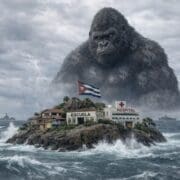
King Kong And The Island: America’s Moral Collapse And Cuba

By Ron Cheong

News Americas, TORONTO, Canada, Tues. Feb. 17, 2026: For more than sixty years, Cuba has endured relentless external pressure from the United States. The embargo, designed to strangle trade, cripple the economy, and punish a population for the choices of its government, has long made daily life a struggle. Today, the situation is more difficult than ever: fuel shortages have grounded planes and paralyzed public transport; tourism, a crucial source of income, has all but collapsed; and the economy teeters under layers of scarcity and deprivation. Decades of hardship have forged resilience in the Cuban people, but the severity of these pressures makes one wonder: can Cuba survive this new trial, or are these dark hours edging it closer to the brink?

Despite these extraordinary challenges, Cuba has preserved a surprising measure of moral and social integrity. Health care remains universal, education is free and widely accessible, and violent crime is low. The government, while politically centralized and media tightly controlled, has consistently prioritized the welfare of its citizens over elite enrichment. In practical, people-centered terms, Cuba remains morally and functionally resilient, even under extreme external duress.

The U.S.: A Democracy Under Siege From Within

Contrast this with the United States, once hailed as the world’s premier democracy. Formally, Americans enjoy freedoms enshrined in law: free speech, press protections, competitive elections, and an independent judiciary.

But these formal liberties are increasingly being hollowed out in practice: There have been unprecedented calls to “nationalise” US elections and talk about cancelling the midterms – even as the blockade of Cuba is being justified as “pressuring the Cuban government to hold free elections.”  At the same time, American civic trust is being battered – protests are met with militarized force as in Minnesota, while the blockade of Cuba is also unashamedly being justified in the name of “Promoting human rights and political freedoms.”

Wealth is concentrated in the hands of the top 1%, which dominates political donations, lobbying, and policy outcomes. Media ownership is similarly consolidated in the hands of a few, producing shallow, sensationalist coverage that leaves large swaths of the population misinformed. Judicial appointments are increasingly partisan.

In other words, the United States is showing the signs of a democracy under stress, much like historical empires before it: Rome, Tsarist Russia, and the Soviet Union all exhibited elite capture, norm erosion, and civic disengagement before systemic collapse. Formal freedoms exist, but meaningful self-correction has become compromised. Citizens may vote, speak, and organize, yet their ability to influence outcomes is heavily filtered through wealth, media bias, and institutional manipulation.

The Moral Challenge

The contrast is striking. Here is a small island, subjected to decades of external aggression and severe deprivation, yet maintaining a society that, in practice, prioritizes the collective welfare of its people. Meanwhile, a wealthy, globally dominant democracy – free in principle – struggles to ensure that its citizens’ basic needs are met and its political system functions equitably.

Cuba’s one-party system and state-aligned media are often cited as moral deficits. Yet what moral weight do political freedoms carry if the society that claims them fails to meet the basic needs of its people? The Cuban system, despite restrictions on political plurality, has consistently delivered healthcare, education, and security – the material foundations of dignity and life.

Historical Lessons: Decline, Inequality, And Moral Authority

History teaches that empires and states rarely fall suddenly; decline is usually the cumulative effect of inequality, elite capture, and norm erosion. Rome’s senatorial elites insulated themselves while ordinary citizens struggled; Tsarist Russia refused reform until the system collapsed; the Soviet Union stagnated under rigid institutions and external overreach. In each case, the formal structures of governance persisted even as the underlying moral and functional legitimacy deteriorated.

The United States now exhibits eerily similar patterns: economic inequality has hollowed out political influence; media concentration distorts public understanding; civic trust is fractured; and institutional norms are under strain. Ironically, it is the US rather than Cuba, which has survived decades of external punishment, that faces internal moral and systemic fragility – a democracy that risks eroding from within.

Kant wrote, “The worth of a person consists in being a subject capable of reason and moral choice, not merely a means to an end.” By this measure, America’s moral authority is increasingly compromised: citizens are treated less as moral subjects with agency than as data points filtered through the lens of wealth and influence.

King Kong Vs. The Island

Even if we take it that Cuba’s government system is seriously flawed, the metaphor is unavoidable: the United States, a global behemoth wielding overwhelming power, functions as a predator – King Kong – crushing a small, vulnerable island beneath its weight. The embargo and aggressive sanctions on Cuba reveal a democracy that has abandoned moral principle in favor of domination. Meanwhile, Cuba, the small animal beneath the shadow of that predator, has demonstrated resilience, cohesion, and a people-centered ethic that the predator itself increasingly lacks.

Cuba has survived decades of punishment and deprivation. But the current crisis – fuel shortages, economic paralysis, and a collapse of tourism – may be the severest it has ever faced. Will the island endure these dark hours? History shows that resilience is possible, but the strain is immense, and the outcome is uncertain.

A Moral Reckoning

The contrast could not be starker: a wealthy, formally free democracy showing cracks in its moral and functional foundations, juxtaposed with a small, embattled island maintaining social cohesion and prioritizing human welfare under extreme external pressure. The United States has long claimed moral and political superiority; today, its claim rings hollow. It’s democracy, once celebrated, risks being remembered as a system where freedom existed in theory but was undermined by the concentration of wealth, the distortion of information, and the erosion of institutional norms.

Meanwhile, Cuba, despite political limitations, demonstrates that people-centered governance, moral integrity, and social cohesion have so far survived even under extraordinary external duress. The moral lesson is stark: power alone does not confer legitimacy; justice and care for citizens do. If the U.S. continues to prioritize domination, wealth, and spectacle over the well-being of its people, it risks becoming a giant whose size conceals rot, while a small island showed what resilience and moral governance truly look like.

EDITOR’S NOTE: Ron Cheong, born in Guyana, is a community activist and dedicated volunteer with an extensive international background in banking. Now residing in Toronto, Canada, he is a fellow of the Institute of Canadian Bankers and holds a Bachelor of Science degree from the University of Toronto. His comments are his own and do not reflect those of News Americas or its parent company, ICN.

RELATED: Clarion Across The Atlantic: Barbados Mia Mottley’s Third Mandate And The Rise Of Caribbean Moral Leadership