The Cuban Revolution Holds Out Against US Imperialism

By Vijay Prashad

News Americas, WASHINGTON, D.C., Thurs. Feb. 19, 2026: In January 2026, US President Donald Trump declared Cuba to be an “unusual and extraordinary threat” to US security – a designation that allows the United States government to use sweeping economic restrictions traditionally reserved for national security adversaries. The US blockade against Cuba began in the 1960s, right after the Cuban Revolution of 1959, but has tightened over the years. Without any mandate from the United Nations Security Council, which permits sanctions under strict conditions, the United States has operated an illegal, unilateral blockade that tries to force countries from around the world to stop doing basic commerce with Cuba. The new restrictions focus on oil. The United States government has threatened tariffs and sanctions on any country that sells or transports oil to Cuba.

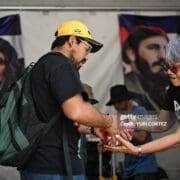
Members of the Association of Cuban Residents in Mexico A.C. “Jose Marti” prepare humanitarian aid in front of posters of Argentineborn Cuban revolutionary Ernesto “Che” Guevara and Cuban leader Fidel Castro at a collection center set up in Plaza El Zocalo in Mexico City on February 17, 2026, as part of a collection campaign in solidarity with Cuba. (Photo by Yuri CORTEZ / AFP via Getty Images)

On 3 January, the United States attacked Venezuela and kidnapped President Nicolás Maduro Moros and National Assembly deputy Cillia Flores. As 150 US military aircraft sat above Caracas, the United States informed the Venezuelan government that if they did not concede to a list of demands, the US would essentially convert downtown Caracas to Gaza City. The remainder of the government, with no leverage in the conversation, had to effectively make a tactical compromise and accept the US demands. One of these demands was that Venezuela cease to export oil to Cuba. In 2025, Venezuela contributed about 34 percent of Cuba’s total oil demand. With Venezuelan oil out of the picture in the short run, Cuba already anticipated a serious problem.

But this was not all. Mexico supplied 44 percent of Cuba’s imported crude oil in 2025. Pressure now mounted from Washington on Mexico City to cease its oil exports to Cuba, which would then mean that almost 80 percent of Cuba’s oil imports would disappear. In a phone call between Mexico’s President Claudia Sheinbaum and Trump, he claimed that he told her to stop selling oil to Cuba, but she denied that, saying that the two presidents only talked in broad terms about US-Mexico relations. Either way, the pressure on Mexico to stop its oil shipments has been considerable. Sheinbaum has stressed that Mexico must be permitted to make sovereign decisions and that the Mexican people will not buckle under US pressure. Cutting fuel to Cuba would cause a humanitarian crisis, so Sheinbaum said her government would not accept the Trump demand.

Trump’s savage policy has effectively cut off much of Cuba’s oil imports, which has created a major energy crisis on the island of eleven million people. There are rolling blackouts, fuel shortages for hospitals, water systems, and transportation, and rationing of electricity. Due to the lack of aviation fuel, several commercial airlines – such as Air Canada – have stopped their flights to Havana.

The United Nations has warned that the US pressure campaign – especially the policy to target fuel – threatens Cuba’s food and water supplies, hospitals, schools, and basic services. UN officials, including the UN Special Rapporteur on human rights in Cuba, have condemned the US tightening of the blockade as a measure that directly harms ordinary citizens. They pointed out that restrictions make it harder for hospitals to obtain essential medicines, dialysis clinics to operate, and medical equipment to reach patients, worsening the health crisis on the island. The Special Rapporteur described the policy as “punitive and disproportionate,” emphasizing that it violates international law and deepens socio-economic hardships. The UN has urged the United States to lift sanctions and prioritize humanitarian exemptions, stressing that dialogue and cooperation—not coercive measures—are necessary to protect Cuban lives and human rights.

A group of United Nations human rights experts condemned Trump’s executive order as a “serious violation of international law” and “a grave threat to a democratic and equitable international order.” They argued that Trump’s order seeks to coerce Cuba and third states by threatening trade sanctions, and that such extraterritorial economic measures risk causing severe humanitarian consequences. Their statement made it clear that no right under international law permits a State to impose economic penalties on third States for lawful trade relations, and they called on the Trump administration to rescind the illegal order. The UN General Assembly has voted overwhelmingly against the blockade every year since 1992, often with only the US and Israel opposed.

The Blockade by the US has had a grave impact on Cuba’s development paradigm. Since the start of the Blockade over sixty years ago, the US has cost Cuba $171 billion or if adjusted for the price of gold, $2.10 trillion. Between March 2024 and February 2025, the Cuban government estimates that the Blockade caused about $7.5 billion in damages, a 49 percent increase since the previous period. If you take the $171 billion number, the Cuban people lose $20.7 million per day or $862,568 per hour. These losses are grievous for a small country that attempts to build a rational society rooted in socialist values.

Response from Havana

Cuba’s President Miguel Díaz-Canel has strongly condemned the tightened US measures as an ‘economic war’ and has argued that the US policy is designed to weaken Cuba’s sovereignty. The government calls this an “energy blockade” and emphasises that the shortages on the island are a direct result of US coercive policies. In reaction, the Cuban Revolution has implemented emergency plans, including fuel rationing to prioritise essential services such as hospitals, water systems, and public transportation. Cuba has also announced state directives to manage diminished energy supplies, including shifts toward alternative and renewable energy sources where feasible. The Chinese government has donated equipment for large-scale solar parks to be built in Artemisa, Granma, Guantánamo, Holguín, Las Tunas, and Pinar del Río. In the long-term, China will assist Cuba to build 92 solar farms to add 2,000 megawatts of solar capacity. To assist households in remote areas, the Chinese government has sent 5,000 solar kits for rooftop energy harvesting. Fuel from Mexico and Russia, as well as other countries is now on the way to Cuba. Trump’s policy of isolation has not fully succeeded.

The Cuban government said it is in touch with Washington but has not yet held direct high-level talks. President Díaz-Canel has said that his government would speak to the United States but only under three important conditions. First, that the dialogue will be respectful, serious, and without pressure or preconditions. Second, the dialogue must respect Cuba’s sovereignty, independence, and political system. And finally, the Cuban government is unwilling to negotiate the Cuban Constitution (recently revised in 2019) or Cuba’s commitment to socialism. If the United States insists on a discussion on any of these three issues, there will be no dialogue. The Cuban Revolution’s defiance on these issues is rooted in its history, since the Revolution itself was an act of defiance against the US claim to control the Western Hemisphere through the 1823 Monroe Doctrine (now renewed by Trump in 2025 with his Corollary). This defiance has been contagious, building a Latin American resistance to US imperialism from the 1960s to the present – including at the heart of the Bolivarian process in Venezuela.

The Angry Tide

Latin America is going through a rapid and dangerous transformation. Country after country – from Argentina to El Salvador – have elected to power political formations from the Far Right of a Special Type. These are leaders who have committed themselves to strong conservative social values (rooted in the growth of reactionary Evangelical Christianity across the Americas), to a ruthless attack on the poor through a war on crime (shaped by a theory that calls for the arrest of any potential criminals and their incarceration, a policy pioneered by El Salvador’s Nabil Bukele), and by a sharply turn toward Western Civilisation that includes an orientation towards the United States and against China (this sentiment oscillates from a celebration of Western culture to a hatred of communism). The emergence of the Far Right of a Special Type appears as if it will be in charge for a generation if it can erase the left from power in Colombia, Cuba, Mexico, Nicaragua, and Venezuela (in Brazil, this Right has already taken charge of the legislature).

The parallel attacks on Venezuela and Cuba are part of the United States’s contribution to this rise of the Angry Tide across the Americas. Trump and his cronies would like to install their kind of leaders – such as Javier Milei – across the Americas as part of the Trump Corollary to the Monroe Doctrine. It is this that revives the idea of sovereignty in the Americas. When the Puerto Rican rapper Bad Bunny ended his performance at the US Super Bowl with a celebration of all the countries in the Americas, and when he named each of them, that gesture was itself part of the battle over the idea of sovereignty.

The Cuban Revolution holds out against US imperialism, but under great pressure. Solidarity with Cuba is for the Cuban people, for the Cuban Revolution, for the reality of sovereignty across the Americas, and for the idea of socialism in the world. This is now the frontline of the fight against imperialism.

EDITOR’S NOTE: Vijay Prashad is an Indian historian and journalist. He is the author of forty books, including Washington Bullets, Red Star Over the Third World, The Darker Nations: A People’s History of the Third World, The Poorer Nations: A Possible History of the Global South, and How the International Monetary Fund Suffocates Africa, written with Grieve Chelwa. He is the executive director of Tricontinental: Institute for Social Research, the chief correspondent for Globetrotter, and the chief editor of LeftWord Books (New Delhi). He also appeared in the films Shadow World (2016) and Two Meetings (2017).

SOURCE: Globetrotter
Is Trinidad And Tobago Quietly Becoming America’s Caribbean Energy Bridge To Venezuela?

News Americas, PORT OF SPAIN, Trinidad, Thurs. Feb. 19, 2026: Trinidad and Tobago, whose prime minister has alienated her CARICOM colleagues to cozy up to the new US administration, is now emerging as one of the most strategically important energy intermediaries in the Western Hemisphere, following the issuance of two new United States General Licenses authorizing certain oil and gas activities involving neighboring Venezuela.

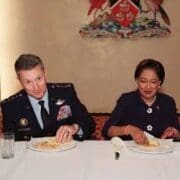
FLASHBACK – Chairman of the US Joint Chiefs of Staff General Dan Caine enjoys doubles with Prime Minister Kamla Persad-Bissessar at a meeting in Trinidad on Nov. 26, 2025. (Facebook image)

The licenses, granted under U.S. Treasury Department authority, now provide a structured legal framework allowing Trinidad and Tobago to pursue energy development projects tied to Venezuelan offshore gas reserves while remaining compliant with U.S. sanctions and financial controls. But beyond their technical scope, the approvals signal a deeper geopolitical and economic shift – one that positions Trinidad & Tobago as a critical bridge between American energy policy and some of the region’s largest untapped gas reserves.

Prime Minister Kamla Persad-Bissessar described the development as a significant opportunity to strengthen Trinidad and Tobago’s role as a hemispheric energy hub.

“As a longstanding close partner of the United States, Trinidad and Tobago views this development as an important opportunity to deepen hemispheric energy cooperation, strengthen regional stability, and reinforce trusted commercial ties,” the Prime Minister said in a statement.

At the center of this strategic shift lies the Dragon gas field, located near the maritime border between Trinidad and Venezuela. The field is estimated to hold approximately four trillion cubic feet of natural gas and has been the subject of ongoing negotiations involving multinational energy companies Shell and BP, along with Trinidad’s state-owned National Gas Company.

The project had previously been stalled after the U.S. revoked licenses in 2025 amid sanctions and political tensions with Venezuela. The new licenses restore a pathway forward, albeit under strict financial oversight. Payments related to oil and gas activities must be routed through designated accounts controlled by the U.S. Treasury, ensuring compliance with sanctions and preventing direct financial benefit to Venezuela’s government.

For Trinidad and Tobago, which allowed the US military to use its shores in its so-called narco-war in the Caribbean, which led to the kidnapping of Venezuelan President Nicholas Maduro and his wife, the implications extend far beyond a single project.

Energy has long been the backbone of Trinidad’s economy, but declining production from mature fields and global energy transitions have put pressure on the country to secure new supply sources. Access to Venezuelan gas – facilitated through U.S.-approved channels – could help stabilize domestic energy production, sustain petrochemical industries, and preserve thousands of jobs tied to the country’s energy sector.

More importantly, the licenses elevate Trinidad’s role from energy producer to strategic energy intermediary.

With existing liquefied natural gas (LNG) infrastructure, refining capacity, and decades of technical expertise, Trinidad is uniquely positioned to process and distribute gas resources within a framework acceptable to global financial markets and Western regulators. This makes the country a vital node in regional energy security, particularly as geopolitical tensions reshape global supply chains.

The timing is also significant. As global energy markets face continued volatility and the US seeks to diversify supply sources closer to home, Trinidad is gaining renewed strategic importance.

Industry analysts say the licenses reflect growing confidence in Trinidad’s regulatory stability and its reliability as a U.S. partner in managing sensitive energy operations near Venezuela. US President Donald Trump is considering a visit to Venezuela, though he did not specify when the trip might take place or what agenda it would entail.

Beyond direct economic gains, the development reinforces Trinidad’s influence with the Trump administration in the Caribbean. A strengthened energy sector enhances the country’s capacity to supply neighboring islands, support regional industrial activity, and anchor broader economic integration efforts.

The move also underscores a broader shift in how the Caribbean and the Americas are perceived by the US. Once viewed primarily as its backyard, the Trump administration has increasingly turned to dominate there as it now controls the oil in Venezuela.

For Trinidad and Tobago, the new licenses represent more than regulatory approvals. They mark a pivotal moment in the country’s evolution — from a regional energy producer to a geopolitical energy bridge linking Caribbean resources, American policy, and global markets.

As energy security becomes central to global economic stability, Trinidad’s role may prove increasingly indispensable.

RELATED: CARICOM’s Animal Farm? – Why The Caribbean Is United in Rhetoric, Divided In Reality

Trump Confuses Bahamas And Bermuda At White House Black History Month Event

By NAN NEWS EDITOR

News Americas, NEW YORK, NY, Thurs. Feb. 19, 2026: US President Donald Trump is facing renewed criticism after appearing to confuse two nations in the Americas – The Bahamas and Bermuda – during of all events- a White House Black History Month event.

While recognizing former NFL star Herschel Walker, who currently serves as U.S. Ambassador to The Bahamas, Trump stumbled over the name of the country he represents.

“Herschel Walker… he’s ambassador to the Bahamas. I don’t know. Bahamas, Bermuda, Berhamas, whatever. A nice place!” Trump said, drawing attention for both the confusion and apparent dismissiveness.

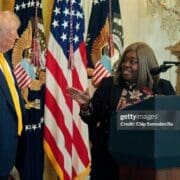
Small business owner Arnetta Bradford of Hope, Arkansas speaks alongside U.S. President Donald Trump during a Black History Month reception in the East Room of the White House on February 18, 2026 in Washington, DC. The president issued a proclamation recognizing Black History Month on Feb. 3. (Photo by Chip Somodevilla/Getty Images)

The Bahamas and Bermuda are distinct nations with separate governments, histories, and geopolitical roles. The Bahamas is an independent Caribbean nation of roughly 400,000 people and a key U.S. regional partner. Bermuda, meanwhile, is a British Overseas Territory located in the North Atlantic and operates under a different constitutional and diplomatic structure.

For Caribbean observers, the moment carries deeper symbolic implications beyond a simple verbal slip.

Small island nations in the Caribbean have long played outsized roles in global finance, climate diplomacy, tourism, and regional security cooperation with the United States. The Bahamas in particular is central to U.S. maritime security, migration management, and financial regulation cooperation.

Such misidentifications risk reinforcing longstanding frustrations among Caribbean leaders and diaspora communities who have often argued that the region is treated as interchangeable or peripheral in global political discourse, despite its strategic importance.

Diplomatic recognition, Caribbean analysts say, is not simply about protocol but about respect.

In recent years, Caribbean nations have increased their influence globally, particularly through climate advocacy, financial diplomacy, and economic partnerships. Leaders such as Barbados Prime Minister Mia Mottley have emerged as prominent voices in international forums, while countries like Guyana, Trinidad and Tobago, and The Bahamas are playing expanding roles in energy, finance, and regional development.

The Bahamas itself maintains deep diplomatic and economic ties with the United States, including cooperation on banking regulation, tourism, law enforcement, and national security initiatives.

The appointment of Walker as ambassador underscored the importance of that bilateral relationship. However, public confusion about the country’s identity – especially at a Black History Month event intended to recognize Black leadership and contributions – has prompted broader reflection on how Caribbean nations are perceived within U.S. political consciousness.

For many Caribbean Americans, the moment highlights a larger issue of visibility.

The Caribbean diaspora has made enormous contributions to American society, from civil rights and politics to medicine, business, and culture. Yet, Caribbean nations themselves often remain misunderstood or overlooked in public discourse even as the US has turned the region from a zone of peace into a region where boats are being bombed without real cause, leaving several Caribbean nationals dead to date. Since September last year, the United States has carried out at least 36 similar strikes in Caribbean and Eastern Pacific waters, killing more than 120 individuals suspected of involvement in drug trafficking, according to U.S. military data.

The incident also comes at a time when the Caribbean is gaining increasing geopolitical relevance amid shifts in global energy markets, climate negotiations, and nearshoring strategies. Ultimately, while political misstatements are not uncommon, moments like these resonate deeply in regions whose histories have long been shaped by external powers.

For Caribbean nations that continue to assert their voice and sovereignty on the global stage, recognition – accurate and respectful – remains an essential part of partnership.

RELATED: U.S. Military Strike Raises Urgent Questions About Caribbean Sovereignty After Possible St. Lucian Deaths

The Majesty Of Reverend Jesse Jackson

By Dr. Isaac Newton

News Americas, NEW YORK, NY, Weds. Feb. 18, 2026: I was deeply touched by his incredible capacity to let words and meaning jolt the soul through the rhythm of hope, the call to faith, and his relentless pursuit of freedom, dignity, and justice for all, especially the downtrodden and outcast. Long before I met him, his voice had already crossed oceans and entered the crowded chambers of my own conscience. Then I met him in Jersey City when he attended an African American Interdenominational Convention. His presence was radiant, marked by his moving smile and infectious, confident humility, which drew people to him with a sense of wonder and whispering pride. In that room, I encountered a leader and a living sermon. Before my eyes stood a man whose very cadence carried the heartbeat of generations who had been told to wait their turn in history.

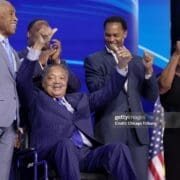
FLASHBACK – The Rev. Jesse Jackson, seated, cheers on Aug. 19, 2024, during the Democratic National Convention at the United Center. (Brian Cassella/Chicago Tribune/Tribune News Service via Getty Images)

The man was Jesse Jackson, but the moment belonged to something larger than biography. He rose from the soil of segregation and shaped his public life with the discipline of Christian conviction and the daring imagination of prophetic faith. As a protégé of Martin Luther King Jr., he learned that moral courage must be organized and that faith without public action is only private comfort. His declaration to keep hope alive evolved beyond a slogan into a theology of survival for people battered by exclusion. When he affirmed that he was somebody, he was restoring sacred worth to those who had been measured and dismissed. He taught that dignity is conferred by the Creator, not the powerful, and therefore cannot be revoked by prejudice, poverty, or political neglect.

For Caribbean and African peoples, his words traveled like trade winds across the Atlantic. In Kingston, Port of Spain, Bridgetown, Georgetown, Lagos, Monrovia, Accra, Nairobi, and Gaborone, communities wrestling with the aftershocks of colonialism and economic vulnerability heard in his voice a summons to believe again. Hope, in his lexicon, was nothing short of disciplined resistance. It was the courage to count the cost of freedom and to pay it with patience, organization, and sacrifice. He insisted that faith must move beyond sanctuary walls into voting booths, classrooms, boardrooms, and streets. He spoke to fishermen and factory workers, to teachers and taxi drivers, to students who feared their dreams were too fragile for harsh realities. His mission dignified ordinary labor and reminded entire regions that the foundation of justice is built by hands that history often overlooks.

Yet, his majesty did not depend on perfection. He faced his own foibles in public view, and critics were swift and relentless. What distinguished him was not an absence of flaw but an unwillingness to be imprisoned by it. He understood that moral authority will not share the same room with moral infallibility. His Christian faith compelled confession, correction, and continuation. In this he modeled a rare form of leadership for a skeptical age. He showed that one can stumble and still stand for something larger than the stumble. For communities accustomed to seeing their champions either idolized or discarded, his resilience offered a third path, accountability without annihilation. That lesson is vital for societies struggling to nurture leaders who are human yet heroic in purpose.

As he transitions from the center of public life into the solemn dignity of legacy, his meaning deepens. The majesty of Reverend Jackson lives in the marches he led, the speeches he delivered, and in the moral vocabulary he expanded for the world. He taught that hope is a discipline, that dignity is sacred, that freedom demands cost, and that faith can animate public courage across race, region, and religion. His love for ordinary men and women of all races transcended pedigree and geography because he believed each person bore a divine imprint. For Caribbean and African peoples, and for all who yearn to triumph over despair, his life stands as a testament that history can bend when souls refuse to bow. His legacy lives on, both as memory and as mandate for generations yet unborn to keep hope alive and to rise each morning declaring with conviction that they too are somebody.

EDITOR’S NOTE: Dr. Isaac Newton is a globally experienced thought leader, Harvard, Princeton, and Columbia trained strategist, and advocate for social justice and leadership excellence. With over 30 years of expertise in bridging cultural, economic, and ideological divides, he brings a nuanced perspective to complex issues shaping global and regional landscapes.

RELATED: Two Visions, One Day: The Stark Contrast Between Donald Trump And Dr. King