Here’s What Marco Rubio Offered CARICOM Leaders At St. Kitts Summit
News Americas, BASSETERRE, St. Kitts and Nevis, Weds. Feb. 25, 2026: U.S. Secretary of State Marco Rubio used his appearance at the 50th Regular Meeting of the Conference of CARICOM Heads of Government in St. Kitts to signal what he called a “reinvigorated” U.S. focus on the Caribbean and Western Hemisphere.
Speaking at the St. Kitts Marriott Beach Resort, Rubio framed his visit – the first by a U.S. Secretary of State to a CARICOM heads meeting in a decade – as evidence that Washington is prioritizing the region after years of relative neglect.
But beyond the rhetoric of partnership, what exactly did Rubio put on the table?
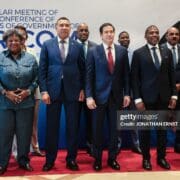
US Secretary of State Marco Rubio participates in a family photo with Caribbean Community (CARICOM) heads of government in Basseterre, Saint Kitts and Nevis, February 25, 2026. Rubio is meeting with Caribbean leaders seeking a common line on Venezuela and pressure on Cuba. He’s also addressing President Donald Trump’s priorities, including combating illegal immigration, drug trafficking and regional security. (Photo by Jonathan Ernst / POOL / AFP via Getty Images)
Here’s a breakdown.
1. Expanded Security Cooperation
Rubio identified transnational criminal organizations – particularly narcotics trafficking networks – as the most urgent shared threat facing the Caribbean and the United States.
He warned that these groups now possess funding and military-style weaponry that rival the power of some states. He acknowledged that many illegal firearms flowing into the region originate in the U.S. and said Washington is working to curb that pipeline.
Rubio pointed to recent U.S. actions designating violent groups as terrorist organizations and imposing sanctions on individuals who support them, including in Haiti. He also cited the heavily armed drug cartels operating in Mexico as an example of the scale of the threat.
What this means:
The U.S. is signaling deeper law enforcement coordination, intelligence sharing, and security alignment with Caribbean governments.
What was not announced:
No new regional security fund. No specific dollar commitments. No named initiative or timeline.
2. Energy Partnership and Economic Growth
Rubio emphasized energy development as a pathway to prosperity for CARICOM states. He acknowledged that several countries are exploring oil, gas, and renewable energy projects and said the United States wants to be a partner in responsible energy expansion.
“Energy is critical for every economy in order to prosper,” Rubio said, noting that safe and responsible resource development can generate wealth and stability.
He also encouraged efforts to make the region more attractive for U.S. investment, saying American businesses should play a role in Caribbean economic diversification.
What this means:
Washington is encouraging U.S. private-sector engagement in Caribbean energy and infrastructure sectors.
What was not announced:
No new trade agreement. No financing package. No development bank program or grant funding was unveiled.
3. Venezuela Policy Shift
Rubio devoted a significant portion of his remarks to Venezuela, saying the country is “better off today than it was eight weeks ago” following political changes there.
He cited the release of political prisoners, the closure of the Helicoide prison facility, and renewed oil revenues directed toward public services as signs of progress. He confirmed that the U.S. has reopened its embassy in Caracas.
Rubio said Washington’s immediate priority after Nicolás Maduro’s capture was preventing instability, migration flows, and regional spillover violence. He added that fair democratic elections will ultimately be necessary for long-term legitimacy.
He positioned a stable, democratic Venezuela as a potential future energy partner for the Caribbean and a reduced source of regional instability.
4. A “Reinvigorated” Relationship
Rubio stopped short of calling the moment a “reset,” instead describing it as a reinvigoration of longstanding bilateral and regional ties.
“The stronger, safer, more prosperous and more secure that all of your countries are, the stronger, safer and more secure the United States is going to be,” he told leaders.
His central message was clear: U.S. security and prosperity are intertwined with the Caribbean’s.
The Bottom Line
Rubio offered strategic engagement, security alignment, and energy partnership. He signaled sustained diplomatic attention and personal commitment during his tenure.
What he did not offer were concrete funding commitments, new regional programs, or specific economic packages.
For CARICOM leaders marking their 50th regular meeting, the message was one of renewed political attention – with the details of implementation still to come.