CARICOM In The Era Of Zero-Sum Geopolitics: Finding Its Way In A Fragmenting Global Order

By Ron Cheong

News Americas, NEW YORK, NY, Mon. Mar. 30, 2026: CARICOM began as an ambitious project rooted in regional unity, resilience to external shocks and climate change, integrated economic development, and the pursuit of a single, stronger voice in international affairs. For small states navigating a complex world, collective representation promised far greater influence than fragmented national positions. Today, it remains the oldest surviving integration movement in the developing world.

But that vision is under strain – not only from internal dissent, but from the collision of multiple global shifts unfolding at once.

Recent criticism from Trinidad and Tobago’s Prime Minister, Kamla Persad-Bissessar, underscores growing frustration within the bloc. Her remarks questioning CARICOM’s reliability in defending Trinidad and Tobago against threats from the former Nicholas Maduro administration in Venezuela, and its long-term effectiveness, reflect deeper concerns about the organization’s ability to respond cohesively to external threats. While such internal tensions are significant, they are only part of a broader challenge.

Beyond the region, powerful external forces are reshaping the geopolitical landscape. The Caribbean is no longer navigating a single axis of great power rivalry, but a convergence of pressures: a more assertive and conditional U.S. posture, a recalibrating Chinese economic strategy, and global shocks – including those affecting oil flows through the Strait of Hormuz -alongside persistent regional complexities involving Venezuela and Cuba.

For CARICOM’s roughly 18.5 million citizens, this convergence represents both heightened vulnerability and potential opportunity. At stake is not only economic stability, but, for some smaller states, long-term resilience. Bridging internal divides and advancing a unified strategic vision is no longer optional – it is essential. Given the region’s shared history, including the enduring legacy of colonial “divide and conquer” tactics, maintaining cohesion across differing political alignments remains critical, though undeniably difficult.

The American Shift: Influence Through Pressure, Not Partnership

The most immediate external pressures stem from intensifying great power rivalry, particularly the evolving posture of the United States.

Where Washington once balanced competition with engagement, its approach has become more narrowly transactional. Increasingly, U.S. policy emphasizes sanctions, investment scrutiny, and geopolitical pressure – especially in sectors deemed sensitive or strategic.

This shift risks eroding decades of influence built through trade, development assistance, education, and institutional partnerships. Many Caribbean governments now perceive U.S. engagement as more conditional – focused less on expanding local opportunity and more on limiting Chinese presence.

The result is not wholesale alignment with China, but rather strategic diversification. Caribbean states are responding pragmatically to what they perceive as a narrowing of options from a traditional partner.

China’s Quiet Pivot: From Mega-Projects to Market Strategy

In parallel, China is adjusting its own approach.

Rather than retreating, Beijing is recalibrating. Trade remains central to its engagement, even as large-scale state-backed financing slows. CARICOM exports to China remain relatively modest -approximately $370–450 million annually, while imports from China run into the billions, reflecting a persistent structural imbalance.

At the national level, the trend is even more pronounced. In Trinidad and Tobago, for example, China’s share of imports has risen significantly over the past decade, contributing to ongoing trade deficits.

However, the nature of Chinese involvement is evolving. Large infrastructure loans are giving way to smaller, more targeted investments, particularly in telecommunications, renewable energy, and digital infrastructure. This shift reflects both increased risk sensitivity in Beijing and broader changes in the global economic environment.

For Caribbean economies, this model may offer a better fit. Smaller-scale investments can integrate more effectively into local markets, supporting incremental productivity gains without the burden of large sovereign debt obligations.

The trade-off, however, is clear: reduced capital inflows paired with increased import dependence. Without a coherent industrial policy, the region risks deepening its role as a consumption market rather than developing into a production hub.

Oil Shock And Economic Divergence

Compounding these dynamics is renewed volatility in global energy markets.

Instability affecting key transit routes such as the Strait of Hormuz – through which roughly one-fifth of global oil supply passes, has driven price fluctuations with far-reaching consequences. For major exporters like Brazil and Guyana, this presents a significant windfall.

For most CARICOM states, however, the impact is overwhelmingly negative.

As net energy importers, rising oil prices translate directly into inflation, increased transportation costs, and mounting fiscal pressure. Governments face difficult choices: absorb rising costs through subsidies or pass them on to consumers – both of which carry economic and political risks.

Given the relative inelasticity of demand for essential goods such as food and fuel, higher prices do little to reduce consumption; instead, they intensify economic hardship.


Cuba: Between Constraint And Opportunity

Few countries illustrate these overlapping pressures more clearly than Cuba. Although not a CARICOM member, it remains an important regional partner.

Decades of U.S. sanctions have constrained Cuba’s access to global finance, energy, and trade, challenges further compounded by Venezuela’s economic difficulties. Yet the current geopolitical moment may offer limited, incremental openings.

As U.S. strategic attention shifts elsewhere, enforcement of sanctions can become uneven. While the embargo remains firmly in place, there are signs of small-scale humanitarian and commercial flows reaching Cuba via third countries, suggesting a gradual testing of its practical limits.

At the same time, China’s evolving investment approach focused on targeted sectors may align with Cuba’s strengths in biotechnology, pharmaceuticals, and renewable energy.

These developments do not signal a breakthrough, but they do point to the possibility of modest, gradual easing at the margins of Cuba’s economic isolation.

A Moment Of Strategic Fluidity

What defines the current global environment is not dominance, but uncertainty.

China is recalibrating. The United States is reprioritizing. Energy markets remain volatile. Even long-isolated actors like Cuba may be finding limited openings.

For the Caribbean, this moment presents both risk and opportunity.

Absent a deliberate and coordinated strategy, the region risks drifting into deeper dependency -importing more, producing less, and remaining exposed to external shocks. With stronger policy coordination, investment in regional production, and diversified partnerships, however, CARICOM could instead enhance its resilience.

In this context, countries like Guyana – with its growing oil sector, abundant arable land, and freshwater resources, could play a pivotal anchoring role in regional development.

Beyond Zero-Sum Geopolitics

Ideally, the Caribbean’s future would not be determined solely in Washington or Beijing. The region should not be forced into binary choices between competing powers.

In reality, geography, logistics, and deep economic ties ensure that the United States will continue to exert significant influence. Yet the global order is shifting, and relationships are evolving.

What many in the region seek is not dominance from external partners, but consistency, reliability, and mutual respect – partnerships that endure beyond political cycles and do not abruptly reverse course.

As Canadian Prime Minister Mark Carney noted at the World Economic Forum in Davos: “It calls for honesty about the world as it is… We know the old order is not coming back. We shouldn’t mourn it. Nostalgia is not a strategy.”

For the Caribbean, that realism is essential.

At a time of global fragmentation, the region once again stands at a crossroads. The difference today is that it has more options – but also less margin for error.

CARICOM’s greatest strength remains what inspired its creation: a shared history, a sense of kinship, and the enduring potential of collective action. United, it is far better positioned to navigate the uncertainties ahead than divided.

EDITOR’S NOTE: Ron Cheong is a frequent political commentator and columnist whose recent work focuses on international relations, economic resilience, and Caribbean-American affairs. He is a community activist and dedicated volunteer with extensive international banking experience. Now residing in Toronto, Canada, he is a fellow of the Institute of Canadian Bankers and holds a Bachelor of Science degree from the University of Toronto.

RELATED:

The Long Siege Of Cuba: CARICOM At Last Begins Pooling Cash For Cuba Relief Supplies

The Long Siege Of Cuba & Caribbean Geopolitics: The Prequel To King Kong And The Island

King Kong And The Island: America’s Moral Collapse And Cuba

No Rihanna – But Fenty Beauty Just Launched In Guyana

News Americas, NEW YORK, NY, Mon. Mar. 30, 2026: Rihanna may not have been in Guyana on Saturday, but her presence was unmistakable.

Fenty Beauty, the globally recognized cosmetics brand founded by the Barbadian superstar, officially launched in Guyana on March 28th, marking a significant milestone for the country’s retail landscape and highlighting a broader shift in how global brands are engaging with Caribbean markets.

FLASHBACK – Rihanna is seen on January 19, 2026 in New York City. (Photo by XNY/Star Max/GC Images)

The highly anticipated launch took place at Glamour Beauty’s MovieTowne location in Georgetown, drawing strong crowds despite inclement weather. For many customers, it was a long-awaited opportunity to access a brand that has already built a loyal following across the Caribbean diaspora.

The rollout was spearheaded by Glamour Beauty, one of Guyana’s premier retail chains, founded by entrepreneur Varsha Sharma. According to Sharma, the launch followed a year-long effort to secure a contract with Fenty Beauty – a process that reflects both the complexity of global brand partnerships and the growing readiness of Guyana’s retail sector to meet international standards.

FLASHBACL : Rihanna poses in front of own ad campaign at bus stop in Barbados bearing mother’s name after Fenty Beauty was launched in her Caribbean hometown in 2024. (IG image)

“This launch proves that Guyana is no longer on the sidelines of beauty,” Sharma told News Room Guyana. “We’re part of it now. We’re not just launching a brand. We’re making a statement that Guyana is ready – that we deserve global brands and that we can deliver world-class experiences right here at home.”

The expansion was supported by Miami-based distributor Essence Corp, which is helping drive Fenty Beauty’s growth across the Caribbean. While the brand has long been accessible through online purchases and informal distribution channels, its direct retail presence in Guyana marks a new level of accessibility for local consumers.

Guyana now joins more than ten Caribbean territories where Fenty Beauty products are available, reflecting a steady expansion strategy aligned with rising consumer demand across the region.

At the launch, customers were able to test products on-site, with professional makeup artists providing personalized shade matching and recommendations. For many, the experience represented more than convenience — it signaled a shift in what is available locally.

“It’s like knowing that Fenty is here means I can explore skincare and makeup without having to order overseas,” News Room quoted customer Matthew Jeffrey as saying. “We’ve had options before, but mostly drugstore brands. This is different.”

The brand’s emphasis on inclusivity – particularly its wide range of shades designed to serve diverse skin tones – has been a key factor in its global success and strong resonance within Caribbean communities. Local influencers and beauty professionals have long advocated for its availability in Guyana.

Makeup artist and influencer Chantelle Sewett described the launch as transformative for the local beauty industry. “I’m ecstatic,” she was quoted by News Room as saying. “From a makeup artist’s perspective, this is a huge deal. It’s big for our country. The fact that we are being recognized – that matters.”

Beyond beauty, the launch carries broader economic significance.

As Guyana continues to experience rapid growth driven by its expanding oil sector, rising incomes and increased consumer spending are attracting greater attention from international brands. The arrival of globally recognized names like Fenty Beauty reflects growing confidence in the country’s economic trajectory and its potential as a viable retail market.

For consumers, the benefits are immediate: access to premium products without the added costs of international shipping, and the ability to purchase new releases in real time alongside global markets.

For the Caribbean, however, the implications are even more profound.

The launch underscores a shift in how the region is viewed – not as an afterthought, but as a market worth investing in.

Rihanna may not have been there. But her brand’s arrival makes one thing clear: Guyana – and the Caribbean – are no longer on the sidelines.

RELATED: Rihanna Brings Fenty Beauty “Home”

Sean Paul, Keyshia Cole’s ‘Give It Up To Me’ Turns Gold In UK After Chart Comeback

Sean Paul and Keyshia Cole’s (When You Gonna) Give It Up To Me is now certified Gold in the United Kingdom, just 16 months after the 2006 single earned Silver in November 2024.

Dancehall Artist 450 To Release Condom Brand ‘4intimacy’

Dancehall artist 450 will be launching his very own condom brand called 4intimacy.  The brand features three condoms—curated for different users’ preferences and needs—named after some of his tracks.

Caribbean Companies Generate Billions – But Capital Gaps Persist

By NAN Business Editor

News Americas, NEW YORK, NY, Fri. March 27, 2026: The Caribbean is home to a growing number of companies generating hundreds of millions – and in some cases billions – in annual revenue, underscoring the region’s often underestimated economic strength.

A recent data snapshot compiled by Explaining The Caribbean highlights top-performing firms across telecommunications, banking, manufacturing and conglomerates – revealing a network of high-performing enterprises operating across the region.

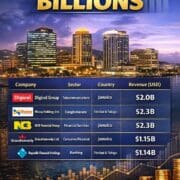
From telecommunications giant Digicel, with estimated revenues exceeding US$2 billion, to diversified conglomerate Massy Holdings and Jamaica’s NCB Financial Group, both reporting revenues above US$2.3 billion, the data paints a clear picture: the Caribbean is not a small market – it is a multi-billion-dollar economic zone.

Top Caribbean Companies by Revenue

“The data reinforces a critical but often overlooked reality we have been reiterating since 2011: the Caribbean is not a small economic region – it is a network of multi-million and billion-dollar enterprises operating across key sectors,” said Felicia J. Persaud, CEO of Invest Caribbean and founder of AI Capital Exchange.

However, the data also highlights a deeper structural challenge.

“While established companies continue to scale, access to structured capital for new and mid-sized projects across the region remains uneven,” Persaud added. “The Caribbean is not lacking capital – it is lacking efficient access to capital. At Invest Caribbean, we see this gap every day. Strong businesses. Real projects. But limited access to structured debt capital.”

The Capital Gap

Despite strong corporate performance, many developers, entrepreneurs and growth-stage businesses across the Caribbean continue to face difficulties accessing financing – particularly for large-scale or cross-border projects.

This disconnect between revenue concentration and capital accessibility has increasingly become a defining issue for the region’s economic future.

While large, established firms benefit from existing banking relationships and internal capital flows, smaller and emerging ventures often struggle to secure funding due to risk perception, fragmented markets and limited structured lending platforms.

The AI Question

At the same time, a new challenge is emerging.

As global industries rapidly shift toward artificial intelligence and digital transformation, Caribbean companies face mounting pressure to modernize operations, improve efficiency and remain competitive on the global stage.

“The next phase of Caribbean competitiveness will not just be defined by revenue, but by how quickly companies adapt to AI and digital transformation,” Persaud noted.

“The risk is not that the Caribbean lacks strong companies – it’s that without accelerated investment in technology and innovation, the region could fall behind globally.”

While some financial institutions and telecom firms have begun investing in digital tools and automation, broader adoption across sectors remains uneven, constrained by infrastructure gaps, limited access to capital and shortages in specialized technical talent.

A Defining Moment

As the Caribbean continues to generate significant corporate revenue across key sectors, the region now faces a critical inflection point.

Bridging the gap between capital availability and access – while accelerating investment in AI and digital infrastructure – will be essential to ensuring long-term competitiveness.

Without it, the region risks remaining a collection of strong legacy companies rather than evolving into a fully integrated, innovation-driven economic powerhouse.

RELATED: IDB Growth Forecast: How Each Caribbean Economy Is Expected To Perform in 2026

Guyana: Oil Boom Surges – But Who Controls The Wealth?

By NAN Business Editor

News Americas, NEW YORK, NY, Fri. Mar. 27, 2026: Guyana’s transformation into one of the world’s fastest-growing oil economies is accelerating, with billions of dollars in production and revenue reshaping the country’s economic future. But as output surges and development costs are steadily repaid, a critical question is emerging: who ultimately controls the wealth being generated?

Over the past five years, Guyana has moved from a frontier oil producer to a major global energy player. Production has rapidly expanded across multiple offshore projects led by ExxonMobil and its partners, with output now approaching nearly one million barrels per day. This dramatic rise has positioned Guyana as one of the most significant new oil producers globally.

At the same time, the country is nearing a key financial milestone. Billions of dollars in development costs – initially fronted by oil companies- are expected to be largely recovered by the end of 2026. This cost recovery phase has long been central to Guyana’s production sharing agreement, which allows companies to recoup investments before full profit sharing takes effect.

However, even as cost recovery nears completion, uncertainty remains around the timeline and structure of Guyana’s full profit realization. While the agreement includes a 50 percent profit-sharing framework, the pace at which Guyana will benefit from that full share remains subject to production dynamics, ongoing project costs, and the broader contractual structure in the Exxon contract.

For many observers, the issue is no longer whether Guyana will generate wealth – but how much of that wealth will remain within the country.

“The issue is no longer growth – it’s control,” said Felicia J. Persaud, the Guyana-born, CEO of Invest Caribbean and founder of AI Capital Exchange. “The next phase for Guyana is not about increasing production, but about increasing participation in the value chain.”

That distinction is critical. While oil revenues are already boosting Guyana’s GDP and government income, long-term economic impact will depend on how effectively the country captures value beyond extraction. This includes local participation in services, infrastructure development, downstream industries, and financial structuring.

The stakes are significant. At current production levels, Guyana’s oil sector is generating billions annually, creating unprecedented fiscal space for national development. Yet, without strong systems to channel and structure that capital, much of the economic benefit risks flowing outward through existing global energy and financial networks. Despite becoming one of the world’s fastest-growing economies due to oil, Guyana faces high poverty, with estimates suggesting 38% to over 50% of the population lives below the poverty line, particularly affecting indigenous communities. Rapid economic growth has not yet fully translated into broad-based prosperity, resulting in high inequality, significant emigration, and rising costs of living

This dynamic is not unique to Guyana. Across the Caribbean, countries are increasingly navigating a similar challenge: how to convert growth into structured, retained wealth. From tourism to energy to financial services, the region is seeing rising revenues—but also facing persistent gaps in capital access, deal structuring, and investment alignment.

Guyana’s case, however, is the most visible example of this transition. As one of the world’s newest oil economies, it represents both the promise and the complexity of resource-driven growth in a globalized system.

The next phase of Guyana’s development will depend on how it navigates this shift—from production to participation, from revenue to control.

As global capital continues to move and reposition, the question for Guyana is no longer whether it can grow, but whether it can structure that growth in a way that ensures long-term national benefit.

Because in today’s global economy, generating billions is only the beginning.

RELATED: Guyana To Repay Billions In Exxon Costs, But Profit Share Still Unclear

Shaggy’s ‘Hey Sexy Lady’ Becomes His 10th UK Silver-Certified Song

Hey Sexy Lady has become Shaggy’s 10th song to earn Silver certification in the UK after the British Phonographic Industry (BPI) certified the 2002 single on Friday, March 27.

Remembering Bob Andy: Five Lessons From The Reggae Legend’s Life

Today marks six years since Bob Andy transitioned, but his impact as a singer and songwriter lives on through Reggae music. 

Cutty Ranks Files US$3 Million Lawsuit Over Unpaid Royalties From El Chombo’s ‘Dame Tu Cosita’

Dancehall veteran Cutty Ranks has filed a US$3 million lawsuit in the United States, alleging that he was never properly paid for his contributions to El Chombo’s 2018 global hit Dame Tu Cosita.

U.S. Political Fallout Reaches Guyana As Corey Lewandowski Exits And Kristi Noem Probe Raise Bigger Questions

By NAN Staff Writer

News Americas, NEW YORK, NY, Fri. Mar. 27, 2026: The latest political fallout from Washington is no longer confined to Capitol Hill. It has now reached the Caribbean -specifically Guyana – raising deeper questions about power, influence, and the region’s growing role in U.S. geopolitical strategy.

Corey Lewandowski to the right of Kristi Noem in this picture from Guyana. (DPI image)

Corey Lewandowski, a longtime political operative and close aide to former U.S. Homeland Security Secretary Kristi Noem, has been fired from his government role amid mounting controversy over his conduct and broader federal investigations. His departure comes amid intensifying scrutiny over his involvement in Department of Homeland Security, (DHS), operations – and after his presence on a high-profile regional trip that included Guyana triggered backlash.

Kristi Noem, the fired US DHS secretary in Guyana meeting with the country’s president. (DPI image)

Photos and reports of Lewandowski traveling alongside Noem in Guyana – part of a wider multi-country tour across Latin America and the Caribbean – drew attention not only to his unofficial influence within DHS but also to the optics of U.S. political power being projected into the region.

At the same time, the situation has escalated significantly in Washington.

A federal inspector general investigation is now underway into how DHS contracts were handled under Noem’s leadership – including actions tied to Lewandowski. The probe, confirmed in recent reporting, is examining the awarding of hundreds of millions of dollars in contracts, including a controversial $220 million advertising campaign that bypassed traditional procurement processes and sparked bipartisan concern.

That investigation is separate from ongoing congressional scrutiny and follows weeks of political pressure over allegations of mismanagement, favoritism, and potential conflicts of interest.

Lewandowski’s role has been particularly controversial. Operating as a “special government employee,” he was not subject to the same disclosure requirements as full-time officials, yet reportedly exercised significant influence over decision-making – including contracts and personnel.

His exit now marks another chapter in a broader unraveling that has already seen Noem removed from her position as DHS Secretary and reassigned to a new diplomatic role as a U.S. envoy for regional security initiatives.

But beyond Washington, the implications are increasingly regional.

Guyana’s appearance in this unfolding story is not incidental.

As one of the fastest-growing oil economies in the world, Guyana has rapidly become a strategic focal point for global energy, investment, and geopolitical positioning. The presence of senior U.S. officials – and politically connected figures like Lewandowski – underscores how central the country has become in U.S. foreign policy calculations, particularly around energy security, migration, and regional influence. Guyana’s President, Irfaan Ali, issued a statement saying Guyana and the United States have reaffirmed their commitment to strengthening security cooperation, following a meeting between Ali and US Special Envoy and former Homeland Security Secretary Kristi Noem and her delegation.” President Ali presented Special Envoy Noem with a painting by Guyanese artist Dillon Craig, featuring the Canje Pheasant alongside the Harpy Eagle, a symbolic gesture highlighting Guyana’s national identity.

Noem’s broader tour, which included Guyana, Costa Rica, and other nations, was tied to advancing U.S. security initiatives across the hemisphere. But the overlap between official diplomacy and emerging political controversy has blurred the lines between policy and optics.

For the Caribbean, this moment is revealing.

It highlights how the region is no longer on the periphery of global power dynamics, but increasingly embedded within them – sometimes in ways that raise difficult questions about transparency, accountability, and influence.

The unfolding investigations in Washington will determine the legal and political consequences for those involved. But the regional impact is already clear.

The Caribbean – and Guyana in particular – is now part of a larger geopolitical story that extends far beyond its borders.

And as global capital, energy, and political interests continue to converge in the region, the question is no longer whether the Caribbean matters – but how deeply it is already entangled in the shifting architecture of global power.

RELATED: After Being Fired, Why Is Kristi Noem Touring Guyana and Costa Rica?