


News Americas, NEW YORK, NY, Fri. March 27, 2026: The Caribbean is home to a growing number of companies generating hundreds of millions – and in some cases billions – in annual revenue, underscoring the region’s often underestimated economic strength.
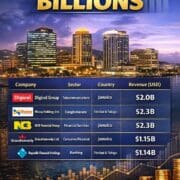
A recent data snapshot compiled by Explaining The Caribbean highlights top-performing firms across telecommunications, banking, manufacturing and conglomerates – revealing a network of high-performing enterprises operating across the region.
From telecommunications giant Digicel, with estimated revenues exceeding US$2 billion, to diversified conglomerate Massy Holdings and Jamaica’s NCB Financial Group, both reporting revenues above US$2.3 billion, the data paints a clear picture: the Caribbean is not a small market – it is a multi-billion-dollar economic zone.
“The data reinforces a critical but often overlooked reality we have been reiterating since 2011: the Caribbean is not a small economic region – it is a network of multi-million and billion-dollar enterprises operating across key sectors,” said Felicia J. Persaud, CEO of Invest Caribbean and founder of AI Capital Exchange.
However, the data also highlights a deeper structural challenge.
“While established companies continue to scale, access to structured capital for new and mid-sized projects across the region remains uneven,” Persaud added. “The Caribbean is not lacking capital – it is lacking efficient access to capital. At Invest Caribbean, we see this gap every day. Strong businesses. Real projects. But limited access to structured debt capital.”
Despite strong corporate performance, many developers, entrepreneurs and growth-stage businesses across the Caribbean continue to face difficulties accessing financing – particularly for large-scale or cross-border projects.
This disconnect between revenue concentration and capital accessibility has increasingly become a defining issue for the region’s economic future.
While large, established firms benefit from existing banking relationships and internal capital flows, smaller and emerging ventures often struggle to secure funding due to risk perception, fragmented markets and limited structured lending platforms.
At the same time, a new challenge is emerging.
As global industries rapidly shift toward artificial intelligence and digital transformation, Caribbean companies face mounting pressure to modernize operations, improve efficiency and remain competitive on the global stage.
“The next phase of Caribbean competitiveness will not just be defined by revenue, but by how quickly companies adapt to AI and digital transformation,” Persaud noted.
“The risk is not that the Caribbean lacks strong companies – it’s that without accelerated investment in technology and innovation, the region could fall behind globally.”
While some financial institutions and telecom firms have begun investing in digital tools and automation, broader adoption across sectors remains uneven, constrained by infrastructure gaps, limited access to capital and shortages in specialized technical talent.
As the Caribbean continues to generate significant corporate revenue across key sectors, the region now faces a critical inflection point.
Bridging the gap between capital availability and access – while accelerating investment in AI and digital infrastructure – will be essential to ensuring long-term competitiveness.
Without it, the region risks remaining a collection of strong legacy companies rather than evolving into a fully integrated, innovation-driven economic powerhouse.
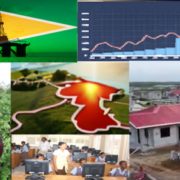
News Americas, NEW YORK, NY, Fri. Mar. 27, 2026: Guyana’s transformation into one of the world’s fastest-growing oil economies is accelerating, with billions of dollars in production and revenue reshaping the country’s economic future. But as output surges and development costs are steadily repaid, a critical question is emerging: who ultimately controls the wealth being generated?
Over the past five years, Guyana has moved from a frontier oil producer to a major global energy player. Production has rapidly expanded across multiple offshore projects led by ExxonMobil and its partners, with output now approaching nearly one million barrels per day. This dramatic rise has positioned Guyana as one of the most significant new oil producers globally.
At the same time, the country is nearing a key financial milestone. Billions of dollars in development costs – initially fronted by oil companies- are expected to be largely recovered by the end of 2026. This cost recovery phase has long been central to Guyana’s production sharing agreement, which allows companies to recoup investments before full profit sharing takes effect.
However, even as cost recovery nears completion, uncertainty remains around the timeline and structure of Guyana’s full profit realization. While the agreement includes a 50 percent profit-sharing framework, the pace at which Guyana will benefit from that full share remains subject to production dynamics, ongoing project costs, and the broader contractual structure in the Exxon contract.
For many observers, the issue is no longer whether Guyana will generate wealth – but how much of that wealth will remain within the country.
“The issue is no longer growth – it’s control,” said Felicia J. Persaud, the Guyana-born, CEO of Invest Caribbean and founder of AI Capital Exchange. “The next phase for Guyana is not about increasing production, but about increasing participation in the value chain.”
That distinction is critical. While oil revenues are already boosting Guyana’s GDP and government income, long-term economic impact will depend on how effectively the country captures value beyond extraction. This includes local participation in services, infrastructure development, downstream industries, and financial structuring.
The stakes are significant. At current production levels, Guyana’s oil sector is generating billions annually, creating unprecedented fiscal space for national development. Yet, without strong systems to channel and structure that capital, much of the economic benefit risks flowing outward through existing global energy and financial networks. Despite becoming one of the world’s fastest-growing economies due to oil, Guyana faces high poverty, with estimates suggesting 38% to over 50% of the population lives below the poverty line, particularly affecting indigenous communities. Rapid economic growth has not yet fully translated into broad-based prosperity, resulting in high inequality, significant emigration, and rising costs of living
This dynamic is not unique to Guyana. Across the Caribbean, countries are increasingly navigating a similar challenge: how to convert growth into structured, retained wealth. From tourism to energy to financial services, the region is seeing rising revenues—but also facing persistent gaps in capital access, deal structuring, and investment alignment.
Guyana’s case, however, is the most visible example of this transition. As one of the world’s newest oil economies, it represents both the promise and the complexity of resource-driven growth in a globalized system.
The next phase of Guyana’s development will depend on how it navigates this shift—from production to participation, from revenue to control.
As global capital continues to move and reposition, the question for Guyana is no longer whether it can grow, but whether it can structure that growth in a way that ensures long-term national benefit.
Because in today’s global economy, generating billions is only the beginning.




News Americas, NEW YORK, NY, Fri. Mar. 27, 2026: The latest political fallout from Washington is no longer confined to Capitol Hill. It has now reached the Caribbean -specifically Guyana – raising deeper questions about power, influence, and the region’s growing role in U.S. geopolitical strategy.
Corey Lewandowski to the right of Kristi Noem in this picture from Guyana. (DPI image)
Corey Lewandowski, a longtime political operative and close aide to former U.S. Homeland Security Secretary Kristi Noem, has been fired from his government role amid mounting controversy over his conduct and broader federal investigations. His departure comes amid intensifying scrutiny over his involvement in Department of Homeland Security, (DHS), operations – and after his presence on a high-profile regional trip that included Guyana triggered backlash.
Kristi Noem, the fired US DHS secretary in Guyana meeting with the country’s president. (DPI image)
Photos and reports of Lewandowski traveling alongside Noem in Guyana – part of a wider multi-country tour across Latin America and the Caribbean – drew attention not only to his unofficial influence within DHS but also to the optics of U.S. political power being projected into the region.
At the same time, the situation has escalated significantly in Washington.
A federal inspector general investigation is now underway into how DHS contracts were handled under Noem’s leadership – including actions tied to Lewandowski. The probe, confirmed in recent reporting, is examining the awarding of hundreds of millions of dollars in contracts, including a controversial $220 million advertising campaign that bypassed traditional procurement processes and sparked bipartisan concern.
That investigation is separate from ongoing congressional scrutiny and follows weeks of political pressure over allegations of mismanagement, favoritism, and potential conflicts of interest.
Lewandowski’s role has been particularly controversial. Operating as a “special government employee,” he was not subject to the same disclosure requirements as full-time officials, yet reportedly exercised significant influence over decision-making – including contracts and personnel.
His exit now marks another chapter in a broader unraveling that has already seen Noem removed from her position as DHS Secretary and reassigned to a new diplomatic role as a U.S. envoy for regional security initiatives.
But beyond Washington, the implications are increasingly regional.
Guyana’s appearance in this unfolding story is not incidental.
As one of the fastest-growing oil economies in the world, Guyana has rapidly become a strategic focal point for global energy, investment, and geopolitical positioning. The presence of senior U.S. officials – and politically connected figures like Lewandowski – underscores how central the country has become in U.S. foreign policy calculations, particularly around energy security, migration, and regional influence. Guyana’s President, Irfaan Ali, issued a statement saying Guyana and the United States have reaffirmed their commitment to strengthening security cooperation, following a meeting between Ali and US Special Envoy and former Homeland Security Secretary Kristi Noem and her delegation.” President Ali presented Special Envoy Noem with a painting by Guyanese artist Dillon Craig, featuring the Canje Pheasant alongside the Harpy Eagle, a symbolic gesture highlighting Guyana’s national identity.
Noem’s broader tour, which included Guyana, Costa Rica, and other nations, was tied to advancing U.S. security initiatives across the hemisphere. But the overlap between official diplomacy and emerging political controversy has blurred the lines between policy and optics.
For the Caribbean, this moment is revealing.
It highlights how the region is no longer on the periphery of global power dynamics, but increasingly embedded within them – sometimes in ways that raise difficult questions about transparency, accountability, and influence.
The unfolding investigations in Washington will determine the legal and political consequences for those involved. But the regional impact is already clear.
The Caribbean – and Guyana in particular – is now part of a larger geopolitical story that extends far beyond its borders.
And as global capital, energy, and political interests continue to converge in the region, the question is no longer whether the Caribbean matters – but how deeply it is already entangled in the shifting architecture of global power.