

Haiti News – Coral Springs Vice Mayor Nancy Metayer Bowen’s Voice Silenced In Florida Tragedy

News Americas, NEW YORK, NY, Thurs. April 2, 2026: The killing of Haitian American Coral Springs Vice Mayor, Nancy Metayer Bowen, is reverberating far beyond Florida, sending shockwaves through Caribbean diaspora communities grappling with both the loss of a rising political voice and the deeper issues her death has brought into focus.

Metayer Bowen, 38, was not just a local elected official in Coral Springs. She represented a new generation of Caribbean American leadership – young, accomplished, and increasingly influential in shaping political engagement among immigrant communities.

Authorities have charged her husband, Jamaican roots Stephen Bowen, with first-degree murder following her death inside their home. Police have described the case as domestic in nature, underscoring a tragic and persistent reality that cuts across communities: intimate partner violence remains one of the leading causes of death for women in the United States. Bowen is being held in the Broward County main jail on charges of premeditated murder and tampering with or fabricating physical evidence. At a first-appearance hearing in Broward County Court Thursday morning, a judge ordered him held without bond.

Bowen, 40, worked at Delray Medical Center, according to the affidavit. He has an active license as a certified radiologic technologist that was issued in 2014 by the Department of Health. He was listed as the chief operating officer of Men of St. Luke Inc., a nonprofit based in Hollywood, as of 2025, state business records show. The organization originally registered in 2009 under the name The Most Worshipful Union Grand Lodge of Florida, St. Luke Lodge #530 and was described as a statewide Masonic organization.

Bowen frequently posted videos of himself at tactical shooting ranges on his personal Instagram. One video pinned to his profile depicts him on a wild boar hunt, smoking a cigar. His bio reads, “God | Husband | Armed.”

Officers found the vice mayor’s body, wrapped in a comforter and black trash bags, in the bedroom of her home in the 800 block of Northwest 127th Avenue Wednesday after her coworkers became concerned that she had not shown up for scheduled city meetings.

Coral Springs City Manager Catherine Givens said at the news conference that the city will have a behavioral health program available to employees.

“What’s worse is the tremendous grief that her family must endure. If you knew Nancy, her family was everything,” Givens said. “… She wasn’t just a leader; she was the light in every room that she entered. She was a steady voice in difficult times, a compassionate soul who lifted others up and a friend to so many.”

Commissioner Joshua Simmons spoke on behalf of the commission, which he said is now “incomplete.”

“She had such a good heart. She truly cared about people, even when people were saying some of the most horrible things about her and us,” Simmons told reporters. “She still cared, rolled up her sleeves, went to every event that she could go to because she truly cared about people and making sure people had a relationship with their elected officials.”

On it’s website, the City posted an image of her with the words “Rest In Peace. A statement added: “The City of Coral Springs remembers Vice Mayor Nancy Metayer with gratitude, respect and deep appreciation for her service to our community. A dedicated public servant, Vice Mayor Metayer served the residents of Coral Springs with passion, integrity and a strong commitment to building a better future for all. Her leadership reflected a deep belief in community, service and stewardship, and her contributions will continue to leave a lasting mark on our city.

But for many in the Haitian and wider Caribbean diaspora, the loss carries an additional weight.

Metayer Bowen was a trailblazer – the first Black and Haitian American woman elected to the Coral Springs Commission – and a key figure in mobilizing Caribbean voters in Florida, a critical political battleground. Her work extended beyond local governance into national politics, including roles connected to presidential campaign outreach targeting Caribbean American communities.

Her death leaves a void not only in public office, but in a growing movement aimed at strengthening diaspora representation and civic participation. Community leaders and advocates say the tragedy is forcing difficult conversations about the intersection of cultural stigma, domestic violence, and access to support systems within immigrant communities.

Rep. Dan Daley, D-Coral Springs, and Rep. Christine Hunschofsky, D-Parkland, attended the news conference to announce her sudden death. They were both close friends of Metayer Bowen. Rep. Anna Eskamani, a Democrat representing the Orlando area, in a statement shared on social media Wednesday said that Metayer Bowen’s family has “already experienced deep loss” with his suicide.

Metayer Bowen’s younger brother, Donovan Joshua Leigh Metayer, died by suicide in their family home in December at age 26. He was a senior at Marjory Stoneman Douglas High School in Parkland during the 2018 mass shooting and struggled with mental health issues afterward, according to a GoFundMe online fundraiser for funeral expenses.

“Nancy and I worked side by side in the reproductive rights movement for years, and I’ve been honored to call her not just a colleague, but a dear friend,” Eskamani wrote. “She was brilliant, compassionate, and deeply committed to justice. I’m heartbroken by this loss, her future in politics and leadership was only just beginning, and our communities will feel that absence profoundly.”

Her family shared a statement on Metayer Bowen’s social media Wednesday evening.

“Throughout her years in public office, she led with integrity, compassion, and an unwavering sense of purpose,” the family’s statement said. “She believed in bringing people together, listening to those she served, and working tirelessly to create positive change in her community. To us, she was a source of strength, wisdom, and love – someone who always put others before herself.”

“While many knew her as a leader and advocate, we knew her as a sister, a daughter, and a friend whose warmth and laughter filled every room. Her legacy will live on not only in the policies she helped shape but in the countless lives she touched.”

While domestic violence is a global issue, experts note that Caribbean and immigrant communities often face additional barriers, including fear of stigma, lack of resources, and reluctance to seek help.

Metayer Bowen’s story, they say, highlights the urgency of addressing these challenges openly.

Her life also reflects the broader trajectory of Caribbean excellence in the diaspora – from public service to scientific work – demonstrating the expanding role Caribbean Americans are playing in shaping U.S. civic life.

Even as the investigation continues, her legacy is already being defined by more than the circumstances of her death. It is rooted in her work to amplify Caribbean voices, expand voter engagement, and open doors for future leaders.

Now, her passing is prompting a renewed call for both protection and progress. For many, the question is no longer just about what happened – but what must change.
War With Iran: The Three Fronts Of Modern Warfare Explained

By Ron Cheong

News Americas, TORONTO, Canada, Weds. April 1, 2026: The war with Iran is reshaping modern warfare, revealing critical failures across military, economic and psychological fronts. Fresh off its stunning strike on Venezuela, capturing President Nicholas Maduro in a display of technological and military prowess, the United States, in coordination with Israel, launched a surprise attack on Iran, even as negotiations for a peace deal were underway.

In the first days of Operation Epic Fury, launched on February 28, the administration basked in an aura of invincibility. Ignoring consultation with allies or NATO, it flaunted military superiority, predicted swift victory, and declared the Iranian leadership “put into the stone age.”

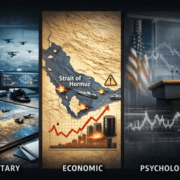
But modern warfare is no longer decided solely on the battlefield. It unfolds across three interlocking fronts: military, economic, and psychological. Victory requires coherence across all three – failure on any one can unravel the rest.

One month into the war with Iran, the picture is not just of setbacks, but of a deeper strategic failure: a conflict launched without clear objectives, without an exit strategy, and with a profound misunderstanding of the adversary.

1. The Military Front: Fighting The Wrong War

On paper, the United States entered with overwhelming superiority. Aircraft carriers, stealth systems, satellites, and precision-strike capabilities have long created an aura of near-invincibility.

But as seen in Ukraine and now Iran, modern warfare has shifted. Dominance in conventional military assets no longer guarantees victory. We live in the era of asymmetric warfare, where weaker opponents avoid direct confrontation and exploit vulnerabilities.

Iran has done exactly that. Instead of matching U.S. air and naval power, it relies on cheap drones, missile swarms, naval mines, and proxy forces. Low-cost drone systems have successfully threatened high-value assets, undermining traditional force hierarchies. Even after heavy bombardment, Iran continues to project power through decentralized and resilient systems.

This is doctrinal, not accidental. History, from Vietnam to Afghanistan, shows that a weaker adversary need not win outright; it only needs to avoid losing while increasing the cost of victory. The United States appears prepared for a conventional war. Iran prepared for a different kind entirely.

2. The Economic Front: The Strait Of Hormuz Miscalculation

If the battlefield revealed tactical misjudgments, the economic front exposes strategic blindness.

At the center is the Strait of Hormuz, through which roughly 20% of the world’s oil supply flows. Iran’s ability to disrupt this chokepoint has proven decisive. Shipping through the strait has collapsed, global oil prices have surged, and inflationary ripple effects are destabilizing energy markets and supply chains worldwide.

Remarkably, Iran has achieved this leverage despite suffering major conventional military losses. This underscores a crucial shift: economic disruption can outweigh battlefield success. Washington may destroy targets, but Tehran can impose costs on the global system itself, turning international pressure back onto the U.S.

This raises a critical question: Was there ever a viable plan to secure the economic front – or was it simply assumed that military dominance would suffice?

3. The Psychological Front: The Collapse Of Deterrence Mythology

Perhaps the most consequential front is psychological.

For decades, U.S. power rested on a potent intangible: the belief in its overwhelming superiority. That belief alone deterred adversaries.

Wars are not just fought with weapons; they are fought with perceptions. Today, that perception is eroding. Iran has withstood sustained bombardment, struck back, and demonstrated that U.S. power, while immense, is not absolute.

Within the United States, conflicting narratives are emerging: official claims of success clash with visible disruptions such as the prolonged closure of Hormuz and rising economic fallout. Globally, allies hesitate, adversaries are emboldened, and neutral actors grow skeptical.

This is how great powers lose more than battles – they lose aura. And once the psychological edge is gone, it is extraordinarily difficult to restore.

The Deeper Problem: No Clear Objective, No Exit

Underlying all three fronts is a more fundamental flaw: What is the objective of this war? Regime change? Deterrence? Elimination of nuclear capability? Restoration of maritime security?

The answers are inconsistent, even contradictory. Recent statements suggest both confidence in victory and uncertainty about outcomes, with talk of withdrawal even if key objectives, like reopening Hormuz, remain unresolved.

That is not a strategy. That is improvisation. Without a clearly defined end state, there can be no coherent path to victory, only drift toward escalation or withdrawal under pressure.

Hubris And The Strategic Trap

History offers a warning: the moment of greatest triumph often precedes the greatest overreach.

Buoyed by successes in Venezuela and technological dominance, the United States appears to have entered this conflict with strategic overconfidence, underestimating Iran’s resilience, asymmetric doctrine, willingness to absorb punishment, and ability to shift the battlefield beyond the military domain.

This is the classic trap of great powers: fighting the war they expect, not the war that is actually being fought.

A Turning Point In Modern Warfare

This conflict may ultimately be remembered not for who won militarily, but for what it revealed:

Cheap technology can neutralize expensive dominance

Economic chokepoints can outweigh battlefield victories

Psychological perception is as decisive as firepower

Most importantly, even the most powerful military is vulnerable when it enters a war without clear objectives, strategic coherence, or a full understanding of its adversary.

If that lesson is not absorbed, this may not just be a difficult war. It may be a defining one.

EDITOR’S NOTE: Ron Cheong is a frequent political commentator and columnist whose recent work focuses on international relations, economic resilience, and Caribbean-American affairs. He is a community activist and dedicated volunteer with extensive international banking experience. Now residing in Toronto, Canada, he is a fellow of the Institute of Canadian Bankers and holds a Bachelor of Science degree from the University of Toronto.

RELATED:

CARICOM News: How U.S. And China Are Shaping Caribbean Energy

The Long Siege Of Cuba: CARICOM At Last Begins Pooling Cash For Cuba Relief Supplies

The Long Siege Of Cuba & Caribbean Geopolitics: The Prequel To King Kong And The Island

King Kong And The Island: America’s Moral Collapse And Cuba

Haiti Child Soldiers: Barbecue, Gangs And A Growing Crisis

By Danny Shaw

News Americas, NEW YORK, NY, Weds. April 1, 2026: A shaky video shot in the streets of Solino in October 2024 captures the reality unfolding in Haiti. In the clip, a contingent of young men and child soldiers wave guns in the air and chant triumphantly: “Take Solino! If you are not with Viv Ansanm, we will burn you all together.” It is a brief, jolting window into the growing power of the Viv Ansanm (Living Together) paramilitary coalition and the central role of children within its ranks.

Despite the insecurity and social crisis affecting the people of Haiti, many residents continue to struggle to carry on with their daily lives in Port-au-Prince. Haiti on March 31, 2026. Under difficult conditions, they demonstrate resilience and determination as they adapt their lives to the reality the country is facing. Citizens continue to go to work as police officers patrol around the streets. (Photo by Guerinault Louis/Anadolu via Getty Images)

As the group expands its control over the country, one glaring reality is that a significant portion of its armed members are under 18. Under the command of Jimmy Chérizier, known as “Barbecue,” and his former lieutenant, escaped kidnapper Kempès Sanon, Viv Ansanm deployed these armed youths to sack the sprawling neighborhoods of Solino. Their assault has displaced over 125,000 people across 24 different communities. “Viv Ansanm burned us out of our homes because we were one of the last bastions of peace and resistance left in Pòtoprens [Port-au-Prince],” said Ezayi Jules, a spokesperson for the community. “They reduced our neighborhoods to ashes. Now our families are homeless as Barbecue runs around everywhere talking about his “revolution.’”

Haiti’s Jimmy “Barbecue” Cherizier presents himself as a revolutionary and is seldom pictured without his rifle and spare clips of ammunition. (Photo by CLARENS SIFFROY/AFP via Getty Images)

Beginning in 2018, Viv Ansanm and its predecessor, the G-9 gang alliance, have targeted and invaded neighborhoods that had long been bulwarks of popular resistance agains the interests of big capital and foreign domination. The numbers speak for themselves. Armed groups murdered more than 5,600 civilians in 2024, and at least 4,026 in the first five months of 2025. The police are no better. The corrupt and fractured National Haitian Police (Police Nationale d’Haïti, PNH), aided by a contingent of U.S.-financed mercenaries, prey upon the same populations as Viv Ansanm. According to one UN study, the police were responsible for 64 percent of the violence in a three-month period between April and June of this year.

On September 30, the UN Security Council approved the deployment of a Gang Suppression Force to Haiti, replacing the Kenya-led Multinational Security Support Mission that had been in the country since June 2024. There are concerns that the latest mission will replicate the failures of the 2004 to 2018 UN Stabilization Mission, failing to address the root causes of the violence while targeting  more ti solda (low-ranking soldiers) and civilians.

This dance of death is all these young “soldiers” have ever known. Traumatized and desensitized, they have been indoctrinated to believe they are fighting a formidable “enemy,”—one that often consists of peaceful communities like Solino, Kafou Fèy, or Nazon, neighborhoods that have long formed the social fabric of the capital. 

UNICEF estimates that over half of the country’s gang members are children. Additionally, children represent half of the more than 1.3 million Haitians displaced by conflict, ensuring a constant reservoir of cannon fodder for a paramilitary army that has now rebranded itself as a political party.

In the most unequal society in the hemisphere, violence robs children of childhood and dehumanizes them to the point that they are capable of the most phantasmic acts. These children are the colonial boomerang of violence hurled back against their own communities and the society that failed to protect them.

From Revolt To Despair

On August 22, 2018, Haiti exploded into open rebellion with millions of Haitians taking to the streets. The impetus was the revelation that the corrupt Tèt Kale Party (PHTK) government had stolen an estimated $3.8 billion dollars from the PetroCaribbean fund set up by the Venezuelan government to provide subsidized oil and gas for the Haitian people. As protests rocked the country, Haiti became peyi lok (a country locked down), demanding the resignation of the corrupt kleptocracy and free elections.

Since this mass uprising, the oligarchs and their U.S. accomplices have armed and unleashed paramilitary gangs to crush the popular movement. In September 2023, the gangs confederated into one criminal alliance called “Viv Ansanm” led by Barbecue, a former police officer. The paramilitaries have since been waging war on local neighborhoods to make sure no one can oppose their reign of kidnapping, sexual violence, and the burning of oppressed communities. Professor Henry Boisrolen breaks down the class dynamics of the gang alliance and project: “The social decomposition caused by so many decades of foreign domination, exploitation, and occupation explain how we arrived at this place.”

Tens of thousands of children make up Viv Ansanm’s rank-and-file of  because they have no other choice. Children do not go to school in the Haitian capital. By January of 2024, the violence had caused 900 schools to shut down in Pòtoprens, denying education to more than 200,000 children. From the cracked screen of his 2020 Motorola Stylus, Lucson Charles, a displaced elementary school teacher, explains just how dire the situation is: “Two hundred and twenty-seven schools in the Ouest department have a 0% success rate [in the latest baccalaureate exam]. Zero admissions. Zero prospects. Zero dreams realized.”

Charles himself, like so many teachers and professionals, is a victim of the orgy of violence. Last year, Viv Ansanm attacked his school. “They stole my HP computer, all of my belongings and burned my house, alleyway, and neighborhood down,” he recalled. “They left us with nothing. This prevents us from fighting back in any effective way.”

Stefan, another displaced teacher, explained that 90 percent of Haitian schools are created by the private sector and churches. The state has completely abandoned investing the national budget in the people, while NGOs throw some disjointed crumbs of charity into the ocean of manufactured want. Who can the population turn to if, as Charles says, “governing seems to boil down to looking the other way while the house collapses?”

Growing Up A Solda

Barbecue claims to be leading an armed revolution, despite a grisly track record of massacres against his own people. Understanding the role of his paramilitary coalition helps connect the dots between the massive influx of U.S. guns, drug running, and a social media cover-up campaign, where the warlords present themselves as revolutionaries fighting the oligarchs.

Barbecue is an enforcer, a hustler, and the top spokesperson of the gangs whose economic and political interests are diametrically opposed to any prospect of peace. He is the epitome of the law of the jungle—the capitalist jungle—that has given birth to many Ti Babecue yo (Little Barbecues).

At the top of the gang hierarchy一below the oligarchs and their intermediaries一Barbecue preaches a sense of belonging and describes the ghettos beyond Viv Ansanm’s control as “the enemy.” His bosses, part of a complex web of power and influence, tell him that the neighborhoods they attack, loot, and burn are “police bases.” This is the only Haiti they know. It is a world of hunger, humiliation, and hell. Young solda, seeking to imitate their social media heroes, can access highly-coveted consumer objects previously out of reach, such as kleren (moonshine), weapons, clothes, sneakers, iPhones, and even girls. Higher-up members may earn a motorbike. This system ensures that, in the context of deepening deprivation in Haiti, there will always be fresh recruits.

Makenson, a longtime friend and community leader, told me about his 16-year-old little brother who was a gang soldier killed by the PNH. Joderson, nicknamed Ti Lanmò (Little or Young Death), “joined [a gang] to protect himself. He joined to gain access.” Impacted by the absence of their parents and the constant grangou (hunger), tire (shootouts), and bal mawon (stray bullets), his brother saw no other choice.  “After a lot of Lanmò San Jou’s guys got killed, some local gangsters asked Joderson if he’d help carry packages and be a lookout from the front of the neighborhood,” he recalls. As his brother became more important to the gang, he acquired money and weapons. “I no longer recognized him,” Makenson said. The brothers lost communication and Makenson was eventually forced to leave his home. Joderson was killed during a police raid in 2024.

Displaced and refusing to embrace the paramilitary project, Makenson worries about future conflicts sparked by these gang invasions. In his home commune of Kwadèbouke, neighboring communities once stood united against the corrupt PNH and the kleptocracy that runs Haiti. Now, reflecting on the system that killed his little brother and so many like him, he wonders what future is possible in a country that is thirsty for revenge. “After being burned out of homes, forgiveness is foreign to our people right now,” he remarked. “When they see Lamo San Jou or Barbecue boasting and celebrating on TikTok, they want blood.”

The Wretched Of The Earth

A piece of propaganda used by the paramilitaries to justify and glorify their use of child soldiers shows several children holding automatic weapons. Below them the text reads: “You created another spirit in a young man the day you chose to murder his family because of the ghettos they are from. You made him live without love, without his mother, older brother and older sister. His revenge will be even worse.” Its creator, Jeff Kanara Larose, is Viv Ansanm’s “Taliban” gang boss in Kanara, a sprawling neighborhood formed by refugees after the 2010 earthquake in Site Soley. Like Barbecue and Lamò San Jou, he has a million dollar FBI bounty on his head and a massive stock of U.S.-made automatic weapons.

It is not clear who the target of revenge is in Kanara’s propaganda. The paramilitaries have not targeted oligarchs or imperialists. Instead, they target the poorest ghettos, home to those that Martinican philosopher Frantz Fanon called “the wretched of the Earth.” These are the effects of colonial processes of dehumanization on the colonized: internalizing and turning the violence towards their own people.

Even amid the violence, the displaced and clear-eyed Haitian intelligentsia and their skeleton of community organizations refuse to demonize these children. Some, like Patrick, a displaced lawyer from Kafou Fèy who now lives packed in a school classroom with his family and hundreds of others, points to the continuous intervention of western powers in the country. “This is the result and continuation of the 1915 U.S. occupation of Haiti,” he said.

Others like Erika, a Haitian mother of two whose entire extended family was burned out of Delmas 31, highlight the need to build alternatives to militarization. “These children are the orphans of the 2010 earthquake and the harsh neoliberal economy,” she said. ”They have a lot of blood on their hands, they have raped many of us and our daughters. But there are better solutions than a superior force coming into Haiti and murdering them all.”

Unfortunately, Haiti’s elites and western powers continue to send foreign soldiers, who do not speak Kreyòl or understand anything about the country, to face the gangs. Two armies, both armed to the teeth with U.S. guns, are squaring off, with the Haitian people hopelessly trapped in the middle.

Editor’s Note: Some names and details have been changed to protect the safety of the Haitian social leaders and journalists.

EDITOR’S NOTE: Danny Shaw is an International Affairs analyst with TeleSUR, HispanTV, and other international media outlets. He teaches Latin American and Caribbean studies at the City University of New York and has worked with Haitian social movements and studied Kreyòl since 1998. His work can be found at @profdannyshaw.

Credit Line: This is syndicated in partnership with the North American Congress on Latin America (NACLA).

RELATED: Haiti TPS Update 2026: What Haitians In The U.S. Should Know

Caribbean Women Entrepreneurs And Financial Literacy: Profit Without Pressure

By Michelle Baptiste

News Americas, NEW YORK, NY, Weds. April 1, 2026: April marks the intersection of Stress Awareness Month and Financial Literacy Month, two conversations that are often treated separately, but for women entrepreneurs, especially in the Caribbean, are deeply connected.

Because here is the truth many are afraid to say out loud: profit should not come at the cost of your peace.

For too long, women have been conditioned to believe that financial success requires constant sacrifice …. long hours, emotional exhaustion, and the pressure to be everything to everyone. We are business owners, mothers, caregivers, partners, and community leaders. And while we are capable of carrying it all, the real question is: should we have to?

As the founder of a growing wellness and shapewear brand, I have lived this reality firsthand. My journey into entrepreneurship was not born from ease; it was built through personal loss, health challenges, and the responsibility of rebuilding my life while raising a family. I understand what it means to pursue income while managing stress, uncertainty, and expectation.

But what I’ve learned (and what I now teach) is this: sustainable success requires both financial strategy and emotional discipline.

The Hidden Cost Of “Hustle Culture”

Many women are building businesses in survival mode. They are earning, yes, but they are also overwhelmed, overextended, and one step away from burnout.

This is where financial literacy must evolve beyond numbers. It’s not just about how much you make, it’s about how you make it, what it costs you, and whether it’s sustainable.

If your business is profitable but you are constantly exhausted, disconnected, and stressed, then the model needs to be re-evaluated.

Because burnout is not a badge of honor. It is a warning sign.

Building Profit Without Burnout

The goal is not to work less, it’s to work smarter, with intention and structure. Here are four key strategies every woman entrepreneur should consider:

1: Build Systems, Not Just Sales
Many businesses rely heavily on the owner being present for every transaction. This creates pressure and limits growth. Simple systems, automated responses, structured workflows, and clear processes can free up time and mental space while maintaining income.

2: Price for Profit, Not Survival

Underpricing is one of the fastest ways to increase stress. When your pricing does not reflect your value, you are forced to work more just to meet basic financial goals.
 Financial literacy means understanding your numbers, your margins, and positioning your offer accordingly.

3. Protect Your Energy Like You Protect Your Income
Time is not your only resource; your energy is just as valuable. Set boundaries. Schedule rest. Create a business structure that allows you to step away without everything falling apart.

4. Align Your Business With Your Life
Too many women build businesses that look good on the outside but feel overwhelming on the inside. Your business should support your lifestyle—not consume it. That means designing a model that fits your capacity, your priorities, and your long-term vision.

Wellness As A Financial Strategy

There is a misconception that wellness and business are separate conversations. They are not. A stressed, exhausted entrepreneur cannot make clear decisions, lead effectively, or scale sustainably. Emotional well-being directly impacts financial performance.

When women prioritize their mental health, they show up more confidently, make better decisions, and build stronger, more profitable businesses. In other words, peace is productive.

A New Model For Women In Business

I believe this is the moment for women, especially in the Caribbean and across the diaspora – to redefine what success looks like. It is not just about revenue. It is about freedom, clarity, and sustainability. It is about building businesses that allow you to:

Earn well

Live fully

Rest without guilt

And grow without breaking

We do not have to choose between profitability and peace. We can have both, but only if we are willing to challenge the old narrative that says success must come at the expense of sacrifice. Because the future of women in business is not burnout. It is balance, strategy, and self-worth.

EDITOR’S NOTE: Michelle Baptiste is a Caribbean entrepreneur and founder of Selecfit, a wellness and shapewear brand rooted in confidence, resilience, and purpose. Through her work, she champions women building successful businesses without sacrificing their well-being, drawing from her own journey of motherhood and perseverance to inspire women across the Caribbean and diaspora. Connect with her on social media: Facebook & YouTube: @SelecFit; Instagram & TikTok: @selecfitshapewear.