

The Data Tells A Different Story About Black Immigrants

By Felicia J. Persaud

News Americas, NEW YORK, NY, Fri. April 24, 2026: At a time when immigration rhetoric in the United States has reached a fever pitch, a new report from the Pew Research Center offers a powerful reminder: the story being told about immigrants – particularly Black immigrants – is often not the truth.

The data tells a very different story. According to Pew’s latest analysis, there are now 5.6 million Black immigrants living in the United States, making up roughly one in ten Black people in the country.

That alone should shift the conversation. Because Black immigrants are not a small or marginal group. They are a significant and growing part of the American story.

And yet, they are rarely at the center of the national immigration debate. Even more telling is their legal status.

Despite narratives that often conflate immigration with illegality, the Pew data shows that 79% of Black immigrants are in the United States legally, while a majority – 61% – are naturalized U.S. citizens.

That means most Black immigrants are not only here lawfully, but they are also Americans who can vote.

Fully. Legally. Permanently.

And still, they are often treated as outsiders, with xenophobic talk about “eating cats and dogs,” committing crimes, or worse of all, being from “S-Hole” countries.

The data also challenges assumptions about education and contribution.

Today, 35% of Black immigrants hold a bachelor’s degree or higher, a rate that exceeds that of U.S.-born Black Americans. Among African-born immigrants, that number is even higher, with some of the most highly educated immigrant populations in the country coming from nations like Nigeria.

These are not communities on the margins. They are doctors, nurses, entrepreneurs, educators, and caregivers. They are part of the infrastructure of American life.

And their numbers are growing.

African-born immigrants, according to the data, are now the fastest-growing segment of the Black immigrant population, increasing fourfold since 2000. At the same time, Caribbean immigrants remain a dominant force, making up a similarly large share of the Black immigrant population.

Together, African and Caribbean immigrants account for the overwhelming majority of Black immigrants in the United States. That is not incidental.

It reflects a deep and ongoing relationship between the United States and the Black diaspora – one that has shaped culture, labor, politics, and identity for generations.

And yet, despite these contributions, the policy environment is moving in the opposite direction.

Immigration crackdowns are intensifying. Temporary protection is being challenged. Legal pathways are becoming more uncertain. Huge bonds are being tacked on to simple visitors and business visas.

And Black immigrants – like other immigrant groups – are increasingly caught in that shift. This disconnect between reality and rhetoric is where the real story lies. Because the data makes one thing clear: Black immigrants are not a burden on the United States. They are part of its growth. Part of its workforce. Part of its future.

And yet, the question of belonging continues to linger. Who gets to be seen as American? Who gets to be protected?, Who gets to stay? These are not new questions. But they take on new urgency in a moment where facts are often overshadowed by fear.

Because when a group that is largely legal, highly educated, and deeply embedded in the fabric of the country is still viewed through the lens of suspicion, it suggests that the issue is no longer just immigration. It is perception. And perhaps something deeper. Because the data tells a story.

The question is whether America is willing to listen.

Felicia J. Persaud is the founder and publisher of  NewsAmericasNow.com, the only daily syndicated newswire and digital platform dedicated exclusively to Caribbean Diaspora and Black immigrant news across the Americas.
RELATED: 11 Immigrants Now Dead In ICE Custody In 2026 As Questions Mount Over Care and Release Practices

ACTIF2026 Signals Opportunity – But Caribbean Projects Face A Qualification Gap

By NAN Business Editor

News Americas, NEW YORK, NY, Fri. April 24, 2026: The upcoming AfriCaribbean Trade and Investment Forum (ACTIF2026) is being positioned as a key platform to deepen trade and investment ties between Africa and the Caribbean – but a persistent challenge remains: project readiness.

Afreximbank has signed a hosting agreement with the Government of St. Kitts and Nevis for the fifth edition of the forum, scheduled for July 29–31, 2026 in Basseterre. The event is expected to bring together governments, investors, development finance institutions, and private sector leaders from across both regions.

ACTIF has emerged as a leading platform for mobilizing capital and advancing Africa–Caribbean economic cooperation. The 2025 edition resulted in five Caribbean deals totaling approximately US$291 million, while Afreximbank has approved more than US$700 million in financing across CARICOM markets in recent years.

The 2026 forum is expected to focus on identifying priority projects and accelerating execution across sectors including infrastructure, tourism, energy, and trade.

But while opportunity is expanding, access to capital is not automatic. Across the Caribbean, many projects continue to face challenges in securing financing – not due to lack of investor interest, but due to gaps in structure, financial clarity, and overall investment readiness.

Invest Caribbean CEO Felicia J. Persaud noted that “the challenge is not just access to capital – it is qualification.”

Many otherwise promising projects fail to secure funding due to gaps in financial clarity, collateral structures, and execution planning, she added.

Still others struggle to understand the differences between debt and equity financing, or the stages of capital – from pre-seed to Series A – often approaching investors without the level of structure or documentation required to support multi-million-dollar raises.

To put that into perspective, institutional lenders like Afreximbank require far more than an idea or concept. Financing consideration typically depends on a fully developed project package – including feasibility studies, ownership and governance structures, land title and regulatory approvals, detailed financial models, and clearly defined debt and equity frameworks.

Projects must also demonstrate market demand, operational readiness, environmental compliance, and realistic revenue projections backed by data.

As global institutions like Afreximbank expand their footprint in the region, the demand for bankable, well-structured projects is increasing – but the supply of investment-ready opportunities remains limited. Without that alignment, opportunities risk remaining announcements rather than funded deals, Persaud said.

ACTIF2026 is expected to play a critical role in strengthening Africa–Caribbean partnerships and advancing the concept of “Global Africa,” but translating interest into actual investment will depend heavily on the quality and readiness of projects presented.

Assess your project’s funding readiness through Invest Caribbean and AI Capital Exchange

RELATED: US Travel Warning Issued For Trinidad and Tobago

Caribbean Economic Growth 2026–2027: World Bank Reveals Diverging Outlook

By NAN Business Editor

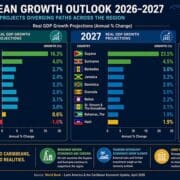
News Americas, NEW YORK, NY, Fri, April 24, 2026: Caribbean economies are set to follow sharply different growth paths in 2026 and 2027, with oil-producing nations surging ahead while tourism-dependent economies face slower expansion, according to new data from the World Bank. The latest Latin America and Caribbean Economic Update shows that while the Caribbean economic growth overall continues to struggle with slow growth, the Caribbean is increasingly split between high-growth and moderate-growth economies.

At the center of this divergence is Guyana, which remains the region’s fastest-growing economy, driven by its oil boom. Growth is projected at 16.3% in 2026, rising further to 23.5% in 2027, far outpacing every other Caribbean nation.

Suriname is also emerging as a strong performer, with growth expected to reach 4.0% in 2026 and 4.5% in 2027, supported by energy-related investments and future oil production expectations.

By contrast, many tourism-dependent economies are seeing more modest expansion. The Bahamas is projected to grow at 2.2% in 2026 and 1.9% in 2027, while Barbados is expected to post 2.7% growth in 2026 and 3.0% in 2027.

Jamaica, however, stands out on the downside, with the economy expected to contract by -1.0% in 2026 before recovering to 3.2% in 2027, reflecting ongoing economic pressures and recovery challenges.

Smaller economies like Grenada, Dominica and St. Vincent and the Grenadines are expected to maintain steady but moderate growth in the 2.8%–3.1% range over the next two years.

Haiti remains one of the region’s most fragile economies, with growth projected at just 0.6% in 2026, rising to 1.9% in 2027, underscoring continued structural challenges.

Overall, the World Bank warns that despite pockets of strong performance, the Caribbean’s outlook reflects a broader pattern across Latin America and the Caribbean, where growth remains constrained by limited investment, global uncertainty, and structural weaknesses.

“Stagnation in economic growth and persistent difficulties in creating high-quality jobs have moved industrial policy back to the radar of the policy debate,” the Bank noted.

As global conditions remain uncertain, the report emphasizes that long-term growth across the Caribbean will depend on stronger institutions, improved investment climates, and the ability to attract capital into productive sectors.

Invest Caribbean CEO, Felicia J. Persaud, noted that “for investors, the takeaway is clear: growth is not uniform – and capital must be deployed strategically.”

Understanding where growth is accelerating – and where it is constrained – will be critical for deploying capital effectively across the Caribbean in 2026 and beyond.

Assess your project’s funding readiness now.

RELATED: U.S., China Tensions Rise Over Bahamas Hospital Project