The British Empire They Carried: The Fractured Identity Of Britain’s Caribbean Generation
By Nyan Reynolds
News Americas, NEW YORK, NY, Weds. May 13, 2026: There are elderly men and women throughout the Caribbean today who grew up saluting the British flag, singing “God Save the Queen,” learning British history in school, and pledging allegiance to a Crown that once claimed them as its own. Many of them are now in their sixties, seventies, and eighties, yet few fully understand that at one point in history, they were legally tied to the British Empire as nationals of the United Kingdom and Colonies. Even fewer understand what happened to that identity after independence arrived across the Caribbean.
Recently, I began asking older Caribbean people a simple question:
“Did you know that before independence, you were legally connected to Britain as a colonial national?”
Most looked confused.
Citizen Of The United Kingdom And Colonies
Some had never heard the term “Citizen of the United Kingdom and Colonies,” commonly referred to as CUKC. Others assumed that because Jamaica, Trinidad, Barbados, and other Caribbean nations later became independent, whatever relationship existed before simply disappeared without consequence. A few believed they were always only Jamaican, Trinidadian, or Barbadian. Yet history tells a far more complicated story.
For generations born under British colonial rule, identity was never as simple as geography. A child born in Jamaica in 1957 was not born into the same constitutional reality as a child born in Jamaica in 1970. One was born into the British Empire. The other was born into an independent nation. That distinction matters because law shapes identity, and identity often survives long after laws change.
Before Jamaica gained independence in 1962, it was a British colony. The same was true for many Caribbean territories that existed under British control for centuries. People born in these colonies were classified under British nationality law as British subjects and later as Citizens of the United Kingdom and Colonies following the British Nationality Act of 1948. Their nationality did not come from words printed on a birth certificate. It came from the legal structure governing the colony itself.
In practical terms, this meant that many Caribbean people born before independence were legally tied to Britain. They were part of an imperial system that viewed the colonies not as foreign lands, but as extensions of British rule. This reality shaped every aspect of life. Children attended schools that centered on British history and British values. They learned about British monarchs, wars, literature, and patriotism. Portraits of the Queen hung in classrooms. The Union Jack represented authority and national belonging. The British Empire was not presented as distant. It was presented as home.
This is one of the most overlooked psychological consequences of colonialism.
Colonial education did not merely teach subjects. It taught identity. It cultivated loyalty to the empire and produced generations who were conditioned to see Britain as the political and cultural center of their world. Many Caribbean people grew up knowing more about English kings and queens than they knew about African civilizations, Caribbean resistance movements, or their own ancestral histories. Their worldview was filtered through the lens of empire.
INDEPENDENCE
Then independence arrived.
For countries like Jamaica, Trinidad and Tobago, and Barbados, independence represented liberation, dignity, and self-determination. These nations could finally govern themselves without direct colonial oversight. Flags changed. Constitutions changed. Political power shifted into local hands. Across the Caribbean, independence was celebrated as the birth of a new national consciousness.
Yet, beneath the celebration lay another reality rarely discussed.
A generation of people who had spent their entire lives being shaped as colonial subjects suddenly found themselves politically reclassified. The imperial identity they inherited no longer carried the same meaning it once had. Many transitioned from being legally connected to Britain to being citizens of newly independent Caribbean nations almost overnight. The empire that once claimed them was shrinking, and as it shrank, so too did the meaning of imperial citizenship.
This created a profound contradiction.
How do you spend your childhood singing “God Save the Queen,” pledging loyalty to Britain, and learning that you belong to an empire, only to later discover that the relationship was politically temporary?
How does a person emotionally process the idea that they were once considered part of Britain, only to later become categorized as separate from it?
For many Caribbean people, these questions were never clearly explained. Life simply moved forward. Nations became independent, passports changed, and new national identities emerged. Yet the emotional and psychological transition was far more complicated than the constitutional transition.
The law changed quickly. Identity did not.
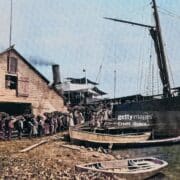
This fracture became even more visible during the Windrush era. Thousands of Caribbean people migrated to Britain after World War II to help rebuild the country. Britain faced labor shortages in transportation, healthcare, manufacturing, and public services. Caribbean migrants answered the call because many believed they were traveling not to a foreign country, but to what they had been taught was the “mother country.”
Some arrived holding British passports. Many had every reason to believe they belonged there legally and culturally. They worked in hospitals, factories, railways, and transit systems. They paid taxes, raised families, and helped shape modern Britain itself.
Yet decades later, many members of the Windrush generation found themselves questioned, detained, denied healthcare, denied employment, and even threatened with deportation because they could not produce paperwork proving rights they once assumed were unquestionable. The Windrush scandal exposed a painful truth about empire: people who were once welcomed as imperial citizens later became treated as immigrants whose belonging could be challenged.
That contradiction still echoes across the Caribbean diaspora today.
Many elderly Caribbean people do not fully know the legal history of their former status within the empire. They remember the flag. They remember the songs. They remember the schools and the rituals of British colonial life. But few were taught how dramatically their political identity shifted after independence. Some still carry an emotional attachment to Britain while simultaneously identifying deeply with their Caribbean nationhood. Others reject colonial identity altogether because of the harm colonialism inflicted upon the region.
The result is a layered identity that cannot be reduced to a single label.
ANCESTRY
Many Caribbean people are African by ancestry, Caribbean by culture, British by colonial formation, and part of a wider Black Atlantic experience shaped by slavery, migration, empire, and resistance. The modern world prefers clean national categories such as citizen, immigrant, foreigner, or national. But the empire created identities far more complex than modern immigration systems are comfortable admitting.
This is why history matters.
Not because people want to remain trapped in the past, but because the people who lived this history are still alive. There are senior citizens walking throughout Jamaica, Trinidad, Barbados, and the broader Caribbean who were born into one constitutional reality and aged into another. Some never understood the transition. Some never questioned it. Some are only now realizing that the empire they pledged loyalty to once considered them part of itself.
Their story deserves to be told because identity is not merely paperwork. It is memory. It is education. It is belonging. It is the stories nations tell people about who they are.
The Caribbean carries deep scars from colonialism, but it also carries forgotten truths. One of those truths is that there exists a generation whose lives were shaped by an empire that later redrew the boundaries of belonging around them. They were taught to see Britain as home while simultaneously being kept at the edges of it. They inherited an identity that dissolved politically even while its psychological imprint remained.
And perhaps the greatest tragedy is not simply that this happened, but that so many people who lived through it were never fully told the story of who they once were.