
Popcaan Earns First Billboard Hot 100 Entry With Drake Collab ‘Amazing Shape’
Popcaan has earned the first Billboard Hot 100 entry of his career, with his Drake collaboration Amazing Shape debuting at No.

Popcaan has earned the first Billboard Hot 100 entry of his career, with his Drake collaboration Amazing Shape debuting at No.
By Staff Reporter | NewsAmericasNow.com
NEWS AMERICAS, NY, NY, Weds. May 27, 2026: The Caribbean has been placed squarely at the center of a geopolitical confrontation between Washington and Havana that is rapidly moving beyond the realm of diplomacy – one that carries direct and immediate consequences for every nation in the region.
The escalating crisis between the United States and Cuba carries profound implications for the broader Caribbean – a region that has consistently called for an end to the US embargo through CARICOM resolutions and maintains diplomatic and economic ties with Havana that now put Caribbean governments at risk of secondary sanctions exposure under the Trump administration’s expanding pressure campaign.
Cuba’s Foreign Minister Bruno Rodriguez Parrilla framed the moment in stark terms at the United Nations Security Council on Tuesday: a small island nation of 10 million people facing the full military, economic, and legal pressure of the world’s most powerful country – with the Caribbean caught squarely in between.
“I call on the international community to mobilize to prevent a humanitarian catastrophe that could be imposed through arms or the fuel blockade,” Rodriguez told the Security Council, as reported by AFP. “Now should be the time for solidarity with Cuba.”
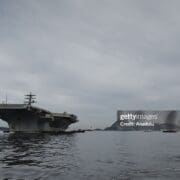
The clearest signal of how far the confrontation has escalated came when the United States deployed the USS Nimitz aircraft carrier and three escort warships to the southern Caribbean, as confirmed by US Southern Command.
The Nimitz is one of the US Navy’s most powerful nuclear-powered aircraft carriers, capable of projecting overwhelming air and naval power across the entire region. Its arrival in Caribbean waters – the shared waters of island nations from Jamaica to Trinidad, from Barbados to the Bahamas – places the military weight of the confrontation directly in the Caribbean’s backyard.
The deployment coincided with the unsealing of a superseding federal indictment last week, charging former Cuban President Raul Castro and five co-defendants for the alleged 1996 shoot-down of two unarmed civilian aircraft operated by Brothers to the Rescue over international waters, killing four Americans. It followed Secretary of State Marco Rubio’s remarks at Homestead Air Reserve Base — approximately 180 miles from Cuba – in which he acknowledged that Cuba hosts Russian and Chinese intelligence operations on its soil and described Cuba as “a failed state 90 miles from our shores run by friends of our adversaries.”
Cuba reportedly maintains an arsenal of military drones provided by Russia and China, which the United States has characterized as a regional threat. The convergence of military, legal, diplomatic, and humanitarian developments marks what analysts are describing as the most dangerous escalation in US-Cuba relations since the Cuban Missile Crisis of 1962.
In a remarkable television appearance on Tuesday, Rodriguez appeared on Fox News in an exclusive interview with anchor Gillian Turner – and did not hold back. “In all areas, however, he lies, he lies on and on. He continuously intends to deceive the public opinion in the US, the US Congress, and the international community,” Rodriguez said of Rubi on Fox News.
Rodriguez accused Rubio of driving a dangerous political narrative designed to manipulate American public opinion and build support for military aggression against Cuba — and flatly rejected the Trump administration’s characterization of Cuba as a national security threat.
“Cuba is a small island – 100,000 square kilometers and 10 million inhabitants,” Rodriguez was quoted as saying. “Based on what logic, what would be the common sense behind the idea that Cuba could threaten a nuclear superpower?”
Rodriguez also addressed the federal indictment of Raul Castro, questioning its timing after three decades. “Why did it wait for 30 years to do this?” he asked. “What is the ethical value? What is the legal value behind these allegations right now? Or if this is part of the political narrative aimed at manipulating the US public opinion to justify a military aggression against Cuba?”
The Cuban foreign minister also challenged Rubio’s personal authority to speak on Cuban affairs – pointing to the Secretary of State’s background as the son of Cuban immigrants who left the island before the revolution.
“He was not born in Cuba. He does not know Cuba. He knows nothing about Cuba,” Rodriguez said.
Rodriguez also condemned the United States oil blockade that has sparked massive blackouts across most of Cuba since January 2026 – and rejected a $100 million US humanitarian aid offer announced by Rubio in a video message to the Cuban people on May 20, describing it as cruel given that Washington simultaneously maintains the energy blockade causing the crisis.
“The Secretary of State is one of the main masterminds behind the military threat against Cuba, the energy blockade,” he stated.
As military and diplomatic tensions escalated, Caribbean-American Democratic Congresswoman Yvette D. Clarke – the daughter of Jamaican immigrants and chair of the Congressional Black Caucus – wrote directly to President Donald Trump and Secretary of State Rubio demanding an immediate end to the oil blockade imposed on Cuba.
In her letter, Clarke appealed to the Trump administration to relieve economic pressure on the island, which she said has led to increased infant mortality rates, the threat of starvation, and a declining standard of living for Cuban civilians. “Under the administration’s oil blockade and tightening of sanctions, Cubans are dying,” Clarke wrote, as quoted in her letter.
She cited reports indicating that Cuba’s infant mortality rate has more than doubled since 2018 as a result of sanctions — with food shortages leading to more underweight pregnant mothers and newborns unable to survive. “With food shortages leading to more underweight pregnant mothers and their newborns, too many Cuban children are unable to make it out of the hospital and home to their families,” Clarke wrote, as quoted in her letter.
“Enough is enough,” Clarke added, as quoted in her letter. “The Congressional Black Caucus will not stand by and allow this administration to continue this barbaric policy that generates unimaginable human suffering in Cuba. We are demanding that you end the oil blockade, lift the sanctions on Cuba, and allow the Cuban people access to the most basic resources they need to sustain life on the island.”
Clarke’s letter came as the Trump administration deployed the USS Nimitz carrier strike group to Caribbean waters – a move that underscored the mounting military dimension of a crisis that began as an economic and diplomatic confrontation.
For CARICOM member states – many of which maintain longstanding diplomatic, trade, and energy relationships with Cuba – the escalation places governments in an increasingly difficult position. The expansion of US secondary sanctions to foreign entities doing business with Cuba now puts Caribbean banks, energy companies, and businesses at direct risk of US sanctions exposure simply for maintaining normal commercial relationships with Havana.
The arrival of a US aircraft carrier in the waters shared by Caribbean island nations – without formal notification or consultation with regional bodies – signals a unilateral approach to Caribbean security that CARICOM has historically resisted. The region is watching. And the stakes, as Cuba’s foreign minister told the United Nations on Tuesday, could not be higher. “I call upon Latin America and the Caribbean to act in order to preserve their condition as a Zone of Peace and to avert adverse consequences that would destabilize the region,” he added.
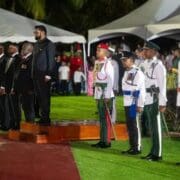
News Americas, NEW YORK, NY, Tues. May 26, 2026: Guyana turned 60 today; 60 years since its independence from Britain in 1966.
At a flag-raising ceremony for the nation’s 60th Independence Anniversary at Fort Island along the Essequibo River, President Irfaan Ali declared that Guyana is now “one of the world’s fastest-growing economies worth more than US$75 billion.”
“We are today, the fastest growing economy on earth,” he was quoted as saying. “Not in this hemisphere, not in the Caribbean – but on an entire planet.”
On paper, the numbers are staggering. The International Monetary Fund has confirmed that Guyana led the world with an average real GDP growth of 47 percent per year between 2022 and 2024, recording double-digit growth for six consecutive years. Oil production from the offshore Stabroek Block now surpasses 915,000 barrels per day, making Guyana South America’s third-largest oil producer. The national budget crossed one trillion Guyanese dollars for the first time in 2024. Per capita income, once recorded at around $340, is projected to approach $38,000 by 2028.
Impressive numbers. But numbers, as any Guyanese on the ground will tell you, don’t buy tennis rolls.
This week, ahead of the pomp and ceremony surrounding the 60th, the Guyana Kaieteur News reported something that should stop everyone mid-applause: the cost of living in Guyana – the globally promoted oil-rich capital of the Caribbean – has become so high that many Guyanese are now buying single tennis rolls, butter flaps, and small pastries on credit just to survive the week.
Let that sink in. The fastest-growing economy on earth. And its people are eating on credit.
According to Numbeo data, the estimated monthly costs for a family of four in Guyana run approximately GY$708,000 – roughly US$2,500 – excluding rent. The average gross salary ranges from G$100,000 to G$174,000 per month – between $480 and $835 USD. The median individual income is between G$50,000 and G$60,000 – or between $240 and $290 USD – meaning half of the country’s workforce earns less than this.
A standard senior citizen receives a non-contributory Old Age Pension of G$46,000 per month – approximately $220 USD. Compare that to the Numbeo cost-of-living estimate, and you see the disparity in stark relief.
As the war in Iran sends gas prices soaring, Guyanese are being forced to pay more for kerosene to cook and for transportation. Kerosene – the cheapest fuel – now runs $3.17 to $3.40 USD per gallon. Cooking gas costs roughly $22 to $27 USD. A meal at an inexpensive restaurant costs approximately $12 USD. A gallon of milk runs about $13. A dozen eggs, $4.50.
The salary data tells the real story. According to Paylab’s Guyana Salary Survey:
Expat and oil and gas engineers earn $3,000 to $6,000+ per month
Senior finance and IT managers earn $1,500 to $2,500+
Public school teachers and nurses earn $500 to $750
Administrative assistants earn $350 to $500
Retail, security, and service workers earn $290 to $350
The hospitals the government has built are understaffed and lack basic drugs in their pharmacies, forcing nationals to pay far more at private pharmacies. The many roads and bridges President Ali cited as “the clearest evidence” of transformation are real. But roads do not pay rent. Bridges do not fill a prescription.
The data clearly shows who is benefiting from the wealth the President is celebrating. Expats and foreign workers; while nationals struggle.
On the Corruption Perceptions Index, Transparency International gives Guyana a score of 40 as of 2025 – ranking it 84th out of 182 countries.
More telling is this: in 2026, Guyanese citizens are still leaving the country despite the nation possessing one of the world’s fastest-growing GDPs. The UN’s Human Flight Index places Guyana at roughly 8.2 out of 10 – making it a leading country for human capital loss in South America, well ahead of Venezuela at 6.5 and Suriname at 5.7.
The 2026 Democracy and Development Report from the United Nations Development Programme ranks Guyana 12th globally for brain drain. In Latin America and the Caribbean, the country sits fourth – behind only Haiti, Jamaica, and one other regional nation. Nearly 90 percent of Guyanese with tertiary education eventually migrate, the report finds, with North America the most common destination. Earlier World Bank data has long held that about 39 percent of Guyanese citizens already live abroad.
Two stories are running simultaneously. One is a sovereign balance sheet that most finance ministries in the region would trade theirs for. The other is a quiet, steady exit by the people who would normally be running its hospitals, classrooms, regulatory agencies, and ministries.
Many Guyanese are still awaiting the $100,000 grant the government promised since last December. That is not a footnote. That is a policy failure in the middle of an oil boom. I left Guyana in 1996, nearly 30 years ago. I have watched from the United States. Guyana has transformed from one of the poorest nations in the Western Hemisphere to the fastest-growing economy on earth. I wanted nothing more than to celebrate that transformation today. But I cannot celebrate numbers when many are still suffering.
Guyana at 60 should be a country where every national born and living there is building real, generational wealth from the oil beneath its waters. Instead, the Natural Resource Fund sits above US$3.1 billion while Guyanese buy tennis rolls on credit.
The PPP/Civic government must move beyond rhetoric and ribbon-cuttings. Roads and bridges are necessary. They are not sufficient. Sixty years of independence demands more than infrastructure. It demands that the ordinary Guyanese – the teacher, the nurse, the security guard, the senior citizen living on $220 a month – feel this oil wealth in their daily lives. Not in presidential speeches. Not in budget headlines. In their pockets.
No one in Guyana should be struggling to buy a packet of tennis rolls in an oil-rich nation. Not at 60. Not ever. Guyana at 60 should be wealthy for all – not just for some.
EDITOR’S NOTE: Felicia J. Persaud is a Guyana-born media entrepreneur, founder of News Americas Now, Hard Beat Communications, Invest Caribbean, CaribPR Wire, and AI Capital Exchange. She has lived in the United States since 1996.