
Queens, NY Soldier Killed In Iranian Attack In Jordan Was Born In Trinidad

By Staff Writer, NewsAmericas Now

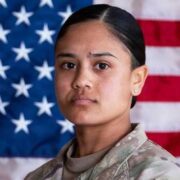
News Americas, NEW YORK, NY, Thurs. July 23, 2026: U.S. Army Sgt. Angel Sarah Rampersad, who was killed in action on July 17 during an Iranian ballistic missile and drone attack on Muwaffaq Salti Air Base in Jordan, was an immigrant from Trinidad and Tobago.

Rampersad, 28, of Ozone Park, Queens, was reportedly killed during an Iranian ballistic missile and drone attack on the Muwaffaq Salti Air Base in Jordan, according to the Department of War. She was born in Trinidad and Tobago and moved to New York at age 5 with her mother, an American citizen, and an older sister. Her Trinidad-born father remained in Trinidad.

She grew up in Ozone Park, NY, and taught herself to play drums, sang in her church choir, and ran track and played softball at Forest Hills High School. An uncle who served in the military inspired her toward the Army, though her mother, Carol Acevedo, initially asked her to attend college first. Rampersad enrolled at CUNY’s John Jay College of Criminal Justice before enlisting at 21, around 2019, and re-enlisted last year. Her awards included the Army Commendation Medal, the Army Achievement Medal with two Oak Leaf Clusters, the Army Good Conduct Medal, the National Defense Service Medal and the Army Service Ribbon.

Remembered in Ozone Park

Members of a US Army carry team transports a flag-draped transfer case containing the remains of US Army Sergeant Angel S. Rampersad during a dignified transfer solemn event at Dover Air Force Base in Dover, Delaware, US, on Wednesday, July 22, 2026. The US and Iran signaled they aren’t ready to return to the negotiating table after both countries escalated attacks deep into a second week of renewed fighting. Photographer: Daniel Heuer/Bloomberg via Getty Images

An American flag now flies at half-staff outside her family’s home in Queens, NY. Rampersad was one of four American service members killed in the attack, alongside Army 1st Lt. Tyler James Feehan, 25, of Hawaii, and Army Pvt. Isabella Gonzales, 19, of Texas. A fourth soldier, Sgt. Michael Emmanuel Swinton of North Carolina, died separately while attempting to disarm a downed Iranian drone in Iraq. Their deaths bring the total number of American service members killed since the war with Iran escalated to 18.

Sgt. Rampersad was assigned to 1st Battalion, 57th Air Defense Artillery Regiment, 52nd Air Defense Artillery Brigade, 10th Army Air & Missile Defense Command, Ansbach, Germany.

The government of Trinidad and Tobago said Rampersad’s heritage gave her death “a particular resonance” for the nation, extending sympathies to her family, fellow service members and all those whose lives she touched.

In a statement released by her family, Rampersad was remembered as “a gentle giant” who “stood up for those who couldn’t fight for themselves – a defender, a friend,” and who “loved her family fiercely and will live on in the hearts of everyone she touched.”

“Today, we mourn the loss of Sgt. Angel Rampersad,” said Brig. Gen. Glenn Henke, commanding general of the 10th Army Air and Missile Defense Command, in a statement.

Rampersad’s family traveled to Dover Air Force Base in Delaware on Wednesday for the dignified transfer of her remains alongside those of the three other fallen service members, a ceremony attended by President Trump and Secretary of War Pete Hegseth.

New York Gov. Kathy Hochul and other officials also offered condolences, with Hochul saying, “New York, and our nation, are safer because of brave Americans like her who answer the call to serve” while New York City’s Mayor Zohran Kwame Mamdani stated: “Sgt. Rampersad’s courage and sacrifice will be remembered not just in Queens, but across all five boroughs. My deepest condolences are with her family, loved ones, and all those grieving this profound loss.”

Sergeant Rampersad was assigned to the 52nd Air Defense Artillery Brigade, 10th Army Air & Missile Defense Command, in Ansbach, Germany. Her father is a national of Trinidad and Tobago, while her mother is an American citizen.

“Her passing is therefore mourned with particular sorrow in Trinidad and Tobago. Though she served under the United States flag, Sergeant Rampersad also shared a meaningful connection with our nation through her Trinidad and Tobago heritage.,” said Trinidad & Tobago Prime Minister Kamala Persad-Bissessar. On Tuesday July 21st, a team from the Consulate General of the Republic of Trinidad and Tobago in New York visited Sergeant Rampersad’s family to express the nation’s sympathies and offer support.

The Ozone Park Residents Block Association planned a candlelight vigil outside Rampersad’s family home this week, with neighbors describing her as someone whose sense of duty and warmth touched the wider community well beyond her own family.

NewsAmericasNow extends its condolences to Sgt. Rampersad’s family and the entire Trinidadian and Trinidadian-American community during this difficult time.

RELATED: Guyana – US Pushes To Lead Guyana’s Energy Future As Country’s Aging Ferry Fleet Turns Deadly

Buju Banton Says Dancehall Cannot Be Trapped: ‘This Is Rebel Music’

Buju Banton has a clear message for anyone trying to reshape dancehall into something it was never meant to be: the music is free, and it must stay that way.

Guyana – US Pushes To Lead Guyana’s Energy Future As Country’s Aging Ferry Fleet Turns Deadly
By NAN Business Editor, NewsAmericas Now

News Americas, WASHINGTON, D.C., Thurs, July 23, 2026: The United States is positioning American companies to dominate Guyana’s energy and infrastructure sectors as the South American nation’s oil-fueled economy continues its rapid expansion, according to a State Department readout of a US-Guyana investment forum held last Thursday in Washington – a push that lands even as ordinary Guyanese confront the human cost of decades of underinvestment closer to home.

Just two days after the forum wrapped, the 87-year-old ferry MV Barima capsized off Guyana’s coast. The confirmed death toll has since risen to 65, with 76 rescued out of the 179 people the government says were aboard, leaving roughly 38 people still unaccounted for as search and recovery operations continue. Of the bodies recovered, 44 have been positively identified by relatives, and 23 have been released to their families for funeral rites and burial. The government has deployed 19 vessels and three aircraft to the search, and technical teams are now assessing how to right the capsized vessel, plan to use marine salvage airbags to restore its buoyancy before towing it closer to shore so recovery operations can continue under safer conditions.

A ferry carrying 179 passengers capsized off the coast of Guyana with authorities saying 76 people had been rescued so far, with 63 confirmed dead, in Guyana, on July 19, 2026. (Photo by Guyana Prime Minister’s Office / Handout /Anadolu via Getty Images)

The disaster has renewed scrutiny of a domestic transportation system that has been patched rather than modernized for years, even as billions in oil revenue have flowed through the country and Washington courts American businesses to lead its energy and infrastructure future. The juxtaposition has been hard for many Guyanese to ignore this week: a government being asked to open its most valuable sector further to foreign capital, while the vessels its own citizens depend on to reach hinterland and Indigenous communities remain decades old.

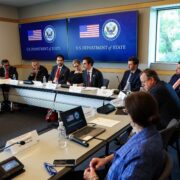
Deputy Secretary of State Christopher Landau addressed the US-Guyana Investment Enabling Forum, co-hosted with the Business Council for International Understanding at the Donald J. Trump Institute of Peace, bringing together senior US and Guyanese officials alongside private-sector leaders. According to the State Department’s media note, the forum focused on strengthening investor confidence and expanding US commercial engagement in Guyana’s business environment, energy sector and infrastructure.

The State Department described commercial diplomacy as “a core element of American foreign policy,” stating that “the United States is committed to ensuring that where American companies invest, the U.S. Government stands behind them,” including cutting red tape and expanding access to financing. The department said Washington is “positioning American businesses to lead in energy, infrastructure, and other sectors central to” Guyana’s growth.

Part of a months-long push

Thursday’s forum builds on a series of high-level engagements between Washington and Georgetown dating back at least to early June, when Guyana’s Foreign Minister Hugh Todd and Foreign Secretary Robert Persaud met in Washington with Landau, Secretary of Energy Chris Wright, and Acting Assistant Secretary of War for Homeland Defense and Hemispheric Affairs Joseph Humire. Those talks covered energy security, border security cooperation, irregular migration, and combating illicit trafficking, alongside the commercial agenda.

In each of these engagements, US officials have paired the investment push with public reaffirmations of Guyana’s “sovereignty and territorial integrity” – language that has taken on added significance given Guyana’s long-running border dispute with Venezuela over the oil-rich Essequibo region.

Why it matters

The push for a larger American commercial footprint in Guyana’s energy sector comes as questions have already emerged over how the country’s oil wealth is being tracked. NewsAmericasNow previously reported on a $6.7 billion discrepancy between the Bank of Guyana’s reported oil revenue and the amount ExxonMobil says it has recovered from its cost bank – a gap that, applied to Guyana’s current 14.5% revenue share, could represent close to $1 billion the country may never have received.

With Guyana holding one of the fastest-growing oil economies in the world and a population of fewer than one million people, the scale of foreign investment now being actively courted – and which companies end up leading the sectors that will define the country’s economic future – carries outsized weight for ordinary Guyanese. The MV Barima disaster is a stark reminder of what that weight looks like on the ground: a nation courting billions in foreign energy investment while a domestic ferry system serving its most remote communities has gone without a purpose-built replacement for decades. Prime Minister Phillips said this week that the government will finance funeral and burial expenses and provide immediate assistance to affected families, while any decision on compensation will wait for the findings of an independent Commission of Inquiry. “The focus now is not on compensation,” Phillips said. “The focus is on recovering bodies, financing the burial and funeral rites, and providing whatever assistance the families need now.”

NewsAmericasNow will continue tracking US-Guyana engagement as the investment relationship develops.

RELATED: Guyana: The MV Barima Tragedy Puts The Spotlight On A Decades-Old Issue – An Aging Ferry Fleet