
The Guyana Elections Commission Hasn’t Met In A Year – And Still Doesn’t Reflect Who Actually Won

By NAN Staff Writer, NewsAmericas Now

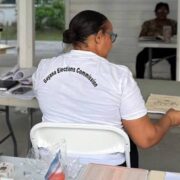
News Americas, GEORGETOWN, Guyana, Weds. August 12, 2026: The Guyana Elections Commission has not held a single meeting since last September’s general elections, and when it does eventually reconvene, its composition still won’t reflect who Guyanese voters actually elected to Parliament.

WIN, the party led by Opposition Leader Azruddin Mohamed, holds 16 seats in the National Assembly following the 2025 elections, the largest opposition bloc by a wide margin. It holds zero seats on GECOM. APNU, which won 12 National Assembly seats, less than WIN, holds three GECOM seats. The mismatch stems from GECOM’s structure, which allocates opposition-nominated commissioners based on party configurations that predate the 2025 vote and have never been updated to reflect it.

The Carter Center’s warning

FLASHBACK – Supporters of Guyana’s presidential candidate Azruddin Mohamed from the WIN party take part in a campaign rally in Georgetown on August 30, 2025. Guyana will hold presidential elections on September 1, 2025. (Photo by Joaquin Sarmiento / AFP) (Photo by JOAQUIN SARMIENTO/AFP via Getty Images)

The Carter Center, the U.S.-based election monitoring organization that has observed more Guyanese elections than any other country, issued a formal statement this week calling the impasse a matter of “considerable concern.” Following stakeholder meetings held in Georgetown in June, where the organization’s delegation met with President Irfaan Ali, Opposition Leader Mohamed, GECOM, and a broad range of civil society and political stakeholders, the Center warned that without a fully functioning commission, GECOM will be unable to organize local government elections by this year’s statutory deadline, and will run out of time to implement reforms before Guyana’s next general election.

“The Carter Center notes with considerable concern the current impasse surrounding the composition of the Guyana Elections Commission,” the organization said, calling on officials to amend the 2022 Constitutional Reform Act to reflect the country’s current parliamentary makeup. The Center noted it welcomed Attorney General Anil Nandlall’s earlier acknowledgment, made in May, that the Act requires updating, but the amendment still hasn’t happened.

Nandlall has previously said the government is committed to implementing most of the Carter Center’s recommendations, but cautioned the process would proceed “in stages,” particularly where constitutional amendments are required. Opposition Leader Mohamed has separately called on GECOM’s current opposition-nominated commissioners, appointed under a previous Opposition Leader before WIN’s 2025 breakthrough, to resign.

A pattern of institutions under strain

The GECOM standoff lands in the same stretch of weeks Guyana’s Commission of Inquiry into the MV Barima disaster has faced protests over alleged conflicts of interest among its members, and just days after revelations that the Caribbean Court of Justice’s own president stands accused by a majority of his fellow judges of attempting to influence the ruling in Mohamed’s own extradition case. Three separate Guyanese and regional institutions, an elections body, a disaster inquiry, and the region’s highest court, are now facing public questions about whether they can be trusted to function independently, all within the same month.

For a country navigating record oil wealth, a rebuilt international profile, and a fast-approaching local government election deadline it may not be able to meet, the Carter Center’s warning is a reminder that institutional credibility, once eroded on multiple fronts at once, becomes far harder to rebuild than any single crisis alone.

NewsAmericasNow will continue tracking GECOM’s status and Guyana’s electoral reform process.

RELATED: A Sitting CCJ Judge Says The Court’s President Tried To Influence The Ruling Against Guyana’s Opposition Leader.

Message To The USA – DO NOT COMPETE FOR THE CARIBBEAN. BUILD WITH IT.

By Dr. Isaac Newton

News Americas, NEW YORK, NY, Weds. August 12, 2026: The USA’s security and the Caribbean’s sovereignty need not be opposing interests. They can become the foundation of a new hemispheric bargain.

The United States and the Caribbean are approaching a defining moment. Washington sees a strategic corridor through which drugs, human trafficking, illicit finance, weapons and irregular migration can reach American shores. Caribbean governments see a different danger: policies that can constrict their economies, limit legitimate mobility and erode the sovereignty that small nations have defended for generations. Neither concern should be dismissed. America has a legitimate interest in the security of its southern neighborhood. The Caribbean has an equally legitimate interest in its sovereignty, prosperity and peace. The mistake is treating these interests as competing claims. They are connected. A secure Caribbean is in America’s interest. A prosperous and sovereign Caribbean is part of that security. The relationship therefore needs more than another round of diplomatic statements. It needs a new design, built on a proposition both sides can understand: America should help build the conditions for Caribbean security, while the Caribbean assumes greater responsibility for the security it seeks.

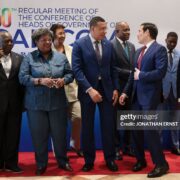
FLASHBACK – US President Donald Trump signs a proclamation at the “Shield of the Americas” Summit at Trump National Doral in Miami, Florida, March 7, 2026. President Trump is hosting a dozen right-wing leaders from Latin America and the Caribbean to discuss issues facing the region, from organized crime to illegal immigration. The summit also aims to serve Washington by boosting US interests in the region and curbing those from foreign powers like China. (Photo by SAUL LOEB / AFP via Getty Images)

That proposition begins with reciprocity. Caribbean governments should strengthen regional cooperation against trafficking, organized crime, financial crime, weapons and irregular migration through stronger border systems, better intelligence and coordinated enforcement. Washington should match that commitment with predictable visa policies, lawful migration channels, technology partnerships, expanded economic opportunity, development finance and infrastructure investment. Citizenship by investment programs should receive serious scrutiny, rigorous due diligence and transparent enforcement where weaknesses exist, but legitimate economic activity should not be swept aside with broad restrictions. Security policy is strongest when it distinguishes genuine risk from collective suspicion. The principle should be simple: if the Caribbean is asked to provide greater security, it should receive greater opportunity. That is not a concession from Washington or a favor to the islands. It is the price of a durable partnership.

The second shift is economic. If Washington is concerned about China’s expanding presence across the Caribbean, it should compete with better choices, not narrower choices. Build the port. Modernize the airport. Strengthen the power grid. Expand digital infrastructure. Protect water systems. Finance climate resilient communities. Support industries that allow Caribbean citizens to find opportunity without leaving home. Caribbean governments, for their part, should welcome investment from America, China and elsewhere under rules that protect transparency, national interest, environmental responsibility and sovereignty. A small country should not have to choose its investor before it chooses its project. America should ask not, “How do we prevent China from building here?” but, “What can we build here that the Caribbean will choose?” That is a more confident form of competition. It does not demand loyalty before delivering value. It earns partnership by delivering value.

The third shift is diplomatic. Cuba and Venezuela should not turn the Caribbean into another arena for great power confrontation. The region possesses something Washington and Beijing cannot purchase: proximity, history, relationships and regional legitimacy. Those assets give Caribbean governments a distinctive role in humanitarian assistance, economic reconstruction, institutional renewal and peaceful democratic development. But there is a crucial difference between helping a country find a better future and deciding that future for it. The Caribbean should support democracy without becoming an instrument of regime change. It should support humanitarian relief without becoming a proxy. It should encourage stability without accepting actions that destabilize its own neighborhood. The Zone of Peace should mean more than the absence of war. It should mean the presence of diplomacy strong enough to prevent confrontation from becoming conflict. The Caribbean’s greatest power may be its ability to create a room where powerful countries that disagree can still sit together.

The fourth shift is regional. Washington is right that seventeen Caribbean states negotiating separately can weaken their collective influence. But regional unity must not become political uniformity. The formula should be one regional strategy, many sovereign states. CARICOM and other regional institutions should develop common positions on security, migration, investment, energy, disaster resilience and trade, while preserving each nation’s right to make its own decisions. The United States should engage that regional strategy at a serious strategic table rather than rely primarily on bilateral leverage. A five year Caribbean American Compact should establish specific commitments, deadlines and public measures of performance. Security cooperation should have measurable targets. Investment should produce measurable results. Visa policy should have benchmarks. Migration arrangements should have accountability. Development should show evidence. Diplomacy should be judged by what changes after the meeting, not by how polished the communiqué looks.

The deeper opportunity is to replace an old question with a better one. For generations, the question has too often been, Who has influence over the Caribbean? That is a question shaped by the politics of another century. The question now should be: What can America and the Caribbean build together that neither can build alone? America needs a stable, secure southern neighborhood. Caribbean nations need access to American markets, capital, technology, education and security cooperation. Neither side benefits from a Caribbean weakened by poverty, insecurity, climate shocks or political instability. Neither side benefits from sovereignty being treated as an inconvenience. The objective should be security without subordination, investment without dependency, mobility with dignity, democratic development without destabilization and prosperity designed to outlast political cycles. The Caribbean should not be America’s backyard. It should not be China’s playground. It should be a sovereign partner and a hemispheric bridge. And that is the strategic idea worth remembering: Do not compete for the Caribbean. Build with it.

EDITOR’S NOTE: Dr. Isaac Newton is a leadership strategist, governance scholar, ordained minister, author, and President of Paramount Communication & Marketing, LLC. Educated at the University of Southern Caribbean, Oakwood University, Princeton, Columbia, and Harvard, he advises leaders across government, higher education, nonprofit organizations, and the private sector on ethical leadership, governance, institutional renewal, and organizational excellence. He is the author of several books and coauthor of Steps to Good Governance, When Nations Kneel, Daring to Hope, and the forthcoming The Belief Code.

RELATED: The Ledger Never Closed: The Lasting Business of Slavery and the Unfinished Work of Freedom

Derrick Morgan Gets the Key: Ska Legend Honoured by Lauderhill 64 Years After Soundtracking Jamaica’s Independence

Sixty-four years after Derrick Morgan told a newly independent Jamaica to “Forward March,” the King of Ska is still moving forward — and collecting his flowers along the way.

Bambaata Marley Replaces Mystic Marley at Reggae on the River

The last-minute lineup swap at Reggae on the River is already dividing fans. Bambaata Marley, son of Ziggy Marley, has been announced as a replacement for his cousin Mystic Marley, daughter of Stephen Marley, at the annual festival held at County Line Ranch in Piercy, California.

Esh Morgan’s ‘The A Team’ Official Visualizer Premieres August 13

The phrase “you’ve heard the song, now step inside the story” is doing a lot of work here and honestly, it’s got people curious.

Ziggy Marley to Perform ‘Racism Is a Killa’ on Jimmy Kimmel Live

Ziggy Marley says Jimmy Kimmel Live is the only show in the US that agreed to let him perform “Racism Is a Killa” on national television.

Gramps Morgan and UB40 Are Bringing Reggae to San Diego This Halloween

Gramps Morgan is spending Halloween in San Diego, and he’s not coming alone. The self-proclaimed King of Country Reggae is set to share the stage with UB40 on October 31st, and he made sure to announce it himself directly to fans on Twitter.

Full-Circle Moment: Shenseea and Vybz Kartel Finally Share the Stage

The moment that dancehall fans had been waiting for did not come with much warning, but it landed hard when it did.

Shaggy Is Heading to Lithuania and He’s Got a Message for the Fans

Shaggy just put Lithuania on notice. The dancehall legend took to Facebook to announce he’s bringing the show to Zalgirio Arena, and the message was classic Shaggy short, direct, and in full patois: “Lithuania wah gwann??!

The Davido Dozen: 12 ‘Oriade’ Tracks Land on Billboard’s U.S. Afrobeats Songs Chart

Twelve songs from a single album hitting the same chart in the same week is the kind of stat that makes you do a double-take.