
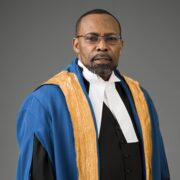
The Caribbean Court Of Justice, And The Standard The Judiciary Must Meet

By Dr. Isaac Newton

News Americas, NEW YORK, NY, Thurs. Aug. 13, 2026: Independence begins with the integrity of the process. The allegations concerning the President of the Caribbean Court of Justice, CCJ, Justice Winston Anderson are serious, but they remain allegations until tested against evidence. They may be substantiated, partly substantiated, or found to have no foundation. All three possibilities must remain genuinely open.

That is why Justice Winston Anderson should have no role in selecting those who conduct the review, defining its mandate, controlling its evidence, participating in its deliberations, or receiving information unavailable to others. Every real or apparent conflict should be removed. A credible process must be capable of finding wrongdoing if wrongdoing occurred and clearing an innocent person if the evidence does not support the allegations.

The issue is therefore larger than Justice Anderson, opposition leader Azruddin Mohamed, or Guyana. It concerns the confidence citizens place in the region’s highest court. If the allegations are proven, particularly if judicial proceedings or a litigant’s rights were improperly affected, the law should provide an appropriate response and remedy. If they are not proven, that conclusion should be stated with equal clarity. The purpose of an independent review is not to protect an institution or punish an individual. It is to establish what happened. Preserve the evidence. State the mandate. Remove conflicts. Examine the facts. Explain the findings. Then allow the evidence and the law to determine what follows.

Caribbean history makes this responsibility especially important. For generations, the region worked to build institutions in which justice would not depend upon political power, personal influence, or colonial authority. The creation of the Caribbean Court of Justice in 2001 and its inauguration in 2005 reflected that larger effort to strengthen Caribbean legal independence and confidence in Caribbean justice. Judicial independence was never intended to mean that judges are beyond scrutiny. It means that judges must be free to decide according to law, while the institutions around them must be strong enough to examine credible concerns fairly and without fear.

That is the standard this moment should reinforce. The region should strengthen transparent procedures for judicial complaints, clear conflict rules, protection for evidence and witnesses, and public explanations of consequential findings, subject always to lawful limits. The goal should not be to weaken the judiciary. It should be to make legitimate judicial authority more trustworthy. A court becomes stronger, not weaker, when it can demonstrate that the same principles of fairness it applies to others also govern the examination of its own conduct.

The lesson should outlast this controversy: no judge should be condemned without evidence, no credible allegation should be dismissed without examination, and no institution should be so important that the truth must be protected from scrutiny.

EDITOR’S NOTE: Dr. Isaac Newton is a leadership strategist, governance scholar, and author specializing in institutional excellence, ethical leadership, and human development. Educated at the University of the Southern Caribbean, Oakwood University, Princeton, Columbia, and Harvard, he writes on leadership, governance, diplomacy, economics, the development of people and institutions. He is the author of Fix It Preacher, Face Life Squarely, and Intimate Intimacy; coauthor of Steps to Good Governance and Daring to Hope; and author of the forthcoming When Nations Kneel and The Belief Code.

RELATED: Message To The USA – DO NOT COMPETE FOR THE CARIBBEAN. BUILD WITH IT.

The US Claims These Four Caribbean Countries Are Failing Fiscal Transparency. Here’s Why

By NAN Staff Writer, NewsAmericas Now

News Americas, WASHINGTON, D.C., Thurs. August 13: Washington just called out four Caribbean governments by name for fiscal tranparency, and the receipts are public.

Belize, the Dominican Republic, Haiti and Suriname are among 67 governments worldwide the U.S. State Department says failed to meet minimum fiscal transparency standards in its newly released 2026 Fiscal Transparency Report, out Tuesday. Of 139 governments and one entity assessed, only 73 passed. This isn’t a one-off audit, Congress mandates the review every single year specifically to track whether U.S. taxpayer dollars sent abroad as foreign assistance are actually being watched properly.

Where each Caribbean nation fell short

Belize made its enacted budget, year-end report, and debt information public, but sat on its executive budget proposal well past a reasonable timeframe. Its supreme audit institution doesn’t meet international independence standards and doesn’t publish findings promptly either. Washington’s fix: get the budget proposal out faster, and give the auditors real independence.

The Dominican Republic came closest to a clean bill of health, publishing its executive budget, enacted budget, and year-end report on time and online, with information judged generally reliable and complete. Its single lingering problem: the supreme audit institution still isn’t independent enough.

Haiti’s report is the most damning of the four. Yes, it published its enacted budget and year-end report, but not its executive budget proposal, and the government was found to be running off-budget accounts with zero oversight or audit, money moving with essentially no one watching. Its supreme audit institution failed independence standards and sat on its findings instead of publishing them. Public procurement contracts weren’t disclosed either. Washington’s message to Haiti: kill the off-budget accounts, or audit them properly, and start showing your work.

Suriname actually has one thing the other three don’t: a supreme audit institution that genuinely meets international independence standards. But the mining sector tells a different story, Suriname has laws on the books for awarding natural resource extraction contracts, and the report found the government didn’t appear to actually follow them. Basic information on mining concessions wasn’t made public either. And the country’s sovereign wealth fund? Perfectly legal framework, sitting completely empty, nothing in it to even disclose.

Why this matters beyond a report card

This isn’t just Washington playing accountability referee for sport. The State Department says fiscal transparency directly shapes how competitive American businesses can be abroad, less corruption risk, cleaner contract-awarding, and required debt disclosure that protects against predatory lending deals.

And the timing lands hard. These four nations are already under a magnifying glass on other fronts, Guyana’s MV Barima accountability crisis dominating headlines, Haiti’s TPS collapse sending deportation flights soaring. Now add: the U.S. government itself, on paper, saying it can’t fully see where the money’s going in four Caribbean capitals.

NewsAmericasNow will continue tracking fiscal transparency and accountability issues across the region.

Diddy Alleges Stolen Footage Ended Up in 50 Cent’s Netflix Series in New Court Filing

The detail that keeps this story moving is not just that Sean Combs is fighting multiple legal battles from behind bars, but that his legal team is now pointing a finger directly at a Netflix production connected to one of his most vocal critics.

Should Vybz Kartel Receive a National Honour? Culture Experts Say It’s Possible

No formerly incarcerated dancehall artist has ever received a national honour in Jamaica. That fact alone makes the question of whether Vybz Kartel could one day join that list feel like a stretch, but some of the country’s most respected cultural voices are not so quick to rule it out.

Denise Belfon Says Drake Helped Her Finally Get Paid for ‘Work’ Sample After Nearly 30 Years

Denise Belfon has been waiting nearly three decades to get paid for one of the most sampled vocals in Caribbean music history, and she says it took Drake’s team to finally make it happen.

Seyi Vibez Returns With High-Octane New Single ‘GTA’

Seyi Vibez just dropped “GTA,” and the first thing you notice is that he is not here to ease you in gently.

Darkoo Taps Asake for New Single ‘THAT GIRL!’

The most interesting thing about “THAT GIRL!” is not just that it pairs two of the hottest names in Afrobeats right now, it is how naturally the contrast between them works.

Malie Donn Upholds Portmore’s Dancehall Legacy With Debut Album ‘The Golden Child’

Malie Donn was sitting alone in his living room, his baby mother pregnant in the next room, when he recorded “V6,” the song that would eventually go viral across TikTok and introduce the world to one of dancehall’s most promising new voices.

Thanksgiving Services and Funeral Set for Fantan Mojah This Week

One month after Owen “Fantan Mojah” Moncrieffe died of heart complications at the University Hospital of the West Indies, the dancehall and reggae community is gathering this week to say a proper goodbye.

Roe Summerz Breaks Free With Viral Reggae Anthem ‘Free From Evil’

For most people, summer is a season.

For reggae singer Roe Summerz, it’s a state of mind.