Ayra Starr’s ‘StarrGirl’ Is a Bold, Audacious Leap for Modern African Pop

Most artists making their third album play it safe. Ayra Starr did the opposite, and the result is 46 minutes of music that genuinely refuses to sit still long enough for you to pin it down.

Sean Paul & Chronic Law Lead Steve Gong’s Star-Studded ‘Well Wet’ Riddim

The most interesting thing about the “Well Wet” riddim from Steve Gong Production is not just who is on it, but how far apart some of these artists are in their careers and still ended up on the same project.

Soca’s Biggest Star Machel Montano Gets A Shrine In Brooklyn, Right As Carnival Season Kicks Off

By NAN ET Editor, NewsAmericas Now

News Americas, BROOKLYN, NY, Fri. August 21, 2026: Just weeks before Eastern Parkway fills with soca, steel pan and a sea of Caribbean flags for Labor Day, Brooklyn Public Library is giving the genre’s biggest name his own dedicated stage. Journey of a Soca King: The Exhibition, presented by the library and the Machel Montano Foundation for Greatness, opens at Central Library tomorrow, Saturday, August 22 and runs through September 12, spanning the entire lead-up to this year’s West Indian American Day Carnival on September 7th.

The timing places the exhibition, and Montano’s more than four-decade career, directly inside the season that carries his music every year. Carnival week traditionally builds through the final days of August into Labor Day itself, with J’Ouvert and the main parade drawing between one and three million people to Crown Heights annually, many of them dancing to Montano’s songs along the way.

Costumes, trophies, and a career that started at seven

A very young Machel Montano performing at The FANN Club in Brooklyn, NY in 1987. (Hayden Roger Celestin image)

The exhibition features costumes, trophies and vinyl records spanning Montano’s career, offering an immersive look at an artist who began performing in 1982 at age seven and released his debut album, Too Young To Soca, in 1985 to widespread acclaim. He remains Trinidad and Tobago’s most decorated Road March champion, with a record 12 titles, and holds additional honors including National Calypso Monarch, Chutney Soca Monarch, and the Hummingbird Gold National Medal.

The exhibition follows the 2026 documentary Like Ah Boss: Journey of a Soca King, centered on Montano’s 16 performances during the 2015 Carnival season. The film will be projected onto Central Library’s facade on September 3rd, right as The West Indian American Carnival week itself kicks into high gear across Brooklyn, NY.

A Brooklyn story as much as a Trinidad one

Machel Montano brought Trinidad Carnival to Central Park for two sold-out nights of his “This Is The Encore” tour

While soca originated in Montano’s native Trinidad and Tobago, the exhibition specifically highlights the role Brooklyn played in his rise, a fitting home for it, given the borough’s status as the epicenter of Caribbean carnival culture in North America since the celebration relocated there in the 1960s.

NewsAmericasNow will continue covering Carnival season and Caribbean culture’s biggest moments across the diaspora.

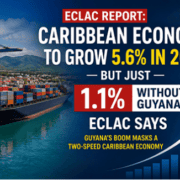
Caribbean Economy To Grow 5.6% In 2026 – But Just 1.1% Without Guyana, ECLAC Says

By NAN Business Editor

News Americas, NEW YORK, NY, Fri. August 21, 2026: The Caribbean economy is projected to grow by an impressive 5.6% in 2026 and 7.9% in 2027, but new United Nations data show that one country is dramatically altering the regional picture: Guyana.

Without Guyana, Caribbean economic growth falls to just 1.1% in 2026 and 2.2% in 2027, according to the newly released Economic Survey of Latin America and the Caribbean 2026 from the Economic Commission for Latin America and the Caribbean, ECLAC.

The striking difference illustrates the growing economic divide between oil-rich Guyana and much of the rest of the Caribbean. ECLAC forecasts Guyana’s economy will expand by 16.2% this year before accelerating to 19.7% in 2027. No other Caribbean economy comes close. Antigua and Barbuda, Grenada and Suriname share second place in the 2026 rankings, with projected growth of 3.5% each.

Caribbean Growth Forecasts Ranked

RankEconomy202620271Guyana16.2%19.7%2=Antigua and Barbuda3.5%3.5%2=Grenada3.5%3.5%2=Suriname3.5%4.4%5Dominica3.1%2.8%6St. Vincent and the Grenadines3.0%2.6%7=Barbados2.5%2.2%7=Belize2.5%2.3%9=The Bahamas2.0%2.2%9=St. Kitts and Nevis2.0%2.5%9=Saint Lucia2.0%1.5%12Trinidad and Tobago0.8%1.5%13Jamaica-1.2%2.5%

Source: ECLAC. Forecasts based on information available as of July 28, 2026.

Jamaica Forecast To Contract

At the opposite end of the table is Jamaica. ECLAC forecasts a 1.2% contraction in 2026, followed by a recovery to 2.5% growth in 2027.

Trinidad and Tobago is expected to post the second-weakest Caribbean performance this year, growing only 0.8%, before improving modestly to 1.5% next year.

Suriname, meanwhile, is forecast to accelerate from 3.5% growth in 2026 to 4.4% in 2027, putting it behind only Guyana among the Caribbean economies listed for next year.

The Bahamas is projected to grow 2% this year and 2.2% in 2027, while Barbados is forecast at 2.5% and 2.2%, respectively.

Caribbean Growth Outpaces Wider Region – On Paper

The Caribbean’s headline performance also appears exceptional when compared with Latin America and the Caribbean as a whole. ECLAC expects the wider region to grow only 2.2% in 2026, down from 2.4% in 2025, before recovering to 2.5% next year. But once Guyana is excluded, the Caribbean’s 1.1% growth forecast actually falls well below the wider regional projection.

ECLAC warns that the region remains caught in a prolonged period of weak economic expansion. If its latest forecasts prove correct, Latin America and the Caribbean will have experienced five years of average growth of approximately 2.3% – a pace the UN body considers insufficient to sustainably raise per-capita income and close development gaps.

Investment, Debt And Informality Remain Challenges

The problem extends beyond GDP growth. ECLAC identifies weak investment, slowing formal employment creation and persistent labor informality among the structural constraints limiting the region’s economic potential.

Nearly half of employed people across Latin America and the Caribbean continue to work informally, according to the report. The Commission argues that formal companies are better positioned to exploit economies of scale, adopt innovation, access financing and build productive capabilities.

Caribbean governments also continue to face substantial fiscal constraints. Gross public debt in the Caribbean stood at approximately 73% of GDP in 2025, according to ECLAC, while high financing costs and growing interest payments constrain governments’ ability to increase public investment and fund economic transformation.

The new projections therefore tell two Caribbean economic stories. One is a region apparently racing ahead at 5.6%. The other is a Caribbean outside Guyana growing at barely 1.1%. For businesses, governments and investors, the difference between those two numbers may be more revealing than the headline forecast itself.

READ MORE: For the investor analysis and what the country-by-country forecasts could mean for capital and investment, read “Caribbean Growth Forecast 2026–2027: Guyana Powers Regional Expansion, But The Numbers Reveal A Two-Speed Economy” on Invest Caribbean.


RELATED: ExxonMobil Just Posted $14.5 Billion In Profit As Guyana Is Still Burying Its Dead And Protesting In The Streets

New Data Points To A Caribbean Capital-Readiness Gap As Businesses Seek Millions In Financing

By NAN Business Editor

News Americas, NEW YORK, NY, Tues. August 25, 2026: Caribbean businesses may face another obstacle beyond the region’s widely discussed shortage of financing – Caribbean Capital-Readiness. Many may not yet be prepared for the type of institutional capital they are seeking.

A new analysis of financing demand submitted to AI Capital Exchange, the debt pre-qualification platform powered by Invest Caribbean, has identified recurring mismatches between financing requests and the revenue, sponsor equity, collateral and financial documentation presented by prospective borrowers.

ACE has analyzed more than $200 million in financing demand, with Caribbean commercial real estate alone accounting for more than $244 million in stated financing requests in the platform’s current dataset. The findings do not represent approved or financeable transactions. Rather, they capture stated capital demand submitted for consideration — a distinction that Invest Caribbean says is central to understanding the region’s financing problem.

Millions Sought, But Equity Remains A Challenge

The commercial real estate data offers some of the starkest examples. One Caribbean request sought $150 million in financing while reporting $3 million in cash equity, equivalent to approximately 2% of the amount requested. Another sought $50 million against $2 million in reported cash equity, while a $32.473 million request reported no cash equity contribution. Some applicants also reported having no audited financial statements.

The findings suggest that the challenge confronting Caribbean businesses may not simply be finding institutions willing to lend. Businesses must also arrive with financial structures capable of satisfying institutional lending requirements.

Being Ready To Pitch Isn’t Being Ready For Capital

Data from ACE’s Capital Readiness assessment reinforces that conclusion. Among Caribbean respondents seeking financing of $1 million or more, roughly 9 in 10 reported either no annual revenue or less than $500,000 in annual revenue. Yet approximately two-thirds said their pitch deck was ready.

That distinction has become a central part of ACE’s capital-readiness message. A pitch deck can communicate an investment proposition, but institutional debt decisions typically depend on considerably more: revenue and repayment capacity, sponsor equity, collateral where applicable, financial statements and the underlying structure of the transaction.

Debt, Equity – Or Both?

The findings also highlight a persistent source of confusion among businesses seeking capital: the difference between debt and equity. Early-stage businesses without sufficient operating revenue may be better suited to equity capital than conventional institutional debt. Larger projects may require sponsors to raise equity before lenders will finance the remaining capital requirement.

Other transactions may require a combination of the two. Similar mismatches are appearing in submissions from outside the Caribbean. ACE has observed African expansion financing requests of as much as $5 million against annual revenue as low as $150,000, while Capital Readiness data from Latin America includes seven-figure financing demand from businesses reporting less than $500,000 in annual revenue.

The emerging data suggests that capital readiness could therefore be a broader challenge across developing and emerging markets.

From Capital Access To Capital Readiness

The findings raise an important question for Caribbean economic-development programs. While considerable attention is devoted to expanding access to finance, connecting businesses with lenders may accomplish little when businesses have not first been taught how institutional capital works. That includes understanding appropriate debt levels, sponsor equity, financial documentation, repayment capacity and whether a business needs debt, equity or a combination of both.

Invest Caribbean executives argue that closing this knowledge gap should become part of the region’s broader conversation about SME development and investment. Read the full Invest Caribbean Intelligence analysis on the Caribbean capital-readiness gap at Invest Caribbean.

RELATED: Why Caribbean and Latin American Hotel and Commercial Property Owners Should Be Refinancing Now