Koffee’s ‘Toast’ Certified Gold in France

Eight years after its release, “Toast” is still picking up hardware. Koffee’s breakout track has just been certified gold in France by the SNEP, the country’s official music certification body, after crossing 15 million streams in the territory.

Omah Lay Links With BEAM and Gyptian on Afro-Dancehall Cut ‘As We Get High’

The most interesting thing about “As We Get High” is not who is on it, but who put it together.

Skillibeng Thrills UK Fans, Brings Out Koffee at London Carnival Weekend Show

The moment Koffee walked out on stage at KOKO in Camden, the crowd stopped singing and just screamed.

The 25 Best Buju Banton Songs, Ranked

Few voices in the history of Caribbean music carry the weight, range, and authority of Buju Banton.

iQor Launches Global Gaming Center of Excellence in Trinidad and Tobago

News Americas, FT. LAUDERDALE, Fla., Sept. 08, 2026: iQor, a global leader in customer experience business process outsourcing, today announced the launch of its global Gaming Center of Excellence in Trinidad and Tobago. The new center serves as the flagship hub for iQor’s expanding global Gaming Practice, anchoring the leadership that oversees gaming delivery across Egypt, the Philippines and Colombia. The center features a new gaming-native Player Support program for one of the world’s leading video game publishers.

The launch reflects iQor’s growing investment in specialized customer experience solutions for the gaming industry, where player expectations continue to rise alongside the complexity of live-service titles, cross-platform and mobile-first experiences and global gaming communities. Retaining and engaging players is now as critical for publishers and studios as acquiring them, making Player Support a critical function that goes beyond resolving issues to protecting player trust, engagement and long-term loyalty.

iQor’s Gaming Practice brings together Player Support, Trust and Safety and content moderation, player insights and technology-enabled operations to help publishers create more connected player experiences. The Trinidad and Tobago Center of Excellence is designed specifically around the needs of players, with specialists who understand games, gaming communities and the emotional connection players have with their progress and experiences.

Team members are selected not only for their customer service capabilities, but also for their gaming experience, critical-thinking skills and ability to communicate naturally and authentically with players. Training consists of hands-on game and platform immersion, simulated player interactions, technical troubleshooting and empathy-based resolution practices.

“Players know right away whether the person helping them truly understands their game,” said John Pompei, gaming industry veteran and vice president, Gaming Practice at iQor. “We built this program around people with real gaming knowledge and hands-on training, because great Player Support is about more than resolving an issue. It’s about protecting a player’s progress, building trust and strengthening their connection to the game.”

As part of its investment and commitment to serve the gaming industry, iQor built dedicated gaming stations within its Trinidad hub, giving Player Support specialists hands-on access to the games, consoles, PCs, mobile devices, peripherals and platforms players use. Located near the production floor, the stations enable specialists to play, test and navigate common player scenarios firsthand, building deeper knowledge of the in-game player experience and greater credibility in support interactions.

The Trinidad-based team assists players with account access, game progression, missing content, purchases, technical issues and other challenges that affect gameplay.

Structured quality management, coaching and operational insights continuously strengthen the player experience, with the ability to incorporate AI-enabled capabilities as the partnership evolves and the publisher’s needs grow.

iQor selected Trinidad and Tobago as its global Gaming Center of Excellence based on the market’s customer experience talent, cultural alignment with North American players and ability to scale with game launches, live events and shifts in player demand.

As iQor’s global Center of Excellence for gaming, Trinidad and Tobago is where the strategies, training models and operational playbooks powering iQor’s Gaming Practice are built and refined, then deployed across the company’s broader gaming footprint in Egypt, the Philippines and Colombia, where teams support live-service and console gaming clients across more than 20 languages, including a leading global console manufacturer.

Beyond its delivery operations, iQor is deepening its presence in the gaming industry as a sponsor of the Live Service Gaming Summit | Game Publishing, Marketing & Community UK 2026, Sept. 8-9 at the Millennium Gloucester Hotel and Conference Centre in London, UK. Pompei will join Jonathan Shroyer, senior vice president, Gaming and AI at iQor, on stage in a session titled Your Player Doesn’t Know Your Org Chart – Why Connected Player Intelligence Is the Next Operating Model for Gaming to discuss how iQor helps gaming companies strengthen player loyalty through player support, trust and safety, community engagement and AI-powered insights that turn player interactions into opportunities for retention and growth.

About iQor
iQor is a trusted partner in customer experience solutions for global brands and a portfolio company of Mill Point Capital. With 45,000 employees across 10 countries, iQor combines three decades of expertise with AI-driven innovation to optimize performance across the entire customer lifecycle. Through its three delivery pillars — Grow, CXBPO, and infinityAiQ — iQor delivers scalable solutions that drive acquisition, engagement, and retention. Powered by advanced analytics and a people-first culture, iQor transforms customer interactions into measurable growth. Recognized as a Great Place to Work® and a leader in CX excellence, iQor empowers brands to grow smarter. Learn more at iQor.com.

You may also like: ExxonMobil Warns Investors Guyana’s Oil Profits Will Shrink Again

The 40 Best Dancehall Albums of All Time

Ask any selector worth their weight in vinyl: picking the best dancehall albums of all time is an argument that never ends.

The 30 Best Dancehall Love Songs of 2026: The Definitive Ranked List

The best dancehall love songs do something that few other genres can match: they compress raw desire, tender devotion, and irresistible riddim into a single track that plays equally well at a Kingston bashment, a London wedding, and a Saturday-morning kitchen.

The 20 Best Shenseea Songs

When the conversation turns to the best Shenseea songs, the sheer range of the catalogue is the first thing that stops you.

‘I Didn’t Make a Penny’: Iley Dread Claims Coolie Dance Success Left Him Empty-Handed – Kings of kings boss opens up about the ‘betrayal’

One of dancehall’s most lucrative riddims has returned to the spotlight—but for veteran producer Colin “Iley Dread” Levy, the renewed attention has reopened a 23-year-old wound.

Haitians Use West Indian American Day Carnival Parade To Spotlight On TPS Crisis

By Staff Writer, NewsAmericas Now

News Americas, BROOKLYN, NY, Mon. Sept. 7, 2026: Hundreds of thousands turned out for Brooklyn’s annual West Indian American Day Carnival Parade today but for many Haitian marchers, this year’s celebration doubled as a pointed message about the crisis facing their community following the loss of Temporary Protected Status.

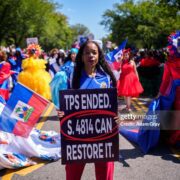
A woman wears a dress about Temporary Protected Status (TPS) during the annual West Indian American Day Carnival Parade on September 7, 2026 in the Brooklyn borough of New York City. This year’s parade was held against the backdrop of Federal immigration enforcement intensifying against Caribbean and other Black immigrant communities, as Haitians lost their Temporary Protected Status. (Photo by Adam Gray/Getty Images)

Natalie Lafontant, who organizes Lespri Ayiti, the parade’s largest Haitian mas group, said the mood carried real weight this year. “There’s a somber cloud over it with everything that has happened from last year to this year with TPS… what’s happening in detention centers, and those who are being sent back with no valid way of living or supporting themselves,” she said. Still, she said the response to hardship wasn’t surrender. “If you know anything about the Caribbean, especially about Haiti, we use music, dance, art, to continue to strive and push through,” she said.

In June, the Supreme Court ruled that federal courts cannot review the Trump administration’s decision to end TPS for Haitian and Syrian immigrants, clearing the way for roughly 350,000 Haitians to lose the protection. A federal judge finalized the order in early August, and work permits tied to Haitian TPS expired July 27.

A woman wears a dress about Temporary Protected Status (TPS) during the annual West Indian Day Parade on September 7, 2026 in the Brooklyn borough of New York City. This year’s parade was held against the backdrop of Federal immigration enforcement intensifying against Caribbean and other Black immigrant communities, as Haitians lost their Temporary Protected Status. (Photo by Adam Gray/Getty Images)

Lafontant’s group, about 180 artists, designers, musicians and residents, struggled to find float sponsors this year given the costs of insurance, costumes and care for marchers. “But we continue to do it because we love our country,” she said.

New York’s Haitian community, roughly 163,000 people in the metropolitan area, is the second-largest in the U.S. after Miami, with most settled in Brooklyn’s Flatbush, East Flatbush and Crown Heights neighborhoods. Many arrived during and after the Duvalier dictatorship of the 1970s and 80s, part of a broader history of resistance tracing back to the Haitian Revolution, when enslaved and free Black people overthrew French colonial rule in the only successful slave revolt in modern history.

This woman holds a sign about Pierre Damas Bel during the annual West Indian Day Parade on September 7, 2026 in the Brooklyn borough of New York City. This year’s parade was held against the backdrop of Federal immigration enforcement intensifying against Caribbean and other Black immigrant communities, as Haitians lost their Temporary Protected Status. (Photo by Adam Gray/Getty Images)

That legacy shaped this year’s costumes. Fashion designer Clara Poteau created royal blue emperor robes honoring Jean-Jacques Dessalines, a revolutionary leader and Haiti’s first head of state after independence. Other designs featured miniature Haitian flags and the faces of national football stars Duckens Nazon and Emmanuel Sanon, while a “Freedom” T-shirt carried the flags of nations Haitian revolutionary leaders helped liberate, including Venezuela, Colombia, Ecuador, Peru, Bolivia, Panama, Mexico and Greece.

New York City Mayor Zohran Mamdani marches in the annual West Indian Day Parade on September 7, 2026 in the Brooklyn borough of New York City as a parade goer holds a sign on TPS. (Photo by Adam Gray/Getty Images)

Edwina Paul, founder of the women’s coalition Fanm Se Poto Mitan, left Haiti in 1993 amid instability and said the parade reflects why so many made that same journey. “We don’t come here to sin, we don’t come here to kill. We come here to work, to have a better education,” she said.

Violence marred part of the celebration

The parade was briefly interrupted around 4 p.m., one and a half hour before the new 5:30 PM finish, when at least three people were shot in separate incidents near the route, according to police. A man was shot near Nostrand Avenue and St. John’s Place in Crown Heights, with a suspect quickly taken into custody; a woman was shot and a man grazed in the leg near Eastern Parkway and Kingston Avenue. The parade concluded at 5:30 p.m., earlier than in past years, as part of city officials’ effort to curb violence, with checkpoints and bag restrictions in place along the route.

NewsAmericasNow will continue covering the Haitian community’s response to TPS policy changes.