News Americas, NY, NY, Mon. Sept. 28, 2006: The next UN Secretary-General will inherit a deeply divided world. For Guyana, that may make the case for Carolyn Rodrigues-Birkett more compelling – but winning the race will require careful diplomacy among the major powers.
The next Secretary-General of the United Nations will inherit one of the most difficult international environments in the organization’s history. Speaking at the Munich Security Conference, outgoing Secretary-General António Guterres warned that the global community had become more fragmented and divided than at any time in the previous 75 years. He went further, arguing that the transition toward a multipolar world was taking place without sufficiently strong global institutions to manage it. The result, he warned, could be greater chaos, opportunism and transactional politics rather than structured cooperation.
Remarkably, Guterres suggested that the Cold War was, in some respects, less dangerous. The confrontation between the United States and Soviet Union carried the constant threat of nuclear war, but it also produced established mechanisms for arms control and crisis management. Today, he argued, the world faces not only nuclear danger but also the existential challenges of climate change and uncontrolled artificial intelligence – without comparable mechanisms for managing them.
That is the world into which the next Secretary-General will step. Global cooperation has become harder to sustain. Strategic competition between the United States and China is reshaping trade and supply chains. Traditional alliances are under strain as national interests increasingly take precedence over collective approaches. Regional conflicts have multiplied, while the international system faces mounting pressure over climate change, food security, migration, technology and artificial intelligence.
And the Secretary-General will have to manage a crisis of confidence within the United Nations itself: pressure for institutional reform, chronic funding difficulties, and paralysis within the Security Council, where the veto powers of the five permanent members can prevent collective action.
The question, therefore, is not simply who should occupy the Secretary-General’s office. It is what kind of leadership the international system requires at a moment when the old assumptions underpinning that system are being challenged.
A Race At A Critical Stage
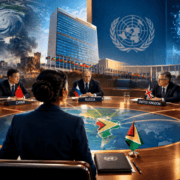
Against this background, the contest to succeed António Guterres has reached a critical stage. The third Security Council straw poll, conducted on September 18, put Costa Rica’s Rebeca Grynspan narrowly ahead of Guyana’s Carolyn Rodrigues-Birkett. Grynspan received nine “encourage” votes, five “discourage” votes and one “no opinion”; Rodrigues-Birkett received eight “encourage,” six “discourage” and one “no opinion.” The two have emerged as the leading candidates through the first three rounds.
The result is significant because the race remains far from settled. The eventual candidate must secure at least nine votes in the 15-member Security Council and, critically, cannot receive a veto from any of the five permanent members – China, France, Russia, the United Kingdom and the United States.
Guyana’s candidacy has the backing of CARICOM, and President Irfaan Ali used his address to the 81st session of the General Assembly to make a direct appeal for Rodrigues-Birkett. He argued that the world should look beyond the size of the country that nominated her and consider the experience and qualities she could bring to an organization in need of renewal.
The symbolism is considerable. The Caribbean has never produced a Secretary-General. No woman has ever held the position. Rodrigues-Birkett would therefore represent not simply a Caribbean candidate, but a woman from a small developing state and an Indigenous Caribbean background seeking to lead the world’s principal multilateral institution. But symbolism alone will not decide the contest.
How the Decision Is Actually Made
Although all 193 UN member states ultimately participate in the formal appointment process, the decisive stage takes place in the Security Council.
During the informal straw polls, the 15 Council members indicate whether they “encourage,” “discourage” or have “no opinion” on each candidate. In the early rounds, the identities of the permanent members behind individual votes are not disclosed. Later stages are designed to make the positions of the five permanent members clearer.
Under Article 97 of the UN Charter, the General Assembly appoints the Secretary-General only after receiving a recommendation from the Security Council. The General Assembly then votes on that recommendation. In practical terms, therefore, the Security Council is where the decisive bargaining occurs. That makes the current geopolitical environment both a complication and a potential opportunity for Guyana.
Guyana’s Security Council Record
Guyana has something important to bring to the table: recent experience at the center of the very multilateral system that the next Secretary-General will be expected to repair. Guyana served a two-year non-permanent term on the Security Council in 2024–2025 and held the Council presidency in February 2024 and June 2025. During its tenure, Guyana placed particular emphasis on climate change, food insecurity and conflict, while also highlighting peacebuilding, women and security, and youth and children in conflict.
Its February 2024 presidency was particularly notable. Guyana brought the relationship between climate change, food insecurity and conflict to the centre of a high-level Security Council debate. The UN itself subsequently highlighted the importance of the climate-food-conflict nexus
This gives Guyana a credible argument that the concerns of small and vulnerable states are not peripheral to international security. They are increasingly central to it. Climate change, food insecurity, poverty, environmental degradation and conflict are no longer neatly separated problems. For many developing countries, they are interconnected drivers of instability.
That perspective is particularly relevant to a UN struggling to adapt institutions created in 1945 to the realities of the twenty-first century.
The Geopolitical Tightrope
But there is another dimension to the campaign, and it is considerably more complicated. Guyana’s strategic relationships intersect with the interests of all three major powers: the United States, China and Russia.
Guyana has a particularly close security relationship with the United States, especially in the context of Venezuela and wider Caribbean security. At the same time, China is an important economic partner with interests in infrastructure, trade and development throughout the region. Russia, meanwhile, maintains a close relationship with Venezuela.
Guyana therefore has to navigate a diplomatic landscape in which its national interests do not always align neatly with those of any one major power. That makes the campaign less a matter of persuading countries to “support Guyana” than of demonstrating why a Rodrigues-Birkett Secretary-General could serve the broader interests of a divided international community.
There may also be an important regional calculation. President Ali and Guyana’s delegation recently joined US President Donald Trump, Secretary of State Marco Rubio and other leaders of the Shield of the Americas in adopting a joint communiqué focused on economic, security and multilateral coordination. Guyana’s participation reinforces its growing role in the security and economic architecture of the Western Hemisphere.
That relationship should not be reduced to a simple quid pro quo over the Secretary-General’s appointment. But it does give Guyana a channel for making the case directly to Washington that the choice of Secretary-General matters to the future effectiveness of the multilateral system – including one in which the United States has substantial strategic interests.
The same logic applies, in different ways, to China and Russia. The objective should not be to present a Rodrigues-Birkett candidacy as an instrument against any particular power. That could make her less acceptable, not more. The stronger diplomatic argument is that the next Secretary-General must be someone capable of working across competing geopolitical blocs without becoming the representative of any one of them.
A Caribbean Moment
This is where CARICOM’s collective weight becomes important. The Caribbean has never occupied the Secretary-General’s office. The region has a legitimate interest in greater representation within an international system in which small states often find themselves negotiating with much larger powers.
Rodrigues-Birkett’s candidacy also carries a wider representation argument: a woman from the Caribbean, from a small developing state and with Indigenous Caribbean heritage, would bring experiences that have never been represented at the highest level of the UN.
But CARICOM should be careful not to frame the contest simply as a test of whether the great powers respect small states. That risks turning a campaign for a candidate into a confrontation between blocs.
A more effective argument would be that the present crisis of multilateralism is precisely why the next Secretary-General should be someone capable of building bridges across those divisions.
That is a message that can potentially resonate in Washington, Beijing, Moscow, London and Paris – as well as among the many smaller states whose interests are often overshadowed by great-power competition.
The Work Ahead
The third straw poll should therefore be viewed not as a verdict but as a map. Rodrigues-Birkett is only one vote short of the nine “encourage” votes required in the latest informal poll, but the six “discourage” votes demonstrate that significant resistance remains. More importantly, the early straw polls do not reveal which positions belong to the permanent members.
Guyana and CARICOM consequently have considerable diplomatic work ahead. They need to identify where support for Rodrigues-Birkett is firm, where it is movable, and where resistance may be connected to particular geopolitical concerns. They need to understand not only the positions of the five permanent members but also the calculations of the elected members of the Council.
And they need to make the campaign about more than Guyana. The central message could be much larger: the world is entering an increasingly multipolar era, but the institutions designed to manage that world have not kept pace. The next Secretary-General therefore needs to be a bridge-builder – someone able to engage great powers without becoming captive to them, while ensuring that the concerns of smaller and developing states remain part of the global conversation.
That is a difficult case to make. But it is also precisely the kind of case that a candidate from Guyana can credibly embody. The paradox of this race is that the very fragmentation threatening the effectiveness of the United Nations may create the opening for a candidate whose principal asset is the ability to bridge divides.
For Guyana, the challenge now is to turn that possibility into a diplomatic strategy – quietly, persistently and with enough sophistication to make the major powers see Rodrigues-Birkett not merely as Guyana’s candidate, but as a potentially useful candidate for a United Nations struggling to find its way in a fractured world.