

Guyana Police Arrest Country’s Opposition Leader For Fourth Time In Weeks

By News Americas Now Staff Writer

News Americas Now, GEORGETOWN, Guyana, Wed. October 28, 2026: Guyana Opposition Leader Azruddin Mohamed was arrested Wednesday for at least the fourth time since early September, as police opened another investigation involving the businessman-turned-politician.

This time the arrest came over allegations that a police constable was paid by Mohamed for government surveillance footage connected to a controversial shooting incident earlier this month. Mohamed, leader of the opposition We Invest in Nationhood, (WIN), party, was arrested at his Eccles, East Bank Demerara residence, according to police.

Head of the Guyana Police Force’s Criminal Investigations Department, Deputy Commissioner Wendell Blanhum, confirmed the arrest. “I can confirm that Mr. Azruddin Mohamed was arrested,” Blanhum said. The latest arrest concerns an investigation into how Mohamed obtained video recordings from Guyana’s government-operated Safe Country surveillance system. Police allege a 20-year-old constable attached to the Force’s Command Centre downloaded footage and provided it to Mohamed in exchange for GY$800,000.

Police said the constable told investigators that he downloaded the recording on October 23 and saved it to a flash drive after being instructed to do so by Mohamed. According to the police account, an employee of Mohamed transported the constable to Mohamed’s Houston, East Bank Demerara residence the following day, where the officer was allegedly paid GY$800,000 in cash in exchange for the recording.

Police further allege the constable spent some of the money during a shopping trip and gave the remainder to his mother. The allegations have not yet been tested in court, and police had not announced new charges against Mohamed in connection with the alleged payment as of Wednesday afternoon.

VIDEO AT CENTER OF SHOOTING DISPUTE

The footage at the center of the investigation was publicly screened by Mohamed during a press conference Monday. Mohamed said the approximately 23-minute recording supported his assertion that an October 12 encounter involving Senior Superintendent Prem Narine, head of the Guyana Police Force’s Special Branch, amounted to a failed attempt on his life.

Police have presented a sharply different account. According to investigators, Narine was at his Barr Street, Kitty residence on the night of October 12 when he observed a vehicle carrying Mohamed and two other men travelling slowly in the area. Police said Narine heard what appeared to be a gunshot and responded by firing several rounds toward the vehicle.

Mohamed has disputed that version of events and has said the surveillance recording demonstrates that an attempt was made on his life. He has also indicated that he intends to pursue private criminal charges against Narine. Mohamed and two associates were arrested following the incident and subsequently charged in connection with alleged firearm and ammunition possession and attempting to pervert the course of justice. They were granted bail. Those proceedings remain separate from the new investigation into how Mohamed obtained the government surveillance recording.

FOUR ARRESTS IN WEEKS

Wednesday’s detention adds to a striking series of encounters between Guyana’s main opposition leader and law enforcement authorities. In early September, Mohamed was arrested during an investigation involving alleged unauthorized drone activity near President Irfaan Ali’s private residence at Leonora.

He was released on self-bail, but was arrested a second time later that same night after returning to the area with supporters and livestreaming from the vicinity. Police said at the time that he had allegedly breached security protocols. He was subsequently released again. Then, on October 13, Mohamed was arrested with two associates following the shooting incident near Narine’s residence.

Wednesday’s arrest therefore marks at least the fourth time Mohamed has been taken into police custody since early September. The repeated arrests come as Mohamed and his father, businessman Nazar Mohamed, are also fighting extradition proceedings brought at the request of the United States. Those proceedings are separate from the latest police investigations and are scheduled to return to court in November.

CONSTABLE, MOTHER ALSO DETAINED

The police constable accused of providing the surveillance footage and his mother also remained in custody on Wednesday. The constable’s father has moved to the High Court seeking their release, arguing through an attorney that the police must establish a lawful basis for continuing to detain them. The court application challenges the legality of their detention and asks that they either be brought before the court or released, with or without conditions.

Meanwhile, Guyana Attorney General Anil Nandlall has said the alleged payment for the footage could potentially raise questions involving bribery, evidence tampering and attempting to pervert the course of justice. No court has yet determined that Mohamed committed any of those offences in connection with the leaked footage.

The continuing investigation now adds another layer to an increasingly contentious confrontation involving Guyana’s opposition leader, senior members of the police force and the government’s own surveillance system. At the center of that confrontation remains the October 12 shooting – an incident Mohamed describes as an attempt on his life, while police maintain that their actions arose from an alleged firearm discharge near the home of the country’s Special Branch chief.

With the surveillance video now itself the subject of a criminal investigation, the dispute has expanded beyond what happened that night to include how potentially critical evidence was obtained, who had access to it, and whether the recording ultimately supports either side’s account.

RELATED: Guyana Opposition Leader Azruddin Mohamed Granted Bail As Lawyers Allege ‘Calculated Attempt’ To Eliminate Him
Did U.S. Pressure Split The Caribbean On Cuba Embargo Vote?

By News Americas Now Analyst

News Americas Now, NEW YORK, NY, Wed. October 28, 2026: For more than three decades, Caribbean governments have largely stood with Cuba at the United Nations in opposing the United States’ economic embargo. Today, October 28, 2026, that solidarity fractured dramatically.

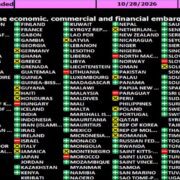
The United Nations General Assembly voted 130-17, with 25 abstentions, to again call for an end to the U.S. economic, commercial and financial embargo against Cuba. The resolution passed overwhelmingly, but support fell sharply from 2025, when 165 countries voted in favor, seven voted against and 12 abstained.

The most striking shift came from Cuba’s own neighborhood. Trinidad and Tobago voted against the resolution alongside the United States, while Guyana, Jamaica, Haiti and the Dominican Republic abstained. Trinidad and Tobago supported the resolution last year, while Guyana, Jamaica, and Haiti also moved away from their previous support.

The question now confronting the region is whether those changes reflect independent reassessments of Cuba, growing concern about Havana’s human-rights record – or the expanding weight of U.S. diplomatic, security and migration policy across the hemisphere.

A Changing U.S.-Caribbean Relationship

The vote comes as Washington deepens cooperation with several Caribbean governments on issues extending far beyond Cuba. Guyana, the Dominican Republic, and Trinidad and Tobago are all members of the U.S.-backed Shield of the Americas, an initiative whose members say they are seeking closer coordination on economic security, regional security, and multilateral diplomacy.

A September joint statement signed by the United States, Guyana, Trinidad and Tobago and other participating governments committed members to strengthening cooperation across three pillars: economic, security and multilateral coordination. That does not establish that participation in the Shield determined Wednesday’s Cuba vote. But the alignment is notable.

Trinidad and Tobago, one of the Caribbean states participating in the initiative, moved from supporting the anti-embargo resolution in 2025 to voting against it this year. Guyana, also a Shield member, moved from support to abstention.

At the same time, both Washington and Caribbean governments have been negotiating new migration arrangements tied to the Trump administration’s expanded use of third-country transfers. Guyana finalized a one-year migration cooperation framework with the United States under which it may receive vetted third-country nationals removed from the United States. Under the arrangement, six Cuban and Afghan nationals arrived in Guyana in September. Georgetown maintains that it retains complete discretion over whom it accepts and that the program is temporary rather than permanent resettlement.

Jamaica has also entered a third-country transit arrangement with Washington. Its government says the program allows small numbers of non-Jamaican migrants to transit through Jamaica with International Organization for Migration support before returning to their countries of origin or moving elsewhere. Kingston has stressed that people with criminal records will not be accepted and that the arrangement can be suspended under specified conditions.

Again, those agreements do not prove a quid pro quo involving Cuba. But they illustrate how deeply U.S. priorities now intersect with the foreign-policy decisions of Caribbean governments.

Washington Made No Secret Of Its Campaign

The Trump administration openly campaigned against the annual Cuba resolution. U.S. Ambassador to the United Nations Mike Waltz urged governments to reject what Washington characterizes as a propaganda exercise by Havana, pointing to political prisoners, Cuba’s human-rights record, the role of military-controlled enterprises and allegations involving Cuban nationals fighting alongside Russian forces in Ukraine.

The administration’s lobbying was more intensive than in previous years, and the final tally shows that substantially more governments either voted with Washington or declined to support Cuba. Cuba has gone further, alleging that some governments faced threats involving tariffs, visas and U.S. assistance if they failed to side with Washington.

Cuban officials have not publicly produced evidence establishing those allegations. What is indisputable is that Wednesday’s vote represented one of the most significant erosions of support for Cuba’s anti-embargo resolution in years.

The Caribbean Question

For Caribbean governments, the shift raises uncomfortable questions about sovereignty and regional foreign policy. The region has historically opposed the U.S. embargo even when individual governments disagreed with Havana’s political system. The argument has generally rested on opposition to unilateral economic sanctions and a belief that countries should determine their own political and economic systems without external coercion.

That history also sits within a much older debate over U.S. power in the hemisphere. From the Monroe Doctrine of the 19th century to Theodore Roosevelt’s later “Big Stick” approach, Washington has repeatedly asserted a special strategic interest in the Americas.

Today’s instruments are different. They include trade, investment, security partnerships, migration cooperation, sanctions, diplomatic alliances, and multilateral coordination rather than the overt interventions associated with earlier eras. Still, the underlying question remains relevant: how independently can small Caribbean states conduct foreign policy when their economic, security and migration relationships with the United States are becoming increasingly intertwined?

People collect recyclable materials from a rubbish container on a street in Havana on October 26, 2026. (Photo by YAMIL LAGE / AFP via Getty Images)

Cuba’s confrontation with Washington is also unfolding against an increasingly severe economic and humanitarian crisis on the island. U.S. sanctions and restrictions on fuel and financial access are not the sole causes of Cuba’s economic problems — the country also faces longstanding structural weaknesses, low productivity, debt, and government policy failures – but international agencies say the embargo has magnified those problems by restricting access to foreign exchange, technology, financing, and international markets. A United Nations report cited economic contraction, high inflation, shortages of medicines and declining purchasing power, while the latest fuel restrictions have contributed to widespread blackouts and a dramatic collapse in public transportation. Cuba’s transportation minister said this month that passenger trips could fall by 75 percent this year compared with 2025, as fuel supplies tighten further.

The debate over Washington’s influence is occurring alongside an unprecedented expansion of U.S. military force in waters surrounding Latin America and the Caribbean. Since September 2025, the United States has carried out more than 70 lethal strikes against vessels it alleges were involved in drug trafficking in the Caribbean Sea and eastern Pacific, killing at least 240 people as of October 28. U.S. Southern Command says intelligence identified the vessels as connected to narcotics trafficking, but in many cases the government has not publicly released evidence establishing the identities or alleged crimes of those killed. Independent monitors say none of those killed were formally charged or brought before a court before the strikes. The Trump administration argues that the operations are part of an armed conflict against drug cartels and are necessary to curb narcotics trafficking, while human-rights organizations and legal experts have challenged the legality of killing suspected traffickers at sea without arrest or judicial process.

Cuba Still Wins – But The Message Changed

Despite the shift, Cuba still secured the support of 130 countries. Many governments continued to argue that the embargo violates principles of international law and has imposed economic hardship on ordinary Cubans, while simultaneously expressing concerns about human rights and political freedoms on the island.

The resolution remains non-binding, and only the U.S. Congress can fully lift the statutory embargo. But the annual vote has always carried symbolic weight. This year, the symbolism changed. Cuba still won the vote. Washington, under Donald Trump, however, demonstrated that it can move governments that once reliably stood with Havana – including governments in the Caribbean.

And that leaves a question extending well beyond Cuba: was Wednesday’s Caribbean split simply a change in national foreign-policy calculations – or evidence that U.S. leverage in the hemisphere is once again reshaping how the region votes?

RELATED: Guyana Signs ‘Landmark’ Defense Pact With U.S. As Deadly Caribbean Boat-Strike Campaign Tops 238 Killed

Is U.S. ICE Fighting A War Or Enforcing Immigration Laws?

By Felicia J. Persaud

News Americas Now, Weds. Oct. 28, 2026: On October 8th, an ICE officer fired seven shots at a vehicle in the Marble Hill neighborhood of New York City during an attempted immigration arrest. Inside were 28-year-old Dominican immigrant Oscar Belgal and his five-year-old son.

Belgal was struck in the neck. His five-year-old son was physically unharmed, but the emotional consequences are another matter. His mother, Arianna Montero, said the child has been experiencing nightmares and has stopped speaking since witnessing his father being shot. Federal officials say Belgal drove toward agents and endangered their lives. Questions remain about the encounter, including whether
the plainclothes officers were clearly identifiable.

But the shooting raises a larger question: Why are immigration arrests on American streets increasingly resembling combat operations? Are we fighting a war? And if so, against whom? Belgal’s shooting came nine months after two U.S. citizens were killed in Minneapolis during federal immigration enforcement operations.

On January 7, Renée Nicole Macklin Good, a 37-year-old mother, was fatally shot by an ICE officer. On January 24, Alex Jeffrey Pretti, a 37-year-old intensive care nurse, was killed by Border Patrol officers. Both deaths sparked questions about the use of force, official accounts of the encounters, and the need for independent investigations. Neither victim was an immigrant facing deportation. Yet both lost their lives during immigration enforcement operations.

And now another man has been shot, with a young child just feet away.  This followed the September 20 shooting of Wilber Rafael Garces Perez, a 28-year-old Venezuelan DoorDash delivery driver, in Austin, Texas. Federal authorities allege that Garces Perez struck an ICE officer with his vehicle’s side mirror while attempting to flee and later tried to hit an officer with his car. Garces Perez disputes that account, saying an unmarked federal vehicle struck his car before an agent shot him in the back. The officer who fired was not wearing a body camera.

We are told these operations are necessary to enforce immigration laws and protect public safety. Federal authorities argue that officers face dangerous suspects, including people who resist arrest or use vehicles as weapons. Those risks cannot simply be dismissed. Law enforcement officers have a right to protect themselves and others from imminent threats. But immigration enforcement is civilian law enforcement, not warfare.

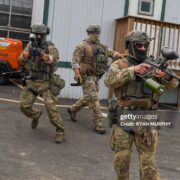
So why are Americans seeing masked federal agents carrying AR-15-style rifles, conducting heavily armed operations in residential neighborhoods, and sometimes firing multiple rounds during attempted arrests? What determines when such weapons and tactics are
necessary? What alternatives are considered before an encounter becomes potentially deadly? And who independently examines those decisions afterward?

The Department of Homeland Security’s own use-of-force policy establishes that deadly force must be objectively reasonable and
necessary to protect against an imminent threat of death or serious bodily injury. Fleeing alone does not justify shooting someone. These standards matter because the power to arrest is not the authority to kill.

Another troubling dimension to this debate is the following. According to the National Immigration Project, at least 28 people had reportedly died in ICE custody in 2026 as of October 5. ICE reported 33 detainee deaths in 2025, the highest annual total in more than two decades. These deaths are not all shootings, nor do they share identical circumstances. But they raise another question about the government’s
responsibility for people whose liberty it has taken away.

When someone dies in federal custody, what independent examination determines whether appropriate medical care, supervision, and safeguards were provided? And when an immigration operation ends in gunfire, how quickly does the public receive the evidence necessary to evaluate the official explanation?

We can recognize the government’s authority to enforce immigration law without accepting that every enforcement tactic is necessary or
proportionate. We can recognize the dangers officers sometimes face while insisting that their decisions remain subject to scrutiny. And we can acknowledge that some people targeted for arrest have criminal histories without treating those histories as justification for whatever force is subsequently used against them.

America is not a battlefield. Its streets are not combat zones. Immigration officers do not encounter enemy combatants. They are
individuals with legal rights, regardless of nationality or immigration status. Renée Good was an American citizen. So was Alex
Pretti. Oscar Belgal is a Dominican immigrant who survived being shot while his young son sat nearby.

Different people. Different circumstances. But the same fundamental question: If U.S. ICE is enforcing immigration laws rather than fighting a war, why are some of its operations ending in gunfire – and what is being done to ensure that an arrest does not become a death sentence?

Felicia J. Persaud is the founder and publisher of  NewsAmericasNow.com, the only daily syndicated newswire and digital platform dedicated exclusively to Caribbean Diaspora and Black immigrant news across the Americas.

RELATED: When Deportation Hits Home: The Economic Ripple Effect On Black Caribbean Immigrant Families

Trinidad Son Remanded After Being Charged With Murders Of Mother And Teenage Sister

By News Americas Now Staff Writer

News Americas Now, PORT OF SPAIN, Trinidad, Wed. October 28, 2026: A 20-year-old Trinidad man accused of murdering his mother and teenage sister has been remanded to prison following his first court appearance.

Nicholas Ramlal appeared before High Court Master Valene Guerra Abraham on Tuesday after being charged with the murders of his mother, Rosanna Ramlal, 49, and his 17-year-old sister, Alina Ramlal. He was not called upon to plead because the charges were laid indictably, and he was remanded in custody until February 22.

The charges relate to the October 16 deaths of Rosanna and Alina at the family’s Seventh Avenue home in Malick, Barataria. Police and firefighters responding to reports of a fire at the residence at about 2:40 p.m. discovered the bodies of the mother and daughter inside. Post-mortem examinations conducted at the Forensic Sciences Centre later revealed that both victims had been shot in the head before the fire was started.

Rosanna worked as a doubles vendor, while Alina was a student. Their husband and father, Wesley “Fats” Ramlal, owner of Fats Doubles on Maraval Road in Port of Spain, was reportedly away on a hunting trip when the killings occurred.

Initial reports suggested that Nicholas Ramlal told investigators he had been at home playing video games when he heard noises coming from one of the bedrooms. According to those early reports, he claimed that when he went to investigate, he saw four masked men assaulting the women and demanding money before shooting them. He reportedly escaped with minor scratches.

The investigation, however, subsequently turned toward Ramlal. Following consultation with the Office of the Director of Public Prosecutions, homicide investigators were given approval to charge him with both murders.

The charges were laid by W/Cpl Timothy of the Homicide Bureau of Investigations. Ramlal was formally charged on Monday before making his first court appearance yesterday.

The case has drawn attention in Trinidad and Tobago because of the violent deaths of a mother and daughter inside their family home and the subsequent arrest of the woman’s own son. Ramlal remains accused of the crimes and is presumed innocent unless and until proven guilty in a court of law.

RELATED: The Face Of A Murderer – Guyana Father Remanded For Murder Of 6-Year-Old Son

Blakk Rasta Added to Gramps Morgan’s Ghana Jamaica Homecoming Festival

The man who wrote a reggae song called “Barack Obama” is heading to Legon. Gramps Morgan has confirmed that Blakk Rasta will perform live at the Ghana Jamaica Homecoming Festival, set for December 5 at Legon Sports Stadium.[#item_full_content]  

Producer Withdraws ‘Janice STFU’ Copyright Lawsuit Against Drake After 10 Days

Ten days. That’s how long Aviel Hirschfield’s copyright lawsuit against Drake lasted before the producer quietly pulled the plug.[#item_full_content]  

50 Cent Sues Rick Ross’ Ex Tia Kemp for $6 Million Over Posts About His Son Sire

The number on 50 Cent’s newest lawsuit might look familiar to anyone tracking his beef with Rick Ross.[#item_full_content]  

Lil Durk Offers Future Music Income in New Bid for Release from Jail

Lil Durk is willing to bet his catalog on staying put. In a new filing, the Chicago rapper’s lawyers offered up his future royalties, publishing income and touring money as bond security, and the mother of the man killed in the case says she won’t stand in the way.[#item_full_content]  

Jay-Z Officially Named Super Bowl LXI Halftime Show Headliner

For six years, Jay-Z has been the man helping decide who gets the Super Bowl halftime stage.[#item_full_content]  

Yaadcore Releases ‘Rasta Time’ EP Featuring Capleton and Imeru Tafari

Nyabinghi drums and digital trap beats are not a pairing you hear every day, but that collision sits at the heart of “Choppa Dem,” the opening salvo on Yaadcore’s new EP Rasta Time.[#item_full_content]