News Americas Now, BUXTON, Guyana, Sun. Nov. 15, 2026: Eusi Kwayana came home on Saturday, Nov. 14, 2026. Born Sydney King, the revolutionary, educator, Pan-Africanist, writer and political activist who outlived nearly every major figure of Guyana’s pre-independence political generation, was laid to rest Nov. 14 in Buxton, the East Coast Demerara village that shaped him – and which he, in turn, helped shape.
Kwayana died Oct. 10, 2026, in Atlanta, Georgia, at the age of 101. But at his funeral, there was little sense that the ideas of the man known affectionately as Baba Eusi were being buried with him. Speaker after speaker returned to the same themes that had defined his century of life: service, education, courage, human dignity, intellectual independence, racial solidarity and the power of ordinary people to transform their society.
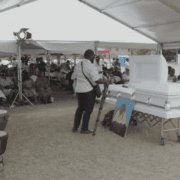
Brother Eusi Kwayana buried in Buxton, Guyana following a viewing on Nov. 14, 2026.
David Hinds, MP of the Working People’s Alliance, the party Kwayana co-founded with Dr. Walter Rodney, Rupert Roopnarine and others, described him as “one who came to set the captives free.”
“Now he lies motionless here,” Hinds said, “but be satisfied that your legacy is in motion.” He called Kwayana “our gift to the world and God’s gift to us,” saying the lifelong activist had effectively taken “an oath of poverty so the rest of us could be rich — educationally and economically.”
Kwayana, Hinds recalled, taught generations never to surrender. “He was like a river, always flowing,” he said, “overflowing its banks to set us free.” That imagery was fitting for a man whose political life stretched from British Guiana through independence and into the modern Guyanese state.
Kwayana joined the Political Affairs Committee in 1946, before the formation of the People’s Progressive Party. He was detained after Britain suspended British Guiana’s constitution in 1953, later became associated with the People’s National Congress, helped build African cultural and political organizations including ASCRIA, and became a founding figure in the Working People’s Alliance.
Yet those who gathered in Buxton remembered a man whose loyalties ultimately transcended party. He was remembered instead for insisting on principle, human emancipation and what he called the self-emancipation of ordinary people. One tribute captured that philosophy through one of the defining questions of the modern age: artificial intelligence.
Kwayana, the speaker recalled, was not afraid of artificial intelligence because he believed human intelligence remained superior. Technology and machines, the tribute continued, “must be in the service of human beings.” Only then, the speaker said, could humanity “make the leap that is necessary to make a new society.”
It was an extraordinary observation at the funeral of a man born in 1925 – one that revealed just how forward-looking Kwayana remained even in his final years. His thinking, however, was never divorced from the earth beneath his feet.
He urged people to “listen to the land and the water.” For Kwayana, progress was not simply technological or economic. It was human. It rested on memory, community, culture, nature, dignity and the willingness of people to understand the world around them.
THE PHILOSOPHY
That philosophy was forged in Buxton. Kwayana, then Sydney King, moved there with his mother at age seven. The village – built through the collective efforts of formerly enslaved Africans – became what his official obituary described as his spiritual, intellectual, and political home. Its traditions of self-reliance, cooperative labor, education and community governance profoundly shaped his understanding of freedom and responsibility.
Education became one of his most enduring acts of service. Though he never attended secondary school or university, Kwayana became a formidable self-taught intellectual. In 1954, he established County High School in Buxton, opening secondary education to young people who otherwise had limited access.
Many former students remembered him Saturday not first as politician, but as teacher. The funeral itself reflected the breadth of the man.
Emceed by Karen DeSouza of Red Thread, and community residents. Wazir Mohamed a former executive member of the WPA who worked for decades with Kwayana, challenged mourners to consider what Kwayana would be doing if he were alive amid the disputes and injustices confronting Guyanese today.
Former WPA Executive Member Wazir Mohammed speaks at the funeral of Brother Eusi Kwayana on Nov. 14, 2026.
“He would be on their case,” Mohamed said. Pointing to the rights of the Barima family, Mohamed argued that Kwayana’s legacy was not something Guyana could safely place in the past.
He called Kwayana one of the most consequential leaders the country had produced and told young Guyanese that his life had left them a template – for recovering humanity, dignity and the meaning of people’s power. “No dictator,” he reminded them. People’s power, he said, is about dignity and respect.
That insistence on the agency of ordinary people ran through Kwayana’s life. He believed political freedom could never be delivered solely by governments or leaders. People themselves had to develop the knowledge, confidence and collective capacity to change their circumstances.
His son offered another measure of a meaningful life: “You are not successful until your successors are successful.” His daughter, too, turned Kwayana’s legacy toward the generations that follow. “We all have a genius in us,” she told mourners, urging them to have the courage to identify that genius and the integrity to use it.
A granddaughter of Brother Eusi Kwayana reflects at his funeral on Nov. 14, 2026 in Buxton, Guyana.
It was perhaps the most appropriate farewell to a man whose life resisted easy categorization. Kwayana was politician and dissident. Teacher and student. Pan-Africanist and advocate of multiracial solidarity. Writer and community organizer. Cultural nationalist and internationalist. A man deeply rooted in Buxton who nevertheless saw humanity far beyond the boundaries of village, race, party or nation.
His official obituary describes a thinker who believed that liberation was not simply freedom from oppressive systems, but the transformation of human relationships and the cultivation of intellectual and spiritual independence. That may ultimately be the most important inheritance Eusi Kwayana leaves Guyana.
The casket of Brother Eusi Kwayana was loaded onto a horse cart in Buxton, Guyana on Nov. 14, 2026 for the procession to his burial.
Procession to the burial of Guyana icon Eusi Kwayana on Nov. 14, 2026
Burial of Eusi Kwayana in Buxton Guyana on Nov. 14, 2026.
Not a political party; not a title; not even the extraordinarily long bibliography of writings accumulated over a century. But a way of living.
Stand up.
Think for yourself.
Teach somebody else.
Serve without demanding reward.
Respect your own humanity and the humanity of others.
Listen to the land.
Listen to the water.
And never surrender the power of human beings to build a more just society.
As Hinds told the gathering in Buxton: “We bury him, but not the memory.” Eusi Kwayana has returned to the soil of the village he loved. But the river is still flowing.
A legacy website, EusiKwayanaLegacy.com, was launched in October as part of a wider program of remembrance spanning Atlanta and Guyana.