By NAN Staff Writer
News Americas, NY, NY, Thurs. Sept. 23, 2026: When West Manchester Township police pulled over Haitian born Pastor Molis Augustave on September 5th for a broken headlight, the traffic stop wasn’t just bad luck – it was the direct result of a local policy decision made just weeks earlier, one residents had specifically warned would produce exactly this outcome.
In July, West Manchester Township’s council voted 2-1 to enter a 287(g) agreement with US Immigration and Customs Enforcement, allowing local police to act as an extension of federal immigration enforcement. Roughly 50 residents showed up to oppose it. One commenter asked directly how officers would determine “who is a legal citizen and who is an illegal citizen” during routine encounters – a question that, two months later, played out with Augustave’s headlight stop.
Police Lieutenant John Hanuska defended the agreement at the time, telling residents the township could enforce the law “impartially” while still showing compassion for individuals’ circumstances, and pointed to the death of a Pennsylvania state trooper killed by an undocumented driver as justification. Council members reserved the right to revisit or terminate the agreement – but as of this week, it remains in place, and it is the agreement that handed Augustave to ICE.
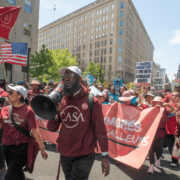
Augustave, a York pastor, husband, and father of two children, and former organizer with We Are CASA, has lived in the US for roughly a decade, most recently under Temporary Protected Status until Haiti’s TPS designation was terminated. He is married to a US citizen, his two children were born in the US, and he had a pending green card application – denied this week, according to his legal team, with no reason given.
DEPORTATION
He was scheduled for a deportation flight to Haiti on September 17th and was pulled off the plane at the last minute after a nationwide advocacy campaign led by his wife, Omara. Eighty-nine others on that same flight were not so fortunate. Augustave remains in ICE custody in Louisiana, roughly 1,000 miles from his family, and faces the next scheduled deportation flight to Haiti today, September 23rd.
“They were going to unjustly deport me to Haiti. I was already on the plane when, at the last minute, they pulled me off,” Augustave said last week in a statement. “I want to go home to my wife and children in Pennsylvania. While I have been waiting, I have been pastoring inside these walls… My life is not worth more because I am a pastor. My family does not matter more than others because people heard our story.”
His legal team has a Motion to Reopen his removal proceedings pending before the Board of Immigration Appeals and a habeas corpus petition pending before the US District Court for the Western District of Louisiana. Faith leaders in York, including Pastor Liz North of Grandview York Church and Pastor Joel Folkemer of Union Lutheran Church, gathered this week to publicly demand his release, alongside a coalition of national immigrant rights groups including We Are CASA, CHIRLA, the Florida Immigrant Coalition, the New York Immigration Coalition, and the Fair Immigration Reform Movement.
West Manchester Township is one of a growing number of Pennsylvania municipalities that have signed 287(g) agreements with ICE in 2026, a trend that has quietly expanded the reach of federal immigration enforcement into routine local policing across York, Lancaster, and Lebanon counties – largely without the scrutiny that a case like Augustave’s is now bringing to it.
ICE did not respond to a News Americas query on why Augustave’s green card application was denied.