Posts

Is The US Committing Murder In Caribbean Waters? Rights Group Say Yes

News Americas, New York, Fri. Oct. 17, 2025: With over 27 people now dead from unilateral U.S. military strikes in Caribbean waters near Venezuela, human rights organizations are accusing the Trump administration of murder.

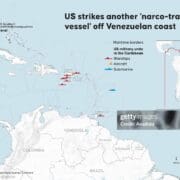
An infographic titled “US strikes another ‘narco-trafficking vessel’ off Venezuelan coast” created in Ankara, Turkiye on October 15, 2025. US President Donald Trump said the US carried out another strike Tuesday on ‘a narco-trafficking vessel’ off the coast of Venezuela. (Photo by Yasin Demirci/Anadolu via Getty Images)

“All available evidence suggests that President Trump’s lethal strikes in the Caribbean constitute murder, pure and simple,” said Jeffrey Stein, staff attorney with the ACLU’s National Security Project. “The public deserves to know how our government is justifying these attacks as lawful, and, given the stakes, immediate public scrutiny of its apparently radical theories is imperative.”

On October 15, the Center for Constitutional Rights and the American Civil Liberties Union filed a Freedom of Information Act, (FOIA) request seeking the Justice Department’s Office of Legal Counsel, (OLC) opinion authorizing these strikes. The groups argue that the U.S. has crossed a dangerous legal and moral line by targeting unarmed civilians under the guise of anti-narcotics operations.

Lethal Strikes Under “Counter-Narcotics” Cover

Since early September, the U.S. has launched repeated airstrikes against private vessels it claims were drug-smuggling boats operating in international Caribbean waters. The strikes – now totaling at least six – are part of a new Joint Task Force, (JTF), initiative under the U.S. Southern Command, (SOUTHCOM), which aims to “synchronize and augment counter-narcotics efforts” across the Western Hemisphere.

The JTF, led by the II Marine Expeditionary Force, integrates military, intelligence, and Homeland Security resources, expanding aerial and maritime surveillance, real-time intelligence sharing, and rapid-response capabilities. The Trump administration claims these measures are essential to dismantling narcotrafficking networks it now labels as “terrorist non-state armed groups.”

However, legal scholars say the administration’s reclassification of narcotics cartels as “terrorists” stretches the limits of both domestic and international law, effectively treating criminal suspects as combatants.

Legal Ambiguity and Public Outrage

During recent Senate hearings, Attorney General Pam Bondi declined to confirm the existence of legal guidance authorizing such strikes. But Charles Young, nominated as U.S. Army general counsel, admitted that the OLC opinion exists, drafted by an interagency working group including White House and executive branch lawyers.

“This is an unprecedented expansion of presidential power,” said Baher Azmy, legal director of the Center for Constitutional Rights. “In a constitutional democracy, no president can arbitrarily choose to assassinate individuals from the sky based on his whim or say-so.”

Amnesty International condemned the attacks as “murder—plain and simple,” noting that the administration has provided “no plausible legal justification” for killing alleged drug smugglers without evidence or due process.

“This was the fifth U.S. strike in the Caribbean since early September, bringing the body count to 27,” said Daphne Eviatar, Amnesty International USA’s Director for Security and Human Rights. “These airstrikes outrageously flout international law and set a dangerous precedent for other leaders around the world.”

Military Fallout and Regional Alarm

Meanwhile, tensions are rising within the U.S. military itself. Defense Secretary Pete Hegseth announced that Admiral Alvin Holsey, who leads SOUTHCOM operations in Latin America, will step down two years early. Sources told Reuters that disagreements over the legality and escalation of Caribbean operations contributed to his decision.

Holsey’s resignation comes as the U.S. continues a military buildup near Venezuela, deploying guided missile destroyers, F-35 fighter jets, and a nuclear submarine. The administration insists these moves are necessary to counter “narcoterrorist threats,” though critics say they risk igniting a regional conflict.

Adding to concerns, Trump confirmed he has authorized CIA covert operations inside Venezuela, heightening fears of regime-change efforts against President Nicolás Maduro.

Collateral Damage and Human Cost

Boats are pictured on the shore of La Cueva Bay, north coast of Trinidad and Tobago, on October 16, 2025. Police in Trinidad and Tobago told AFP on October 16, 2025, they are investigating whether two citizens were among six people killed in a US strike on a boat allegedly transporting drugs from Venezuela after reports by residents of Las Cuevas village. (Photo by AFP) (Photo by STRINGER/AFP via Getty Images)

Among those killed in the fifth strike were two men from Trinidad and Tobago – Chad “Charpo” Joseph and Rishi Samaroo – whose families insist they were not involved in drug trafficking. “If you see a boat, you are supposed to stop and intercept it, not blow it up,” said Joseph’s aunt, Lynette Burnley, calling the attack “wickedness.”

To date, at least 28 people have been killed in the ongoing U.S. operation, which rights groups warn amounts to extrajudicial execution.

As the ACLU and CCR press for transparency, the question remains: can the U.S. justify these killings under international law – or is it rewriting the rules of engagement in its own image?

Ramotsamai Itumeleng Khunyeli contributed to this story.

Fifth US Strikes Near Venezuela Brings Death Toll To 27

By NAN Caribbean Desk

News Americas, Miami, FL, Tues. Oct. 15, 2025: The US strikes near Venezuela is turning deadlier by the week. Donald Trump today confirmed a fifth strike killing six more “just off the coast,” bringing the regional death toll to 27.

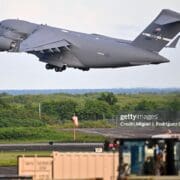
A Boeing C-17 Globemaster departs from José Aponte de la Torre Airport, formerly Roosevelt Roads Naval Station, on September 12, 2025, in Ceiba, Puerto Rico. The Trump administration recently carried out a drone strike in the southern Caribbean against a boat that had left Venezuela and was suspected of transporting drugs. Eleven people died in the attack. The president claimed that the vessel was operated by the Venezuelan gang Tren de Aragua. (Photo by Miguel J. Rodríguez Carrillo/Getty Images)

President Donald Trump announced the latest strike on social media Tuesday, claiming the vessel targeted was “affiliated with a Designated Terrorist Organization conducting narcotrafficking.” The administration has provided no evidence to substantiate the link, nor identified the nationality of the victims.

Legal and human rights experts have condemned the operations as extrajudicial killings, arguing that suspected drug smugglers are civilians – not enemy combatants – and that the military cannot lawfully target them outside of an active armed conflict. Congress has not authorized the use of force against criminal cartels or drug traffickers.

New Joint Task Force Announced

The escalation came just four days after the U.S. Southern Command (SOUTHCOM) announced the formation of a new Joint Task Force (JTF) under the II Marine Expeditionary Force (II MEF) to “synchronize and augment counter-narcotics efforts” across the Western Hemisphere.

According to SOUTHCOM, the task force will:

Integrate the capabilities of II MEF with Homeland Security and other U.S. agencies;

Expand aerial surveillance and maritime patrols;

Enhance intelligence fusion and rapid-response capacity;

Conduct joint training with regional forces and advise partner nations on counter-narcotics operations.

Adm. Alvin Holsey, SOUTHCOM Commander, who was said to be visiting Grenada today, said the goal is to “detect, disrupt, and dismantle illicit trafficking networks faster and at greater depth.”

Lt. Gen. Calvert Worth, head of II MEF and now JTF Commander, added that his team “will leverage maritime patrols, aerial surveillance, precision interdictions, and intelligence sharing to counter illicit traffic and uphold the rule of law.”

Regional Unease

Holsey’s visit this week to Grenada – his first since assuming the Command – has already sparked public concern in Grenada, where reports surfaced that Washington has requested permission to install US radar equipment and technical personnel at the Maurice Bishop International Airport.

The Grenadian government confirmed it is “carefully assessing” the U.S. request, citing the need to protect national sovereignty, tourism safety, and public interest. “The Ministries of National Security, Legal Affairs and Foreign Affairs are carefully assessing the request and reviewing the request in technical consultations, in coordination with the Grenada airports Authority and other relevant agencies,” the Dickon Mitchell government said, adding that it is carefully reviewing the request in accordance with established national procedures.

“Any decisions will be made only after all technical and legal assessments are completed. We wish to assure our citizens that any decision taken will be guided by Grenada’s sovereignty, public safety, and national interest, including the protection of our tourism industry, the traveling public, and the country’s economic well-being,” the government said, adding it  continue to keep the public informed as developments unfold.

However, former Senate President Chester Humphrey and ex-Foreign Minister Peter David have warned that the move could be a precursor to U.S. military action against Venezuela.

David said while Grenada values its long-standing ties with both Washington and Caracas, “unilateral action… perceived as hostile will be both counterproductive and destabilizing.”

Antigua and Barbuda Prime Minister Gaston Browne, says his country has absolutely no interest in hosting any form of military assets, and that the situation regarding Grenada is “really a sovereign issue” for  the government of that island.

“If they decide to accommodate the United States, there is nothing we can do. We would have to respect the decision,”  Browne told reporters on a conference call from St. John’s.

Regional Implications

Analysts say the combination of lethal strikes and expanded U.S. presence marks a dramatic militarization of Caribbean waters, raising new questions about sovereignty, legality, and the region’s role in America’s “war on drugs.”

Critics argue that the Caribbean — long a zone of peace and cooperation on maritime security — is being transformed into a forward operating theater for U.S. military operations, with little transparency or regional consultation. Critics, including congressional Democrats, legal scholars, and human rights groups, have stressed that even if any of the boats recently bombed by the Trump administration were trafficking drugs, the strikes still violate international and federal law. Such criticism has not deterred the administration. Amnesty International USA declared: “This is murder. The US government must be held accountable.”

Is ExxonMobil Operating At A $6 Billion Or $3.4 Billion “Loss” In Guyana?

Analysis By NAN Business Editor

News Americas, Georgetown, Guyana, Tues. Oct. 14, 2025: ExxonMobil’s Guyana President, Alistair Routledge on Monday claimed the company is “still operating in the red to the tune of around US$6 billion” in Guyana, as he retorted over to a question by three U.S. senators on the company’s tax breaks. So which number is closer to reality: $6 billion or $3.4 billion in losses?

The ExxonMobil Guyana offices at 86 Duke Street in Georgetown, Guyana. Photographer: Jose A. Alvarado Jr./Bloomberg via Getty Images

What Routledge Said

Speaking at Exxon’s Ogle, East Coast Demerara headquarters, Routledge told reporters that the NGO Oil and Gas Governance Network, (OGGN) may have misled U.S. senators about the company’s tax filings. He said that ExxonMobil Guyana is still operating with a negative cash flow of around six billion US dollars.

“We continue to be actually cash flow negative on an accumulative basis… we are probably still around six billion US dollars in negative cash flow as we look at the cumulative expenditures and cumulative revenues that we’ve seen from the Stabroek Block,” he told reporters.

Routledge asserted that in ExxonMobil Corporation’s 2023 and 2024 tax filings, there were no Guyanese tax credits included in either of those filings, “and you would recall that prior to 2023, we were not making profits here in Guyana, so there were no tax credits from that. Up until this point, there have been no Guyana tax credits used by ExxonMobil.”

The Alternative Figure: $3.4 Billion

But Exxon’s own Guyana website identifies a different figure: US$3.4 billion in red ink — even while acknowledging an accounting profit in 2024. According to Exxon’s 2024 financials:

Gross production rose sharply with the Prosperity FPSO, boosting revenue for all partners

Despite posting an accounting profit, the company said it remains “in the red” by US$3.4 billion

Exxon and its co-venturers have invested a cumulative US$55 billion in Guyana to date. This divergence begs the question: how can a company be both profitable on paper and yet claim to be billions in losses?

The Contractual Context

Under the 2016 Production Sharing Agreement (PSA), Exxon’s Guyana deal allows it to recover up to 75% of its share of oil revenue for cost recovery before profit payments begin. In practice, this means a large portion of early revenue goes to recovering the developer’s costs- capital, exploration, infrastructure – leaving little net profit early on.

Furthermore, financials for 2024 show:

Operating expenditures of GYD 477.6 billion

Depreciation/amortization at GYD 301.8 billion

Exploration, production, royalties also eat into margins

These mechanics help explain how Exxon could legitimately claim negative cash flow despite strong revenues.

Why It Matters for Guyana

The optics of a $6B loss vs $3.4B matters deeply for public trust, fiscal policy, and future licensing. Guyana has collected over US$6.2 billion in oil profits and royalties since 2020 – so when Exxon claims it’s in the red, critics say the narrative raises concerns about transparency and fairness. If Exxon can delay or reduce profit sharing through cost recovery claims, that changes the magnitude and timing of what Guyana as a partner actually realizes.

Bottom Line

Both $6 billion and $3.4 billion claims could contain grains of truth, depending on accounting methods, timing, amortization and recovery policies.

Routledge emphasized cash flow negativity and absence of Guyanese tax credits in filings.

Exxon’s public data insists on a lower loss figure despite profits.

The discrepancy boils down to methodology, timing, and cost recovery mechanics.

So, while the $6B figure commands headlines, the $3.4B estimate rooted in Exxon’s own reporting asks where did the almost three additional billion come from?. It’s really a question of how loss and profit are really defined.

These Are The Best Caribbean Resorts, Hotels & Villas Of 2025

News Americas, NEW YORK, NY, Thurs. Oct. 9, 2025: The Caribbean once again proved its dominance as a world-class travel destination at the 32nd Annual World Travel Awards (WTA), held recently at Sandals Grande Saint Lucian. From luxurious beachfront Caribbean resorts to intimate boutique hideaways and eco-conscious retreats, the 2025 winners showcase the best in regional hospitality, design, and service excellence.

Hosted on the island of Saint Lucia, the glittering red-carpet gala celebrated the finest in Caribbean tourism – recognizing the resorts, hotels, and villas that continue to redefine paradise for travelers across the globe.

Sandals Dominates the Region

FLASHBACK – Just before stepping into the spotlight for his Broadway run in Moulin Rouge, acclaimed actor and Broadway star Taye Diggs took time to unwind at Sandals Royal Curacao on June 17, 2025 in Willemstad, Curacao. (Photo by John Parra/Getty Images for Sandals Resorts)

Jamaica emerged as one of the biggest winners of the evening, cementing its position as the region’s tourism powerhouse. Sandals Resorts International once again reigned supreme, earning the title of Caribbean’s Leading Hotel Brand 2025, while several of its properties took home major awards:

Sandals Montego BayCaribbean’s Leading All-Inclusive Resort 2025

Sandals Dunn’s RiverCaribbean’s Leading Luxury All-Inclusive Resort 2025

Sandals South CoastCaribbean’s Most Romantic Resort 2025

Sandals Grande St. LucianCaribbean’s Leading Honeymoon Resort 2025

Sandals Royal CuraçaoCaribbean’s Leading Dive Resort 2025

Jamaica also dominated in the luxury and villa categories, with GoldenEye Villa crowned Caribbean’s Leading Luxury Hotel Villa, and Round Hill Hotel and Villas winning Caribbean’s Leading Villa Resort 2025.

Adding to its accolades, Princess Grand Jamaica took home the award for Caribbean’s Leading New Resort, while Princess Senses The Mangrove was named Caribbean’s Leading Water Villa Resort 2025.

Saint Lucia Shines Bright

The host island of Saint Lucia dazzled on its home turf, taking top honors in multiple categories that highlight its enduring romantic and natural appeal.

Serenity at Coconut Bay was named Caribbean’s Leading Adult-Only All-Inclusive Resort 2025, while the island itself was honored as both Caribbean’s Leading Honeymoon Destination and Caribbean’s Leading Adventure Tourism Destination.

Among Saint Lucia’s elite resorts, Jade Mountain Resort stood out as Caribbean’s Leading Luxury Honeymoon Resort, and The Landings Resort and Spa captured Caribbean’s Leading Luxury All-Suite Resort 2025.

Meanwhile, Caille Blanc Villa & Hotel received the distinction of Caribbean’s Leading Boutique Hotel 2025, and Grande Beachfront Villa Suite at The Landings Resort & Spa was celebrated as Caribbean’s Leading Hotel Suite 2025.

Turks & Caicos Tops Family and Beach Categories

The Turks & Caicos Islands maintained their reputation for pristine beaches and family-friendly luxury. Beaches Turks & Caicos was named Caribbean’s Leading All-Inclusive Family Resort 2025, while The Palms Turks & Caicos earned the title of Caribbean’s Leading All-Suite Hotel.

The islands themselves claimed two of the night’s most coveted honors: Caribbean’s Leading Beach Destination and Caribbean’s Most Romantic Destination 2025.

Luxury Leaders Across the Region

Elsewhere in the Caribbean, excellence shone brightly across islands large and small:

Amanera, Dominican RepublicCaribbean’s Leading Beach Resort 2025

Aurora Anguilla Resort & Golf ClubCaribbean’s Leading Resort 2025

Curtain Bluff Resort, Antigua & BarbudaCaribbean’s Leading Green Resort 2025

Four Seasons Resort NevisCaribbean’s Leading Luxury Island Resort 2025

Malatai Villa, JamaicaCaribbean’s Leading Luxury Private Villa 2025

Sugar Beach, A Viceroy Resort, St. LuciaCaribbean’s Leading Luxury Resort 2025

Ambergris Cay, Turks & CaicosCaribbean’s Leading Private Island Resort 2025

Jungle Bay, DominicaCaribbean’s Leading Retreat 2025

Hotel Indigo Grand CaymanCaribbean’s Leading New Hotel 2025

A Celebration of Caribbean Excellence

From eco-luxury resorts in Antigua to family getaways in Turks & Caicos and honeymoon sanctuaries in Saint Lucia, the 2025 World Travel Awards once again underscored the Caribbean’s unmatched diversity and depth of hospitality.

As WTA Founder Graham Cooke noted, this year’s winners “represent the gold standard of global travel — destinations and brands that continue to raise the bar for quality, sustainability, and authentic Caribbean experience.”

With new developments and record arrivals across the region, the Caribbean’s tourism industry continues to thrive — reminding the world that when it comes to paradise, there’s nowhere quite like the islands of the Caribbean.

Indicted Before Swearing-In: Azruddin Mohamed’s Legal Trouble Casts Shadow Over Guyana’s Opposition Leadership

By News Americas Staff Writer

News Americas, FORT LAUDERDALE, FL, Mon. Oct. 6, 2025: Guyana’s fast-changing political landscape took another stunning turn Monday as Azruddin Mohamed, the businessman whose family empire dominates the nation’s gold trade and who is set to become the country’s opposition leader, was indicted by a U.S. federal grand jury in Florida today.

Azruddin Mohamed, the US sanctioned and now indicted businessman and founder of the WIN party.

The indictment, filed in the Southern District of Florida and unsealed today, October 6, charges Azruddin Mohamed and his father, Nazar “Shell” Mohamed, with multiple counts of wire fraud, mail fraud, money-laundering conspiracy, and asset-forfeiture violations. It marks the latest escalation in a widening transnational probe into the operations of Mohamed’s Enterprise, long one of Guyana’s largest gold exporters.

Azruddin’s indictment lands at a moment of political triumph: his We Invest in Nationhood (WIN) party finished second in Guyana’s September 1 general election, earning him the constitutionally recognized post of Opposition Leader. His pending swearing-in now thrusts Guyana into an unprecedented situation – one in which a man facing serious U.S. criminal charges could soon occupy one of the highest offices in the country’s democratic system.

A Collision of Law and Leadership

The federal charges allege that the Mohameds engaged in complex schemes to defraud both U.S. and Guyanese authorities through falsified export documentation and under-reported taxes. Prosecutors cite violations of U.S. laws governing fraud and money-laundering conspiracies.

According to the 11-count indictment, Mohamed’s Enterprise allegedly reused sealed shipping boxes and invoices to create the false impression that duties and royalties on exported gold had been paid when, in fact, they had not. The complaint also references the company’s alleged role in undervaluing luxury vehicle imports, including a 2020 Lamborghini Roadster SVJ declared at US $75,300 instead of its estimated US $695,000, depriving the Guyana Revenue Authority, (GRA) of roughly G $383 million in taxes.

If convicted, the defendants face lengthy prison sentences, multimillion-dollar fines, and forfeiture of assets – including a US $5.3 million gold shipment seized in Miami in 2024.

Political Shockwaves

The news has sent tremors through Georgetown’s political establishment. Supporters of the WIN party frame the indictment as a foreign intervention timed to derail a populist movement, while critics argue it underscores long-standing concerns about corruption and the blending of business and politics in Guyana’s resource-rich economy.

With Guyana being now one of the world’s fastest-growing oil producers, the optics are fraught. The United States remains a key partner in security and energy investment – yet its justice system is now directly targeting the man expected to lead Guyana’s parliamentary opposition. Diplomats and analysts warn this could complicate bilateral relations, limit Mohamed’s travel, and cast a shadow over the country’s efforts to project transparency to investors.

Legal Battles at Home

Azruddin Mohamed’s legal troubles are not confined to the United States. In Georgetown, he and family members face Customs Act charges tied to undervalued imports of several luxury cars. The GRA estimates total unpaid duties at more than G $1.2 billion. Although the family won a temporary injunction preventing seizure of the vehicles earlier this year, the judicial review hearing continues before Justice Gino Persaud, with a ruling expected October 31st.

The Road Ahead

Despite the indictment, Mohamed’s swearing-in is expected to proceed as the Guyanese constitution presumes innocence until conviction. Still, the juxtaposition is stark: a newly elected opposition leader confronting both a domestic tax probe and a sweeping U.S. criminal case.

For many Guyanese, the episode encapsulates the nation’s broader crossroads – a young petro-state flush with promise yet haunted by questions of governance, transparency, and accountability.

Prime Minister Rosie Douglas Remembered: 25 Years After His Passing, His Vision Endures

By Dr. Isaac Newton

News Americas, NEW YORK, NY, Mon. Oct. 6, 2025: There are men who walk softly upon the earth, and there are men who stride as though the earth itself pauses to listen. The late Prime Minister of Dominica, Rosie Douglas, was unmistakably the latter. He spoke with the fire of prophets and the tenderness of poets. He believed that even the smallest island could send ripples across oceans and that a people once bound by colonization could rise to become the architects of their own destiny.

The late Prime Minister of Dominica, Rosie Douglas died on Oct. 1, 2000.

Born to privilege but baptized in struggle, Rosie Douglas lived at the intersection of comfort and conviction. Educated in Canada, he was imprisoned for his fearless stand against racism and injustice, only to be later vindicated by the same academic institution, Concordia University (formerly Sir George Williams University), for his role in the 1969 student revolt. History has indeed absolved him. In 2022, Concordia University issued a formal apology, acknowledging that it should have taken more seriously the allegations of racism made by Caribbean students against one of its professors.

When Rosie Douglas ascended to the office of Prime Minister in January 2000, he governed like a man set aflame by possibility. In a mere eight months, he reached across oceans and ideologies with bold imagination. He signed a three-hundred-million-dollar agreement with China to construct an international airport, engaged Europe’s social democrats, and rallied the Dominican diaspora and African Americans to invest in his homeland. For him, politics was not limited to performance but focused on purpose. Leadership, he believed, was guided more by the spirit of service than by the lure of power.

Today, as Dominica and the wider Caribbean once again stand at a crossroads, confronting climate anxiety, economic fragility, and a generation wrestling with displacement, Rosie’s voice still drifts upon the trade winds: Rise, my people. Rise higher than your fears. He reminds us that independence without imagination is hollow, leadership without love is barren, and progress without unity is fragile.

From his brief yet blazing journey, three timeless lessons continue to shine.

Dream large but work wisely. Build bridges wider than borders. Serve with love, not ego.

To dream large but work wisely is to transform climate anxiety into creativity, to harness the winds and waves of our islands as engines of renewal. To build bridges wider than borders is to see Caribbean youth using art, science, and digital innovation not to compete but to collaborate. And to serve with love, not ego, is to call our leaders to exchange vanity for vision, to root out corruption, and to elevate service as the highest form of citizenship.

Prime Minister Rosie Douglas’s body rests in the soil of Hampstead, Dominica, but his spirit still sings through the Caribbean wind. He stands as proof that one life, lived fiercely and faithfully, can light a thousand lamps. For every young Dominican who questions their significance in a vast and indifferent world, remember this: Rosie Douglas already proved that small nations can dream beyond their size and stand tall among giants. His dream of a prosperous Dominica did not die with him. It stirs anew, especially in the hearts of our youth.

A week before his passing, Prime Minister Douglas stood at Georgetown University and offered a vision that continues to stir the Caribbean soul:

“The region must plan its future through continuous dialogue, market-driven integration, and new alliances with the developed world.”

He reminded us that the Caribbean must think strategically, craft long-term solutions, and refuse to drift upon the tides of chance. Nations rise when vision outlives the visionary. His call remains clear and commanding: Think strategically. Act boldly. Build bridges wider than the waters that divide us.

The Caribbean was never meant merely to drift. It was destined to define, to imagine, and to reshape the world in the rhythm of its own soul.

EDITOR’S NOTE: Dr. Isaac Newton is the co-author of Steps to Good Governance. A graduate of Harvard, Princeton, and Columbia, he is a global leadership, change management, and policy adviser to distinguished leaders around the world.

A fugitive’s freedom: Assata Shakur’s exile in Cuba

By Manolo De Los Santos

News Americas, NEW YORK, NY, Fri. Oct. 3, 2025: The news of Assata Shakur’s death in Havana, Cuba, on September 26, was met with a deep sense of shared loss among revolutionaries and activists worldwide. Shortly after, at a gathering in New York, Cuban Foreign Minister Bruno Rodriguez Parrilla, spoke simply, “We fulfilled our duty.” This humble statement encapsulated four decades of unwavering commitment by the Cuban state to protect one of the United States’ most hunted revolutionaries and let her live her life as a free woman. Cuba’s steadfast stance, despite immense pressure and threats, highlights a fundamental truth: a nation’s principles are revealed not just by its words, but by the people it chooses to protect.

The late JoAnn Chesimard, aka Assata Shakur, holding the manuscript of her autobiography with Old Havana, Cuba, in the background on October 7, 1987. (Photo by Ozier Muhammad/Newsday RM via Getty Images)

A life of struggle and political awakening

Born JoAnne Chesimard on July 16, 1947, in New York City, Assata’s life reflected the turbulent reality of being a Black woman in the United States. She came of age during the peak of the Civil Rights, Black Power, and Anti-War movements, a period that profoundly shaped her political consciousness and that of countless young people across the country. She initially attended the Borough of Manhattan Community College and then transferred to the City College of New York, where she became a powerful voice for student activism and a key organizer. Her journey led her to join the Black Panther Party (BPP) in Harlem, an organization that, within a short period, would leave an indelible mark on the struggle for Black liberation. While the mainstream media often portrayed the BPP as a violent gang, Assata and others knew it as a vital organization grounded in the community that ran free breakfast programs for children, offered health clinics, championed self-defense against police brutality, and mobilized the Black community into political struggle.

Assata and many others in the New York branch of the BPP would later join the Black Liberation Army (BLA). This clandestine organization emerged from a militant wing of the movement. It advocated for armed struggle against the oppressive US government, seeing it as a legitimate way to confront the infrastructures of white supremacy and racism at the core of American society and achieve freedom for Black people. This shift was also a direct response to the brutal repression the Black Panther Party faced from the United States government, which sought to dismantle and destroy Black and Left organizations. Countless leaders of the Black Panther Party, like Fred Hampton, were assassinated, while many others were framed, arrested on false charges, and held as political prisoners for decades.

The United States government’s repression of the Black Liberation Movement was not limited to public arrests and trials. A far more insidious campaign, the FBI’s Counter-Intelligence Program (COINTELPRO), operated in the shadows, unknown to the public and the activists it targeted. From the mid-1950s to the early 1970s, COINTELPRO was a systematic effort to “expose, disrupt, misdirect, discredit, or otherwise neutralize” political organizations deemed a threat to national security, with the Black Panther Party (BPP) and other Black revolutionary groups as primary targets.

The FBI, under the direction of J. Edgar Hoover, viewed these movements as a grave internal threat. The program used a wide range of tactics, from psychological warfare to outright violence. Agents sent anonymous letters to foment distrust and rivalry between Black leaders and organizations, often leading to internal schisms and sometimes violence. The FBI also used informants to infiltrate groups, spread disinformation, and provoke clashes with law enforcement. The goal was to dismantle these movements from within, without ever having to acknowledge the government’s role.

The existence of COINTELPRO remained a closely guarded secret until March 8, 1971, when a group of activists calling themselves the Citizens’ Commission to Investigate the FBI broke into a small FBI field office in Media, Pennsylvania. They stole hundreds of documents and, after carefully reviewing them, released the papers to news agencies. These documents provided irrefutable proof of the FBI’s illegal activities against domestic political groups. The exposure led to public outrage, Senate hearings led by Frank Church, and a greater understanding of the lengths the government would go to suppress dissent.

The unjust trial and daring escape

On May 2, 1973, Assata was stopped on the New Jersey Turnpike with two fellow BLA members. A shootout ensued, resulting in the death of a New Jersey State Trooper and one of her comrades, Zayd Malik Shakur. Assata herself was shot and seriously wounded. What followed was a highly publicized trial that was widely condemned as a political witch-hunt. Assata was charged with murder, despite being shot in the back and having her hands up. The evidence against her was flimsy and circumstantial, with forensic experts testifying that her wounds made it physically impossible for her to have fired a weapon.

Despite the lack of credible evidence, she was convicted in 1977. In a system designed to crush dissent and criminalize Black people, her conviction was a foregone conclusion. “I am a 20th-century escaped slave,” she famously said. “Because the legal system in the United States is vicious, racist, and unjust. And I had no hope for a fair trial.”

After two years in prison, on November 2, 1979, she made her legendary escape with the help of fellow BLA members. This act of liberation was not just for her but was a powerful symbol for the movement.

The Cuban haven and US hypocrisy

After her daring escape, Assata Shakur found her way to Cuba, where she was given political asylum in 1984. For the US government, this was a direct affront. The pressure on Cuba to return her began almost immediately and never ceased. The campaign against her was not just a pursuit of a fugitive; it was an attempt to make an example of a prominent revolutionary and to punish Cuba for its solidarity with her.

The US government repeatedly attempted to criminalize Cuba’s decision to grant her asylum by labeling the country a “state sponsor of terrorism”. The bounty on Assata’s head was a constant reminder of this campaign. In 2005, the reward was set at USD 1 million, a move that coincided with a period of increased hostility and renewed threats from the Bush administration against Cuba. In 2013, the FBI, under the Obama administration, elevated her to its Most Wanted Terrorist list, a classification typically reserved for al-Qaeda and ISIS leaders, and increased the bounty to USD 2 million. This unprecedented move was meant to demonize her and justify any action taken against her, including attempts to capture her “dead or alive”. The use of billboards, particularly in New Jersey, was a public relations campaign designed to rally public opinion against her and against Cuba.

Cuban officials consistently and forcefully defended their decision. Fidel Castro called her a “true political prisoner” who was “a victim of the fierce repression against the Black movement.” In his view, the US attempt to portray her as a terrorist was “an injustice, a brutality, an infamous lie.” In a show of continued defiance, other officials and ordinary people alike in Cuba have echoed this sentiment, viewing her as an honored guest and a sister in struggle. For Cuba, granting asylum to Assata was not just a matter of politics but a matter of principle, a testament to its anti-imperialist and anti-racist convictions.

The terrorists next door: Luis Posada Carriles and Orlando Bosch

The US government’s obsession with Assata Shakur is thrown into stark relief when compared to its treatment of Luis Posada Carriles and Orlando Bosch Ávila, two of the most notorious anti-Cuban terrorists. Both men were Cuban exiles who were openly funded and trained by the CIA to carry out a campaign of violence against the Cuban Revolution.

Their most infamous act was the bombing of Cubana Flight 455 in October 1976. The civilian airliner exploded in mid-air shortly after takeoff from Barbados on its way to Jamaica, killing all 73 people on board, including the entire Cuban national fencing team. Both Posada Carriles and Bosch were arrested in Venezuela for the crime. However, they were eventually released, and both found their way back to the United States.

Posada Carriles, a former CIA asset trained in sabotage, explosives, and guerrilla warfare, was directly implicated in the bombing and other terrorist attacks across Latin America. Despite overwhelming evidence and his own admissions in a 1998 interview with the New York Times, the US government refused to extradite him to Cuba or Venezuela. In 2005, he was arrested in the US for illegal entry but was later released on a technicality.

Similarly, Orlando Bosch, who was arrested and briefly imprisoned in the US for a bazooka attack on a Polish freighter in Miami, was later allowed to return to the US after a concerted lobbying effort from prominent Cuban-American politicians. The US Department of Justice officially described him as a terrorist, yet he was pardoned by President George H.W. Bush.

The contrasting treatment of Assata Shakur and these two terrorists speaks volumes about the US government’s true priorities. While it hunted a Black revolutionary for decades, it provided a safe haven to men who committed acts of mass murder against Cuban civilians. This profound hypocrisy exposes a clear double standard: dissent at home is labeled as terrorism, while violence against a so-called enemy abroad is deemed a justifiable political act. It underscores the political nature of Assata’s persecution and the double standards of the US justice system. It cements her place as a symbol of resistance against a deeply flawed and unjust system. Meanwhile, to this day, Cuba remains on the State Sponsors of Terrorism list.

A beacon for future generations

Assata Shakur’s flight and exile were not just a physical escape from an unjust and violent system; they were a political and ideological act. Her unwavering belief in a socialist future, a world free from the exploitative forces of capitalism, imperialism, and racism, was what made her a profound threat to the US establishment. Her vision sought a fundamental restructuring of society, a vision that directly challenged the very foundation of US power. This is why her presence in socialist Cuba was not by accident but a deeply symbolic act of solidarity. For millions of young people who have discovered her story, whether through her powerful autobiography or a simple poster declaring “Assata is welcome here,” she is more than a historical figure. She is a living testament to the possibility of resistance. She embodied the courage not only to think about change but to fight for a new world entirely. Her words, “I don’t think that there’s any way that you can be a revolutionary without having a socialist vision,” serve as a beacon, affirming that the struggle for Black liberation is inextricably linked to the internationalist fight for a world without blockadessanctionsgenocides, and US imperialism. Her legacy is a powerful reminder that true freedom requires us to dismantle the old and build something new, together.

EDITOR’S NOTE: This article was produced by Globetrotter. Manolo De Los Santos is Executive Director of The People’s Forum and a researcher at Tricontinental: Institute for Social Research. His writing appears regularly in Monthly Review, Peoples Dispatch, CounterPunch, La Jornada, and other progressive media. He coedited, most recently, Viviremos: Venezuela vs. Hybrid War (LeftWord, 2020), Comrade of the Revolution: Selected Speeches of Fidel Castro (LeftWord, 2021), and Our Own Path to Socialism: Selected Speeches of Hugo Chávez (LeftWord, 2023).

Source: Globetrotter and Peoples Dispatch

Caribbean Restaurants Score Big: Stush in the Bush and Buzo Osteria Make North America Best Restaurants

News Americas, NEW YORK, NY, Tues. Sept. 30, 2025:The Caribbean culinary scene has scored a major victory on the international stage, with two restaurants from the region earning coveted spots on the World’s 50 Best Restaurants in North America list for 2025. Jamaica’s Stush in the Bush and Barbados’ Buzo Osteria Italiana now stand shoulder to shoulder with top dining destinations across the U.S., Canada, and Mexico — proving that Caribbean cuisine is as innovative, diverse, and world-class as any in the hemisphere.

Stush in the Bush: Farm-to-Table Brilliance in Jamaica

One of the fine dishes on the menu at Stush In the Bush.

Nestled in the lush hills of St. Ann, Jamaica, Stush in the Bush is more than just a restaurant — it is a love story, a cultural experience, and a bold reimagining of Ital cuisine. Founded by husband-and-wife team Christopher and Lisa Binns, the restaurant embodies a holistic farm-to-table ethos.

Guests begin their journey by walking through an organic farm where much of the produce on their plates is grown. The couple emphasizes sustainability, respect for the land, and celebrating the abundance of Jamaica’s soil. Dishes are not only vegetarian or vegan-friendly but elevated to fine-dining artistry.

Lisa Binns, co-founder and storyteller behind the brand, often reminds visitors that “food is love.” At Stush in the Bush, every meal becomes an act of communion — combining Rastafari Ital traditions with gourmet presentation. The restaurant’s recognition on the 50 Best list signals not just excellence in taste, but also the global rise of sustainable Caribbean gastronomy.

Buzo Osteria Italiana: Italian Flavors with a Caribbean Soul

While Stush in the Bush leans into Jamaica’s roots, Barbados’ Buzo Osteria Italiana offers an unexpected twist — refined Italian dining at the heart of the Caribbean. With chic interiors, a robust wine program, and impeccable service, Buzo is led by the talented Chef Nakita Goddard, a Barbadian trailblazer in a male-dominated global industry.

What makes Buzo stand out is not just its dedication to authentic Italian cuisine — from handmade pastas to wood-fired pizzas — but how it pairs those traditions with Caribbean warmth and flair. Chef Goddard has earned respect for her leadership and her ability to balance tradition with innovation, proving that the Caribbean can excel far beyond its expected culinary lanes.

The restaurant’s recognition highlights the region’s ability to attract global fine-dining enthusiasts while celebrating local leadership in international cuisine.

What This Means for Caribbean Culinary Tourism

The inclusion of Stush in the Bush and Buzo Osteria Italiana on North America’s 50 Best Restaurants list is about more than prestige. It reflects a growing acknowledgment that Caribbean cuisine is diverse, sophisticated, and worthy of global spotlight.

For years, Caribbean food has been stereotyped as casual fare — jerk chicken, patties, roti, or fried fish. While those dishes remain cultural staples, restaurants like these show that the region is equally capable of producing sustainable fine dining and world-class culinary experiences.

This recognition is also a boost for tourism. Food travelers — a fast-growing niche — are more likely to add Jamaica and Barbados to their itineraries when destinations boast award-winning restaurants. It positions the Caribbean not just as a place for sun and sand, but also for unforgettable dining adventures.

A Defining Moment for Caribbean Cuisine

Both restaurants represent different sides of the Caribbean story. Stush in the Bush is rooted in land, culture, and a return to sustainable living. Buzo Osteria Italiana blends global influence with local leadership, proving the Caribbean’s versatility.

Together, their recognition on the North America’s 50 Best Restaurants list is a milestone. It sends a clear message: Caribbean chefs, restaurateurs, and communities are ready to take their place on the world stage.

As the culinary world continues to evolve, the Caribbean’s diversity — from Ital vegan plates in Jamaica to refined Italian dining in Barbados — shows that this region has flavors, stories, and innovations that deserve to be celebrated globally.

US Trafficking In Persons Report Places 2 Countries On Tier 3 List, Several On Tier 2

News Americas, NEW YORK, NY, Tues. Sept. 30, 2025: The U.S. Department of State’s 2025 Trafficking in Persons Report has placed two Caribbean nations in its lowest category – Tier 3 – while ranking others across Tier 2 and the Tier 2 Watch List, underscoring the region’s ongoing struggle to meet global anti-trafficking standards.

FLASHBACK – Detainees accused of involvement in a network of international sexual exploitation, are escorted after a hearing at the Permanent Attention Court of the National District, in Santo Domingo, on August 29, 2022. – Judge Kenya Romero issued 18 months of preventive detention against 11 of the 21 defendants, of Dominican, Colombian and Venezuelan nationalities, belonging to the alleged human trafficking network for sexual exploitation, which was dismantled in Operation Cattleya. Eighty women from Colombia and Venezuela who were lured into the Dominican Republic with false promises of well paid jobs, were rescued in the operation. (Photo by Erika SANTELICES / AFP) (Photo by ERIKA SANTELICES/afp/AFP via Getty Images)

The Dutch Caribbean territory of Sint Maarten joins Cuba on the Tier 3 list this year again this year, signaling governments failed to meet the minimum standards of the US’ Trafficking Victims Protection Act, (TVPA), and are not making significant efforts to do so. According to the report, Tier 3 nations can face restrictions on U.S. foreign assistance and reduced support in accessing international financing.

What Tier 3 Means

Tier 3 is considered the most serious category under the TVPA. Countries in this ranking are judged not only to have widespread trafficking challenges but also to lack the political will or sufficient measures to combat the issue. Sanctions may include withholding of non-humanitarian aid and blocking loans from multilateral institutions like the International Monetary Fund and World Bank, unless waived by the U.S. President for strategic or humanitarian reasons.

For Sint Maarten and Cuba, the listing highlights systemic failures in protecting vulnerable populations and prosecuting traffickers. It also raises concerns about complicity or inaction among government officials in addressing the crisis.

Tier 2 and Tier 2 Watch List in the Caribbean

While only two Caribbean nations landed on Tier 3, many others remain under close scrutiny.

Tier 2 countries include:

Antigua & Barbuda

Belize

Jamaica

Curaçao

Dominican Republic

Saint Vincent and the Grenadines

Aruba

Trinidad and Tobago.

These governments “do not fully meet the TVPA’s minimum standards but are making significant efforts to bring themselves into compliance.” That effort includes passing laws, prosecuting cases, or supporting victims, though progress remains uneven. Last year, Curacao was on the Tier 3 level but has managed to move into Tier 2 this year.

Meanwhile, Saint Lucia and Barbados were placed on the Tier 2 Watch List. Countries on this list face additional warning signs: significant increases in estimated trafficking victims, insufficient evidence of progress compared to prior years, or troubling signs of complicity by government officials. A Watch List designation is often a precursor to Tier 3 if sustained improvements are not made.

How Trafficking Is Defined

A model walks the runway wearing Stop Human Trafficking during Prestige NYFW 2025 on September 12, 2025 in New York City. (Photo by Sean Zanni/Getty Images for Prestige NYFW)

Under the TVPA and the UN’s Palermo Protocol, human trafficking encompasses:

Acts: recruiting, transporting, or harboring people for labor or sex.

Means: using force, fraud, or coercion.

Purpose: exploiting victims for commercial sex, forced labor, or slavery-like practices.

Notably, a person does not need to be moved across borders for trafficking to occur. Victims can be exploited within their own communities.

US Findings and Sources

The TIP Report is compiled from a wide range of sources, including U.S. embassies, international NGOs, survivor testimony, government data, and investigative journalism. The 2025 report covers efforts between April 1, 2024, and March 31, 2025.

According to the State Department, governments are judged not on the size of the trafficking problem, but on their concrete efforts to combat it. These efforts are assessed based on prosecutions, victim protections, prevention campaigns, and budgetary resources devoted to anti-trafficking measures.

Implications for the Caribbean

The findings come as a warning for Caribbean governments that remain vulnerable to human trafficking due to porous borders, reliance on migrant labor, and tourism-driven economies. Sint Maarten’s downgrade to Tier 3 alongside Cuba raises particular concern given its role as both a tourist destination and transit point.

For nations on Tier 2 and the Watch List, the report serves as both recognition of progress and a cautionary note that efforts must be scaled up. The U.S. emphasized that countries failing to demonstrate measurable progress may face automatic downgrades in future reports.

The Bottom Line

Human trafficking continues to pose a grave threat across the Caribbean, with women, children, and migrant workers especially at risk. The 2025 TIP Report makes clear that while some governments are moving in the right direction, others risk international isolation for their failure to act.

Guyanese-Born Des Moines Superintendent Detained By ICE

News Americas, NEW YORK, NY, Fri. Sept. 26, 2025: The arrest of Guyanese immigrant Dr. Ian Andre Roberts, the Des Moines Superintendent of its public schools in Iowa, has sent shockwaves through Iowa’s largest school district — and among the Guyanese immigrant community in the U.S.

ICE arrests Guyanese national serving as Des Moines Public Schools Superintendent. (US ICE Image)

U.S. Immigration and Customs Enforcement (ICE) confirmed today that Roberts, a Guyana-born educator who has worked in American school systems for two decades, was taken into custody today, September 26th, after a “targeted enforcement operation.” The agency alleges Roberts remained in the country despite having a final order of removal issued in May 2024 and lacked work authorization. He is being held at the Woodbury County Jail in Iowa.

Dramatic Detention

ICE says its officers attempted to approach Roberts as he sat in his vehicle. The superintendent allegedly fled, abandoning his car before police located and arrested him. ICE reported that Roberts was carrying a loaded handgun, a fixed-blade hunting knife, and $3,000 in cash at the time of his detention.

The discovery raises questions about Roberts’ personal safety concerns and his state of mind leading up to the arrest. In a press release, ICE stated Roberts had prior weapon possession charges dating back to February 2020. “This suspect was arrested in possession of a loaded weapon in a vehicle provided by Des Moines Public Schools after fleeing federal law enforcement,” said ICE ERO St. Paul Field Office Director Sam Olson. “This should be a wake-up call for our communities to the great work that our officers are doing every day to remove public safety threats. How this illegal alien was hired without work authorization, a final order of removal, and a prior weapons charge is beyond comprehension and should alarm the parents of that school district.”

A Respected Educator

The arrest is particularly jarring for the Des Moines community, where Roberts has been credited with driving innovative reforms since joining the district in July 2023. School board chair Jackie Norris expressed shock at a Friday press conference, saying the board only learned of the immigration enforcement action hours earlier. “There is much we do not know,” Norris said. “However, what we do know is that Dr. Roberts has been an integral part of our school community since he joined over two years ago. He has advocated for students and staff and helped us reimagine education for future generations.”

Roberts, a former special education teacher, earned advanced degrees including a doctorate focused on inclusion for special needs students. He also consulted on leadership development and has been described by colleagues as deeply committed to student success.

Impact On Guyanese Immigrants

Roberts’ detention has rippled beyond Iowa, resonating strongly with the Guyanese diaspora — one of the fastest-growing immigrant groups in the U.S. According to the Migration Policy Institute, more than 300,000 Guyanese immigrants live in the United States, with concentrations in New York, New Jersey, Florida, and Texas. Many are lawful permanent residents or naturalized citizens, but cases like Roberts’ highlight the precarious status of those with unresolved immigration issues.

Advocacy groups worry the arrest could heighten fear among Caribbean immigrants, especially those with pending asylum cases, TPS renewals, or old removal orders.

Legal Questions Ahead

ICE has not disclosed whether Roberts will face federal prosecution for fleeing officers or for the weapons found in his possession. His legal team is expected to challenge his detention and seek a stay of removal, which could delay deportation proceedings while the courts review his case.

For now, the Des Moines school district faces uncertainty about its leadership. Board officials have said they are developing contingency plans to ensure continuity of operations while awaiting more information.

A Community in Limbo

Whether Roberts will be allowed to remain in the U.S. or be forced to return to Guyana remains unclear. What is clear is that his detention has sparked a conversation far beyond Des Moines — about belonging, due process, and the contributions of Caribbean immigrants to American life.