
The Cuban Revolution Holds Out Against US Imperialism

By Vijay Prashad

News Americas, WASHINGTON, D.C., Thurs. Feb. 19, 2026: In January 2026, US President Donald Trump declared Cuba to be an “unusual and extraordinary threat” to US security – a designation that allows the United States government to use sweeping economic restrictions traditionally reserved for national security adversaries. The US blockade against Cuba began in the 1960s, right after the Cuban Revolution of 1959, but has tightened over the years. Without any mandate from the United Nations Security Council, which permits sanctions under strict conditions, the United States has operated an illegal, unilateral blockade that tries to force countries from around the world to stop doing basic commerce with Cuba. The new restrictions focus on oil. The United States government has threatened tariffs and sanctions on any country that sells or transports oil to Cuba.

Members of the Association of Cuban Residents in Mexico A.C. “Jose Marti” prepare humanitarian aid in front of posters of Argentineborn Cuban revolutionary Ernesto “Che” Guevara and Cuban leader Fidel Castro at a collection center set up in Plaza El Zocalo in Mexico City on February 17, 2026, as part of a collection campaign in solidarity with Cuba. (Photo by Yuri CORTEZ / AFP via Getty Images)

On 3 January, the United States attacked Venezuela and kidnapped President Nicolás Maduro Moros and National Assembly deputy Cillia Flores. As 150 US military aircraft sat above Caracas, the United States informed the Venezuelan government that if they did not concede to a list of demands, the US would essentially convert downtown Caracas to Gaza City. The remainder of the government, with no leverage in the conversation, had to effectively make a tactical compromise and accept the US demands. One of these demands was that Venezuela cease to export oil to Cuba. In 2025, Venezuela contributed about 34 percent of Cuba’s total oil demand. With Venezuelan oil out of the picture in the short run, Cuba already anticipated a serious problem.

But this was not all. Mexico supplied 44 percent of Cuba’s imported crude oil in 2025. Pressure now mounted from Washington on Mexico City to cease its oil exports to Cuba, which would then mean that almost 80 percent of Cuba’s oil imports would disappear. In a phone call between Mexico’s President Claudia Sheinbaum and Trump, he claimed that he told her to stop selling oil to Cuba, but she denied that, saying that the two presidents only talked in broad terms about US-Mexico relations. Either way, the pressure on Mexico to stop its oil shipments has been considerable. Sheinbaum has stressed that Mexico must be permitted to make sovereign decisions and that the Mexican people will not buckle under US pressure. Cutting fuel to Cuba would cause a humanitarian crisis, so Sheinbaum said her government would not accept the Trump demand.

Trump’s savage policy has effectively cut off much of Cuba’s oil imports, which has created a major energy crisis on the island of eleven million people. There are rolling blackouts, fuel shortages for hospitals, water systems, and transportation, and rationing of electricity. Due to the lack of aviation fuel, several commercial airlines – such as Air Canada – have stopped their flights to Havana.

The United Nations has warned that the US pressure campaign – especially the policy to target fuel – threatens Cuba’s food and water supplies, hospitals, schools, and basic services. UN officials, including the UN Special Rapporteur on human rights in Cuba, have condemned the US tightening of the blockade as a measure that directly harms ordinary citizens. They pointed out that restrictions make it harder for hospitals to obtain essential medicines, dialysis clinics to operate, and medical equipment to reach patients, worsening the health crisis on the island. The Special Rapporteur described the policy as “punitive and disproportionate,” emphasizing that it violates international law and deepens socio-economic hardships. The UN has urged the United States to lift sanctions and prioritize humanitarian exemptions, stressing that dialogue and cooperation—not coercive measures—are necessary to protect Cuban lives and human rights.

A group of United Nations human rights experts condemned Trump’s executive order as a “serious violation of international law” and “a grave threat to a democratic and equitable international order.” They argued that Trump’s order seeks to coerce Cuba and third states by threatening trade sanctions, and that such extraterritorial economic measures risk causing severe humanitarian consequences. Their statement made it clear that no right under international law permits a State to impose economic penalties on third States for lawful trade relations, and they called on the Trump administration to rescind the illegal order. The UN General Assembly has voted overwhelmingly against the blockade every year since 1992, often with only the US and Israel opposed.

The Blockade by the US has had a grave impact on Cuba’s development paradigm. Since the start of the Blockade over sixty years ago, the US has cost Cuba $171 billion or if adjusted for the price of gold, $2.10 trillion. Between March 2024 and February 2025, the Cuban government estimates that the Blockade caused about $7.5 billion in damages, a 49 percent increase since the previous period. If you take the $171 billion number, the Cuban people lose $20.7 million per day or $862,568 per hour. These losses are grievous for a small country that attempts to build a rational society rooted in socialist values.

Response from Havana

Cuba’s President Miguel Díaz-Canel has strongly condemned the tightened US measures as an ‘economic war’ and has argued that the US policy is designed to weaken Cuba’s sovereignty. The government calls this an “energy blockade” and emphasises that the shortages on the island are a direct result of US coercive policies. In reaction, the Cuban Revolution has implemented emergency plans, including fuel rationing to prioritise essential services such as hospitals, water systems, and public transportation. Cuba has also announced state directives to manage diminished energy supplies, including shifts toward alternative and renewable energy sources where feasible. The Chinese government has donated equipment for large-scale solar parks to be built in Artemisa, Granma, Guantánamo, Holguín, Las Tunas, and Pinar del Río. In the long-term, China will assist Cuba to build 92 solar farms to add 2,000 megawatts of solar capacity. To assist households in remote areas, the Chinese government has sent 5,000 solar kits for rooftop energy harvesting. Fuel from Mexico and Russia, as well as other countries is now on the way to Cuba. Trump’s policy of isolation has not fully succeeded.

The Cuban government said it is in touch with Washington but has not yet held direct high-level talks. President Díaz-Canel has said that his government would speak to the United States but only under three important conditions. First, that the dialogue will be respectful, serious, and without pressure or preconditions. Second, the dialogue must respect Cuba’s sovereignty, independence, and political system. And finally, the Cuban government is unwilling to negotiate the Cuban Constitution (recently revised in 2019) or Cuba’s commitment to socialism. If the United States insists on a discussion on any of these three issues, there will be no dialogue. The Cuban Revolution’s defiance on these issues is rooted in its history, since the Revolution itself was an act of defiance against the US claim to control the Western Hemisphere through the 1823 Monroe Doctrine (now renewed by Trump in 2025 with his Corollary). This defiance has been contagious, building a Latin American resistance to US imperialism from the 1960s to the present – including at the heart of the Bolivarian process in Venezuela.

The Angry Tide

Latin America is going through a rapid and dangerous transformation. Country after country – from Argentina to El Salvador – have elected to power political formations from the Far Right of a Special Type. These are leaders who have committed themselves to strong conservative social values (rooted in the growth of reactionary Evangelical Christianity across the Americas), to a ruthless attack on the poor through a war on crime (shaped by a theory that calls for the arrest of any potential criminals and their incarceration, a policy pioneered by El Salvador’s Nabil Bukele), and by a sharply turn toward Western Civilisation that includes an orientation towards the United States and against China (this sentiment oscillates from a celebration of Western culture to a hatred of communism). The emergence of the Far Right of a Special Type appears as if it will be in charge for a generation if it can erase the left from power in Colombia, Cuba, Mexico, Nicaragua, and Venezuela (in Brazil, this Right has already taken charge of the legislature).

The parallel attacks on Venezuela and Cuba are part of the United States’s contribution to this rise of the Angry Tide across the Americas. Trump and his cronies would like to install their kind of leaders – such as Javier Milei – across the Americas as part of the Trump Corollary to the Monroe Doctrine. It is this that revives the idea of sovereignty in the Americas. When the Puerto Rican rapper Bad Bunny ended his performance at the US Super Bowl with a celebration of all the countries in the Americas, and when he named each of them, that gesture was itself part of the battle over the idea of sovereignty.

The Cuban Revolution holds out against US imperialism, but under great pressure. Solidarity with Cuba is for the Cuban people, for the Cuban Revolution, for the reality of sovereignty across the Americas, and for the idea of socialism in the world. This is now the frontline of the fight against imperialism.

EDITOR’S NOTE: Vijay Prashad is an Indian historian and journalist. He is the author of forty books, including Washington Bullets, Red Star Over the Third World, The Darker Nations: A People’s History of the Third World, The Poorer Nations: A Possible History of the Global South, and How the International Monetary Fund Suffocates Africa, written with Grieve Chelwa. He is the executive director of Tricontinental: Institute for Social Research, the chief correspondent for Globetrotter, and the chief editor of LeftWord Books (New Delhi). He also appeared in the films Shadow World (2016) and Two Meetings (2017).

SOURCE: Globetrotter

Is Trinidad And Tobago Quietly Becoming America’s Caribbean Energy Bridge To Venezuela?

News Americas, PORT OF SPAIN, Trinidad, Thurs. Feb. 19, 2026: Trinidad and Tobago, whose prime minister has alienated her CARICOM colleagues to cozy up to the new US administration, is now emerging as one of the most strategically important energy intermediaries in the Western Hemisphere, following the issuance of two new United States General Licenses authorizing certain oil and gas activities involving neighboring Venezuela.

FLASHBACK – Chairman of the US Joint Chiefs of Staff General Dan Caine enjoys doubles with Prime Minister Kamla Persad-Bissessar at a meeting in Trinidad on Nov. 26, 2025. (Facebook image)

The licenses, granted under U.S. Treasury Department authority, now provide a structured legal framework allowing Trinidad and Tobago to pursue energy development projects tied to Venezuelan offshore gas reserves while remaining compliant with U.S. sanctions and financial controls. But beyond their technical scope, the approvals signal a deeper geopolitical and economic shift – one that positions Trinidad & Tobago as a critical bridge between American energy policy and some of the region’s largest untapped gas reserves.

Prime Minister Kamla Persad-Bissessar described the development as a significant opportunity to strengthen Trinidad and Tobago’s role as a hemispheric energy hub.

“As a longstanding close partner of the United States, Trinidad and Tobago views this development as an important opportunity to deepen hemispheric energy cooperation, strengthen regional stability, and reinforce trusted commercial ties,” the Prime Minister said in a statement.

At the center of this strategic shift lies the Dragon gas field, located near the maritime border between Trinidad and Venezuela. The field is estimated to hold approximately four trillion cubic feet of natural gas and has been the subject of ongoing negotiations involving multinational energy companies Shell and BP, along with Trinidad’s state-owned National Gas Company.

The project had previously been stalled after the U.S. revoked licenses in 2025 amid sanctions and political tensions with Venezuela. The new licenses restore a pathway forward, albeit under strict financial oversight. Payments related to oil and gas activities must be routed through designated accounts controlled by the U.S. Treasury, ensuring compliance with sanctions and preventing direct financial benefit to Venezuela’s government.

For Trinidad and Tobago, which allowed the US military to use its shores in its so-called narco-war in the Caribbean, which led to the kidnapping of Venezuelan President Nicholas Maduro and his wife, the implications extend far beyond a single project.

Energy has long been the backbone of Trinidad’s economy, but declining production from mature fields and global energy transitions have put pressure on the country to secure new supply sources. Access to Venezuelan gas – facilitated through U.S.-approved channels – could help stabilize domestic energy production, sustain petrochemical industries, and preserve thousands of jobs tied to the country’s energy sector.

More importantly, the licenses elevate Trinidad’s role from energy producer to strategic energy intermediary.

With existing liquefied natural gas (LNG) infrastructure, refining capacity, and decades of technical expertise, Trinidad is uniquely positioned to process and distribute gas resources within a framework acceptable to global financial markets and Western regulators. This makes the country a vital node in regional energy security, particularly as geopolitical tensions reshape global supply chains.

The timing is also significant. As global energy markets face continued volatility and the US seeks to diversify supply sources closer to home, Trinidad is gaining renewed strategic importance.

Industry analysts say the licenses reflect growing confidence in Trinidad’s regulatory stability and its reliability as a U.S. partner in managing sensitive energy operations near Venezuela. US President Donald Trump is considering a visit to Venezuela, though he did not specify when the trip might take place or what agenda it would entail.

Beyond direct economic gains, the development reinforces Trinidad’s influence with the Trump administration in the Caribbean. A strengthened energy sector enhances the country’s capacity to supply neighboring islands, support regional industrial activity, and anchor broader economic integration efforts.

The move also underscores a broader shift in how the Caribbean and the Americas are perceived by the US. Once viewed primarily as its backyard, the Trump administration has increasingly turned to dominate there as it now controls the oil in Venezuela.

For Trinidad and Tobago, the new licenses represent more than regulatory approvals. They mark a pivotal moment in the country’s evolution — from a regional energy producer to a geopolitical energy bridge linking Caribbean resources, American policy, and global markets.

As energy security becomes central to global economic stability, Trinidad’s role may prove increasingly indispensable.

RELATED: CARICOM’s Animal Farm? – Why The Caribbean Is United in Rhetoric, Divided In Reality

Trump Confuses Bahamas And Bermuda At White House Black History Month Event

By NAN NEWS EDITOR

News Americas, NEW YORK, NY, Thurs. Feb. 19, 2026: US President Donald Trump is facing renewed criticism after appearing to confuse two nations in the Americas – The Bahamas and Bermuda – during of all events- a White House Black History Month event.

While recognizing former NFL star Herschel Walker, who currently serves as U.S. Ambassador to The Bahamas, Trump stumbled over the name of the country he represents.

“Herschel Walker… he’s ambassador to the Bahamas. I don’t know. Bahamas, Bermuda, Berhamas, whatever. A nice place!” Trump said, drawing attention for both the confusion and apparent dismissiveness.

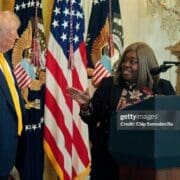
Small business owner Arnetta Bradford of Hope, Arkansas speaks alongside U.S. President Donald Trump during a Black History Month reception in the East Room of the White House on February 18, 2026 in Washington, DC. The president issued a proclamation recognizing Black History Month on Feb. 3. (Photo by Chip Somodevilla/Getty Images)

The Bahamas and Bermuda are distinct nations with separate governments, histories, and geopolitical roles. The Bahamas is an independent Caribbean nation of roughly 400,000 people and a key U.S. regional partner. Bermuda, meanwhile, is a British Overseas Territory located in the North Atlantic and operates under a different constitutional and diplomatic structure.

For Caribbean observers, the moment carries deeper symbolic implications beyond a simple verbal slip.

Small island nations in the Caribbean have long played outsized roles in global finance, climate diplomacy, tourism, and regional security cooperation with the United States. The Bahamas in particular is central to U.S. maritime security, migration management, and financial regulation cooperation.

Such misidentifications risk reinforcing longstanding frustrations among Caribbean leaders and diaspora communities who have often argued that the region is treated as interchangeable or peripheral in global political discourse, despite its strategic importance.

Diplomatic recognition, Caribbean analysts say, is not simply about protocol but about respect.

In recent years, Caribbean nations have increased their influence globally, particularly through climate advocacy, financial diplomacy, and economic partnerships. Leaders such as Barbados Prime Minister Mia Mottley have emerged as prominent voices in international forums, while countries like Guyana, Trinidad and Tobago, and The Bahamas are playing expanding roles in energy, finance, and regional development.

The Bahamas itself maintains deep diplomatic and economic ties with the United States, including cooperation on banking regulation, tourism, law enforcement, and national security initiatives.

The appointment of Walker as ambassador underscored the importance of that bilateral relationship. However, public confusion about the country’s identity – especially at a Black History Month event intended to recognize Black leadership and contributions – has prompted broader reflection on how Caribbean nations are perceived within U.S. political consciousness.

For many Caribbean Americans, the moment highlights a larger issue of visibility.

The Caribbean diaspora has made enormous contributions to American society, from civil rights and politics to medicine, business, and culture. Yet, Caribbean nations themselves often remain misunderstood or overlooked in public discourse even as the US has turned the region from a zone of peace into a region where boats are being bombed without real cause, leaving several Caribbean nationals dead to date. Since September last year, the United States has carried out at least 36 similar strikes in Caribbean and Eastern Pacific waters, killing more than 120 individuals suspected of involvement in drug trafficking, according to U.S. military data.

The incident also comes at a time when the Caribbean is gaining increasing geopolitical relevance amid shifts in global energy markets, climate negotiations, and nearshoring strategies. Ultimately, while political misstatements are not uncommon, moments like these resonate deeply in regions whose histories have long been shaped by external powers.

For Caribbean nations that continue to assert their voice and sovereignty on the global stage, recognition – accurate and respectful – remains an essential part of partnership.

RELATED: U.S. Military Strike Raises Urgent Questions About Caribbean Sovereignty After Possible St. Lucian Deaths

The Majesty Of Reverend Jesse Jackson

By Dr. Isaac Newton

News Americas, NEW YORK, NY, Weds. Feb. 18, 2026: I was deeply touched by his incredible capacity to let words and meaning jolt the soul through the rhythm of hope, the call to faith, and his relentless pursuit of freedom, dignity, and justice for all, especially the downtrodden and outcast. Long before I met him, his voice had already crossed oceans and entered the crowded chambers of my own conscience. Then I met him in Jersey City when he attended an African American Interdenominational Convention. His presence was radiant, marked by his moving smile and infectious, confident humility, which drew people to him with a sense of wonder and whispering pride. In that room, I encountered a leader and a living sermon. Before my eyes stood a man whose very cadence carried the heartbeat of generations who had been told to wait their turn in history.

FLASHBACK – The Rev. Jesse Jackson, seated, cheers on Aug. 19, 2024, during the Democratic National Convention at the United Center. (Brian Cassella/Chicago Tribune/Tribune News Service via Getty Images)

The man was Jesse Jackson, but the moment belonged to something larger than biography. He rose from the soil of segregation and shaped his public life with the discipline of Christian conviction and the daring imagination of prophetic faith. As a protégé of Martin Luther King Jr., he learned that moral courage must be organized and that faith without public action is only private comfort. His declaration to keep hope alive evolved beyond a slogan into a theology of survival for people battered by exclusion. When he affirmed that he was somebody, he was restoring sacred worth to those who had been measured and dismissed. He taught that dignity is conferred by the Creator, not the powerful, and therefore cannot be revoked by prejudice, poverty, or political neglect.

For Caribbean and African peoples, his words traveled like trade winds across the Atlantic. In Kingston, Port of Spain, Bridgetown, Georgetown, Lagos, Monrovia, Accra, Nairobi, and Gaborone, communities wrestling with the aftershocks of colonialism and economic vulnerability heard in his voice a summons to believe again. Hope, in his lexicon, was nothing short of disciplined resistance. It was the courage to count the cost of freedom and to pay it with patience, organization, and sacrifice. He insisted that faith must move beyond sanctuary walls into voting booths, classrooms, boardrooms, and streets. He spoke to fishermen and factory workers, to teachers and taxi drivers, to students who feared their dreams were too fragile for harsh realities. His mission dignified ordinary labor and reminded entire regions that the foundation of justice is built by hands that history often overlooks.

Yet, his majesty did not depend on perfection. He faced his own foibles in public view, and critics were swift and relentless. What distinguished him was not an absence of flaw but an unwillingness to be imprisoned by it. He understood that moral authority will not share the same room with moral infallibility. His Christian faith compelled confession, correction, and continuation. In this he modeled a rare form of leadership for a skeptical age. He showed that one can stumble and still stand for something larger than the stumble. For communities accustomed to seeing their champions either idolized or discarded, his resilience offered a third path, accountability without annihilation. That lesson is vital for societies struggling to nurture leaders who are human yet heroic in purpose.

As he transitions from the center of public life into the solemn dignity of legacy, his meaning deepens. The majesty of Reverend Jackson lives in the marches he led, the speeches he delivered, and in the moral vocabulary he expanded for the world. He taught that hope is a discipline, that dignity is sacred, that freedom demands cost, and that faith can animate public courage across race, region, and religion. His love for ordinary men and women of all races transcended pedigree and geography because he believed each person bore a divine imprint. For Caribbean and African peoples, and for all who yearn to triumph over despair, his life stands as a testament that history can bend when souls refuse to bow. His legacy lives on, both as memory and as mandate for generations yet unborn to keep hope alive and to rise each morning declaring with conviction that they too are somebody.

EDITOR’S NOTE: Dr. Isaac Newton is a globally experienced thought leader, Harvard, Princeton, and Columbia trained strategist, and advocate for social justice and leadership excellence. With over 30 years of expertise in bridging cultural, economic, and ideological divides, he brings a nuanced perspective to complex issues shaping global and regional landscapes.

RELATED: Two Visions, One Day: The Stark Contrast Between Donald Trump And Dr. King

Is Year-Round Avocado Production Jamaica’s Next Major Agricultural Investment Opportunity?

By News Americas Business Editor

News Americas, NEW YORK, NY, Weds. Feb. 168, 2026: Jamaica’s push toward year-round avocado production is more than an agricultural milestone. It represents a potential turning point in the Caribbean’s economic evolution – one that could position agriculture as a scalable investment sector capable of generating sustained export revenue, attracting private capital, and strengthening long-term food security.

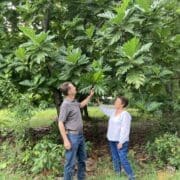
Mary and Mike McLaughlin, co-founders of Trees That Feed Foundation, visiting some of the first breadfruit trees they planted in Jamaica. (Contributed image)

For the first time in its history, Jamaica is preparing to produce avocados continuously throughout the year, thanks to the introduction of three new varieties – Carla, Hass, and Semil31 – through a partnership between the Ministry of Agriculture, Fisheries and Mining and the Trees That Feed Foundation. The initiative is designed to eliminate traditional seasonal production gaps, allowing farmers to harvest and supply markets consistently rather than intermittently.

This shift fundamentally changes the economics of avocado production in Jamaica.

Historically, Caribbean agriculture has faced a critical limitation: unpredictability. Seasonal harvest cycles restricted farmers’ ability to meet export demand consistently, making it difficult to secure long-term contracts or attract investment in processing, logistics, and infrastructure. Year-round production, however, provides the stability required to scale output and integrate into global supply chains.

Chief Technical Director in Jamaica’s Ministry of Agriculture, Orville Palmer, emphasized the economic significance of the initiative, noting that the move aligns with the government’s strategy to expand agricultural exports while providing farmers with steady income streams. Reliable production, he said, could elevate avocado to become as economically significant to Jamaica as its iconic ackee industry.

Globally, avocado demand has surged over the past decade, driven by consumer demand in North America, Europe, and emerging markets where health-conscious diets and plant-based foods are gaining popularity. The Hass avocado alone represents a multi-billion-dollar global export market, dominated by producers such as Mexico, Peru, and the Dominican Republic. Jamaica’s entry into year-round production opens the door to capturing a share of that rapidly growing sector.

Beyond exports, the development has broader implications for agricultural investment across the Caribbean.

Year-round production transforms agriculture from a seasonal activity into a predictable revenue-generating sector—one capable of supporting financing structures, infrastructure investment, and long-term business planning. Consistent output allows investors to evaluate risk more accurately, while farmers benefit from stable income rather than volatile seasonal earnings.

“Year-round production transforms crops like avocado from seasonal income sources into scalable investment assets,” said Felicia J. Persaud, CEO of Invest Caribbean and founder of AI Capital Exchange. “This creates opportunities for farmers, investors, and diaspora capital to participate in building sustainable wealth while strengthening the Caribbean’s food production and export capacity that is still heavily dependent on imports.”

The initiative also highlights the growing importance of agricultural diversification in the Caribbean’s economic future. While tourism has historically dominated the region’s economy, governments are increasingly seeking to strengthen domestic production and reduce reliance on imports. The Caribbean currently imports billions of dollars in food annually, creating both vulnerability and opportunity. Expanding local agricultural production allows countries to retain more economic value domestically while improving food resilience.

In Jamaica’s case, the new avocado varieties are being cultivated at the Bodles Research Station, where budwood sourced from the Dominican Republic is undergoing quarantine and field trials before distribution to farmers across the island. The effort reflects years of research and collaboration aimed at creating a sustainable production model suited to Jamaica’s climate and agricultural landscape.

The economic impact extends beyond farmers. Increased production supports growth across the agricultural value chain, including transportation, packaging, export logistics, and food processing. These downstream sectors generate employment, stimulate rural economies, and contribute to national GDP growth.

For the Caribbean more broadly, Jamaica’s breakthrough represents a blueprint for transforming agriculture into a modern economic engine. It demonstrates how innovation, strategic partnerships, and long-term planning can reposition traditional industries for global competitiveness.

As global demand for food continues to rise and supply chains diversify, Jamaica’s move toward year-round avocado production signals that Caribbean agriculture may be entering a new era – one defined not by subsistence or seasonality, but by scalability, investment, and economic opportunity.

RELATED: Is The Caribbean Emerging As A Global Wealth And Investment Platform?

Does This Caribbean Resort Expansion Signal A Shift From Tourism Destination To Global Wealth Hub?

By NAN Business Editor

News Americas, NASSAU, Bahamas, Tues. Feb. 17, 2026: When Baha Mar broke ground on its more than $700 million beachfront expansion on Nassau’s Cable Beach recently, the announcement was framed as a tourism milestone. The project will add 345 guest rooms, 77 branded luxury residences, and thousands of jobs. But beneath the ceremonial shovels and economic optimism lies a deeper question: Is the Caribbean quietly evolving from a tourism destination into a global wealth hub?

Baha Mar has officially broken ground on a new beachfront resort and branded residences on Cable Beach, marking a more than $700 million expansion that will add 345 guest rooms and 77 luxury residences to the country’s premier integrated resort destination.

For decades, the Caribbean’s economic identity has been anchored in hospitality. Resorts brought visitors, jobs, and foreign exchange. Yet today’s mega-developments increasingly reflect something more complex. The inclusion of branded luxury residences alongside hotel rooms signals a structural shift. These are not merely places to visit. They are places to own, invest, and store wealth.

This distinction matters.

Branded residences have become one of the fastest-growing segments of global real estate. Buyers are typically ultra-high-net-worth individuals seeking lifestyle, security, and jurisdictional diversification. By integrating residences into resort ecosystems, developers are transforming Caribbean properties into hybrid assets – part hotel, part private enclave, part global wealth infrastructure.

The Baha Mar expansion fits squarely within this model. Designed by internationally renowned architectural firm Foster + Partners, the project is positioned not just as a hotel, but as a premium residential and investment destination. Owners gain access to an established ecosystem that includes the Caribbean’s largest casino, luxury retail, championship golf, and more than 45 restaurants and lounges.

This model aligns with a broader global trend: the migration of capital into lifestyle jurisdictions.

In an era defined by geopolitical uncertainty, rising taxes in traditional wealth centers, and increasing interest in residency and citizenship mobility, wealthy individuals are diversifying geographically. The Caribbean, with its political stability, proximity to North America, and established financial frameworks, has emerged as a preferred destination.

The Bahamas, in particular, has strengthened its position through infrastructure investment, financial services sophistication, and its appeal as both a tourism and financial jurisdiction.

Bahamas Prime Minister Philip Davis underscored the significance of the expansion, describing the investment as a signal of confidence in the country’s economic future. “It is a signal to the world that our economy is steady, our tourism sector is growing, and our country is moving in the right direction,” he said.

Yet, the implications extend beyond tourism metrics.

Luxury developments increasingly function as anchors for broader economic ecosystems. They generate construction employment, permanent hospitality jobs, and demand for local suppliers—from farmers and fishermen to logistics providers and professional services. Baha Mar alone already employs more than 5,300 Bahamians, with an additional 1,400 positions expected once the new expansion is complete.

But perhaps more importantly, such developments reshape how the Caribbean is perceived globally.

Historically marketed primarily as a leisure destination, the region is now also being positioned as a place of long-term presence. Ownership, not just visitation, is becoming central. This transition enhances economic resilience by diversifying revenue streams beyond seasonal tourism cycles.

It also reflects the Caribbean’s integration into global capital flows.

Wealth today is increasingly mobile. Investors seek jurisdictions that offer quality of life, asset protection, and global accessibility. High-end resort developments provide precisely that intersection. They offer physical assets tied to globally recognized brands, located in politically stable environments, and embedded within service ecosystems designed for international clientele.

The Caribbean’s appeal is reinforced by geography itself. Located between North and South America, and accessible from major global financial centers, the region occupies a strategic position that combines lifestyle with connectivity.

Critically, this evolution does not eliminate tourism. Rather, it elevates it.

Tourism remains the foundation. But layered atop it is a new economic dimension—one centered on ownership, capital preservation, and global residency patterns. The resort becomes not just a destination, but a node within the architecture of global wealth.

For countries like The Bahamas, this shift offers opportunity – but also responsibility. Managing growth sustainably, ensuring local participation, and balancing foreign investment with national interests will determine how fully the region benefits.

What is clear is that the Caribbean’s economic narrative is expanding.

As cranes rise above Cable Beach and branded residences take shape alongside hotel towers, the message extends beyond Nassau. The Caribbean is no longer simply a place the world visits.

It is increasingly a place the world invests in, lives in, and anchors wealth within.

RELATED: The Caribbean’s Middle Class Is Being Built —And Broken — At The Same Time

King Kong And The Island: America’s Moral Collapse And Cuba

By Ron Cheong

News Americas, TORONTO, Canada, Tues. Feb. 17, 2026: For more than sixty years, Cuba has endured relentless external pressure from the United States. The embargo, designed to strangle trade, cripple the economy, and punish a population for the choices of its government, has long made daily life a struggle. Today, the situation is more difficult than ever: fuel shortages have grounded planes and paralyzed public transport; tourism, a crucial source of income, has all but collapsed; and the economy teeters under layers of scarcity and deprivation. Decades of hardship have forged resilience in the Cuban people, but the severity of these pressures makes one wonder: can Cuba survive this new trial, or are these dark hours edging it closer to the brink?

Despite these extraordinary challenges, Cuba has preserved a surprising measure of moral and social integrity. Health care remains universal, education is free and widely accessible, and violent crime is low. The government, while politically centralized and media tightly controlled, has consistently prioritized the welfare of its citizens over elite enrichment. In practical, people-centered terms, Cuba remains morally and functionally resilient, even under extreme external duress.

The U.S.: A Democracy Under Siege From Within

Contrast this with the United States, once hailed as the world’s premier democracy. Formally, Americans enjoy freedoms enshrined in law: free speech, press protections, competitive elections, and an independent judiciary.

But these formal liberties are increasingly being hollowed out in practice: There have been unprecedented calls to “nationalise” US elections and talk about cancelling the midterms – even as the blockade of Cuba is being justified as “pressuring the Cuban government to hold free elections.”  At the same time, American civic trust is being battered – protests are met with militarized force as in Minnesota, while the blockade of Cuba is also unashamedly being justified in the name of “Promoting human rights and political freedoms.”

Wealth is concentrated in the hands of the top 1%, which dominates political donations, lobbying, and policy outcomes. Media ownership is similarly consolidated in the hands of a few, producing shallow, sensationalist coverage that leaves large swaths of the population misinformed. Judicial appointments are increasingly partisan.

In other words, the United States is showing the signs of a democracy under stress, much like historical empires before it: Rome, Tsarist Russia, and the Soviet Union all exhibited elite capture, norm erosion, and civic disengagement before systemic collapse. Formal freedoms exist, but meaningful self-correction has become compromised. Citizens may vote, speak, and organize, yet their ability to influence outcomes is heavily filtered through wealth, media bias, and institutional manipulation.

The Moral Challenge

The contrast is striking. Here is a small island, subjected to decades of external aggression and severe deprivation, yet maintaining a society that, in practice, prioritizes the collective welfare of its people. Meanwhile, a wealthy, globally dominant democracy – free in principle – struggles to ensure that its citizens’ basic needs are met and its political system functions equitably.

Cuba’s one-party system and state-aligned media are often cited as moral deficits. Yet what moral weight do political freedoms carry if the society that claims them fails to meet the basic needs of its people? The Cuban system, despite restrictions on political plurality, has consistently delivered healthcare, education, and security – the material foundations of dignity and life.

Historical Lessons: Decline, Inequality, And Moral Authority

History teaches that empires and states rarely fall suddenly; decline is usually the cumulative effect of inequality, elite capture, and norm erosion. Rome’s senatorial elites insulated themselves while ordinary citizens struggled; Tsarist Russia refused reform until the system collapsed; the Soviet Union stagnated under rigid institutions and external overreach. In each case, the formal structures of governance persisted even as the underlying moral and functional legitimacy deteriorated.

The United States now exhibits eerily similar patterns: economic inequality has hollowed out political influence; media concentration distorts public understanding; civic trust is fractured; and institutional norms are under strain. Ironically, it is the US rather than Cuba, which has survived decades of external punishment, that faces internal moral and systemic fragility – a democracy that risks eroding from within.

Kant wrote, “The worth of a person consists in being a subject capable of reason and moral choice, not merely a means to an end.” By this measure, America’s moral authority is increasingly compromised: citizens are treated less as moral subjects with agency than as data points filtered through the lens of wealth and influence.

King Kong Vs. The Island

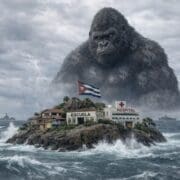
Even if we take it that Cuba’s government system is seriously flawed, the metaphor is unavoidable: the United States, a global behemoth wielding overwhelming power, functions as a predator – King Kong – crushing a small, vulnerable island beneath its weight. The embargo and aggressive sanctions on Cuba reveal a democracy that has abandoned moral principle in favor of domination. Meanwhile, Cuba, the small animal beneath the shadow of that predator, has demonstrated resilience, cohesion, and a people-centered ethic that the predator itself increasingly lacks.

Cuba has survived decades of punishment and deprivation. But the current crisis – fuel shortages, economic paralysis, and a collapse of tourism – may be the severest it has ever faced. Will the island endure these dark hours? History shows that resilience is possible, but the strain is immense, and the outcome is uncertain.

A Moral Reckoning

The contrast could not be starker: a wealthy, formally free democracy showing cracks in its moral and functional foundations, juxtaposed with a small, embattled island maintaining social cohesion and prioritizing human welfare under extreme external pressure. The United States has long claimed moral and political superiority; today, its claim rings hollow. It’s democracy, once celebrated, risks being remembered as a system where freedom existed in theory but was undermined by the concentration of wealth, the distortion of information, and the erosion of institutional norms.

Meanwhile, Cuba, despite political limitations, demonstrates that people-centered governance, moral integrity, and social cohesion have so far survived even under extraordinary external duress. The moral lesson is stark: power alone does not confer legitimacy; justice and care for citizens do. If the U.S. continues to prioritize domination, wealth, and spectacle over the well-being of its people, it risks becoming a giant whose size conceals rot, while a small island showed what resilience and moral governance truly look like.

EDITOR’S NOTE: Ron Cheong, born in Guyana, is a community activist and dedicated volunteer with an extensive international background in banking. Now residing in Toronto, Canada, he is a fellow of the Institute of Canadian Bankers and holds a Bachelor of Science degree from the University of Toronto. His comments are his own and do not reflect those of News Americas or its parent company, ICN.

RELATED: Clarion Across The Atlantic: Barbados Mia Mottley’s Third Mandate And The Rise Of Caribbean Moral Leadership

Is The Caribbean Emerging As A Global Wealth And Investment Platform?

By NAN Business Editor

News Americas, NEW YORK, NY, Mon. Feb. 17, 2026: For decades, the Caribbean has been defined in global imagination by tourism – sun, sea, and sand. But new economic data and shifting investment patterns suggest a deeper transformation may be underway. Increasingly, the region is positioning itself not merely as a destination for visitors, but as a platform for global capital, strategic investment, and wealth creation.

Recent analysis from FDI Intelligence confirms what regional leaders and investors have begun to recognize: the Caribbean is diversifying beyond tourism into sectors such as energy, logistics, agribusiness, financial services, and infrastructure.

This shift is being driven by several converging forces. Oil discoveries in Guyana and Suriname have drawn billions in foreign investment. Nearshoring trends are positioning Caribbean countries as strategic gateways for companies seeking alternatives to Asia-based supply chains. Financial services, corporate structuring, and cross-border trade infrastructure are expanding. And regional integration efforts are lowering barriers to capital movement.

As FDI Intelligence noted, “FDI remains vital to the Caribbean’s competitiveness and economic diversification,” reflecting the region’s growing appeal to global investors.

The numbers tell a compelling story. Capital commitments reached $17.6 billion in 2022 and remained elevated at $15.7 billion in 2023, driven largely by energy investment and strategic infrastructure development. Meanwhile, Guyana’s economy alone has experienced historic expansion, with GDP increasing nearly fivefold between 2020 and 2025.

But beyond energy, the Caribbean’s appeal lies in its unique structural advantages: political stability, geographic proximity to North and South America, an educated workforce, and tax-efficient financial frameworks that attract multi-national corporations and investors.

Felicia J. Persaud, CEO of Invest Caribbean and founder of AI Capital Exchange, believes the region is entering a defining moment.

“The Caribbean is no longer simply a tourism economy – it is emerging as one of the most overlooked wealth and investment platforms globally, something I have been saying since 2011,” Persaud said. “From energy and logistics to financial structuring and capital markets, the region offers strategic entry points for investors seeking growth, diversification, and long-term value.”

She cautioned that global investors risk missing a generational opportunity if they continue to view the Caribbean through outdated lenses.

“What we are witnessing is structural transformation,” Persaud added. “The Caribbean is becoming a bridge between capital and opportunity- connecting global investors with projects in energy, infrastructure, real estate, and private enterprise. Those who recognize this shift early will benefit most.”

This transformation is also reinforced by regional integration policies aimed at creating a more unified economic space. Agreements allowing free movement of people, expanding trade partnerships, and improving logistics infrastructure are reducing historic fragmentation that once limited scale. Diversification of export markets and investment sources has become a top priority for businesses and governments amid global trade tensions and uncertainty that is affecting FDI decisions. Merchandise exports from 12 Caribbean small states, tracked by the World Bank , reached a record high of $31bn in 2024. 

At the same time, global geopolitical shifts are accelerating interest in the Caribbean. Companies seeking to diversify supply chains away from geopolitical risk zones are increasingly turning to the region as a stable, strategically located alternative.

The Caribbean’s evolution reflects a broader global trend: capital is no longer flowing exclusively to traditional financial centers. Instead, investors are seeking emerging platforms where regulatory frameworks, geographic advantages, and growth potential intersect.

This shift does not mean tourism will disappear. Rather, tourism is becoming one component of a more diversified economic foundation that includes energy production, logistics hubs, financial structuring, and investment facilitation.

For Caribbean nations, this moment presents both opportunity and responsibility. Building durable institutions, improving capital markets access, and strengthening regional coordination will be essential to sustaining momentum.

For global investors, however, the message is increasingly clear. The Caribbean is no longer simply a vacation destination. It is becoming an investment destination.

Major Lazer’s Boost To The Jamaican Bobsled Team

News Americas, NEW YORK, NY, Fri. Feb. 13, 2026: When American electronic dance music and DJ group Major Lazer stepped forward with a $10,000 donation to support the Jamaican bobsled team at the Winter Olympics in Milan, the gesture represented more than financial help. It underscored the enduring bond between Caribbean culture, diaspora success and national pride on the global stage.

FLASHBACK – Diplo performs onstage during the Major Lazer Mixtape Release Party at Coyo Taco on December 04, 2025 in Miami, Florida. (Photo by Julia Beverly/Getty Images)

The internationally acclaimed music collective – whose roots are deeply intertwined with Jamaican sound system culture – did not just support athletes. They reaffirmed a cultural lineage that continues to propel Jamaica beyond geographic and economic limits.

For a tropical island nation with no natural winter sports infrastructure, Jamaica’s continued presence in Olympic bobsledding has always been a symbol of resilience, ingenuity, and belief. Since the team’s historic debut at the 1988 Calgary Winter Olympics – later immortalized in the film Cool Runnings – Jamaica’s bobsledders have come to represent the audacity of small nations to compete in spaces never designed for them.

Major Lazer’s donation arrives at a critical moment, as the team prepares to compete once again against countries with far greater funding, facilities, and institutional support.

Walshy Fire, a Chinese-Jamaican member of the group, has long emphasized that Major Lazer’s creative DNA is rooted in Jamaican culture. That connection reflects a broader truth: the Caribbean diaspora has become one of the region’s most powerful global assets.

From music stages to Olympic tracks, diaspora success is increasingly feeding back into national advancement. This act of support highlights an evolving reality – Caribbean athletes and cultural ambassadors are no longer operating in isolation. They are part of a growing ecosystem where diaspora influence, cultural capital, and global visibility converge to create opportunity.

The Jamaican bobsled team’s continued journey at this 2026 Olympics is not simply about medals. It is about visibility, identity, and defying expectations as they get ready for their heats on Feb. 16th in Milan.

And Major Lazer’s contribution sends a clear message: Caribbean excellence does not stand alone. It is powered by a global community that understands its value – and is willing to invest in its future.

ABOUT THE GROUP

Major Lazer maintains a deep, foundational connection to Jamaica, blending dancehall, reggae, and soca with electronic beats. Founded in 2008, the group often collaborates with Jamaican artists, headlines local shows, and has recently added British-Jamaican artist America Foster to its lineup. Their 2025 project, Gyalgebra, continues this Caribbean focus. 

Caribbean Unity Tested As Election Interference Allegations Threaten Regional Trust

By Keith Bernard

News Americas, NEW YORK, NY, Thurs. Feb. 12, 2026: The recent report regarding Prime Minister Kamla Persad-Bissessar’s denial of UNC interference in the upcoming Barbados elections is more than a simple political rebuttal; it is a signal of a deepening fracture in our regional diplomatic fabric. The narrative unfolding here suggests a shift from mutual respect to a more interventionist style of Caribbean politics. When allegations arise that a governing party in Trinidad and Tobago is actively backing a specific side in a neighbor’s election – particularly just forty-eight hours before the polls opened on February 11th – it casts a long shadow over the sanctity of sovereignty.

FLASHBACK – Kamla Persad-Bissessar, prime minister of Trinidad and Tobago, during the United Nations General Assembly (UNGA) in New York, US, on Friday, Sept. 26, 2025. The United Nations General Assembly, which opened Tuesday, brings more than 150 world leaders and their entourages into Midtown – a convergence that has been compared to hosting the Super Bowl every day for a week, across an entire neighborhood. Photographer: David Dee Delgado/Bloomberg via Getty Images

This pattern of alleged cross-border political interference echoes troubling precedents from other regions that should serve as cautionary tales. Consider Russia’s documented interference in the 2016 U.S. presidential election through disinformation campaigns and cyberattacks- operations that fundamentally undermined public trust in American democratic institutions and poisoned relations between Washington and Moscow for years to come. Or examine China’s increasingly assertive influence operations across the Pacific Islands, where Beijing has allegedly used economic leverage and political donations to sway electoral outcomes in nations like the Solomon Islands and Kiribati, effectively reshaping regional alliances and threatening the traditional influence of Australia and the United States.

Even within democratic blocs, such interference creates lasting damage. The European Union has grappled with accusations that Hungary and Poland have attempted to influence each other’s domestic politics through coordinated media campaigns and financial support for allied parties, weakening the union’s cohesion at precisely the moment it needs solidarity to address migration crises and security threats from Russia. In Latin America, Venezuela’s alleged support for sympathetic political movements in Bolivia, Nicaragua, and Ecuador during the height of the “Pink Tide” era created a polarized hemisphere where accusations of foreign meddling became routine, making genuine regional cooperation nearly impossible.

The creation of a dangerous precedent is perhaps the most worrying aspect of this unfolding story, as the lines between national interests and regional “bloc-building” are becoming dangerously blurred. If we allow the perception to take root that political machinery can be exported across waters to sway local outcomes, we risk turning our neighbors into proxies. This doesn’t just threaten the immediate peace between Port of Spain and Bridgetown; it sets a template for a future where the wealthiest or most organized regional parties can dictate the leadership of smaller nations.

The consequences of such precedents extend beyond bilateral tensions to fundamentally destabilize regional security architectures. When Saudi Arabia and Iran engaged in proxy political warfare across the Middle East – supporting opposing factions in Lebanon, Yemen, Iraq, and Bahrain – the result was not merely diplomatic friction but actual armed conflicts that have cost hundreds of thousands of lives and displaced millions. The Sahel region of Africa offers another stark example: external powers including France, Russia, Turkey, and Gulf states have all sought to influence the political trajectories of Mali, Burkina Faso, and Niger through combinations of military support, political backing, and economic inducements, contributing to a cycle of coups and instability that has made the region a breeding ground for extremism.

Furthermore, we must consider the heavy cost of distrust and the resulting erosion of the CARICOM spirit. Integration depends on the firm belief that each nation’s democratic process is its own, yet by the time a Prime Minister has to issue a “categorical denial” of meddling, the seeds of suspicion have already been sown. History demonstrates how quickly such suspicions can unravel decades of cooperation. The African Union’s effectiveness has been repeatedly undermined by accusations that larger powers like Nigeria, South Africa, and Egypt use their economic weight to influence the domestic politics of smaller member states, making collective action on issues like the Libya crisis or conflicts in the Horn of Africa nearly impossible to coordinate. ASEAN’s principle of non-interference has been tested to breaking point by allegations that Thailand and Cambodia, or Vietnam and the Philippines, have supported opposition movements in each other’s territories, paralyzing the organization’s ability to present a united front on critical issues like the South China Sea disputes or the Rohingya crisis.

The economic consequences alone should give us pause. When members of the Gulf Cooperation Council – supposedly one of the world’s most integrated regional blocs – accused Qatar of political interference in their internal affairs in 2017, the resulting diplomatic crisis and blockade cost the regional economy billions of dollars, disrupted trade networks built over decades, and weakened the GCC’s collective bargaining power vis-à-vis Iran and global energy markets at a critical moment.

Our region cannot afford a narrative of interference; we face collective threats – economic volatility and climate change—that require absolute unity. The stakes for the Caribbean are existential in ways that dwarf even these examples. Small island developing states facing rising sea levels, hurricane intensification, and economic marginalization in global trade systems simply cannot afford the luxury of political division that larger regions might weather. When the Pacific Islands Forum nearly collapsed in 2021 over accusations that Australia and New Zealand were manipulating the selection of the Secretary-General to serve their interests rather than those of smaller island states, it paralyzed the organization’s climate advocacy at precisely the moment when COP26 required maximum Pacific unity. The Caribbean cannot repeat such mistakes when our very existence as viable nations may depend on presenting a coordinated front on climate finance, debt relief, and preferential trade access.

To see our leaders embroiled in accusations of electoral tampering suggests we are looking inward and backward, rather than moving forward as a unified community. The lesson from every region that has traveled this path is clear: once the poison of interference takes hold, it requires years or even decades to restore trust – time we simply do not have.

EDITOR’S NOTE: Keith Bernard is a Guyanese-born, NYC-based analyst and a frequent contributor to News Americas.

RELATED: CARICOM’s Animal Farm? – Why The Caribbean Is United in Rhetoric, Divided In Reality