
Haitian American Congresswoman Salutes TPS Ruling As Little Haiti Prays

News Americas, FORT LAUDERDALE, FL, Weds. Feb. 4, 2026: Haitians in Miami’s Little Haiti gathered in prayer Tuesday night, giving thanks after a federal judge blocked the termination of Temporary Protected Status, (TPS),for Haitians – a move hailed by Haitian American leaders as a critical lifeline for immigrant families.

Haitian American Congresswoman, Sheila Cherfilus-McCormick, praised the ruling, which halts the potential removal of more than 350,000 Haitians living and working in the United States.

“This is a major win for South Florida and for our strong immigrant communities,” Cherfilus-McCormick said in a statement. “This decision confirms what we all know to be true: our nation cannot be at its greatest without Haitian immigrants, who contribute close to $3.4 billion annually to our economy.”

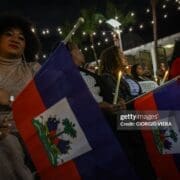
People attend a candlelight vigil for Haitians living in the US under the Temporary Protected Status (TPS) immigration program in Miami, Florida on February 3, 2026. Late on February 2, federal judge Ana C. Reyes of the Federal District Court in Washington, blocked the Trump administration from ending TPS for an estimated 350,000 Haitian immigrants. The status, which offers protection from deportation and work authorization, was set to expire on Feb. 3. (Photo by Giorgio Viera / AFP via Getty Images)

At the prayer vigil held at the Little Haiti Cultural Complex, a small but emotional crowd lit candles and prayed for stability, protection, and the opportunity to continue building their lives in the United States.

The ruling allows more than 350,000 Haitian immigrants nationwide — including an estimated 158,000 in Florida — to remain in the country and continue working, at least temporarily. For many families, the decision brought a measure of relief, tempered by ongoing uncertainty about the future.

“The past five years, what Haiti’s been dealing with — we are not ready,” said Fabiola Barthelemy, a Haitian American who has lived in the U.S. for decades, speaking to CBS News. “The crisis is real. Children are being raped and gangs are still active. Sending people back is like a death sentence to me.”

Although Barthelemy is a U.S. citizen, many members of her family are not. Her daughter, Elizabeth Barthelemy, said the prospect of her relatives being forced to return to Haiti is devastating.

“It would make me feel mad, frustrated, sad and depressed,” she told CBS Miami. “My cousins are like my family. I would go with them.”

Community leaders and elected officials echoed those concerns, stressing that TPS recipients are law-abiding, contributing members of society — not criminals.

On Monday, U.S. District Judge Ana Reyes temporarily blocked the Trump administration’s move to end TPS for Haitians nationwide.

Local officials say the decision offers critical breathing room but does not guarantee a permanent solution.

As of Tuesday night, the U.S. Citizenship and Immigration Services website had not yet been updated to reflect the ruling and continued to list TPS protections for Haitians as ending on Feb. 3rd.

RELATED: US Terminates Somalians Temporary Protected Status

Stella Jean Brings Haiti’s History And Pride To The 2026 Winter Olympics

News Americas, NEW YORK, NY, Weds. Feb. 4, 2026: After crafting the widely praised opening ceremony outfits for Team Haiti at the 2024 Paris Summer Olympics, Haitian-Italian designer Stella Jean is once again partnering with the island nation — this time to design its uniforms for the 2026 Milan–Cortina Winter Olympics.

Haitian-Italian designer Stella Jean is once again partnering with the island nation — this time to design its uniforms for the 2026 Milan–Cortina Winter Olympics.

Team Haiti’s Winter Olympics delegation may be small, but its cultural footprint is anything but. The 2026 team includes just two athletes — Richardson Viano, 23, and Stevenson Savart, 25 — yet Jean is ensuring their uniforms carry the weight of Haitian history, identity, and global presence.

In an interview with the Associated Press, Jean revealed that her original designs featured an image of Toussaint Louverture, the former enslaved general who led the revolution that established the world’s first Black republic in 1804.

“We have a commitment and a responsibility to convey a message,” Jean said. “There are many messages in this uniform. There is a bit of Haiti’s history, there is a representation of one of the fathers of the nation — Toussaint Louverture — a man feared by the most powerful on earth, such as Napoleon.”

However, the International Olympic Committee flagged the image as a violation of Olympic rules prohibiting political, religious, or racial propaganda at Olympic venues, forcing Jean and her team to rework the design.

“Rules are rules and must be respected, and that is what we have done,” Jean explained.

Drawing inspiration from a painting by Haitian artist Edouard Duval-Carrié, which depicts Louverture riding a red horse, Jean collaborated with Italian artisans to reinterpret the imagery without the historical figure. The final uniforms feature a striking red riderless horse set against a tropical backdrop, with the word “Haiti” emblazoned across the top.

Jean also designed a women’s look for Team Haiti, incorporating the traditional Haitian tignon — a headwrap historically imposed on enslaved women to cover their hair, now reclaimed as a symbol of resilience and cultural pride.

“For us, it is important that this horse — his horse, the general’s horse — remains,” Jean said. “It is the symbol of Haiti’s presence at the Olympics. In just a few meters of fabric, we must concentrate history and meaning. This is not about stylistic exercise.”

Haiti’s ambassador to Italy, Gandy Thomas, underscored the broader significance of the moment.

“Haiti’s presence at the Winter Olympics is a symbol — a statement, not a coincidence,” Thomas said. “We may not be a winter country, but we are a nation that refuses to be confined by expectation. Absence is the most dangerous form of erasing.”

Viano, who made history as Haiti’s first-ever Winter Olympian at the 2022 Beijing Games, echoed that sentiment, noting that participation on the global sports stage helps counter persistent negative narratives about the Caribbean nation.

The moment also comes amid heightened global attention on Haitians abroad. Just days before Haiti’s Winter Olympics appearance, a federal judge blocked an effort to end Temporary Protected Status (TPS) for roughly 350,000 Haitian immigrants living in the United States — a decision celebrated across diaspora communities.

Together, Jean’s designs and Team Haiti’s Olympic presence stand as a reminder that representation — on fabric, on snow, and on the world stage — remains a powerful form of resistance.

RELATED: Haitian American Congresswoman Salutes TPS Ruling As Little Haiti Prays

Keznamdi Wins 2026 Reggae Grammy As Caribbean Artists Turn Spotlight on Immigration

By NAN ET EDITOR

News Americas, New York, NY, Mon. Feb. 2, 2026: Independent Jamaican artist Keznamdi captured the 2026 Grammy Award for Best Reggae Album on Sunday night, edging out genre heavyweights, including Vybz Kartel, in a victory that underscored both reggae’s evolving sound and the growing influence of independent Caribbean artists on the global stage.

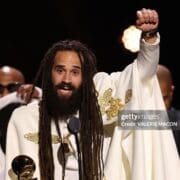
Jamaican musician Keznamdi accepts the Grammy for Best Reggae Album for “BLXXD & FYAH” on stage during the 68th Annual Grammy Awards Premiere Ceremony at the Crypto.com Arena in Los Angeles on February 1, 2026. (Photo by VALERIE MACON / AFP via Getty Images)

Keznamdi claimed the honor for BLXXD & FYAH, released independently in August 2025, marking his first Grammy win and his first nomination. The album triumphed over Kartel’s Heart & Soul, Lila Iké’s Treasure Self Love, Jesse Royal’s No Place Like Home, and Mortimer’s From Within.

Keznamdi (Second from left) accepts the Best Reggae Album award for “BLXXD & FYAH” at the 2026 Grammy Awards Pre-Show (Premiere Ceremony) held at the Peacock Theater in Los Angeles, CA, Sunday, Feb. 1, 2026. (Myung J. Chun / Los Angeles Times via Getty Images)

The announcement was made during the Grammy Premiere Ceremony at the Peacock Theater in Los Angeles on Sunday, February 1.

“Reggae music has always been a music weh defend truths and rights, African liberation, and Black man redemption,” Keznamdi said while accepting the award. “We a represent Jamaican culture — dancehall and reggae.”

A Roots-Deep Reggae Journey

Born into music, Keznamdi is the son of Errol and Kerida, lead vocalists of the international reggae band Chakula. He grew up touring globally and recording in a home studio in the St. Andrew hills of Jamaica, where the band produced ten albums.

He recorded his first song at age five and began performing publicly during his mother’s album release tours for her children’s project Save the World, which became a viral hit in Jamaican primary schools. His musical development continued through studies at St. Mary’s College in Northern California, followed by formative years living in Tanzania and completing high school in Ethiopia.

BLXXD & FYAH features collaborations with Kelissa, Mavado, and Masicka, blending roots consciousness with contemporary global production.

A Defining Caribbean Night at the Grammys

Keznamdi’s breakthrough came on a night that proved unusually resonant for Caribbean and diaspora artists across genres — not only in wins, but in message.

Puerto Rico star, Bad Bunny accepts the Best Música Urbana Album onstage during the 68th GRAMMY Awards at Crypto.com Arena on February 1, 2026 in Los Angeles, California. (Photo by Kevin Winter/Getty Images for The Recording Academy)

Puerto Rico–born global superstar Bad Bunny made Grammy history by becoming the first Latin artist to win Album of the Year with a Spanish-language album. During his acceptance speech, Bad Bunny openly criticized aggressive U.S. immigration enforcement.

“Before I say thanks to God, I’m going to say ICE out,” he told the audience, referencing recent civilian deaths amid heightened enforcement actions. He later added, “We’re not animals. We’re not aliens. We are human beings.”

Bad Bunny also won Best Global Music Performance and Best Música Urbana Album, further cementing his dominance on the night.

Cuban-born icon Gloria Estefan won Best Tropical Latin Album for Raíces and used her moment in the press room to call for a return to democratic principles and humanity in immigration policy.

“These values are the reason people want to be here,” Estefan said. “I hope our government listens to our plea for humanity.”

Caribbean Britain and the Windrush Legacy

Caribbean heritage star, Olivia Dean attends the 68th GRAMMY Awards on February 1, 2026 in Los Angeles, California. (Photo by John Shearer/Getty Images for The Recording Academy)

British singer Olivia Dean, who has Jamaican-Guyanese roots, was named Best New Artist for Nice To Each Other. In her speech, Dean invoked her family’s immigrant history, noting that her grandmother was part of the Windrush generation.

“I’m here as the granddaughter of an immigrant,” she said. “I’m a product of bravery. We’re nothing without each other.”

“ICE OUT” Becomes A Cultural Marker

Beyond speeches, visible protest marked the ceremony. Several artists wore pins reading “ICE OUT,” including Kehlani, Billie Eilish, Justin Vernon of Bon Iver, and jazz vocalist Samara Joy.

The coordinated symbolism reflected a broader moment of cultural dissent — driven largely by artists whose identities are shaped by migration, diaspora, and cross-border histories.

More Than An Awards Night

While Keznamdi’s Grammy win marked a personal and professional milestone – and a victory for independent reggae – the night itself signaled something larger. Caribbean artists were not only recognized for their musical excellence; they used one of the world’s biggest cultural platforms to assert their humanity, history, and right to speak.

In a genre born from resistance and survival, Keznamdi’s words echoed long after the trophy was raised — on a night when Caribbean voices didn’t just win, they defined the moment.

RELATED: Lifetime Achievement Honors For Mr. Vegas, Sly Dunbar and Leroy Sibbles At Reggae Genealogy

Nicki Minaj Fuels Online Firestorm After Roast From Trevor Noah At The Grammy’s

News Americas, New York, NY, Mon. Feb. 2, 2026: Trinidad & Tobago-born rapper, Nicki Minaj, ignited a fresh wave of controversy Sunday night after posting a series of cryptic messages on X that appeared to reference conspiracy theories involving “satanic rituals,” hours after South African-born comedian, Trevor Noah, poked fun at her political alignment during the 2026 Grammy Awards.

In a late-night post that did not name any individual, Minaj alleged that an unnamed “favorite artist” was involved in ritualistic violence tied to a satanic cult. The post quickly drew widespread attention, prompting confusion and concern among fans and critics alike.

Minaj did not offer evidence to support the claims, nor did she clarify whom she was referring to. In the comment section, users pressed her to explain, with some urging her to “name names,” while others questioned why she would raise such allegations on one of music’s most high-profile nights.

The timing of the posts appeared significant. Earlier in the evening, Noah referenced Minaj during his opening monologue at the Grammy Awards, noting her recent appearance at the White House and joking that she was “still with Donald Trump discussing very important issues.” The remark drew laughter and applause inside the Crypto.com Arena.

Minaj also tweeted: “Trevor refuses to come out the closet when everyone in the industry knows his boyfriend. Allegedly.”

She then made several posts about Jay-Z‘s relationships, including photos of him with Beyoncé and one of him with Aaliyah, the images sporting text suggesting he pursued them when they were under 18.

“Are y’all understanding that these ppl have been sacrificing children as a way of gaining & maintaining power? If you ever vote DemonCrat again, you’re just as soulless as they are & will perish. Maybe it’s time for me to do some story times — since I was trying to not say what I know — yet they continue to attempt bullying,” she tweeted.

In another tweet, Minaj said she would not be releasing new music until her contract is renegotiated and she updates everyone on “all the sabotage this RICO is finding out about Billboard.”

“Your favorite artist has been practicing rituals in a satanic cult where they take babies from other countries & mutilate & kill them as a form of a blood sacrifice to their God. You see, when your master is satan, you must constantly shed blood. However, the JIG IS UP,” she wrote in another tweet.

Minaj has become increasingly vocal about her support for President Donald Trump in recent months. Just days before the Grammys, she appeared at a U.S. Treasury Department summit promoting the administration’s “Trump Accounts” initiative, where she publicly described herself as “probably the president’s No. 1 fan” and said criticism of her stance only strengthened her support.

“The hate – or what people have to say – it does not affect me at all,” Minaj told the audience at the Washington event. “It actually motivates me to support him more.”

Following Noah’s onstage comments, Minaj did not directly reference the comedian by name in her social media posts. However, the proximity in timing led many observers to interpret the posts as a reaction to the Grammy monologue.

Cultural critics and media analysts cautioned against conflating satire with personal attacks, while also expressing concern about the spread of conspiracy rhetoric by high-profile public figures. Several commentators noted that such claims, when left vague, can fuel online harassment and misinformation without accountability.

As of Monday morning, Minaj had not issued any clarification or retraction.

The episode adds to an increasingly visible pattern of political polarization spilling into entertainment spaces, where celebrity influence, social media, and national politics intersect – often in unpredictable ways.

Donald Trump threatened to sue Noah for making “false and defamatory” comments regarding his relationship with Jeffrey Epstein.

Writing on Truth Social, Trump said: “Noah said, INCORRECTLY about me, that Donald Trump and Bill Clinton spent time on Epstein Island. WRONG!!! I can’t speak for Bill, but I have never been to Epstein Island, nor anywhere close, and until tonight’s false and defamatory statement, have never been accused of being there, not even by the Fake News Media.

“Noah, a total loser, better get his facts straight, and get them straight fast,” he added. “It looks like I’ll be sending my lawyers to sue this poor, pathetic, talentless, dope of an M.C., and suing him for plenty$.”

RELATED: Trinidad-Born Rapper Nicki Minaj  Signals Citizenship Move