



NEWS AMERICAS, NEW YORK, NY, Tues. May 5, 2026: Caribbean roots stars turned the Met Gala 2026 into a diaspora showcase Monday night, with some of the biggest names in music and entertainment commanding fashion’s most prestigious red carpet under the evening’s “Fashion Is Art” dress code tied to the Metropolitan Museum of Art’s spring exhibition, “Costume Art.”
NEW YORK, NEW YORK – MAY 04: Rihanna attends the 2026 Met Gala celebrating “Costume Art” at the Metropolitan Museum of Art on May 04, 2026 in New York City. (Photo by Theo Wargo/FilmMagic)
Barbados’ own Rihanna cemented her status as the undisputed queen of the Met Gala, arriving in a shimmering sculptural gown by Maison Margiela Couture designed by Glenn Martens. The show-stopping look combined art and technology, featuring a liquid metal fabric woven with silk and recycled metal wiring, an intricate jewel-encrusted long-sleeve bodice in gold and silver, and a dramatic fabric structure that framed her body in what critics immediately dubbed a “sculptural beauty” moment. She completed the look with frosty eyeshadow and a hairstyle adorned with gold hardware.
By her side, A$AP Rocky wore a custom pink Chanel robe-style jacket with black satin lapels, black trousers, and a white shirt – solidifying pink as one of the night’s dominant trends.
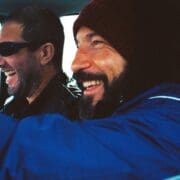
Bad Bunny attends the 2026 Met Gala Celebrating “Costume Art” at the Metropolitan Museum of Art on May 04, 2026 in New York City transformed at an older man. (Photo by Michael Loccisano/GA/The Hollywood Reporter via Getty Images)
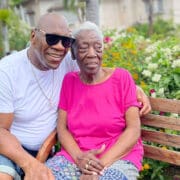
Puerto Rican superstar Bad Bunny – born Benito Antonio Martínez Ocasio – delivered one of the night’s most shocking and viral moments, appearing as a hyper-realistic version of himself 50 years into the future. Using extensive prosthetic makeup created by Mike Marino — the artist behind Heidi Klum’s most elaborate Halloween transformations – he transformed into an elderly man complete with deep wrinkles, age spots, white hair, and a walking cane.
His custom all-black tuxedo, co-designed with Zara, featured an oversized pussy bow necktie directly referencing designer Charles James’s 1947 “Bustle” gown housed in the museum’s permanent collection. The look was widely praised for highlighting the “Costume Art” exhibition’s exploration of the aging body — a stage of life often ignored by the youth-centric fashion industry.
US fashion designer Char Defrancesco, US rapper Cardi B and US designer Marc Jacobs arrives for the 2026 Met Gala celebrating “Costume Art” at the Metropolitan Museum of Art, in New York, on May 4, 2026. (Photo by Angela Weiss / AFP via Getty Images)
Cardi B, whose roots extend to the Dominican Republic and Trinidad and Tobago, made a late-night entrance alongside designer Marc Jacobs despite battling a fever — and the internet noticed. Her custom Marc Jacobs gown leaned heavily into surrealism, featuring a sheer black lace ruffle dress layered over a color-blocked bodysuit, with massive padded sculptural forms around the shoulders and hem inspired by the work of Surrealist artist Hans Bellmer. She navigated the carpet in her signature 9.5-inch platform boots.
Teyana Taylor attends the 2026 Met Gala celebrating “Costume Art” at the Metropolitan Museum of Art on May 04, 2026 in New York City. (Photo by Jamie McCarthy/Getty Images)
Actress and entertainer Teyana Taylor, 35, who carries Caribbean roots and served as a 2026 host committee member, turned heads in a silver fringed Tom Ford gown with a matching fringed headdress that draped dramatically over half her face — one of the night’s most visually striking silhouettes.
Caribbean roots Marcello Hernandez at The 2026 Met Gala Celebrating “Costume Art” held at The Metropolitan Museum of Art on May 04, 2026 in New York, New York. (Photo by Michael Buckner/Penske Media via Getty Images)
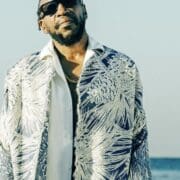
SNL breakout star Marcello Hernández paid direct homage to his Cuban and Dominican heritage through a custom ensemble by Willy Chavarria titled “The Caribbean Canvas.” The structured architectural jacket mimicked the movement of tropical flora, while the lining of his cape featured hand-painted imagery inspired by the streets of Havana and Santo Domingo. Custom boots incorporating traditional Dominican embroidery techniques and a vintage Cartier brooch completed the look.
Caribbean roots Zoë Kravitz attends the 2026 Met Gala celebrating “Costume Art” at the Metropolitan Museum of Art on May 04, 2026 in New York City. (Photo by Jamie McCarthy/Getty Images)
Zoë Kravitz, who carries Bahamian and African American heritage, served on the 2026 host committee and interpreted the “Fashion Is Art” dress code through a lens of dark Victorian romance. Her custom Saint Laurent by Anthony Vaccarello gown – constructed from dense graphic black guipure lace worn unlined – featured a basque waist and structured exaggerated hip panniers nodding to historical Rococo art. Green stone drop earrings and a large ivory sculptural ring by Jessica McCormack completed the ensemble.
Caribbean roots star Rauw Alejandro attends the 2026 Met Gala Celebrating “Costume Art” at the Metropolitan Museum of Art on May 04, 2026 in New York City. (Photo by Michael Loccisano/GA/The Hollywood Reporter via Getty Images)
Puerto Rican superstar Rauw Alejandro arrived in an ultra-modern Saint Laurent look that fashion critics described as Blade Runner-esque — a custom black slick-textured suit with a draped leather top and the night’s most talked-about accessory: silver bridge jewelry across his nose and face created by Ida Lajevardi’s Yaaqee Studio. He also debuted a fresh new hairstyle specifically for the event.
From Barbados to Puerto Rico, Trinidad and Tobago to the Dominican Republic, the Bahamas to Cuba – the 2026 Met Gala made clear that Caribbean heritage is not just present at the intersection of fashion and culture. It is leading it.
The 2026 Met Gala was held Monday, May 4th at the Metropolitan Museum of Art in New York City.

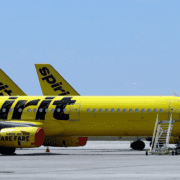
News Americas, NEW YORK, NY, Mon. May 4, 2026: For years, Spirit Airlines was the punchline of airline jokes. It was the airline people warned you about. The one that came with disclaimers. The one where comfort was optional, legroom was negotiable, and expectations had to be managed long before boarding even began.
And yet, for many, it was something far more important. It was access; it was possibility. It was the difference between going home and staying away.
Now, with news surrounding its dissolution following its failed merger efforts with JetBlue Airways, Spirit Airlines is quietly exiting the skies. While some travelers celebrate what they see as the end of a frustrating flying experience, others, particularly within Caribbean communities, are left reflecting on what its absence truly means.
Because for all its flaws, Spirit Airlines served a purpose that many larger carriers either overlooked or priced out of reach.
In 2009, I found myself in a position that many in the Caribbean diaspora know all too well.
A loss in the family.
A sudden need to return home.
A financial reality that did not care about grief.
I had just left college. Money was tight. Responsibilities were not. Flying from New York back to Jamaica was not a luxury. It was a necessity. Like many others in similar situations, cost became the defining factor in whether that journey could even happen.
That is when I found Spirit Airlines.
There were warnings, of course. People told me what to expect, or rather, what not to expect. Comfort was not guaranteed. Space would be limited. The experience, they said, might test my patience.
They were right.
At six feet tall, sitting nearly upright with minimal legroom was not ideal. But none of that mattered in that moment. I was not looking for comfort. I was looking for a way home.
And Spirit gave me that.
The flight attendants were courteous. The process was straightforward. The plane did exactly what it needed to do. It got me from point A to point B safely.
Sometimes, that is all that matters.
For many travelers, especially those from the Caribbean, Spirit Airlines was never about luxury. It was about practicality.
It was about being able to attend a funeral without going into debt.
It was about visiting family during the holidays without sacrificing rent.
It was about maintaining cultural and familial ties across borders in a way that was financially sustainable.
For vacationers, it offered something equally important. Travelers could save on airfare and redirect those funds toward experiences, local businesses, and time spent on the ground rather than in the air.
In this way, Spirit Airlines quietly democratized travel.
It made movement accessible.
And in doing so, it became part of the lives of people who may never have publicly defended it, but relied on it, nonetheless.
To be clear, Spirit Airlines earned much of its criticism.
Its business model, based on unbundled fares and additional fees for carry-ons, seat selection, and even basic comforts, frustrated many passengers. Delays, cancellations, and customer service issues often amplified those frustrations.
For some, the airline represented everything wrong with modern air travel.
And yet, that same model is precisely what allowed it to offer some of the lowest base fares in the industry.
It was not designed to be loved.
It was designed to be affordable.
And for a specific segment of travelers, that trade-off was not only acceptable. It was necessary.
The disappearance of Spirit Airlines does more than remove an option from travel websites.
It creates a vacuum, a gap in the market that will not easily be filled.
Low-cost carriers operate on thin margins, and not every airline is willing, or able, to sustain the kind of pricing structure that made Spirit viable. As consolidation continues across the airline industry, competition shrinks, and with it, the likelihood of consistently low fares.
For travelers who frequently move between the United States and the Caribbean, this shift could have lasting consequences.
Fewer affordable options mean fewer trips; fewer trips mean weaker connections to family, culture, and home.
Larger airlines may absorb some of routes, but they are unlikely to replicate the same pricing model without significant changes to their operations.
The impact of Spirit’s departure will not be evenly distributed.
For higher-income travelers, the difference may be marginal. There may be an increase in ticket prices, but nothing that fundamentally alters their ability to travel.
For working class families, students, and members of immigrant communities, the effect is far more pronounced.
These are the travelers who planned months in advance.
Who searched for deals at odd hours.
Who made sacrifices in other areas of life just to afford a flight.
For them, Spirit Airlines was not just another carrier.
It was a bridge.
Goodbye, Old Friend
It is easy to celebrate the end of something that was often inconvenient.
It is harder to acknowledge the role it played in making life more navigable for those who needed it most.
Spirit Airlines was not perfect.
But it was present.
It showed up in moments that mattered, quietly, affordably, and without pretense.
For many, it carried more than passengers. It carried stories, responsibilities, grief, joy, and the enduring need to stay connected to where we come from.
So, while some may say good riddance, others will say something different.
Something simpler; something more honest.
Goodbye, old friend; you will be missed.


News Americas, NEW YORK, NY, Sat. May 2, 2026: The 2026 Antigua and Barbuda election gives us clear numbers. But numbers do not speak unless we listen carefully to what they mean.
The Antigua and Barbuda Labour Party won about 60 percent of the vote. The United Progressive Party secured about 37 percent. At first glance, that looks like a strong and settled victory.
It is not the full story. Only 62 percent of eligible voters came out to vote. When we look at the full population, the picture becomes sharper and more honest.
The ABLP’s 60 percent becomes 37.2 percent of all eligible voters. The UPP’s 37 percent becomes 22.9 percent of all eligible voters.
This means the government holds power with the direct support of just over one third (1/3) of the country. That is enough to lead. It is not enough to feel secure.
Elections are not just about who wins. They reveal how power really works. In a small country like Antigua and Barbuda, power does not spread evenly. It concentrates in constituencies. It moves through communities where small changes in voter behavior can reshape the entire nation.
A few hundred votes can decide a seat. A single seat can shift the balance of power. That is how fragile political strength can be, even when it looks strong on paper.
Then there is the group that did not vote. 38 percent of eligible voters stayed home. That is not a small number. That is a silent force waiting to be activated. If even part of that group chooses to vote in the next election, they will not just influence the result. They can transform it.
But people do not participate just because they can. They participate when they believe their voice matters. They participate when they trust leaders. They participate when they feel seen and included in the future being promised.
Without that belief, democracy becomes smaller than it should be. This is where the real contest begins.
For the United Progressive Party, 37 percent is a base of support. But it is also a boundary. Growth will not come from speaking louder to the same people. Growth will come from reaching new communities, building new trust, and showing clearly that more citizens belong in the vision they offer.
People move when they feel recognized. They commit when they feel included. They support what they believe reflects their lives.
For the Antigua and Barbuda Labour Party, 60 percent is not protection. It is pressure. Every promise will be measured. Every decision will be judged. Every community will expect results that improve daily life. Winning an election raises expectations. It does not lower them.
Power must now prove itself through performance. This is the balance that defines the moment. One party holds authority. The other holds opportunity. Neither position is permanent.
The system itself is always moving.
Trust can grow. Trust can break. Support can expand. Support can disappear. Momentum can shift quietly and then all at once. In this kind of environment, small changes create big consequences. A conversation can change a mind. A message can shift a community. A few votes can change a constituency. A constituency can change a country.
That is the nature of politics in a small state. Nothing is too small to matter. Sixty percent gives the right to govern. 37 percent keeps competition alive. But the future will not be decided by those numbers alone. It will be decided by those who are not yet engaged and by those who find a way to reach them.
The side that listens more deeply, connects more widely, and earns trust more consistently will shape what comes next.
Because in the end, power is not held by numbers alone. It is held by people. And people can change their minds. Power moves. Power shifts. Power responds. And in Antigua and Barbuda, it is always closer to change than it appears.