

Two Jamaicans Deported To Eswatini Say They Do Not Wish To Return Home, Ministry Says

By Staff Writer, NewsAmericas Now

News Americas, KINGSTON, Jamaica, Thurs. July 16, 2026: Two of three Jamaican nationals reported to be in the Kingdom of Eswatini have told Jamaica’s Ministry of Foreign Affairs and Foreign Trade that they do not wish to return home at this time, the ministry said.

Senator Kamina Johnson Smith, Jamaica’s foreign affairs minister, said the ministry learned of the men’s situation through Jamaica’s Consulate General in Miamiafter one of the men initiated a phone call. He was joined on the call by his attorney, and a second Jamaican national joined the conversation shortly after.

During that call, the ministry said the men were told what consular assistance is available to them and that the Jamaican government stood ready to help facilitate their return. They were also told Jamaica could not determine their immigration status in the United States or secure their return there. Both men maintained they did not wish to return to Jamaica, according to the ministry.

Jamaica’s High Commission in Pretoria, South Africa, which is also accredited to Eswatini, is continuing efforts to make direct contact with a third Jamaican national believed to be in the country, the ministry said.

The ministry said its outreach followed earlier contact by Jamaica’s Embassy in Washington with U.S. authorities, seeking information on the circumstances of the men’s removal to Eswatini, as well as formal representations by the Pretoria High Commission to the Eswatini government.

The ministry did not name the man but reports say one is Junior Alves, a 64-year-old Jamaican pastor. He was among a group deported to Eswatini in July 2026 and remains in detention facing uncertainty over his legal status. Alves, who has lived in the US for 44 years, was among 11 people flown to the southern African state on Wednesday under Washington’s third-country nationals (TCN) program.  He is a father of eight and grandfather of 11, all born on American soil. He and his wife run a transport business and were preparing to open a new office when ICE swooped him up in Florida.

Part of a wider pattern

The case adds to a string of removals of Jamaican nationals to Eswatini under the Trump administration’s third-country deportation program, under which migrants – including some whose home countries are willing to accept them – have been sent to African nations rather than repatriated directly. Eswatini has received at least 19 deportees under the program since July 2025, according to Jamaica Observer reporting, with 17 held in a maximum-security prison as of earlier this month.

A Jamaican man, Orville Etoria, was among the first group of five men sent to Eswatini in July 2025. He was held in a maximum-security prison for more than seven weeks without charge before being voluntarily repatriated to Jamaica in September, with assistance from the United Nations’ International Organization for Migration. His lawyers said at the time that Jamaica had been willing to accept his return, disputing the U.S. Department of Homeland Security’s characterization that the men sent to Eswatini came from countries that had refused to take them back.

DHS described that first group of deportees as convicted criminals whose home countries would not accept them. Johnson Smith’s ministry has previously said Jamaica has not refused the return of any of its citizens.

Ministry: consular help remains available

The ministry said its consular support “remains available in this matter and more broadly, to Jamaican nationals overseas whose circumstances may require its intervention,” and pledged to continue handling the matter “with care, discretion and respect for the rights and decisions of the individuals concerned.”

Jamaican nationals overseas who are in distress or need consular assistance are asked to contact the nearest Jamaican Embassy, High Commission or Consulate, or email the ministry at consular@mfaft.gov.jm.

NewsAmericasNow will continue following developments in this case, including efforts to reach the third Jamaican national believed to be held in Eswatini.

RELATED: DHS Rescinds Biden-Era Public Charge Rule, Giving USCIS Officers Broader Discretion Over Green Card Applications
Caribbean American Lawmakers Back Continued U.S. Military Aid To Israel; Both Received AIPAC Donations

By Staff Writer, NewsAmericas Now

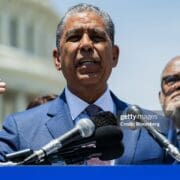
News Americas, NEW YORK, NY, Thurs. July 16, 2026: Caribbean American Rep. Yvette Clarke, a Brooklyn Democrat representing one of the largest Caribbean communities in the country, and Rep. Adriano Espaillat, a Dominican-born Democrat whose district covers parts of Manhattan and the Bronx, both voted on Wednesday, July 15th, to preserve U.S. military assistance to Israel, siding with a narrow majority of House Democrats against a push from the party’s left flank to cut off the funding.

The vote came Wednesday on an amendment from Kentucky Republican Rep. Thomas Massie that would have eliminated $3.3 billion in annual U.S. military assistance to Israel from the fiscal 2027 State, Foreign Operations and Related Programs appropriations bill. The amendment failed 104-314, with 10 members voting present. Massie was the only Republican to support his own measure.

The overall tally masked a sharp divide inside the Democratic caucus. Of the roughly 211 Democrats who cast a vote, 103 voted to strip the aid, while 98 – including Clarke and Espaillat – voted no, and 10 voted present. The split reached into party leadership: House Minority Leader Hakeem Jeffries opposed the amendment, while Minority Whip Katherine Clark broke with him and voted yes.

Caribbean American Representative Yvette Clarke, a Democrat from New York, center, seen here at a rally at Brooklyn Borough Hall in the Brooklyn borough of New York, US, on Thursday, July 9, 2026, also voted against the measure to end military aid to Israel. (Photographer: Michael Nagle/Bloomberg via Getty Images)

Both Clarke and Espaillat are listed among New York’s congressional delegation on Track AIPAC, a donor-tracking site run by the advocacy group Citizens Against AIPAC Corruption, as recipients of donations linked to the American Israel Public Affairs Committee and affiliated pro-Israel groups. The group claims Clarke received over $131,000 while Espaillat, who lost his primary election to Avila Chevalier, a democratic socialist and community organizer, received over $3 million. NewsAmericas Now is continuing to confirm the specific dollar figures attributed to each lawmaker against Federal Election Commission records and will update this story once those figures are verified.

In her own statement Wednesday, Clark agreed the amendment was “overly broad” and an attempt by Republicans to “score cheap political points.”

But she came to a far different conclusion on her ultimate vote. “However, it is clear that the status quo is not tenable. We should not provide a blank check for military aid to any country that does not comply with U.S. law, interests, and values,” Clark said. “The Netanyahu government has failed to meet that standard. I will be voting yes, not because I agree with the entirety of the amendment, or the GOP’s cynical motivations for its consideration, but because I believe we must change course.”

A caucus divided

Jeffries told colleagues in a letter ahead of the vote that he considered the amendment “overly broad,” warning it would also limit funding for refugee resettlement and humanitarian programs. Rep. Greg Casar of Texas, chair of the Congressional Progressive Caucus, said after the vote that opposing the billions in military funding is what matters most, even as he acknowledged the amendment’s broader flaws. Former House Speaker Nancy Pelosi also voted for the cut, saying she wanted her vote to send a message despite viewing the amendment itself as flawed.

The vote is widely seen as an early test of where House Democrats stand on Israel heading into the November midterms, following a string of primary losses this year by incumbents seen as too closely aligned with the Netanyahu government’s conduct of the war in Gaza. Israel’s standing with Democrats will be tested again on August 4, when Michigan voters nominate candidates running for ​U.S. Senate, the U.S. House and governor as the state debates U.S. relations with Israel.

Why it matters for Caribbean communities

Clarke and Espaillat represent two of the most heavily Caribbean and Caribbean-immigrant congressional districts in the country – NY-09 in Brooklyn and NY-13 in upper Manhattan and the Bronx. Both lawmakers have built political careers partly on advocacy for Caribbean and Latin American immigrant constituencies, making their votes on a matter this polarizing among the Democratic base a point of scrutiny within the communities they represent.

RELATED: U.S. Says ‘Do Not Travel’ To Haiti – Then Prepares to Send 330,000 Haitians There Anyway