
Government dismisses UNC “spying” claims

Black Immigrant Daily News

The content originally appeared on: Trinidad and Tobago Newsday

News

Dr Roodal Moonilal.

THE Government on Monday rejected allegations of spying made by Oropouche East MP Dr Roodal Moonilal on the social media show Douglar Politics on Saturday. The show is hosted by Opposition Senator Anil Roberts.

Moonilal said, “Spying is their (PNM) priority and I will tell you about that now.”

He displayed what he claimed to be a cabinet note dated November 16, 2018.

Moonilal claimed the document spoke about the establishment “of memoranda of agreement and non-disclosure agreements with strict confidentiality provisions among government ministries, statutory authorities and other legal entities identified.”

He said one of the entities involved is the Strategic Services Agency (SSA).

Moonilal alleged the SSA is run by political appointees of the Government.

“The National Security Council is staffed by politicians. I was a member of that for five years (under the former UNC-led People’s Partnership government).”

He also claimed the document showed private companies, including telecommunications providers, had to sign non-disclosure agreements to give information to the SSA.

Moonilal alleged this information could be given directly to senior government officials.

He said that information could include e-mails and banking information.

“This government is breaking the law. This is the workings of a dictator of the highest order”

In response, Communications Minister Symon De Nobriga said, “The UNC has made a concerted effort to take to social media at every opportunity it can to make the most outlandish comments which are at the heart of their perpetual campaign of misinformation.”

In this case, De Nobriga continued, “It comes just in time to try and turn the attention away from the recovery of the economy highlighted in our just completed Spotlight on the Economy.”

Describing the Opposition as nothing but a theatre of distraction and misdirection, De Nobriga said the population sees through the antics of its various actors.

“These social media shows are conducted without the immediate scrutiny and interrogation of the media which is the complete opposite of how this Government conducts its business.”

De Nobriga said, “In the absence of that scrutiny, any sense of decency has apparently been thrown by the wayside and it is a race now to see which one of them can make the most outlandish statement and have it reported.”

He said the average citizen did not have time to waste on the UNC’s theatrics.

“We saw the true nature of the Opposition in totality with their refusal to attend the regional showcase that was the Agri Forum and Expo, their boycott of all national independence celebrations, the comments of the Opposition Leader with regards to dismissing the independence struggle and their most recent no show at our Spotlight on the Economy.”

De Nobriga said it is unfortunate that every opportunity the Opposition has to contribute to a national conversation geared towards the best possible future for TT, they have “dragged the flag.”

He observed, “They excel in the bacchanal of their brand of representation.”

NewsAmericasNow.com

Confirman que gasolina regular se encuentra por debajo del dólar

Black Immigrant Daily News

The content originally appeared on: Radio Isla TV

El presidente de la Asociación de Detallistas de Gasolina, Esdras Vélez, confirmó en RADIO ISLA que el precio de la gasolina regular se encuentra por debajo del dólar. 

Esdras Vélez detalló que algunas gasolineras están vendiendo el combustible regular a 89 o 88 centavos. Mientras, la gasolina premium podría estar rondando entre $1.09 a $1.13, informó Vélez.

Vélez informó que la moratoria de La Crudita ya caducó hace varias semanas.  

Pendientes a RADIO ISLA para más información. 

[embedded content]

NewsAmericasNow.com

4G Remains Dominant In The Caribbean: How Long Until 5G Takes Over?

Black Immigrant Daily News

News Americas, NEW YORK, NY, Tues. Sept. 6, 2022: While 4G remains the dominant broadband cellular network technology in the Caribbean, it can only be a matter of time before 5G comes in to replace the current technology. 4G will eventually be phased out. There’s no doubt about that.

However, it’s unlikely to happen any time soon. Realistically speaking, 4G will not be completely replaced for at least another decade, possibly longer.

There has been a lot of talk about 5G technology in recent years; some of it good and some of it bad, and this has got a lot of people asking the question, when will 4G no longer be relevant? Like many places around the world, in the Caribbean, 4G still reigns supreme, but exactly how long will it be until 5G takes over?

What Exactly Is 4G And 5G Technology?

When people are discussing the connectivity of devices to the internet, the term used to describe the system in terms of frequency and speed is 4G or 5G (or even earlier versions, such as 2G and 3G). Each different generation is more advanced than the previous version, and they are defined by the different technologies involved.

5G technology will benefit people in a number of ways. Not only will it provide higher speeds, but it will also provide lower latency and greater capacity for remote execution, plus it will also make average download times much faster. 5G is, therefore, great for online gamers who will then be able to experience their android games from their mobile device like never before.

When Will We See An End To 4G?

It’s still a long way off yet, with many people saying it will be at least ten years before 4G is switched off for good and replaced with 5G. The arrival of 5G will mean that 4G will become obsolete. 4G is the fourth generation of mobile networks, and 5G is the next, more advanced version. Although 5G networks are just starting to come into use on a global scale, there are still a lot of networks that heavily rely on 4G.

There would be a lot of upgrades and developments needed for a seamless transition from 4G to 5G in most places, so it’s not going to happen in the coming months. 2G and 3G services are rapidly on the decline in terms of the number of people using this network technology, which has led to more of a demand for 4G technology. In short, 4G is the only option for customers because 5G is still not yet an option for them. 5G is still only starting to become dominant in a handful of countries. For example, in China, it’s used in approximately 356 cities, and in the United States, in around 296 cities.

5G is also available in almost 100 cities in the Philippines, around 80 cities in South Korea, and a similar number of cities in Canada. In comparison, 5G is also now being used in Spain (in more than 70 cities), Italy (more than 60 cities), Germany (more than 50 cities), the United Kingdom (also in more than 50 cities), and Saudi Arabia (in more than 40 cities).

What Does The Future Look Like For The Caribbean?

There are currently around ten Caribbean and Latin American nations that have already started the initial roll-out of 5G network technology. This means that Caribbean nations won’t have to wait for ten years until 5G first arrives. Instead, it may take this long until 4G is completely phased out by 5G. The Caribbean is a region of the Americas that consists of the Caribbean Sea and more than ten nations, some of which include Antigua and Barbuda, Bahamas, Belize, Cayman Islands, Curaçao, Dominican Republic, Haiti, and Jamaica.

What Comes After 5G?

We still haven’t seen the complete roll-out of 5G, and people are already talking about 6G. What exactly will 6G involve? It could be here sooner than expected, and it will see the birth of a new technology revolution. Some of the devices that may end up using this 6G technology are advanced robotics, computing devices, cars, AI, and many other technological devices that haven’t even been invented yet.

The future of technology is anybody’s guess, and the use of 6G tech is also something that we still cannot yet fully comprehend. It could be twenty years at least before 6G becomes anywhere near as mainstream as 4G technology currently is. For now, the best thing to do would be to leave ideas about 6G to the people who write science fiction novels. 

NewsAmericasNow.com

Le Canada attire les Antillais pour les études supérieures

Black Immigrant Daily News

The content originally appeared on: Martinique FranceAntilles

Depuis quelques années, le Canada s’est imposé comme une des destinations phares pour les Antillais partant faire leurs études supérieures. Mais ce choix s’avère-t-il excellent ?

Le Canada est très vite devenu un eldorado pour les étudiants originaires des Antilles. La proximité géographique (entre 4 et 5 heures de vol entre les Antilles et Montréal), la quasi-absence de décalage horaire (sauf durant l’hiver où l’est du pays a 1 heure de moins que les Caraïbes), le fait que l’on parle français (notamment au Québec), mais aussi les longs hivers glacials et neigeux (leur permettant de les changer de l’air tropical) sont quelques -unes des motivations pour…


France-Antilles Martinique

1310 mots – 06.09.2022

NewsAmericasNow.com

Les nouveaux étudiants ont fait leur rentrée

Black Immigrant Daily News

The content originally appeared on: Martinique FranceAntilles

La rentrée universitaire a débuté au campus de SchOlcher. 1075 nouveaux étudiants inscrits en première année ont fait leur rentrée lors d’une journée d’accueil organisée hier lundi, sur les 6000 étudiants du pôle Martinique de l’Université des Antilles.

L’ambiance était quelque peu solennelle, en matinée de ce lundi 5 septembre, dans l’amphithéâtre Charles Julius du campus de Schœlcher. Sur le site principal du pôle Martinique de l’Université des Antilles (UA), le coup d’envoi de la nouvelle année était donné avec le début de la JANE 2022. Comprenez : la journée d’accueil des nouveaux étudiants, fraîchement inscrits à l’UA pour cette année universitaire 2022-2023.

Après l’accueil et la répartition des nouvelles recrues,…


France-Antilles Martinique

1507 mots – 06.09.2022

NewsAmericasNow.com

Sept 5: Hurricane Danielle stronger; models suggest Europe in its path Loop Cayman Islands

Black Immigrant Daily News

The content originally appeared on: Cayman Compass

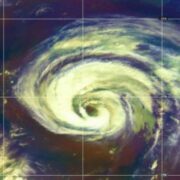
Early on Monday, September 5, 2022, Hurricane Danielle remained a category 1 hurricane, displaying maximum sustained winds of about 90 mph (a category 2 hurricane begins at 96 mph on the Saffir-Simpson Hurricane Wind Scale).

Wind bands

According to the National Hurricane Center, hurricane-force winds extend outward up to 25 miles from the center and tropical-storm-force winds extend outward up to 115 miles.

Projected track

Hurricane Danielle is moving north-northeast at 7 to 8 mph, representing an increase from its earlier movement in the range of 1 to 2 mph.

Danielle is expected to continue north-northeast on Monday, then turning east-northeast by Tuesday night.

All indications are that Hurricane Danielle will pass above the Azores Wednesday night and Thursday during the day.

Hurricane Danielle projected to pass above Azores (Source: The Weather Channel)

Warnings and watches

According to the National Hurricane Center, there are no coastal watches or warnings in effect.

Notwithstanding this, if Hurricane Danielle continues on its current track, it could be a threat to London or somewhere else in Europe sometime after this coming weekend.

Models showing Hurricane Danielle could impact Europe (source: Weather Channel)

NewsAmericasNow.com

UPDATE Sep 5: Kay now a hurricane, threatens Mexico and California Loop Cayman Islands

Black Immigrant Daily News

The content originally appeared on: Cayman Compass

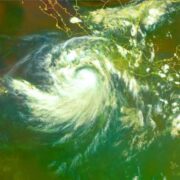
As an update to the below advisory, Tropical Storm Kay is now a category 1 hurricane, with maximum sustained winds of 80 mph and moving west-north-west in range of 10 to 12 mph.

Hurricane Kay is expected to continue this movement into Monday night and then flow in a northwest to north-northwest motion by late Tuesday.

Based on the forecast track, the National Hurricane Center said that the center of Hurricane Kay is expected to remain south and southwest of southwestern Mexico through tonight, then move to the west of the southern Baja California peninsula on Wednesday.

In terms of impacts, Hurricane Kay may produce 3 to 6 inches of rainfall, with isolated storm total amounts of 10 inches, across portions of the Mexican Riviera and western Mexico through Wednesday night. These rainfall amounts could lead to flash flooding, including landslides.

Swells may also affect portions of the coast of southwestern Mexico during the next few days.

Large swells are likely to reach the southern portion of the Baja California peninsula on Tuesday and are expected to spread up the peninsula and the Gulf of California later this week.

These swells will likely cause life-threatening surf and rip current conditions.

As a result of the foregoing, a tropical storm watch is in effect for Loreto southward to Cabo San Lucas and Cabo San Lucas northward to Puerto San Andresito.

Residents in Baja Califorinia must also pay attention to this development as similar warnings may be issued for Baja Califorinia on Monday night or Tuesday.

INITIAL ADVISORY:

Tropical Storm Kay may become a hurricane soon

Early Monday morning, September 5, 2022, Tropical Storm Kay was displaying maximum sustained winds near 45 mph with higher gusts, south of Mexico and California.

If Tropical Storm Kay continues to strengthen, the system may become a category 1 or 2 hurricane later this week.

According to the National Hurricane Center, swells and gusty winds generated by Kay will affect portions of the coast of southwestern Mexico during the next several days, and are likely to cause life- threatening surf and rip current conditions. These swells are expected to reach the southern portion of the Baja California peninsula by Tuesday.

In addition, these areas can expect several inches of rainfall over the next few days, as displayed in the chart below.

Tropical Storm Kay rainfall predictions from The Weather Channel

As a consequence, residents on the southwestern Mexico coast and the Baja California peninsula should remain vigilant and monitor Tropical Storm Kay as the system develops.

NewsAmericasNow.com

? 30,5% en juillet, l’inflation encore plus forte en Ha?ti

Black Immigrant Daily News

The content originally appeared on: Le Nouvelliste

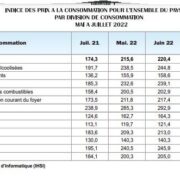
L’inflation import?e et la crise du carburant, comme facteur interne, entre autres, continuent d’impacter les prix sur le march? local au cours du mois de juillet 2022. En effet, l’Indice g?n?ral des prix ? la consommation (IPC, 100 en 2017-2018) a accus? une forte variation mensuelle de 3,2 % et une hausse annualis?e de 30,5 %, contre respectivement 2,2 % et 29 % le mois pr?c?dent, fait savoir l’Institut ha?tien de statistique et d’informatique dans la derni?re publication de sa rubrique mensuelle, intitul?e Le Coin de l’IPC.

Evoluant ? un rythme effr?n? depuis quelques mois, le ph?nom?ne de l’inflation atteint de plus en plus des sommets inqui?tants, avec son quatri?me pic cons?cutif depuis avril 2022 o? elle atteignait 26,7% avant d’atteindre un autre pic de 27,8% en mai ; suivi de 29% en juin et de 30,5% en juillet, et ceci, avec des constats encore plus graves dans certaines r?gions du pays allant au-del? de 31%.

L’augmentation mensuelle de l’IPC r?sulte surtout du comportement des fonctions de consommation : “Produits alimentaires et boissons non alcoolis?es” (3,9 % sur un mois et 32,7 % sur un an),”Articles d’habillement et chaussures” (3,5 % sur un mois et 33,6 % sur un an), “Meubles, articles de m?nage et entretien courant du foyer” (3,4 % sur un mois et 29,6 % sur un an) et “Restaurants” (3,5 % sur un mois et 30,4 % sur un an).

Les produits qui ont le plus influenc? la hausse annuelle de l’inflation sont :

Alimentation : riz en moyenne (46,9 %), petit mil (26,1 %), poulet (44,8 %), lait en poudre (47,4 %), poisson frais (59,3 %), huile comestible (91,2 %), pois sec (31,4 %), sucre en moyenne (48,1 %) et Malta (25,9 %).

Meubles, articles de m?nage et entretien courant du foyer : matelas (43,8 %), groupe ?lectrog?ne (46.4 %) et r?frig?rateur (40,7 %).

Restaurants : repas pris ? l’ext?rieur, c’est-?-dire hors du logement (30,4 %).

Il faut souligner qu’une flamb?e des prix a ?t? observ?e au niveau des produits import?s, soit 43,2 % en glissement annuel. Les produits locaux ne sont pas non plus en reste avec une hausse de 23,2 % de leur indice.

Enfin, toutes les r?gions ont contribu? ? l’accroissement de l’inflation du mois de juillet 2022 pour l’ensemble du pays. Il faut noter toutefois que les variations r?gionales les plus significatives par rapport au mois de juillet 2022 sont observ?es au niveau des r?gions Sud, Reste Ouest et l’Aire m?tropolitaine qui ont cr? respectivement de 33,1 %, 30,7 % et 31 %.

Cyprien L. Gary

R?agir ? cet article

Please enable JavaScript to view the comments powered by Disqus.

NewsAmericasNow.com

Twin Anniversary of Hurricanes Irma and Luis, where do they Stand Among the Worst Hurricanes to Impact Antigua and Barbuda

Black Immigrant Daily News

The content originally appeared on: Antigua News Room

Dale C. S. Destin

They both struck on September 5-6 after traversing over the warm waters of the Tropical North Atlantic. Twenty-six years to the day Hurricane Luis (1995) almost totalled Antigua and Barbuda; twenty-two years later, four years ago, Hurricane Irma (2017) did similarly to Barbuda.

Twenty-six years to the day Luis overwhelm our islands, with the centre partially passing over Barbuda and within 25 miles (40 km) of Antigua. Four years ago today, the date of Irma evoked memories of Luis, but it was no Luis.

Irma set a virtually unreachable bar for strength, but Luis set the record for size and cost. Luis was a great big giant while Irma was a mighty midget. The diameter of Irma’s hurricane-force winds was less than 75 miles (121 km) with a radius of less than 25 miles south of the centre. Contrastingly, the diameter for the hurricane-force winds of Luis was at least twice Irma’s, over 150 miles (241 km), with the hurricane force-wind extending about 50 miles (80 km) to the south.

Hurricane Irma on Sep 5 (top) and Hurricane Luis on Sep 3 (bottom) via NOAA satellites

Strength matters but clearly size matters more. Although both hurricanes took a similar journey through the area, Luis caused hurricane-force winds to reach both Antigua and Barbuda, whereas none reach Antigua from Irma. While in our neck of the woods, Luis had peak sustained winds of 140 mph (225 km/h) and Irma had 180 mph, 129% the strength of Luis but about 50% its size. This is what saved Antigua from the Category 5+++ wrath of Irma.

The actual paths of Hurricanes Irma and Luis courtesy NOAA Historical Hurricane Tracks

Antigua and Barbuda has been impacted by 14 major hurricanes, passing within 69 miles (111 km), on record dating back to 1851. There have been four in the last 26 years–Jose and Irma 2017, Georges 1998 and Luis 1995.

Meteo-France radar image showing the eye of Hurricane Irma passing over Barbuda, about 25 miles north of Antigua, 1:15 am (05:15 UTC) Wednesday Sep 6, 2017

A hurricane that compares well with Irma and Luis is Dog of 1950. Dog, also known as “the great hurricane of the central Atlantic”, came through as a Category 4 hurricane with wind of 130 mph (209 km/h). Its centre passed within 10  miles (16 km) of Antigua and within 15 miles (24 km) of Barbuda. Its powerful eyewall would have impacted both islands, like Luis 45 years later.

Prior to Luis, Dog was considered the most severe hurricane on record in Antigua and Barbuda. The damage caused by Dog amounted to up to US$1 million. In today’s currency, that is equivalent to US$8 million, paling in comparison to the US$100 to US$350 million (US$216 to US$755 million 2021) caused by Luis. Dog’s damage also pales in comparison to that of Irma’s US$136 million (US$153 million 2021). Total damage and loss from Irma were about US$155 million (US$174 million 2021).

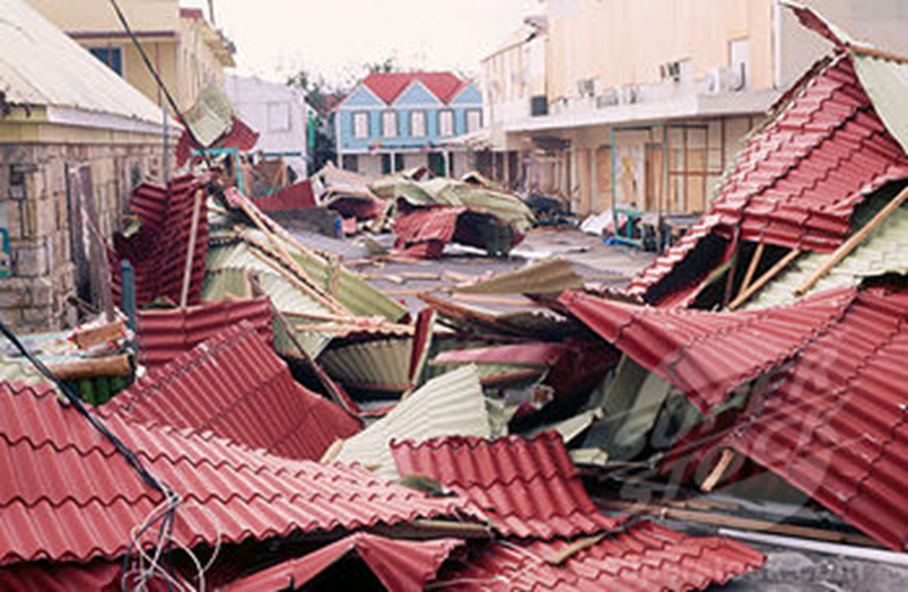
Downtown St. John’s, Antigua with piles of galvanize

Irma ranks as the strongest hurricane to pass within 69 miles of Antigua in the record books, which dates back to 1851. Luis ranks sixth and Dog ranks seventh. Interestingly, 9 of the 14 major hurricanes passing less than 70 miles of Antigua and Barbuda occurred in the pre-climate change era–1980. The second and third strongest were in 1899 and 1928 respectively.

Major hurricanes to pass within 69 miles of Antigua and Barbuda 1851 to 2021. Multiply by 1.61 to get km/hNOAA satellite image showing Barbuda in the eye of Irma 1:45 am (05:45 UTC) Wednesday, 6 Sep 2021

Congratulations to all who survived these hurricane nightmares, which I hate to call anniversaries. Let’s hope we don’t see another Luis or Irma-like major hurricane, which is perhaps wishful hoping. More realistically, let us prepare as much as possible to be hurricane strong i.e. hurricane resilient, so that we are able to put up a better fight to resist the next hurricane be it major or not.

Please follow or continue to follow me for hurricane history and all things weather and climate via TwitterFacebook and Instagram. Also, share this blog, if you found it useful.

Correction: In the original blog post published on September 6, 2021, I mistakenly calculated the current day value of the damage and loss caused by Hurricanes Dog, Luis and Irma. I updated the post to fix the mistakes on September 13. Apologies for the miscalculations.

CLICK HERE TO JOIN OUR WHATSAPP GROUP

NewsAmericasNow.com

BOSL & C.A.R.E. Renew Commitment To Youth Development – St. Lucia Times News

Black Immigrant Daily News

The content originally appeared on: St. Lucia Times News

– Advertisement –

Bank of Saint Lucia (BOSL) and the Centre for Adolescent Renewal & Education (C.A.R.E.) officially signed their annual commitment in support of youth development.

The official signing took place at the Bank’s Financial Centre on Bridge Street with the Executive Director, Dr. Karleen Mason signing on behalf of the institution.

Deputy Managing Director of Operations, Mr. Lyndon Arnold, signed the agreement on behalf of BOSL.

Both representatives expressed their respective organizations’ satisfaction with the relationship that has developed between them over the last few years.

– Advertisement –

Dr. Mason expressed appreciation on behalf of the staff and the management of the institution, particularly in the context of the current economic climate.

Speaking on the partnership, which dates back well over sixteen years, she indicated that, “the bank’s generous donation has come at a time when maintaining a conducive learningenvironment for our trainees is increasingly more challenging. Appropriate tools, equipment and consumable materials are now more expensive, but essential for the trainees in order to develop their competencies for Caribbean Vocational Qualification (CVQ) certification. This timely financial intervention is not only directly impacting the lives of our youth, but, by extension, the economic development of our country.”

The Bank and C.A.R.E., are institutions committed to the development of young people.Successful graduates of the C.A.R.E. programme are equipped to become employed orbecome entrepreneurs in their respective areas of skill.

SOURCE: Bank of Saint Lucia

– Advertisement –

NewsAmericasNow.com