Newsmaker: Demolition in Clifton brings support, criticism of Holness Loop Jamaica

Black Immigrant Daily News

The content originally appeared on: Jamaica News Loop News

This week’s featured development as Newsmaker of the Week just ended is the demolition of approximately numerous houses that were being built on lands reportedly captured and sold by unauthorised persons in Clifton, located in the Greater Bernard Lodge development area in St Catherine.

The demolition of the houses, ordered by Prime Minister Andrew Holness, created a firestorm, with numerous persons verbally attacking the Government for the move, while others agreed that it is time the authorities take a stand on the illegal capturing of land to build squatter settlements.

On the day of the destruction of the houses, home owners were left in tears, looking on helplessly as men on tractors worked to demolish the structures.

One woman, in a viral video, wept openly as she explained that she had paid a man $800,000 for her plot of land.

As the sitting of the House of Representatives drew to a close on Wednesday, it was announced that Prime Minister Andrew Holness would make a statement, leaving many to pontificate on the subject matter of such importance that the nation’s political leader would address Parliament on.

Then he outlined the trouble at hand facing the highly-touted Greater Bernard Lodge development area in St Catherine, which is being touted to become Jamaica’s first smart city.

When completed, the development is to be comprised of a mix of residential housing, commercial and light commercial activities in several blocks, as well as farming activities. It covers a total of 5,400 acres, with the majority (3,027 acres) being reserved for agriculture.

Holness said the informal community of Clifton which is made up of mostly former sugar workers and their descendants, took shape in the middle of the Bernard Lodge lands and predated the development plan.

He noted that since at least 2009, successive governments have taken the decision to regularise the community which falls in the St Catherine South constituency of Member of Parliament (MP) Fitz Jackson.

According to the prime minister, gangsters have captured lands in proximity to Clifton and have been preying on the residents.

Regarding the wider development, Holness said the National Security Council has taken a “great interest in looking at all elements of security in the area”.

He said following surveillance and the submission of a report, “we have discovered that in proximity to Clifton, there is an area that has been captured”.

Specifically, Holness said it has been determined that gangsters have been selling lots of land to people in the captured area.

“The National Security Council in reviewing the development plan, has observed an insidious and growing threat in the area, where alleged gangsters were capturing lands in the area adjoining the Clifton community, creating their own informal subdivision, and selling the lands under the false pretext of ownership or building on it themselves,” said Holness.

The prime minister said the Sugar Company of Jamaica (SCJ) Holdings Limited, which owns the lands, had given warnings and served notices for individuals to cease and desist. But, he said “the capturing and illegal construction has continued to the point where some 30 structures have been identified.”

Holness stressed that while the Government wants every Jamaican to own their own home, it must be done in an orderly and legal way.

“This illegal capturing and building on public or private land will not be tolerated,” he warned, adding that “we will not allow criminal gangs to create communities in the country”.

The prime minister told the House that directions had been given to the security forces to have a strong presence in the area to treat with any threats from any criminal element that may want to interrupt or exercise control or present any obstacle to the Government rectifying the situation.

Prime Minister Andrew Holness (file photo)

He said: “The JDF has deployed a forward-operating base metres away from this area and are conducting regular patrols, and has created a security blanket, including regular drone surveillance, to see whether there will be any movement by criminals in the area.

“Tomorrow (Thursday) the Government will act to demolish those structures that have been illegally erected,” stated Holness, adding that the Government will take steps to deal with structures that have been completed and are occupied.

“To be clear, they will not be allowed to stand,” he said.

Then the day of reckoning came on Thursday morning, when a joint police-military team offered supervision to demolition crews at the section of the Clifton community where the supposed illegal homes were being built.

Many of the unfinished homes were eventually destroyed, leaving behind rubbles of the structures that once stood in all their glory.

One of the homeowners was a 23-year-old woman who was grief-stricken as she spoke to the media.

“Mi all guh look work just fi come pay workman and everything. See it deh, everything gone. Mi nuh know weh fi duh nuh more,” said the woman as tears streamed down her face during a media interview.

She explained that her hairdresser had introduced her to a man who she, in turn, gave her tax registration number (TRN), identification card and the $800,000 for the land to build on. She also said she received a receipt from the individual.

In regards to the demolition, the young woman wailed that, “Nobody nuh gimmi nuh likkle warning, nutten dem nuh gimmi.”

She added that: “Mi just a pass and soldier a tell mi seh dem a lick dung di place.

“Mi jus’ haffi hurry up fi gah work… A $300 mi gah (go) a work wdh a mawning time, ’cause mi nuh have it. Mi a save fi build house yah suh, suh mi nuh know weh fi duh,” said the woman as she sobbed further.

Some of the affected individuals claimed that several civil servants were victims of the demolition exercise, or had unfinished houses on other areas of the land.

Parliamentarian Fitz Jackson, in whose South St Catherine constituency the Clifton community falls, told Loop News on Thursday that a probe is to be carried out into reports that people with documents to show that they were given approval by the authorities to be on sections of the Bernard Lodge property, were also affected by the demolition exercise that took place.

On social media, there were a mixture of perspectives on the issue, which generated heated, passionate discussions.

To the young lady crying in the media interview that has since gone viral, one Facebook user, Moe Moe Vari Bae, did not join the masses who criticised her for purchasing the illegal land.

“People really need to stop criticising the young lady,” the woman wrote.

“She (the grief-stricken homeowner) has a lot of ambition to build her own home… A nuff young people a try them way out. At least give her a notice or something… Nuff more out deh live pan capture land. Ppl (people) have no heart smh,” Moe Moe Vari Bae contended.

Not all felt any sympathy for the woman whose structure was demolished.

Fitz Jackson (file photo)

“Girl you can’t be so na?ve. ppl will take advantage of you,” stated Sabs Gee, another Facebook user.

Arnold Powell shared: “In 2022 yuh buying land without a lawyer and in which day and age yuh getting any land for $800K? Sorry for you, but not sorry.”

To the wider demolition exercise, social media user, Jermaine Robinson, commented: “I’m here wondering if this could have been handled differently.

“I understand the Government’s position, but couldn’t they have confiscated the houses and converted them to the Social Housing Programme, then pay the people for the materials used to build the houses?” he questioned.

“At least there wouldn’t be a total loss of the resources that went into building these houses. I hate to see scarce resources go to waste!!” Robinson indicated.

The conversation also took on the usual political tone.

Opined Shari Mason: “The constituency is a PNP (People’s National Party) constituency, so we know why the demolition was done. No heart Mr Holness!”

To that comment, Luke Henry said: “Law and order must be maintained in Jamaica! No to squatting, houses demolished, argument done. Congrats PM.”

But facing criticisms for the exercise that destroyed the unfinished homes, Holness journeyed to Clifton in Bernard Lodge to meet with the residents, who he promised an opportunity to obtain a mortgage and a legitimate home.

“The Government didn’t come acting to take away anybody’s land,” Holness told the residents in the community on Friday.

“Now, some of the houses that are already here, what we have said when we gave the direction to move with demolition is that if structures are incomplete, demolish those.

“… And you know why? Those structures are actually on agriculture land. If you look at it – and you have to be truthful – they are on the farm land, right,” he indicated and asked rhetorically.

Holness also advised that if the house has a roof or decking, it would not be demolished. The owners, he said, would have to, however, explain to the authorities how they came by the land, and the Government will try to facilitate them.

For his part, MP Jackson assured the residents that there will be a halt on all further demolition of unfinished structures, to facilitate dialogue with SCJ Holdings and other authorities.

During Holness’ visit there were tense exchanges, as some residents refuted claims by the prime minister in Parliament on Wednesday that gangsters had been selling the lands under the pretext of ownership, or building on them.

“When we examined the situation, we only acted when we were certain that certain steps were taken. So we had the evidence of the posting of stop orders,” Holness said before he was interrupted by a resident, who exclaimed, “That’s a lie!”

The prime minister maintained that the SCJ had posted stop orders “twice”. He added that he was informed that the SCJ had been “trying to find people who were doing the structures that were incomplete, (but) nobody would come forward.”

Again, the resident disputed that account.

Despite those assertions by the residents, Holness indicated that, “The Government has to allow you this flexibility (to discuss with SCJ Holdings), and this is why we say you will be able to access a mortgage.

“You’ll be able to buy your house, pay over time the same way you’re doing it now…”

He again assured the residents that they will not be left behind in the Greater Bernard Lodge Development.

“So you are in this community now without a road that is properly paved, without a road that has water and sewer line in it, in a community that is not planned.

“I’m saying to you let us change from this way of settlement to a different way of settlement, where things are orderly, and we won’t leave you out,” declared Holness.

Still, some social media users were critical of the prime minister’s visit to the Clifton community after the demolition was completed.

“So the man who ordered the destruction is also comforting the people who are affected by his instructions? Laughable,” commented Ainsley Walker, a Facebook user.

Natalee Simpson posted: “Going to the residents after the demolition will achieve what? Why you didn’t meet with them before and work on an agreement because the house frames were already up. This is cold behaviour PM!”

Peta Gaye Clarke, however, did not agree with those remarks.

“I notice (and) waited (on) some a unu… unu nuh get facts before unu chat… The ppl (people) dem wrong and if the PM neva guh dat wudda be a different story,” wrote Clarke.

Kerry Mentor commented: “I have no sympathy for these people, because the land set for agriculture and the land could never sell so cheaply, so the PM’s presence is just to show he understands, but I would demolish everything if I was PM.”

NewsAmericasNow.com

‘Hacker’ to deliver keynote at C&W’s cybersecurity forum

Black Immigrant Daily News

The content originally appeared on: Antigua News Room

Miami, FLORIDA (October 9th, 2022) — Public and private sector players are being encouraged to better safeguard their networks and systems against increasing threats from international cybercriminals.

C&W Business, the business-to-business arm of C&W Communications, will host two online forums this month aimed at helping governments, large businesses and individual entrepreneurs better protect their organisations and companies from online threats.

The webinars will feature controversial hacker-turned-computer security specialist Hector Monsegur – the man behind the Anonymous/LulzSec hacker collectives, as well as informant for the Federal Bureau of Investigation (FBI).

“Cybersecurity involves preventing, detecting, and responding to cyberattacks that can have wide-ranging effects on individuals, organisations, local communities, and entire countries. As the Caribbean’s leading service provider, we see it as our responsibility to inform, advise and educate about the varied elements of online security,” said Nicolas Collette, Vice President, B2B, C&W Communications.

“Hector once ruled the ‘hacktivist’ scene breaching security systems of major corporations and governments around the globe, and he will share the mindset of a hacker and how organizations can proactively protect themselves. He will also present the inside secrets of how hackers choose their targets, why hacking appeals to people, how hacking tools work, and how you can protect yourself and loved ones from vulnerability.”

Monsegur, also known by the online pseudonym Sabu, became an informant for the FBI after facing a sentence of 124 years in prison for his role in the LulzSec hacker collective intervening in the affairs of organisations such as News Corporation, Stratfor, UK and American law enforcement bodies and the Irish political party, Fine Gael.

Monsegur now works as an ethical hacker conducting penetration tests – authorized simulated cyberattacks on computer systems performed to evaluate the security of the system.

“Global cyber-attacks increased by 32% in 2022 when compared to 2021, with an all-time high being recorded in the second quarter of this year. The Caribbean and Latin America has also seen the largest increase in attacks, with research suggesting one out of twenty-three organisations impacted weekly – a 43% increase when compared to 2021,” added Collette.

“The cybercriminals are not slowing down and we must be proactive in our approach to safeguarding our networks to withstand any eventuality. With the right technologies in place, most attacks, even the most advanced ones, can be prevented and we are happy to be providing this timely forum for the exchange of knowledge and best practices in reducing and preventing cybercrime in our region.”

CLICK HERE TO JOIN OUR WHATSAPP GROUP

NewsAmericasNow.com

A l’OEA, 19 pays sont favorables ? une aide s?curitaire pour Ha?ti et ? un accord politique entre Ha?tiens

Black Immigrant Daily News

The content originally appeared on: Le Nouvelliste

19 pays de l’OEA, signataires d’une r?solution conjointe, ont, ? l’issue d’une r?union sur Ha?ti en marge de l’Assembl?e g?n?rale de l’Organisation des ?tats am?ricains, affirm? leur engagement ? aider les ha?tiens ? surmonter leurs d?fis s?curitaires et ont appel? la communaut? internationale ? fournir une assistance robuste en mati?re de s?curit? et au renforcement de la PNH, peut-on lire dans une version traduite de la r?solution disponible sur le site d’Affaires mondiales Canada.

<>, peut-on lire dans cette d?claration, faite lors de la 52?me Assembl?e g?n?rale de l’OEA, ? Lima, au P?rou, le 7 octobre 2022.

<>, peut-on lire dans cette d?claration.

Au plan politique, les signataires soulignent que sans un accord politique au terme d’un dialogue inclusif, le r?tablissement de la s?curit? restera un d?fi. <>, selon cette d?claration.

<>, indique cette d?claration.

La d?claration conjointe de ces pays dont les Etats-Unis et le Canada intervient quasiment le m?me jour de la publication dans le journal officiel Le Moniteur d’une r?solution du Conseil des ministres autorisant le Premier ministre Ariel Henry ? <>.

R?agir ? cet article

Please enable JavaScript to view the comments powered by Disqus.

NewsAmericasNow.com

Antonio Guterres exhorte le Conseil de s?curit? ? examiner d’urgence la demande de d?ploiement de force arm?e en Ha?ti et soutient le dialogue inter-ha?tien

Black Immigrant Daily News

The content originally appeared on: Le Nouvelliste

Le secr?taire g?n?ral de l’ONU, Antonio Guterres, <> par la situation en Ha?ti, exhorte la communaut? internationale et le Conseil de s?curit? ? examiner d’urgence la demande du gouvernement ha?tien pour le d?ploiement d’une force arm?e internationale sp?cialis?e en Ha?ti et encourage les acteurs Ha?tiens ? un dialogue inclusif en vue de baliser l’avenir, a indiqu? son porte-parole, Stephane Dujarric, dimanche 9 octobre 2022.

<>, peut-on lire dans une d?claration en anglais de son porte-parole Stephane Dujarric, dimanche 9 octobre 2022.

<< Le Secr?taire g?n?ral a soumis aujourd’hui au Conseil de s?curit? une lettre pr?sentant des options pour un soutien renforc? ? la s?curit? en Ha?ti, comme demand? par le Conseil dans sa r?solution 2645 (2022), a ?galement inform? le porte-parole de Antonio Guterres qui lui aussi, comme les 19 pays signataires de la d?claration sur Ha?ti ? l’OEA, appelle ? un dialogue entre les Ha?tiens.

Le secr?taire g?n?ral appelle les parties prenantes ha?tiennes ? d?passer leurs diff?rences et ? s’engager, sans plus attendre, dans un dialogue pacifique et inclusif sur une voie constructive pour l’avenir. Les Nations Unies sont aux c?t?s du peuple ha?tien et soutiendront les efforts visant ? ?tablir un consensus, ? r?duire la violence et ? promouvoir la stabilit? dans le pays, a indiqu? Stephane Dujarric, porte-parole du secr?taire g?n?ral de l’ONU, <> par la situation en Ha?ti.

Le secr?taire g?n?ral reste gravement pr?occup? par la situation en Ha?ti, qui fait face ? une ?pid?mie de chol?ra dans un contexte de d?t?rioration dramatique de la s?curit? qui a paralys? le pays, a-t-il dit.

Le blocage du terminal p?trolier de Varreux a paralys? les services essentiels n?cessaires pour emp?cher la propagation rapide de la maladie, notamment la distribution d’eau potable. Une fois encore, les secteurs les plus vuln?rables de la population ha?tienne sont ceux qui sont le plus durement touch?s. La priorit? doit ?tre de sauver des vies, a soutenu Stephane Dujarric, porte- parole du patron de l’ONU, Antonio Guterres.

La d?claration du porte-parole parole du secr?taire g?n?ral de l’ONU intervient apr?s la d?claration conjointe de 19 pays dont les Etats-Unis et le Canada affirmant leur <>.

Le 6 octobre, le Conseil des ministres a autoris? le Premier ministre Ariel Henry ? <>.

R?agir ? cet article

Please enable JavaScript to view the comments powered by Disqus.

NewsAmericasNow.com

Teens found not guilty of rape

Black Immigrant Daily News

The content originally appeared on: Antigua News Room

STATE MEDIA: Two teenagers have been acquitted of rape following a trial this week.

A jury of 6 females and 3 males deliberated for some two hours before returning their verdict that the two 19 year old males were not guilty.

They had been charged when they were both 16 following an incident on the 26th of March, 2019.

They had been accused of raping a 14 year old girl on the farm of one of the country’s secondary schools.

However, the two males had consistently countered that the complainant had consented to sexual intercourse.

The two young men were represented by attorney Wendel Robinson and the case was tried before Justice Colin Williams.

CLICK HERE TO JOIN OUR WHATSAPP GROUP

Editor

NewsAmericasNow.com

Shirtless Corentyne man attacked by bees in his yard

Black Immigrant Daily News

The content originally appeared on: INews Guyana
Injured; Harrynarine Ramdas

A Berbice boat owner is now hospitalised after being stung by Africanized bees.

Injured is 47-year-old Harry Narine Ramdas called known as “Eno” of Corriverton, Region Six (East Berbice/Corentyne).

Ramdas received scores of stings to his upper body while he was in his backyard on Saturday.

According to the injured man, at about 14:30h, he was shirtless and had gone to urinate at the back of his yard when he was attacked by a swarm of bees.

“After me done ‘leak’ [urinate]’, dem bee them start come from the sawmill over. And me na bin get on shirt and a whole sixty-something ah dem bite me from me head to me belly,” Ramdas related in his Corentyne dialect.

He noted that at the time of the attack, his nephew was about 40 feet away, cooking but was unhurt.

After the attack, Ramdas was rushed to the Skeldon Hospital, where he was admitted to be treated and remains as a patient. His condition is listed as stable.

According to the boat owner, there is a sawmill next to his house with several derelict vehicles in the compound. He believes the bees inhabit them.

“Me scared bad, me can’t even trust fuh go at the back yard. And right now, me get lil kids,” the stressed.

NewsAmericasNow.com

Medewerkster gokbedrijf verduistert gelden

Black Immigrant Daily News

The content originally appeared on: De Ware Tijd Online

WANICA — Chifany S. is wegens verduistering ingesloten. Ze heeft op verschillende momenten tussen april en oktober een groot bedrag

NewsAmericasNow.com

Putin calls Kerch Bridge attack ‘a terrorist act’ by Kyiv Loop Jamaica

Black Immigrant Daily News

The content originally appeared on: Jamaica News Loop News

ZAPORIZHZHIA, Ukraine (AP) — Russian President Vladimir Putin on Sunday called the attack that damaged the huge bridge connecting Russia to its annexed territory of Crimea “a terrorist act” masterminded by Ukrainian special services.

The Kerch Bridge, which holds important strategic and symbolic value to Russia in its faltering war in Ukraine, was hit a day earlier by what Moscow has said was a truck bomb. Road and rail traffic on the bridge were temporarily halted, damaging a vital supply route for the Kremlin’s forces.

“There’s no doubt it was a terrorist act directed at the destruction of critically important civilian infrastructure of the Russian Federation,” Putin said during a meeting with the chairman of Russia’s Investigative Committee, Alexander Bastrykin. “And the authors, perpetrators, and those who ordered it are the special services of Ukraine.”

Bastrykin said Ukrainian special services and citizens of Russia and other countries took part in the attack. He said a criminal investigation had been launched into an act of terror.

“We have already established the route of the truck,” he said, saying it had been to Bulgaria, Georgia, Armenia, North Ossetia and Krasnodar, a region in southern Russia.

In Kyiv, presidential adviser Mikhail Podolyak called Putin’s accusation “too cynical even for Russia.”

“Putin accuses Ukraine of terrorism?” he said. “It has not even been 24 hours since Russian planes fired 12 rockets into a residential area of Zaporizhzhia, killing 13 people and injuring more than 50. No, there is only one state terrorist and the whole world knows who he is.”

Podolyak referred to missile strikes on the city of Zaporizhzhia overnight that brought down part of a large apartment building. The six missiles were launched from Russian-occupied areas of the Zaporizhzhia region, the Ukrainian air force said.

The region is one of four Russia claimed as its own this month, though its capital of the same name remains under Ukrainian control.

Russia has suffered a series of setbacks nearly eight months after invading Ukraine in a campaign many thought would be short-lived. In recent weeks, Ukrainian forces have staged a counteroffensive, retaking areas in the south and east, while Moscow’s decision to call up more troops has led to protests and an exodus of hundreds of thousands of Russians.

Recent fighting has focused on the regions just north of Crimea, including Zaporizhzhia. Ukrainian President Volodymyr Zelenskyy lamented the latest attack.

“Again, Zaporizhzhia. Again, merciless attacks on civilians, targeting residential buildings, in the middle of the night,” he wrote. At least 19 people died in Russian missile strikes on apartment buildings in the city on Thursday.

“From the one who gave this order, to everyone who carried out this order: They will answer,” he added.

Ukrainian Foreign Minister Dmytro Kuleba called the attacks on civilians in Zaporizhzhia a war crime and urged an international investigation.

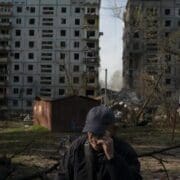
Stunned residents watched from behind police tape as emergency crews tried to reach the upper floors of a building that took a direct hit. A chasm at least 12 meters (40-feet) wide smoldered where apartments had once stood. In an adjacent apartment building, the missile barrage blew windows and doors out of their frames in a radius of hundreds of feet. At least 20 private homes and 50 apartment buildings were damaged, a local official said.

Regional police reported Sunday afternoon that 13 people had been killed and more than 60 wounded in the latest Zaporizhzhia attack, at least 10 of them children.

Tetyana Lazunko, 73, and her husband, Oleksii, took shelter in the hallway of their top-floor apartment after hearing air raid sirens. The explosion shook the building and sent their possessions flying. Lazunko wept as the couple surveyed the damage to their home of nearly five decades.

“Why are they bombing us? Why?” she said.

Others called the missile attack relentless.

“There was one explosion, then another one,” 76-year-old Mucola Markovich said. In a flash, the fourth-floor apartment he shared with his wife was gone.

“When it will be rebuilt, I don’t know,” Markovich said. “I am left without an apartment at the end of my life.”

In another nearby neighborhood ravaged by a missile, three volunteers dug a shallow grave for a German shepherd killed in the strike.

Abbas Gallyamov, an independent Russian political analyst and a former speechwriter for Putin, said prior to his declaration that it was a terror attack, the Russian president had not responded forcefully enough to satisfy angry war hawks. The attack and response, he said, has “inspired the opposition, while the loyalists are demoralized.”

“Because once again, they see that when the authorities say that everything is going according to plan and we’re winning, that they’re lying, and it demoralizes them,” he said.

Putin personally opened the Kerch Bridge in May 2018 by driving a truck across it as a symbol of Moscow’s claims on Crimea. No one has claimed responsibility for damaging the 12-mile (19-kilometer) bridge, the longest in Europe.

Traffic over the bridge was temporarily suspended after the blast, but both automobiles and trains were crossing again on Sunday. Russia also restarted a car ferry service.

Crimea is a popular vacation resort for Russians and people trying to drive to the bridge and back onto the Russian mainland encountered hours-long traffic jams Sunday.

“We were a bit unprepared for such a turn,” said one driver, Kirill Suslov, sitting in traffic. “That’s why the mood is a bit gloomy.”

The Institute for the Study of War said videos of the bridge indicated that damage from the explosion “is likely to increase friction in Russian logistics for some time” but not cripple Russia’s ability to equip its troops in Ukraine.

In other news:

— In the devastated Ukrainian city of Lyman, which was recently recaptured after a months-long Russian occupation, Ukrainian national police said authorities have exhumed the first 20 bodies from a mass burial site. Initial indications are that around 200 civilians are buried in one location, and that another grave contains the bodies of Ukrainian soldiers. The civilians, including children, were buried in single graves, while members of the military were buried in a 40-metre-long trench, according to police.

— The Ukrainian military said Sunday that fierce clashes were taking place around the cities of Bakhmut and Avdiivka in the eastern Donetsk region, where Russian forces have claimed some gains. The General Staff of the Armed Forces of Ukraine did not acknowledge any loss of territory but said “the most tense situation” has been observed around those two cities.

— The head of the International Atomic Energy Agency, meanwhile, said that the Zaporizhzhia nuclear power plant, Europe’s biggest, had been reconnected to the power grid after losing its last external power source early Saturday following shelling. IAEA Director-General Rafael Grossi tweeted that the reconnection was “a temporary relief in a still-untenable situation.”

___

By JUSTIN SPIKE and ADAM SCHRECK, Associated Press

Schreck reported from Kyiv.

NewsAmericasNow.com

Florida school shooter may have been his own worst witness Loop Jamaica

Black Immigrant Daily News

The content originally appeared on: Jamaica News Loop News

FORT LAUDERDALE, Fla. (AP) — It’s possible Florida school shooter Nikolas Cruz talked himself into a death sentence.

Prosecutors played video last week at Cruz’s penalty trial of jailhouse interviews he did this year with two of their mental health experts. In frank and sometimes graphic detail, he answered their questions about his massacre of 17 people at Parkland’s Marjory Stoneman Douglas High School on Feb. 14, 2018 — his planning, his motivation, the shootings.

While it can’t be known what the 12 jurors are thinking, if any are wavering between voting for death or life without parole, his statements to Dr. Charles Scott, a forensic psychiatrist, and Robert Denney, a neuropsychologist, did not help his cause.

“All of this made Cruz himself perhaps one of the state’s best witnesses,” said David S. Weinstein, a Miami defense attorney and former prosecutor who has been monitoring the trial.

The jury will likely decide Cruz’s fate this week. For the 24-year-old to get a death sentence, the jury must be unanimous on at least one victim. But if all 17 counts come back with at least one vote in favor of life in prison, then that would be his sentence. Closing arguments are scheduled Tuesday, with deliberations beginning Wednesday.

Because Cruz’s defence is that his birth mother’s heavy drinking during pregnancy left him brain damaged, prosecutors could have experts examine him for their rebuttal case.

Scott and Denney interviewed him separately for several hours. In each, Cruz sat across the table, handcuffed, a sweater draped over his chest. He sometimes asked for a pen and paper to add diagrams and drawings to his explanations.

“The question is: What will the jury take away from the interviews? Cold-blooded killer who was vengeful and excited about the murders, or a person so hopelessly deranged that he can’t be anything but crazy?” said Bob Jarvis, a professor at Nova Southeastern University’s law school.

The thoughts would return when he watched violent videos, particularly documentaries about mass shootings at Colorado’s Columbine High School, Virginia Tech and elsewhere, he said.

HOW DID CRUZ PLAN THE MASSACRE?

“I did my own research,” Cruz told Scott. “I studied mass murderers and how they did it, their plans, what they got and what they used.”

He detailed the lessons he learned: Watch for would-be rescuers coming around corners, keep some distance from your targeted victims, attack as fast as possible — and “the police didn’t do anything.”

“I have a small opportunity to shoot people for maybe 20 minutes,” Cruz said.

HOW DID CRUZ PREPARE?

He told Scott he put his AR-15-style semi-automatic rifle in a bag the night before and slipped its magazines into a shooting vest. He adjusted the gun’s sights and imagined what the recoil would feel like.

“I didn’t get any sleep,” Cruz said.

He donned the burgundy polo shirt he received when he was a member of the Stoneman Douglas Junior Reserve Officer Training Corps program so he could escape by mingling with fleeing students.

“If I had all my (shooting) gear on, they would have called the cops,” Cruz said.

When he set out at 2 p.m., he told the Uber driver he was in the school orchestra and the bag carried his instrument.

WHAT DID CRUZ DO WHEN HE ARRIVED?

“I walked through the gates. Hopefully, there would be no security guards, but I was wrong,” Cruz told Scott. “I was looking at the guy and he was watching me.”

When Cruz attended Stoneman Douglas, guards frequently checked him for weapons because of his erratic and sometimes violent behavior. When he was expelled a year before the shooting, a guard predicted he would eventually return and shoot people.

Fearing he’d been discovered, Cruz sprinted into a three-story classroom building and quickly assembled his weapon. He told a student who happened upon him to flee because something bad was about to happen.

He then went floor to floor, shooting down hallways and into classrooms, firing 140 shots in all.

“I thought they would scream,” Cruz said about his first three victims. He shot them point-blank outside a locked classroom door. “It was more like they passed out and blood came pouring out of their head. It was really nasty and sad to see.”

But he continued.

“I think I showed mercy to three girls. I was going to walk away, but they showed nasty faces and I went back,” Cruz said. “I thought they were going to attack me.”

Cruz shot several of his victims a second time after they fell, including his final one — a student writhing from a leg wound. He said the boy “gave me a nasty look. A look of anger.”

“His head blew up like a water balloon,” Cruz said.

WHY DID CRUZ STOP SHOOTING?

Students and teachers fled the building or locked themselves in classrooms. The third-floor hallway was now empty except for victims.

“I couldn’t find anyone to kill,” he said. “I didn’t want to do it anymore and I didn’t think there was anyone else in the building.”

He dropped his gun and vest on the stairwell and fled. He was captured an hour later — the police officer had been looking for a young male in a Stoneman Douglas ROTC polo.

CRUZ’S FINAL SAY

As Denney was finishing the final interview, he asked Cruz if there was anything else he should know. Cruz thought for 10 seconds before responding: “Why I chose Valentine’s Day.”

“Because I thought no one would love me,” Cruz explained. “I didn’t like Valentine’s Day and I wanted to ruin it for everyone.”

“Do you mean for the family members of the kids that were killed?” Denney asked.

“No, for the school,” Cruz replied.

The holiday will never be celebrated there again, he said.

By TERRY SPENCER, Associated Press

NewsAmericasNow.com

‘Pandemic of… violence a public health matter’, says commish Loop Jamaica

Black Immigrant Daily News

The content originally appeared on: Jamaica News Loop News

In branding the state of interpersonal violence locally as a pandemic, Police Commissioner, Major General Antony Anderson, has declared that the situation is also indicative of a public health matter because so many persons are being affected.

Anderson, in pointing to recent incidents of violence in schools, said children are among those being affected by the perceived pandemic.

“The pandemic of interpersonal violence is a public health matter and is infecting and affecting several demographics in our society, including our children,” he posited.

“We must teach our children to deal with these conflicts,” said Anderson at a recent police press conference in St Andrew

Since the ending of the COVID-19 protocols and the return to face-to-face classes in schools, the commissioner said the constabulary has taken note of some violent encounters in schools that have become the subject of viral videos.

Among those videos were the moments before and after 16-year-old Kingston Technical High School student, Michion Campbell, was stabbed by a 17-year-old schoolmate of hers.

The latter child has since been charged with murder, and she will remain in police custody until at least November 9.

“We also recall the national conversation in March this year when a student in Trelawny was stabbed to death by another student during a dispute over a ‘guard ring’,” Anderson recounted.

The victim in that incident was 16-year-old Kamal Hall, a fifth form student of William Knibb Memorial High School in Trelawny, who was allegedly killed by another male student after he accused Kamal of stealing his guard ring, something which is usually used by criminals as a perceived form of protection.

Anderson said: “These encounters have been the source of discussions in various quarters, but for us (the police), we have not only been intervening in, but also seeking to prevent these acts of violence.”

He said since the start of the last academic year in schools, the Jamaica Constabulary Force (JCF), through its Community Safety and Security Branch (CSSB), has deployed 245 school resource officers (SROs) in institutions that were identified as potential flash points under the Safe Schools Programme.

“However, this once again underscores a problem that I have sought to shed light on many times; the problem of our culture of violence in the resolution of interpersonal conflicts.

“Over 15 per cent of the murders committed so far this year are attributed to poorly managed interpersonal conflicts,” said Anderson.

He outlined two such violent interpersonal incidents that resulted in deaths.

One was the murder of 52-year-old female pastor, Michelle Roache, who was reportedly stabbed to death by her brother in Content Gardens, Ocho Rios, St Ann on Monday night.

An argument over the lack of electrical supply to Roache’s portion of a house she shared with her brother reportedly led to her death.

“In Port Royal in Kingston East on Tuesday morning, a 41-year-old fisherman was mowed down with a vehicle during another dispute,” outlined Anderson, who repeated his call for better conflict resolution strategies.

The motorist who was involved in the Port Royal incident has since been detained in relation to that matter.

NewsAmericasNow.com