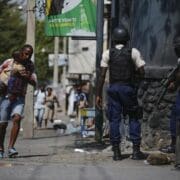
Lawyers: US Wrongly Deported Client to Haiti

Black Immigrant Daily News

The content originally appeared on: Caribbean News Service
FILE – Haitians deported from the United States deplane at the Toussaint Louverture International Airport in Port au Prince, Haiti, Sept. 19, 2021.

Paul Pierrilus was deported two years ago from the U.S. to Haiti, where he has been trying to survive in a chaotic and violent country where he wasn’t born and had never lived.

Both his parents are Haitian, but they emigrated to the French Caribbean territory of St. Martin where Pierrilus was born. The family did not apply for citizenship for him in either Haiti or St. Martin and later moved to the U.S. when he was 5 years old. He grew up in New York speaking English.

Deported — after a long delay — because of a drug conviction two decades ago, Pierrilus is now in Haiti, where he does not speak Haitian Creole, has been unable to find work, and has little savings left as he hopes for a way to leave the increasingly unstable country.

“You have to be mentally strong to deal with this type of stuff,” Pierrilus said. “A country where people get kidnapped every day. A country where people are killed. You have to be strong.”

The 42-year-old financial consultant spends most of his days locked inside a house reading self-help, business and marketing books in a neighborhood where gunshots often echo outside.

Lawyers for Pierrilus in the U.S. are still fighting his deportation order, leaving him in legal limbo as the Biden administration steps up deportations to Haiti despite pleas from activists that they be temporarily halted because of the Caribbean country’s deepening chaos.

His case has become emblematic of what some activists describe as the discrimination Haitian migrants face in the overburdened U.S. immigration system. More than 20,000 Haitians have been deported from the U.S. in the past year as thousands more continue to flee Haiti in risky boat crossings that sometimes end in mass drownings.

Cases like Pierrilus’ in which people are deported to a country where they have never lived are unusual, but they happen occasionally.

Jimmy Aldaoud, born of Iraqi parents at a refugee camp in Greece and whose family emigrated to the U.S. in 1979, was deported in 2019 to Iraq after amassing several felony convictions. Suffering health problems and not knowing the language in Iraq, he died a few months later in a case often cited by advocates.

Pierrilus’ parents took him to the United States so they could live a better life and he could receive a higher-quality education.

When he was in his early 20s, he was convicted of selling crack cocaine. Because he was not a U.S. citizen, Pierrilus was transferred from criminal custody to immigration custody where he was deemed a Haitian national because of his parentage and ordered deported to Haiti.

Pierrilus managed to delay deportation with several legal challenges. Because he was deemed neither a danger to the community nor a flight risk, he was released, issued a work authorization and ordered to check with immigration authorities yearly.

He went on to become a financial planner.

Then, in February 2021, he was deported without warning, and his lawyers don’t know exactly why his situation changed.

Lawyers for the nonprofit Robert F. Kennedy Human Rights organization in Washington have taken up his cause. “We demand that the Biden administration bring Paul home,” organization attorney Sarah Decker said.

French St. Martin does not automatically confer French citizenship to those born in its territory to foreign parents, and his family did not seek it. They also did not formally seek Haitian citizenship, which Pierrilus is entitled to.

Though he could obtain Haitian citizenship, his lawyers have argued that he is not currently a Haitian citizen, had never lived there and should not be deported to a county with such political instability.

U.S. Immigration and Customs Enforcement said in a brief general statement to The Associated Press that each country has an obligation under international law to accept the return of its nationals who are not eligible to remain in the U.S. or any other country.

In 2005, the Board of Immigration Appeals dismissed an appeal by Pierrilus’ previous attorneys to halt his deportation, saying “it is not necessary for the respondent to be a citizen of Haiti for that country to be named as the country of removal.” Decker, his current attorney, disagrees with that finding.

Pierrilus said that while he was being deported, he told immigration officers, “I’m not going anywhere. I’m not from where you’re trying to send me.”

Overpowered and handcuffed, he said he stopped resisting. As he boarded the flight, he recalled that women were screaming and children wailing.

After being processed at the airport, someone lent Pierrilus a cellphone so he could call his parents. They gave him contacts for a family friend where he could temporarily stay. Since then, gang violence has forced him to bounce through two other homes.

Warring gangs have expanded their control of territory in the Haitian capital to an estimated 60% since the 2021 assassination of President Jovenel Moise, pillaging neighborhoods, raping and shooting civilians.

The U.N. warned in January that Haitians are suffering their worst humanitarian emergency in decades. More than 1,350 kidnappings were reported last year, more than double the previous year. Killings spiked by 35%, with more than 2,100 reported.

Pierrilus rarely goes out and relies on his faith for hope. He says he stopped going to church after he saw a livestreamed service in April 2021 in which gangs burst into the church and kidnapped a pastor and three congregants.

He talks to his parents at least once a week, focusing on the progress of his case rather than on challenges in Haiti.

Donate At Caribbean News Service, we do not charge for our content and we want to keep it that way. We are seeking support from individuals and organisations so we can continue our work & develop CNS further.


NewsAmericasNow.com

CARICOM Skilled Workers Programme to be launched with Secondary School Teacher Attachments

Black Immigrant Daily News

The content originally appeared on: Caribbean News Service

The Caribbean Community (CARICOM) Secretariat launches a CARICOM Skilled Workers Programme on Monday with a short hybrid ceremony at its Headquarters in Georgetown Guyana.

CARICOM Secretary-General, Dr. Carla Barnett and the Head of Delegation of the European Union to Barbados, the Eastern Caribbean States, the OECS and CARICOM/CARIFORUM, Ambassador Malgorzata Wasilewska are scheduled to give remarks at Monday’s launch.

Renee Atwell, Dean, CARICOM Youth Ambassador Programme and other officials are also expected to give remarks.

The Skilled Workers Programme, which is supported by the European Union, is intended to provide opportunities for the learning of best practices in the administration of the regimes of the CARICOM Single Market and Economy. It is hoped there will be the development of practical skills through the work-related attachments to assist Member States to implement the CSME and decisions of the Organs and Bodies of the Community. The programme is also intended to create effective advocates for CARICOM integration through the exposure given to participants. Thus, the targeted groups have been selected for the critical role they can play in implementing and sustaining training and advocacy at the national level in respect of the CSME, in particular, the Free Movement of CARICOM skilled nationals.

The launch of the programme will coincide with the component for Secondary School Teachers. Nineteen CARICOM teachers are being placed on two-week attachments to Secondary Schools in Barbados, Belize, Guyana, St. Kitts and Nevis and Trinidad and Tobago during the period 6-17 March 2023.

Other components of the Skilled Workers Programme which will be rolled out later this year involve, attachments to the CARICOM Secretariat for CARICOM Youth Ambassadors; attachments to other CARICOM Member States for Border Control Officers, and National CSME Focal Points.

Monday’s launch will have both in-person participation at the CARICOM Secretariat and other stakeholders joining online.

Donate At Caribbean News Service, we do not charge for our content and we want to keep it that way. We are seeking support from individuals and organisations so we can continue our work & develop CNS further.


NewsAmericasNow.com

Arif Cooper, Jamaican Disc Jockey, Dies After Collapsing At Party

Black Immigrant Daily News

The content originally appeared on: Urban Islandz

Tributes pour in after popular Jamaican Disc Jockey Arif Cooper passed away.

DJ Arif Cooper was deejaying at a party on Saturday night when he collapsed and died, reports claimed in the wee hours of Sunday morning. The entertainer was well known in the music fraternity as one of Jamaica’s best DJs and as a radio broadcaster on the local radio station, FAME 95FM.

According to several news reports, Cooper reportedly died from a suspected heart attack. Details of the medical condition are scarce, but fans at an event held at the Ranny Williams Entertainment Centre in St Andrew on Saturday night says that the disc jockey appeared normal while playing a set at the party before he collapsed and appeared to be having a “seizure.” He was rushed to a local hospital for treatment.

Multiple sources confirmed with Urban Islandz that Cooper was pronounced dead at the hospital by medical staff.

Arif Cooper first began deejaying in the thriving 1990s music culture starting in 1991, but his schooling in music came much earlier thanks to his father, Michael Ibo Cooper, the founder and a member of the legendary reggae band Third World.

Cooper spent much time with his father as a child and benefitted from learning music by playing the piano, and later he would go on to be able to study many popular artists like Stevie Wonder, Bob Marley, Bruce Springsteen, and Sting.

He later joined his father on the road as a crew member for Third world as the band performed across the world.

Cooper later set out on his solo DJ career, starting as a house party DJ but quickly rose in popularity. He, along with several others, founded the popular Syndicate Disco that operated from 1992-1997, and he later left as he took on gigs around the world as a DJ for clubs, parties, and shows in New York, Miami, Los Angeles, Houston, Atlanta, and Japan.

Over the course of his three-decade career, Cooper toured the world as DJ for artists like Sean Paul, Voice Mail, and Alaine and he has also worked with Vybz Kartel, Tami Chynn, Jah Cure, Elephant Man, Baby Cham, Demarco, Aidonia, Konshens, Wayne Marshall, and Christopher Martin.

Sean Paul shared a tribute for the artist on Sunday morning.

“Jah know, still cyaah believe I woke up to this news,” Sean Paul wrote. “So much great musical memories shared with this legendary producer and DJ. Condolences to his family and friends.”

NewsAmericasNow.com

Nicki Minaj Performs With Lil Wayne, Link Up With Skeng At Rolling Loud 2023

Black Immigrant Daily News

The content originally appeared on: Urban Islandz

Lil Wayne brought out Nicki Minaj during his set at Rolling Loud California last night.

Skeng is rubbing shoulders with some of the greatest as he was spotted enjoying the company of Nicki Minaj and Lil Wayne on Saturday night after the latter appeared as a guest during Lil Wayne’s set. The “Red Ruby Da Sleeze” rapper, along with 2 Chainz and Gudda Gudda, all joined Lil Wayne at Rolling Loud California. Excited fans were treated to the Young Money leader and the Queen of Rap performing their hits “Bedrock,” “High School,” “Truffle Butter,” and others.

Wearing a sexy tie-dye mini-dress and sporting the pink and red wig from her “Red Ruby Da Sleeze” launch, the new label owner and Wayne began their joint set to “High School.”

“Ladies and gentlemen, no need for an introduction,” Lil Wayne says as she waves his hand. “The Motherf***king Queen,” he added.

Lil Wayne and Nicki Minaj / @nickiminaj IG

“Cali make some mf noise right now, where my bad b***hes at, where my vatos at? Where my real n****s at,” Minaj says to the audience before the instrumental for the song comes on to thunderous screams.

Nicki Minaj also performed her song “Super Freaky Girl” before jumping into her latest No. 1 track, “Red Ruby Da Sleeze,” which she performed for the first time since the song was released last Friday.

“I just put out this song yesterday, so Imma just let it rock,” Minaj says. The rapper also stopped the song halfway after calling out the deejay, “is the song offbeat?” she asks.

“I said I don’t f**k with horses. I said it’s 700 horses when we fixing to leave but I don’t f**k with horses since Christopher Reeves,” the rapper clarified one of the lyrics of the track.

The rapper had seemingly planned a solo performance for fans which she cut short due to audio issues.

“Stop, what the f**k is good. Yow Juice, fix my mf-ing mix,” Minaj says as the song “Fendi Prints” came on instead of “Red Ruba Da Sleeze” as she directed.

Nicki Minaj, Lil Wayne & Skeng / @nickiminaj IG

“You know I don’t get down like that when the President is in the building, you know I don’t f**k when the GOAT is in the building, I gotta do this sh*t right…you know when Young Money in the building the Queen gotta show the f**k out right,” she added.

The Trinidad-born rapper appeared annoyed at one point as she rolled her eyes when “Chun Li” came on and stopped several times. The audio chips in and out, and it becomes awkward as Lil Wayne tries to talk to fans, but the music comes on abruptly before cutting out again.

In the meantime, Nicki Minaj was all smiles backstage as she posed for photos with Skeng, Mac Maine, and others.

There are reports that she has signed Skeng Don as one of four new artists to her new label, which she announced this weekend. Skeng has not confirmed the reports. On the other hand, the label name has not been revealed yet, but it will be an imprint of Republic Records, the artist shared as she also named veteran A&R Wendy Goldstein, who formerly served as co-president of Republic Records, as head of her label. It’s unclear if Goldstein has left her substantive position at Republic to take on Minaj’s label.

Nicki Minaj also shared a few clips from her appearance.

NewsAmericasNow.com

CTU and UPU to promote digital transformation in postal services in the Caribbean

Black Immigrant Daily News

The content originally appeared on: Caribbean News Service
Rodney Taylor, Secretary-General of the Caribbean Telecommunications Union, and Masahiko Metoki, Director General of the United Nations Universal Postal Union, at the signing of an MoU between the organisations in Geneva, Switzerland.

The Caribbean Telecommunications Union (CTU) and the United Nations Universal Postal Union (UPU) signed a Memorandum of Understanding (MoU) to collaborate and promote digital transformation in postal services in the Caribbean region.

The MoU was signed by the heads of both organisations, Rodney Taylor, Secretary-General of the CTU and Mr. Masahiko Metoki, Director General of the UPU.

Under the terms of the MoU, the CTU and the UPU will collaborate to promote and carry out the deployment of the UPU’s Digital Readiness for E-commerce assessment in the Caribbean in order to contribute to the harmonisation of the region’s digital transformation agendas. The aim is to provide seamless end-to-end e-commerce and e-government services throughout the Caribbean Region.

Speaking from the UPU headquarters in Geneva, SG Rodney Taylor stated, “The partnership between CTU and UPU will be a crucial element in promoting digital transformation and e-commerce in the Caribbean region. We believe that the deployment of the UPU’s initiatives will greatly benefit the citizens and businesses in the region.”

The MoU will also explore the adoption of the UPU’s sponsored “.POST” top-level domain within the postal sector in the region in order to enhance the authenticity and cybersecurity of the associated services provided by the UPU.

The parties further agreed to the implementation of the UPU’s Connect.post initiative in the region with a view to ensuring complete internet access of all of the region’s post offices.

Importantly, the collaboration will greatly assist in the CTU’s efforts to bridge the digital divide and promote digital inclusion in the Caribbean and to provide opportunities for growth and development in the postal and telecommunications sectors.

The CTU and the UPU are committed to working together to achieve their shared goals and objectives, so as to ensure the people of the region benefit from the opportunities offered by their nations becoming digital economies.

The aim of the UPU is, among others, to secure the organisation and improvement of postal services and to promote the development of international collaboration and technical cooperation.

The CTU looks forward to deepening ties with the UPU through the execution of this important MOU.

Donate At Caribbean News Service, we do not charge for our content and we want to keep it that way. We are seeking support from individuals and organisations so we can continue our work & develop CNS further.


NewsAmericasNow.com

Haiti: Surge in gun trafficking fuels spike in gang violence

Black Immigrant Daily News

The content originally appeared on: Caribbean News Service
UNICEF/U.S. CDC/Roger LeMoyne Homicides and kidnappings have increased dramatically in Haiti, particularly in the capital, Port-au-Prince (pictured).

Increasingly sophisticated and high-calibre firearms and ammunition are being trafficked into Haiti, fuelling an ongoing surge of gang violence that has plagued residents for months, according to a new UN assessment released on Thursday.

The UN Office on Drugs and Crime (UNODC) report, Haiti’s criminal markets: mapping trends in firearms and drug trafficking, warns that a recent increase in arms seizures alongside intelligence and law enforcement reporting, suggests trafficking of weapons is on the rise.

‘Volatile situation’

“By providing a rapid assessment of illicit firearms and drug trafficking, this UNODC study seeks to shed light on the trafficking flows enabling gangs in Haiti and fuelling further violence in a volatile and desperate situation to help inform responses and support to the people of Haiti,” said Angela Me, Chief of the UNODC Research and Trend Analysis Branch.

Gang violence fuelling cholera

Gang-related violence in Haiti has reached levels not seen in decades, the UN Secretary-General stated in his January report to the Security Council – compounding the severity of a cholera outbreak, increasing food insecurity, displacing thousands, and keeping children out of school.

At the same time, the incidence of homicides, kidnappings, and displacement is rising across Haiti, which is suffering the worst human rights and humanitarian emergency in decades. Authorities reported 2,183 homicides and 1,359 kidnappings in 2022, almost double the number of cases for the previous year.

Porous borders

As the UNODC assessment has shown, Haiti remains a trans-shipment country for drugs – primarily cocaine – and cannabis entering via boat or plane at public, private, and informal ports, as well as clandestine runways.

Haiti’s porous borders – including 1,771 kilometres of coastline and a 392-kilometre land border with the Dominican Republic – are severely challenging the capacities of the under-resourced and under-staffed national police, customs, border patrols and coast guard, who are themselves targeted by gangs, UNODC said.

The assessment also provides an overview of international, regional, and national responses to date, including efforts to increase support to Haiti’s law enforcement and border management.

It also spotlights the need for comprehensive approaches encompassing investments in community policing, criminal justice reform, and anti-corruption investigations.

Donate At Caribbean News Service, we do not charge for our content and we want to keep it that way. We are seeking support from individuals and organisations so we can continue our work & develop CNS further.


NewsAmericasNow.com

Governance the Key to Fast and Just Renewable Energy Transition

Black Immigrant Daily News

The content originally appeared on: Caribbean News Service
Dr Hyginus ‘Gene’ Leon

Fast and just. These are the foremost principles which must underpin the renewable energy (RE) transition in the Caribbean, asserts President of the Caribbean Development Bank, Dr Hyginus ‘Gene’ Leon.

Speaking this week to scores of energy sector stakeholders from across the Region at the start of the Bank’s Regional Regulatory ASERT 2030 (Accelerated Sustainable Energy and Resilience Transition 2030) Dialogue, Dr Leon flagged the slow pace of RE implementation in the Caribbean and the urgency of the moment.

“…The pace and scale of the implementation of renewable energy in the Caribbean has been unacceptably slow, with an average annual investment in RE capacity averaging US$ 75 million compared to the approximate US$ 1.3 billion per annum which is needed to achieve the regional target,” he stated.

The Bank’s President sounded a note of warning about how the slow energy transition will impact economies on a wider scale if not redressed.

“…There can be no sustainable development without sustainable energy. We are well aware that none of our efforts to build resilience and sustainability in the critical sectors of our economies and societies will yield success without an affordable, reliable supply of energy,” stated Dr Leon.

At the same time, he urged those regulating the sector, to ensure that the renewable energy transition is just and inclusive.

“The matter of a just transition is an area of emphasis because there is a risk that well-capitalised private institutions could profit disproportionately in meeting the scale of investment required, given limitations of fiscal space in the public sector. If inappropriately regulated, vulnerable communities and groups could also benefit less than proportionately from the energy transition,” he cautioned.

He advised that high quality governance of the energy sector was the best defence against this, calling it “the only way to ensure that no one is left behind.”

“When we consider the current challenges that are retarding our progress, whether it be the need to balance the political, technical, and economic objectives; having to treat with legacy issues such as the exclusivity of integrated monopoly utility, and potential stranded assets; or ensuring that risks are allocated appropriately between public and private sectors – the solutions to these and other challenges are a function of governance. Indeed, a mutually agreed approach for an appropriate governance framework will undoubtedly set the scene for an accelerated penetration of RE and ultimately achievement of the regional target,” stated the CDB President.

The two-day event led by CDB in partnership with the Organization of Caribbean Utility Regulators (OOCUR), brought together decision makers and leaders from government energy ministries and regulatory bodies from the Bank’s 19 Borrowing Member Countries (BMCs). It also brought together key development partners working in the energy space in the Region – the government of Canada, the government of the United Kingdom, the European Union, the United States Agency for International Development (USAID), Inter-American Development Bank (IDB), and the Caribbean Centre for Renewable Energy and Energy Efficiency (CCREEE).

Some key outcomes of the dialogue included stakeholders and regulators identifying key priorities for support, and commitments by CDB and partners for technical assistance funding to strengthen regulatory frameworks and capacity across BMCs by BMCs and regulators.

The event also saw clear measures being proposed to increase coordination efforts among partners active in supporting regulatory strengthening and reforms, and a proposal for a minimum regulatory function (MRF) deemed necessary for adoption by BMCs in order for them to unlock private investments in sustainable energy.

CDB and the other development partners present signalled their commitment to support countries in implementing in the short-term, the key elements of an MRF adopted by them.

Donate At Caribbean News Service, we do not charge for our content and we want to keep it that way. We are seeking support from individuals and organisations so we can continue our work & develop CNS further.


NewsAmericasNow.com

4 sugar-producing CARICOM states participate in virtual meeting

Black Immigrant Daily News

The content originally appeared on: Caribbean News Service

The Chairman of the Sugar Association of the Caribbean (SAC) R. Karl James presided over a recent meeting, with full participation from the four sugar producing CARICOM states.

With annual crops underway, or about to start, SAC Directors verified last year’s production statistics and shared projections for the current crop. SAC members also shared challenges and opportunities as they continue to invest to shore up the ability to supply the quantity while diversifying production quality to match all regional sugar demand as well.

Industry Plans

SAC Directors updated individual industry plans and highlighted a number of positive developments. Guyana has plans to bring additional lands under cane production and is expected to increase sugar production from 60, 000 metric tonnes this year to 100,000 metric tonnes by 2024.

A newly refurbished Rose Hall factory, previously closed, is expected to be operational by September of this year. Meanwhile in Belize, this year’s sugar production is projected to approach the 200, 000 metric tonnes mark–the majority of which is destined for regional sugar markets. Additionally, Barbados has enhanced its offering with an improved value-added, packaged sugar product for a key market that it traditionally only provided raw sugar.

Intra-Regional Sugar Trade

Directors noted that the Monitoring Mechanism for Sugar (MMS), implemented in conjunction with CARICOM Secretariat, continues to contribute positively to the intra-regional sugar trade, which has doubled annually since 2019. The MMS is a key tool for the sustained full enforcement of the Common External Tariff (CET) on extra-regional sourced sugar. The two main producers, Belize and Guyana, corroborated the regional growth momentum and expressed the hope for sustained demand uptrends.

SAC Future Work Plan

The Directors received an update on the Association’s proposed Work Plan. Key components of the plan are Green Energy Production, Carbon Credits and Markets, Food Security, Climate Resilience and Integrated Pest Management among other crossing cutting areas for sugar producing states, the regional agriculture sector and the wider CARICOM. Members are currently conducting internal consultations, country and company, with each member identifying priority areas for implementation. A special technical working group, with representation from each member, will collaborate to operationalize the plan based the agreed focus areas.

Regional Food Security

Directors reaffirmed their commitment to the Regional Agricultural Sector Plan, which aims to reduce CARICOM’s food import bill by 25 percent by the year 2025. Despite being a sensitive industry, sugar is still positioned to demonstrate its capacity to meet and even surpass that goal. SAC, therefore, reiterates publicly its desire to work with the CARICOM Special Ministerial Task Force on Food Security and plans to present its Work Plan to them.

Donate At Caribbean News Service, we do not charge for our content and we want to keep it that way. We are seeking support from individuals and organisations so we can continue our work & develop CNS further.


NewsAmericasNow.com

PwC in the Caribbean donates US$60,000 to earthquake recovery efforts in Turkey and Syria

Black Immigrant Daily News

The content originally appeared on: Caribbean News Service

PwC firms in the Caribbean have donated US$60,000 to help victims of last month’s earthquake disaster in Turkey and Syria. Through the PwC Global Office for Humanitarian Affairs and local NGO partners, the donation will be directed to enable rebuilding efforts in Turkey and Syria.

The funds were raised through personal donations made by staff and partners of PwC firms in The Bahamas, Bermuda, British Virgin Islands, Cayman Islands, East Caribbean, Guyana, Jamaica, and Trinidad & Tobago.

Frazer Lindsay, CEO of PricewaterhouseCoopers Caribbean Region Ltd, commented: “As we have done in the past with devastating world events, we wanted to show our care and support to those impacted. I want to say a heartfelt thank you to our people across the Caribbean region for stepping up and giving so generously. Their actions are a true testament to our values.”

In addition to the amounts donated independently by our people, in total, the PwC network is providing approximately US$1 million in much needed humanitarian assistance.

Donate At Caribbean News Service, we do not charge for our content and we want to keep it that way. We are seeking support from individuals and organisations so we can continue our work & develop CNS further.


NewsAmericasNow.com

Premier Brantley: Situation in Haiti could cause region-wide instability, urges national debate on the matter

Black Immigrant Daily News

The content originally appeared on: Caribbean News Service

The upsurge in violence causing socio-economic upheaval in Haiti has serious implications for regional stability and warrants urgent attention, urges Premier of Nevis, Mark Brantley.

“I think the issue of Haiti is one that is not attracting sufficient attention from those of us who find ourselves in leadership positions across the region, and indeed across the world. By all accounts the situation in Haiti has deteriorated badly and the suggestion now is that armed criminal gangs are in control of most of Haiti. The government there has lost much of the control of the territory and the institutions naturally will suffer as a result.

“I recognize that at a recent CARICOM meeting in The Bahamas that Haiti did occupy some time on the agenda and I welcome that, and I say that as the Premier of Nevis and as a Federal representative on the Opposition benches that it is important that we as a region pay close critical and urgent attention to the situation in Haiti,” he said at a press conference on Feb. 28.

Just recently 13 Haiti nationals, including three juveniles, were intercepted by authorities in the waters off Nevis. According to Premier Brantley, this occurrence, the second such illegal entry of Haitians into Nevis, is likely an indication of what should be expected if the situation in Haiti is allowed to pervade.

“The persons who showed up here in Nevis are in my humble view a speck- they’re not even the tip of the iceberg. They are just a drop of water on the top of that iceberg of what could become a flood. And as I indicated in another forum, if even ten percent of the population of Haiti were to seek to flee Haiti because of the deteriorating security circumstances there, then we in our region can potentially see well over one million persons moving in the region.

“I shudder to think how a small island like Nevis or small country like St. Kitts and Nevis- a microstate- would be able to cope with even an influx of say 10,000 people. Think about it- our schools, our health sector, our housing sector, our social services. We have had for example, since this boat came ashore here in Nevis, 13 or so brothers and sisters from Haiti being housed at the community centre in Hanleys Road, and we’ve had of course to feed them and to take care of them. The costs keeps escalating daily; and that’s only 13 people, and so I feel that there is a clear and present danger that if the situation in Haiti is not addressed and Haitians, like people the world over decide to move…we’ve seen it everywhere in the world where there’s crisis, people seek safety, people flee, and if that happens, we have the potential for millions of persons to be seeking to flee Haiti to find comfort and support someplace else,” he said.

An attorney on St. Kitts sought and obtained an injunction to prevent the government from repatriating the illegal immigrants that were detained in Nevis and is seeking asylum for them. The Haitians will be moved to St. Kitts and maintained there until the court hearing, which is scheduled for March 6.

Premier Brantley, who served for seven years as Foreign Affairs Minister for St. Kitts and Nevis, says while he understands the sentimentality surrounding the issue, as a matter of practicality, the small island states of CARICOM simply do not have the resources to handle a large influx of persons in a short period of time.

“I hear the argument being made and I understand the sentiment behind that argument that these are our brothers and sisters, these are Caribbean people, in large measure these are black people like us, and we therefore should welcome them with open arms; but we live in a community where month after month I come here and the press challenges me, as they should, as to whether we are doing enough, whether the resources we’ve allocated to this or that are adequate, and we are in a constant situation in these islands of not having enough resources to provide for who we have here already.

“And so the question that comes is whether or not, with even a moderate number of individuals flowing into St. Kitts and Nevis, can we manage it, or will it lead to instability and difficulty. These are not in some cases people who are coming with money to invest, to buy homes, and to set themselves up. These are individuals who are fleeing a bad situation and are therefore coming looking for an opportunity. So do we have the jobs to provide, do we having the housing to house, do we have the space in our schools to send them to school, do we have the capacity to deal with any health issues that would arise with a large influx of individuals at one time, and will our society be open enough to say that this is something that we ought to do. I think these are all very important questions, because if we were to see a large influx of individuals overnight, it means that we could run the risk of seeing some instability occurring right here…It doesn’t give me any comfort to say these things, I just feel that these are important issues,” he cited, pointing out the obvious communication barrier as the official language of the 11.8 million residents of Haiti is French.

The Premier stated he would welcome a national debate in St. Kitts and Nevis on the issue as a matter of critical importance.

Donate At Caribbean News Service, we do not charge for our content and we want to keep it that way. We are seeking support from individuals and organisations so we can continue our work & develop CNS further.


NewsAmericasNow.com