Dirt Rocc Recalls Orlando Anderson’s Death Row Encounter
The detail that hits hardest in Dirt Rocc’s latest VladTV sit-down is not the violence itself, but how he found out about it.[#item_full_content

The detail that hits hardest in Dirt Rocc’s latest VladTV sit-down is not the violence itself, but how he found out about it.[#item_full_content
A federal judge has dismissed a 15-count lawsuit against Sean “Diddy” Combs, not because of a lack of allegations, but because the plaintiff waited too long to file.[#item_full_content
The most quietly consequential detail in Drake’s ongoing legal saga is not the beef itself, it’s the argument his lawyers are making about rap music as a whole.[#item_full_content
Blaqbonez just gave fans the first real piece of the puzzle, confirming that his next project is called “Nomadinho” and is dropping in October 2026.[#item_full_content
The track blowing up in Brooklyn clubs and upstate New York radio right now was not made by a major label, and that is exactly what makes it interesting.[#item_full_content
A 44-year-old album charting in 2025 is not something you see every day, but that is exactly what is happening for Sister Nancy right now.[#item_full_content
The Caribbean Music Awards returned to the Caribbean for the first time in three years last Saturday, and Shenseea made sure the night belonged to her.[#item_full_content
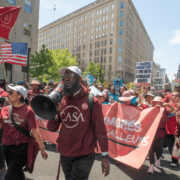
News Americas, NY, NY, Thurs. Sept. 23, 2026: When West Manchester Township police pulled over Haitian born Pastor Molis Augustave on September 5th for a broken headlight, the traffic stop wasn’t just bad luck – it was the direct result of a local policy decision made just weeks earlier, one residents had specifically warned would produce exactly this outcome.
In July, West Manchester Township’s council voted 2-1 to enter a 287(g) agreement with US Immigration and Customs Enforcement, allowing local police to act as an extension of federal immigration enforcement. Roughly 50 residents showed up to oppose it. One commenter asked directly how officers would determine “who is a legal citizen and who is an illegal citizen” during routine encounters – a question that, two months later, played out with Augustave’s headlight stop.
Police Lieutenant John Hanuska defended the agreement at the time, telling residents the township could enforce the law “impartially” while still showing compassion for individuals’ circumstances, and pointed to the death of a Pennsylvania state trooper killed by an undocumented driver as justification. Council members reserved the right to revisit or terminate the agreement – but as of this week, it remains in place, and it is the agreement that handed Augustave to ICE.
Augustave, a York pastor, husband, and father of two children, and former organizer with We Are CASA, has lived in the US for roughly a decade, most recently under Temporary Protected Status until Haiti’s TPS designation was terminated. He is married to a US citizen, his two children were born in the US, and he had a pending green card application – denied this week, according to his legal team, with no reason given.
He was scheduled for a deportation flight to Haiti on September 17th and was pulled off the plane at the last minute after a nationwide advocacy campaign led by his wife, Omara. Eighty-nine others on that same flight were not so fortunate. Augustave remains in ICE custody in Louisiana, roughly 1,000 miles from his family, and faces the next scheduled deportation flight to Haiti today, September 23rd.
“They were going to unjustly deport me to Haiti. I was already on the plane when, at the last minute, they pulled me off,” Augustave said last week in a statement. “I want to go home to my wife and children in Pennsylvania. While I have been waiting, I have been pastoring inside these walls… My life is not worth more because I am a pastor. My family does not matter more than others because people heard our story.”
His legal team has a Motion to Reopen his removal proceedings pending before the Board of Immigration Appeals and a habeas corpus petition pending before the US District Court for the Western District of Louisiana. Faith leaders in York, including Pastor Liz North of Grandview York Church and Pastor Joel Folkemer of Union Lutheran Church, gathered this week to publicly demand his release, alongside a coalition of national immigrant rights groups including We Are CASA, CHIRLA, the Florida Immigrant Coalition, the New York Immigration Coalition, and the Fair Immigration Reform Movement.
West Manchester Township is one of a growing number of Pennsylvania municipalities that have signed 287(g) agreements with ICE in 2026, a trend that has quietly expanded the reach of federal immigration enforcement into routine local policing across York, Lancaster, and Lebanon counties – largely without the scrutiny that a case like Augustave’s is now bringing to it.
ICE did not respond to a News Americas query on why Augustave’s green card application was denied.
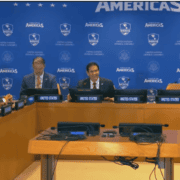
News Americas, NY, NY, Weds. Sept. 23, 2206: Caribbean nations Guyana, Trinidad and Tobago, and the Dominican Republic have signed onto a joint declaration with the United States and 12 other Western Hemisphere nations announcing the first coordinated sanctions action under the “Shield of the Americas” initiative, targeting 24 organizations the signatories designate as narco-terrorist groups.
The Joint Statement on Defending Hemispheric Sovereignty, released by the US State Department‘s Office of the Spokesman on September 22nd, was co-signed by the United States, Argentina, Bolivia, Chile, Colombia, Costa Rica, the Dominican Republic, Ecuador, El Salvador, Guyana, Honduras, Panama, Paraguay, Peru, and Trinidad and Tobago.
The statement builds on three previously announced pillars of the Shield of the Americas – Economic, Security, and Multilateral Coordination – and moves from framework to action, announcing intent to impose asset freezes, immigration and visa restrictions, and criminal liability for individuals or entities providing material support to 24 named organizations.
Among the groups named is Cartel de Los Soles, an organization the US government has directly linked to senior figures within Venezuela’s state and military apparatus under ousted President Nicolas Maduro. Its inclusion places Guyana’s signature on a document formally naming a Maduro-linked entity as a sanctioned narco-terrorist organization – a notable data point given Guyana’s Foreign Affairs Minister Hugh Todd has separately alleged “collusion” between Maduro and Guyanese businessmen Azruddin and Nazar Mohamed, who are currently fighting extradition to the US on gold-export tax fraud charges. Defense lawyers in that case have argued the extradition request is politically motivated, pointing to public statements by senior Guyanese officials against the Mohameds.
The full list of 24 groups spans the hemisphere and includes Mexican cartels (Sinaloa, Jalisco Nueva Generación, Gulf Cartel, Cartel del Noreste, La Nueva Familia Michoacana, Juárez Cartel), Central American gangs (MS-13, Barrio 18), Colombian groups (ELN, FARC dissident factions, Clan del Golfo), Brazilian organizations (Primeiro Comando da Capital, Comando Vermelho), Peru’s Shining Path, Ecuadorian gangs (Los Lobos, Los Choneros, Chone Killers, Los Viagras), and – notably for the Dominican Republic – Haiti’s two dominant gang coalitions, Gran Grif and Viv Ansanm, along with the DR-based Los Tiguerones.
The statement also announces intent to formally request a meeting of the Organization of American States Permanent Council to convene an Organ of Consultation under Articles 6 and 13 of the Inter-American Treaty of Reciprocal Assistance – commonly known as the Rio Treaty – the hemisphere’s mutual-defense pact. Signatories say they intend to participate at the ministerial level in any resulting resolution on collective action against narco-terrorist organizations under the treaty.
The Economic pillar of the broader initiative commits participants to “investment screening mechanisms,” securing critical minerals supply chains “through diversified and reliable sourcing,” and “trusted supplier regulations for digital infrastructure” – provisions that signal closer scrutiny of foreign capital and infrastructure investment entering signatory economies going forward.
Brazil and, until this statement, Colombia had been notable absences from earlier Shield of the Americas declarations; Colombia’s signature now appears on this latest statement.
“This is an important alliance also because it gives us the opportunity to act jointly on economic issues and diplomatic issues. Our voice can be spoken in unison, and we get strength through this type of unity and one of the things that we’re focusing on,” Secretary of State Marco Rubio said at the meeting. “These are groups that operate in different countries; they don’t recognize borders. They collaborate with each other. They don’t recognize the sovereignty of our nations. And sometimes they have the same resources the state has and sometimes even more resources than the state has. Sometimes they’re more sophisticated than the states. And the only way to take them on and to face these criminals and terrorists is for us to come together and coordinate our efforts to defeat them.”

News Americas, NY, NY, Weds. Sept. 23, 2026: President Donald Trump has proposed providing American adults with a $5,000 payment if Republicans retain control of both the House and Senate in the 2026 midterm elections. The proposed payment, described as a “Trump Dividend,” has attracted national attention and raised questions about its affordability, authorization, and potential influence on voters.
The proposal is not currently an enacted or funded federal program. House Speaker Mike Johnson has stated that congressional authorization would be required before the payments could be issued. If approximately 240 million American adults received $5,000 each, the total cost would be approximately $1.2 trillion. Recent reporting also indicates that many Republican candidates have not made the proposal a central part of their campaigns.
These facts raise a larger question for the Afro-Caribbean community: Is a $5,000 promise enough to influence how its members vote? The Caribbean diaspora plays an important role in shaping the political landscape of the United States. As voters prepare for the November 2026 midterm elections, this article explores how eligible African Caribbean voters perceive the proposed payment and whether it affects their political considerations.
How does the proposed $5,000 payment influence the political perceptions and voting considerations of African Caribbean adults during the 2026 midterm election?
To explore this question, I presented five open-ended questions to Afro-Caribbean adults who are eligible to vote. Participants were asked about their initial reactions to the proposal, whether it would influence their voting decisions, which other issues they considered more important, what evidence they would need to consider the promise credible, and how the payment could affect families and the American economy.
Determining the number of Afro-American adults who might receive the proposed payment is not as straightforward as multiplying a single Census population figure by $5,000. The U.S. Census Bureau does not maintain one category that simultaneously identifies Afro-Caribbean identity, adulthood, citizenship, and eligibility under the proposed program.
The 2020 Census provides two relevant population classifications:
Census classificationPopulation of all agesMaximum cost at $5,000 eachCaribbean aloneApproximately 2.1 millionApproximately $10.5 billionCaribbean alone or in any combinationApproximately 2.6 millionApproximately $13 billion
The “Caribbean alone” category represents people who identified only with a detailed Black Caribbean group. The “Caribbean alone or in any combination” category includes those who identified as Caribbean together with another racial identity. Jamaicans and Haitians represented the largest portions of the population in both classifications.
These figures include children, citizens, and noncitizens. Therefore, neither population should be described as the number of people who would automatically qualify for the proposed payment. Eligibility requirements have not been established because there is no enacted program.
For an illustrative calculation, applying an estimated adult share of approximately 80 percent to the broader population produces approximately 2.08 million adults. Multiplying that figure by $5,000 results in an estimated cost of $10.4 billion. This is a demographic illustration, not an official eligibility or expenditure projection.
The responses gathered for this article were consistently skeptical of the proposed payment. Because the number of participants was small, their responses should not be interpreted as representative of the entire Afro-Caribbean electorate. However, they provide insight into how a group of eligible Afro-Caribbean voters evaluated the proposal.
One participant viewed the proposal as an attempt to influence voters “because the President could not otherwise win fairly” they said. The respondent also questioned the practical value of $5,000 when families continue to face the costs of groceries, gasoline, and heating fuel.
This participant did not evaluate the proposed payment in isolation. The respondent connected it to broader concerns involving tariffs, relationships with Canada and China, and American military involvement overseas. For this voter, international affairs and the continuing cost of living carried more weight than the possibility of receiving a one-time payment.
Another participant summarized the proposal in two words: “illegal and ridiculous.” The statement represents the participant’s personal assessment rather than a legal determination. However, it illustrates the ethical concerns some voters may have when a proposed financial benefit is directly connected to a particular electoral outcome. It also demonstrates skepticism about whether the proposal could be legally authorized and practically implemented.
A third participant described the proposal as “nonsense” and stated that it would have no influence on their voting decision. The respondent questioned how Americans would remain economically secure if employment opportunities were increasingly affected by automation and machines.
The participant also expressed little confidence that the current governing party would deliver the payment. The respondent reasoned that if national leaders genuinely wanted to provide economic assistance, they could begin pursuing that relief while already holding office instead of making it dependent on the results of the midterm elections.
This participant believed the proposal’s immediate effect would be to demonstrate how easily some Americans could be influenced by the promise of direct financial assistance. From a longer-term perspective, the respondent feared that promises of this nature could weaken the seriousness of the democratic process and contribute to what the participant described as “the destruction of authentic American history.”
Another participant perceived the proposed payment as “a bribe” and “a sign that the administration can’t run on policies anymore.” The respondent believed that increasing the national debt to finance payments intended to influence voters would ultimately produce a net loss for the country. The proposed payment would have no influence on this participant’s vote. Instead, the respondent identified the national debt, homeland security, and the socioeconomic advancement of Black Americans as more important political considerations.
The participant also questioned how the payments would be financed. The respondent suggested that funding from the private technology sector could make the proposal more feasible because, in the participant’s view, that sector has received significant economic benefits during the previous five years. Even under those circumstances, however, the participant stated that the payment “still wouldn’t earn my vote.”
Although the respondent acknowledged that $5,000 could provide “temporary financial reprieve” to individuals and families experiencing growing consumer debt, the participant was more concerned about the long-term economic consequences. That concern was especially significant for Afro-Caribbean families because of the existing racial wealth gap and the need to protect the economic advancement of the next generation. The respondent cautioned that the community’s limited socioeconomic infrastructure might not be able to withstand crippling inflation if the payments contributed to additional national debt.
Taken together, the responses gathered for this article show that these eligible African Caribbean voters did not evaluate the proposal solely according to the immediate value of a $5,000 payment. They measured it against political credibility, national debt, inflation, employment security, homeland security, international affairs, racial inequality, and the government’s existing record.
Their responses also demonstrate an important distinction between financial need and political influence. A voter may recognize that $5,000 could provide temporary assistance while still rejecting the idea that the payment should determine how they vote. Financial usefulness does not automatically translate into political support.
For these participants, the central question was not simply whether $5,000 would help their families. They also considered whether the promise was credible, properly authorized, economically responsible, and consistent with their expectations of government. Several respondents were particularly concerned that a temporary payment could be followed by greater national debt, inflation, or other long-term economic consequences.
These responses do not establish how the wider Afro-Caribbean community will vote in the 2026 midterm elections. They do, however, provide an important account of how the voters who participated in this article measured the promise. Their assessments extended beyond the immediate value of a check and included the future of their families, the economic advancement of Black Americans, the racial wealth gap, national security, public debt, and the credibility of political leadership.
The objective of this article is not to determine how the Afro-Caribbean community should vote. It is to report how the participating voters measured a political promise against their values, experiences, economic needs, and expectations of government. For those who responded, the possibility of receiving $5,000 was not enough to overcome their larger concerns about governance, trust, and the country’s economic future.