Posts

French Court Closes The Door On Justice For Toxic Pesticide Impacted Guadeloupe And Martinique Victims

By Staff Reporter | NewsAmericasNow.com

News Americas, PARIS, France, Weds. June 24, 2026: A French appeals court has confirmed the dismissal of a landmark criminal case over chlordecone – the toxic pesticide that contaminated more than 90 percent of adults in Guadeloupe and Martinique – effectively closing the door on criminal accountability for one of the Caribbean’s most devastating environmental health scandals.

The Paris Court of Appeal confirmed the dismissal on Monday, June 22, 2026, that was first pronounced in 2023 by two Parisian investigating judges – ending a legal battle that had stretched over 20 years and involved hundreds of victims, farmers, consumer organizations, environmental groups, and public health advocates who had sought criminal accountability from the French state and from the banana industry that used the pesticide.

“It’s a dark, sinister day, since it means that polluters benefit from immunity,” said Christophe Lèguevaques, a lawyer representing the civil parties, as quoted by AFP following Monday’s ruling.

What Is Chlordecone

Chlordecone – also known by its US trade name Kepone – is an organochlorine insecticide that was used intensively on banana plantations in Guadeloupe and Martinique from 1972 to 1993 to combat weevils. The United States Environmental Protection Agency banned the pesticide in 1976. The World Health Organization later classified it as a carcinogen.

France banned chlordecone on the French mainland in 1990 – but continued to allow its use in Guadeloupe and Martinique for three additional years, despite warnings about its dangers. The chemical undergoes no significant degradation in the environment. Scientists estimate that its toxic effects on the soil of the French West Indies will linger for up to 600 years. According to France’s National Agency for Food, Environmental and Occupational Health and Safety, more than 90 percent of adults in Guadeloupe and Martinique have been contaminated by chlordecone.

The Health Consequences

Research from France’s National Institute of Health and Medical Research has established chlordecone as an endocrine disruptor linked to prostate cancer – both islands report some of the world’s highest prostate cancer rates — as well as premature births and developmental issues in children. New research published in October 2025 found that chlordecone also reduces women’s fertility, with those carrying high blood levels found to be 25 to 28 percent less likely to conceive.

In a landmark March 2025 ruling, a French court held the state responsible for the reproductive issues of two women and nine men who developed prostate cancer – acknowledging that France had knowingly exposed them to a toxic pesticide with lifelong consequences. The French government subsequently appealed that decision.

The chemical continues to seep into the soil and water of Guadeloupe and Martinique with each rainfall — contaminating streams, livestock, and crops decades after its use was discontinued.

“The food chain was contaminated,” said Luc Multigner, one of the lead researchers at Inserm who spent two decades studying the pesticide, as quoted in reporting on the crisis. “As a result, contamination wasn’t limited to banana plantation areas only.”

The 20-Year Legal Battle

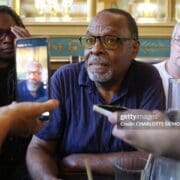
French lawyer Christophe Leguevaques delivers remarks to journalists in regards to a court decision on health issues allegedly linked to chlordecone persticide use, in a cafe near the Palais de Justice courthouse in Paris, on June 22, 2026. After 20 years of legal proceedings, the Paris Court of Appeal upheld a dismissal of the case on June 22, effectively ruling out any reopening of the criminal investigation into the health scandal involving a pesticide used in the French Caribbean despite warnings about its toxicity. (Photo by Charlotte SIEMON / AFP via Getty Images)

A judicial investigation was opened in Paris in 2008 following complaints filed by farmers, consumer and environmental organizations, and public health advocates. The case reached the courts after years of proceedings before being dismissed in 2023 by two investigating judges who ruled that too much time had elapsed to secure criminal convictions.

In their dismissal, the Parisian magistrates acknowledged a “health scandal” and “environmental damage” that would “affect the daily lives” of residents in the overseas territories “for many years to come” – but cited the difficulty of providing criminal evidence of facts committed 10, 15, or 30 years before the filing of complaints.

Monday’s appeal court ruling confirmed that dismissal – and left victims and their lawyers searching for their next legal avenue.

Victims Vow To Fight On

Despite Monday’s ruling, victims and their legal representatives vowed to continue the fight. “The legal battle will undoubtedly continue before the Court of Cassation,” said Rachid Madid, one of the lawyers for the civil parties, as quoted by AFP – adding that if necessary, the case could ultimately be taken to European courts.

“Like the asbestos victims who ultimately won thanks to their tenacity, we will continue our fight,” said Harry Durimel, a civil party and mayor of Pointe-à-Pitre, Guadeloupe, as quoted following the ruling.

Durimel told AFP that he had demonstrated that the statute of limitations could not begin to run as long as the poisoning – which he described as “hidden” – continued, expressing optimism about the outcome of a potential Court of Cassation appeal.

“This is a judgment of colonial continuity,” said Philippe Pierre-Charles, spokesperson for the Lyannaj pou dépolyé Matinik collective, as quoted by AFP. “No investigation was carried out on site by the judges, who did not come, did not meet with any victims.”

“It’s a political decision, we can’t say it comes from the justice system,” said Yvon Sérénus, president of the Collective of Agricultural Workers Poisoned by Pesticides, as quoted by AFP. “It’s a strategy of the State: to let people die without compensating them.”

The Legislative Response

Earlier this month, French lawmakers unanimously acknowledged the state’s role in the chlordecone scandal – setting the goal of decontaminating land and water and compensating victims. A law on the recognition of state responsibility gives the government one year to submit a report to Parliament on the terms of compensation. France has also introduced measures including free chlordecone blood tests and government-funded soil testing. A maximum residue limit policy permits food with low chlordecone levels to be sold – an approach criticized by many in Guadeloupe and Martinique.

“They’re trying to contain the problem, not solve it,” said Josiane Jos Pelage, a pediatrician who hosts community meetings to help residents understand chlordecone and its dangers, as quoted in reporting on the crisis. “It’s not ambitious enough.”

“The state is engaging in double-talk,” said Lèguevaques, as quoted in prior reporting. “The president and some ministers have publicly acknowledged the state’s share of responsibility, so why does it bother them when the courts agree?”

What Comes Next

Victims and their lawyers have signaled they will pursue the case before the Court of Cassation – France’s highest court – and potentially before European courts if necessary. The legislative acknowledgment of state responsibility and the March 2025 civil court ruling establishing the state’s liability for specific victims may provide additional legal pathways for compensation, even as the criminal case is closed.

For the more than 400,000 residents of Guadeloupe and Martinique living with chlordecone contamination in their blood, their soil, and their water – contamination that scientists say will persist for centuries – Monday’s ruling represents a closed door. But as their lawyers and advocates made clear outside the Paris courthouse, it is not the end of the road.


RELATED: Windfall Tax Or Nation Building? The Question Antigua and Barbuda Must Answer

The Untold Story Of The Deacons For Defense: The Hidden Guardians Of The Civil Rights Movement

By Nyan Reynolds

News Americas, NEW YORK, NY, Tues. June 23, 2026: There are chapters of American history that sit quietly in the shadows, not because they lacked importance, but because remembering them forces society to confront uncomfortable truths. One of those chapters is the story of the Deacons for Defense and Justice in Natchez, Mississippi, freedom fighters whose sacrifices have too often been omitted from the larger Civil Rights narrative.

Who among us has truly heard the story of the Deacons for Defense?

When most people hear the word “deacon,” they immediately associate it with the church, a quiet spiritual figure dressed in Sunday clothes, helping guide worshippers into the sanctuary of God. But long before the term became confined to the walls of the church in the minds of many Americans, there were deacons in places like Natchez, Mississippi, who represented something far greater in the struggle for survival. They were not simply leading people to pews; they were helping lead families through fear. They stood watch while crosses burned in the distance. They guarded homes while children slept. They protected meetings where Black citizens gathered to discuss whether they would live long enough to vote, organize, or demand equality.

These men understood something history often refuses to acknowledge faith alone did not stop bombs from exploding or mobs from gathering outside homes in the middle of the night. In many Southern communities, deacons became protectors of both spirit and body. They prayed with their communities, but they also defended them. Their role extended beyond religion into resistance, survival, discipline, and protection during one of the most dangerous periods in American history.

I must admit that until recently, I had never even heard of Natchez, Mississippi. It was only after watching a Frontline-produced documentary released several years ago that I became aware of the history that unfolded there. And perhaps that is part of the problem with history itself. We walk into bookstores every day, into places like Barnes & Noble, searching through shelves filled with historical texts, biographies, and stories of America, yet somehow places like Natchez rarely enter the conversation. Even for those of us who live in the South or in regions closely connected to that history, many of these stories have slowly faded from public consciousness.

And that is dangerous.

Because when history is omitted, people lose more than information; they lose connection. Entire struggles become invisible. Entire communities disappear from memory. The sacrifices of ordinary people become buried beneath simplified narratives that are easier to teach, easier to market, and easier for society to digest.

That is why this generation of conscious writers, historians, and storytellers carry such an important responsibility. We must learn these stories and tell them honestly, so they are not erased by time.

In places like New York City, the memory of Medgar Evers is honored with a school bearing his name. Americans remember him as a martyr for racial equality and justice after his assassination in 1963. Yet far fewer people know the story of his brother, Charles Evers, who became director of the NAACP field office in Natchez and helped organize Black communities living under the constant threat of racial terror.

Natchez was one of the most dangerous places in America for Black citizens during the Civil Rights era. It reportedly had one of the highest per capita concentrations of Ku Klux Klan membership in the country. Racial violence was not occasional; it was systemic. Black families were harassed, followed, photographed, threatened, and bombed. The Klan attended meetings to intimidate local citizens. Crosses burned not merely as symbols, but as warnings. Churches and homes became targets. Men, women, and children lived with the understanding that their lives could be destroyed simply for demanding basic human dignity.

History is ugly. It is painful. But if historians are willing to expose atrocities committed across the world, then we must also preserve the sovereignty of our own past so future generations understand the magnitude of what people endured for freedoms many now take for granted. To soften the brutality of history is to erase the courage of those who survived it.

The story of the Deacons for Defense challenges the popular perception that the Civil Rights Movement was fought solely through passive resistance. While organizations like the NAACP petitioned for desegregation through legal avenues, communities in Natchez faced an enemy unwilling to surrender white supremacy peacefully. The Klan viewed Black advancement as a threat to the racial order they sought to preserve. Ironically, although the Klan was often the aggressor, they framed themselves as defenders of Southern tradition while terrorizing innocent citizens.

That is one of the greatest problems with history: whoever controls the narrative often controls memory itself.

Figures like James Jackson became central to protecting Black communities because survival itself required organization, discipline, and courage. The Deacons for Defense did not emerge from hatred; they emerged from necessity. They understood that in many Southern towns, local law enforcement either ignored racial violence or actively participated in it. In such an environment, self-defense became intertwined with survival.

The reality is difficult for many Americans to confront because it complicates the sanitized version of history often taught in classrooms. The movement for civil rights was not merely speeches and marches. It was fear. It was bloodshed. It was families sleeping with weapons nearby because they did not know whether their homes would still be standing by morning.

Even today, remnants of that trauma remain embedded in the psychology of Black America. There are older generations of Black citizens who still fear police dogs or instinctively move away from barking dogs in public spaces. Those fears did not emerge from imagination. In places like Natchez and throughout the South, dogs were weaponized to instill terror into the hearts of protesters, organizers, and ordinary citizens fighting simply to exist as equals under the law.

So why are these stories not told more often? Why are the Deacons for Defense treated as a footnote rather than a critical part of American history?

Perhaps because their story forces America to confront the reality that freedom was not handed to Black Americans through goodwill alone. It was fought for economically, politically, spiritually, legally, and sometimes physically.

The citizens of Natchez used multiple methods to force change. They organized boycotts against white-owned businesses, understanding that economics could pressure institutions where morality had failed. When business owners began feeling financial losses, many were eventually forced to reconsider their opposition to civil rights reforms. Economic resistance became a powerful weapon against segregation.

Schools slowly became integrated. Public spaces gradually changed. Progress came, but it came on the backs of people who endured unimaginable suffering. Every gain carried the weight of sacrifice.

The men of the Deacons for Defense were more than historical figures hidden in archives or documentaries. They were defenders. They were protectors of families, communities, dignity, and hope during one of the darkest periods in American history. They were fathers, veterans, laborers, ministers, and ordinary citizens who decided their families deserved protection. Their existence reveals something profound about the American struggle for democracy: oppressed people are often forced to defend freedoms long before society is willing to acknowledge they deserve them.

And that is why these stories matter. American history cannot simply celebrate victories while ignoring the cost of achieving them. The truth about Natchez, Mississippi, and the Deacons for Defense is not comfortable, but history was never meant to comfort us. It was meant to teach us.

And if we fail to tell these stories honestly, future generations may inherit the freedoms won by these men and women without ever understanding the terror they endured to make those freedoms possible.

The defenders of Natchez were amazing human beings who did amazing things in the face of unimaginable fear. They stood between terror and their communities when many institutions refused to do so. Their sacrifices deserve more than a passing mention in documentaries or forgotten footnotes buried within textbooks. They deserve remembrance.

And perhaps remembrance itself is one of the greatest forms of justice we can still offer them today.

EDITOR’S NOTE: Nyan Reynolds is a U.S. Army veteran and published author whose novels and cultural works draw from his Jamaican heritage, military service, and life experiences. His writing blends storytelling, resilience, and heritage to inspire readers.  

RELATED:

The Brown Paper Bag Rule: The Segregation We Don’t Talk About

The British Empire They Carried: The Fractured Identity Of Britain’s Caribbean Generation

Windfall Tax Or Nation Building? The Question Antigua and Barbuda Must Answer

By Dr. Isaac Newton 

News Americas, NEW YORK, NY, Mon. June 22, 2026: Every generation is confronted by a question that reveals what kind of nation it wishes to become. Antigua and Barbuda’s government now faces one of those questions. Prime Minister Gaston Browne has proposed a windfall tax on exceptionally profitable companies to help fund national development initiatives, including higher education. The debate, however, is not really a question of taxation. The real issue is whether extraordinary wealth created within a society should help create greater opportunities for the people of that society. Before citizens decide whether to support or oppose the proposal, they must first understand what a windfall tax actually is.

Antigua PM Gaston Browne

A windfall tax is an additional tax imposed on profits that are considered unusually high or unexpected. Imagine two farmers. One farmer increases his harvest because he invested in better equipment, worked longer hours, and improved his techniques. The other farmer receives an unusually large harvest because perfect weather conditions produce an exceptional crop. Most people would agree that the first farmer’s success comes primarily from his effort. The second farmer’s success comes partly from circumstances beyond his control. A windfall tax is based on the belief that when companies earn extraordinary profits because of favorable conditions, market advantages, or unusual circumstances, a portion of those gains can be used to advance the public good. The principle is simple. When fortune smiles unusually on a few, society may reasonably ask whether some of that blessing should help the many.

The strongest argument in favor of a windfall tax is fairness. Antigua and Barbuda must continuously invest in education, healthcare, infrastructure, and youth development. These investments require resources. If a nation can raise revenue from exceptionally profitable companies instead of increasing the burden on ordinary workers and struggling families, many citizens see that as fair. Consider a simple example. Suppose a bank earns profits far above its historical average during a particular period. Citizens may reasonably ask whether a small portion of those exceptional profits could help finance scholarships for hundreds of young people who otherwise could not afford higher education. This is where the windfall tax gains its moral force. It attempts to convert concentrated prosperity into shared opportunity. As a nation, we must always remember that wealth has its greatest value when it expands possibilities for others.

Yet fairness is only one part of the story. A wise policy must also pass the test of sustainability. Imagine a family that receives a large inheritance one year. It would be unwise for that family to assume the same inheritance will arrive every year thereafter. Windfall profits are, by definition, exceptional. They may appear one year and disappear the next. If permanent programs become dependent on temporary revenue, future governments may find themselves facing difficult financial choices. This is why economists often warn that unpredictable income should not be treated as permanent income. Revenue may come and go, but obligations remain. The challenge is not collecting the money. The challenge is building a system that remains strong long after the windfall has passed.

The second concern involves investment and economic confidence. Businesses generally do not fear taxes as much as they fear uncertainty. Investors want to know the rules before they commit their capital. If the definition of a windfall is unclear, companies may wonder whether future success will be rewarded or penalized. That uncertainty can discourage investment, expansion, and job creation. This does not mean a windfall tax is inherently wrong. It means the rules must be transparent, objective, and consistently applied. Citizens should evaluate the proposal using four simple questions. Is it fair? Is it transparent? Will it encourage or discourage investment? Will the money be used in a way that produces measurable benefits for future generations? Public policy should never be judged by intentions alone. It must be judged by results.

The better way forward is not to choose between taxation and development. It is to connect them intelligently. A carefully designed excess profits tax could be used during periods of extraordinary profitability, but a significant portion of the revenue should be placed into a protected national education endowment whose investment earnings support future generations. At the same time, tax administration should be strengthened, private sector partnerships expanded, and universities encouraged to develop additional sources of funding. Such an approach transforms temporary gains into permanent opportunity. Ultimately, the debate before Antigua and Barbuda is larger than a tax. It is a question of national vision. The measure of a society is not how much wealth it creates, but what it chooses to do with that wealth. Great nations are not built when money changes hands. Great nations are built when prosperity is transformed into possibility, and possibility is transformed into progress.

EDITOR’S NOTE: Dr. Isaac Newton is a leadership strategist and governance expert specializing in ethical leadership, institutional reform, and transformational change. Educated at Harvard, Princeton, Columbia, and Oakwood University, he advises governments, boards, and institutions across the Caribbean and internationally. He is the co author of Steps to Good Governance and coauthor of the forthcoming books Daring to Hope and When Nations Kneel.

RELATED:

Father’s Day – A FATHER’S FOOTSTEPS IN ROOMS HE WILL NEVER ENTER

What Makes A Caribbean Teacher Unforgettable

Father’s Day – A FATHER’S FOOTSTEPS IN ROOMS HE WILL NEVER ENTER

By Isaac Newton

News Americas, NY, NY, Sun. June 20, 2026: Happy Father’s Day. A father enters every room his child will one day walk into. That is fatherhood. He shapes a future he will never fully see, yet his presence continues in how his child speaks, decides, and stands under pressure. A child learns life by watching life lived. What is repeated becomes instruction. What is lived in silence becomes formation. What is done when no one is watching becomes an inheritance.

Provision fills a home, but presence forms a person. A child may forget what is given, yet rarely forgets what is shown. Every father writes himself into the future through behavior. He builds rooms he will never enter, influences conversations he will never hear, and prepares decisions he will never witness. Still, those rooms open, and when they do, something familiar appears first: a tone, a response, a way of standing when life becomes heavy. These patterns are absorbed in daily life and repeated without awareness. This is how fathers remain present after they are gone, in rhythm, repetition, and reflection.

Every father leaves something behind. The issue is what that becomes when life grows larger than childhood. Every child eventually steps into rooms their father will never enter, and in those rooms something always speaks first. That voice is the echo of a life once lived beside theirs. A father continues forward in his child long after he stops walking himself. That is fatherhood: a life that keeps moving after the man has stopped, a voice that keeps speaking after silence, a presence that keeps shaping rooms he will never enter.

The measure of fatherhood is not what is given in a moment, but what endures in movement across time. It is seen in what a child becomes when pressure arrives and no instruction is present, only memory. It is revealed in how they respond when life feels unfamiliar yet strangely known. A father is never only remembered. He is repeated. And in that repetition, he continues to live, quietly shaping futures he will never see.

EDITOR’S NOTE: Dr. Isaac Newton is a leadership strategist and governance expert specializing in ethical leadership, institutional reform, and transformational change. Educated at Harvard, Princeton, Columbia, and Oakwood University, he advises governments, boards, and institutions across the Caribbean and internationally. He is the co-author of Steps to Good Governance and co-author of the forthcoming books Daring to Hope and When Nations Kneel.

RELATED:

Caribbean Dilemma – Growing Older Before Growing Rich

What Makes A Caribbean Teacher Unforgettable

Nationals From Four Caribbean Countries Among New York City’s Top Ten Immigrant Groups

By Staff Reporter | NewsAmericasNow.com

News Americas, NEW YORK, NY, Thurs. June 18, 2026: Nationals from four Caribbean countries – Jamaica, Guyana, Haiti, and Trinidad and Tobago – remain among New York City’s ten largest immigrant groups, according to the 2026 edition of The Newest New Yorkers, the city’s most comprehensive portrait of its foreign-born residents in over a decade, released this week by Mayor Zohran Mamdani’s administration.

The report, the first update since 2013, found that New York City’s overall immigrant population remains steady at roughly 3.1 million – more than one-third of the city’s residents and 43 percent of its workforce. Within that population, the four Caribbean nations have maintained an unbroken presence in the city’s top ten foreign-born groups for more than three decades, a continuity the report’s authors describe as evidence of the “large footprint of non-Hispanic Caribbean immigrants in the city.”

Jamaica – Third Largest Immigrant Group In The New York City

New York City was home to 162,490 Jamaican immigrants in 2023, making Jamaicans the third largest foreign-born group in the city overall – a ranking Jamaica has held continuously since 1990, even as its population declined nearly 6 percent over the past decade.

The geography of Jamaican settlement has shifted. A decade ago, Jamaican immigrants were heavily concentrated in Brooklyn. Today they are spread relatively evenly across Brooklyn, Queens, and the Bronx, and the report projects that if current trends continue, Queens will overtake Brooklyn as home to the city’s largest Jamaican population within the next decade.

East Flatbush in Central Brooklyn remains the largest single Jamaican enclave, home to 16,722 Jamaican-born residents – about 10 percent of the citywide total. Canarsie, Flatbush, and Crown Heights each have more than 5,000 Jamaican residents. Southeastern Queens has emerged as an equally significant center, with Springfield Gardens and St. Albans each home to roughly 9,000 Jamaican immigrants.

Guyana – Nearly Half Of All US Guyanese Live In New York City

Guyana’s relationship with New York is unlike that of almost any other immigrant group in the report. Nearly one-half of every Guyanese immigrant living anywhere in the United States has chosen to make New York City their home – the highest such concentration of any country among the city’s top 20 foreign-born groups.

New York’s 129,004 Guyanese immigrants rank as the city’s fifth largest foreign-born group, a position unchanged over the past decade despite a population decline of roughly 6 percent. Fifty-nine percent of that population – 76,698 people – live in Queens.

South Ozone Park stands as the center of Guyanese New York, home to 22,791 Guyanese-born residents in an area long known informally as “Little Guyana,” with a section of Liberty Avenue carrying the name itself. Nearby Richmond Hill, Baisley Park, Queens Village, St. Albans, and South Jamaica form a continuous corridor of Guyanese settlement stretching from Central Brooklyn into Southeastern Queens.

Haiti And Trinidad And Tobago – A Smaller But Resilient Presence

Haiti’s New York-born population stood at 84,120 in 2023, ranking eighth among the city’s foreign-born groups, while Trinidad and Tobago’s population of 69,332 ranked tenth. Both nations have seen their New York populations decline modestly over the past decade — Haiti by roughly 3 percent and Trinidad and Tobago by nearly 14 percent – even as both have held an unbroken position in the city’s top ten immigrant groups for more than three decades.

The report notes that Haitian immigrants have dispersed dramatically beyond New York since 1970, when 72 percent of all Haitian immigrants in the United States lived in the city. By 2023, that share had fallen to under 11 percent, reflecting the growth of Haitian communities in Florida and elsewhere even as New York retains a substantial and historically rooted Haitian population.

The Bigger Picture

Together, Jamaica, Guyana, Haiti, and Trinidad and Tobago accounted for 533,515 New Yorkers as of 2023 – the city’s broader “non-Hispanic Caribbean” population, now representing 17 percent of all foreign-born New Yorkers, down from 19 percent a decade earlier. The decline reflects not a disappearing community but a shifting one, as growth among other immigrant groups, particularly from Asia, has outpaced the Caribbean’s more modest population changes.

“Immigrant New Yorkers are writing the future of this city every day,” Mayor Mamdani said in releasing the report. “From the neighborhoods they have built to the small businesses that have opened, from the languages they speak to the communities they sustain, immigrants make New York the city that it is.”

For the Caribbean diaspora and CARIBID, the data confirms what generations of New Yorkers from these four nations have long understood — that despite shifting numbers and shifting neighborhoods, their place among the city’s defining immigrant communities remains firmly intact.

RELATED:

Jamaican Roots, NBA Glory: How Caribbean DNA Powered The Knicks’ First Championship In 53 Years

Jamaican Olympian Junelle Bromfield Weds Noah Lyles in Cultural Celebration

Exxon To Recover $55 Billion From Guyana – The Median Guyanese Worker Earns $239 A Month

By Staff Reporter | NewsAmericasNow.com

News Americas, GEORGETOWN, Guyana, Weds. June 17, 2026: ExxonMobil’s consortium operating Guyana’s Stabroek Block is on track to fully recover its entire $55 billion investment program by mid-2026 – years ahead of original projections – as oil production surges past 900,000 barrels per day and accelerates toward 1 million.

By any measure of national accounting, Guyana is one of the fastest growing economies on Earth. The International Monetary Fund projects 2026 GDP growth of 16.2 percent. GDP per capita has reached $33,167 – a staggering 22.9 percent increase from 2025. Nominal GDP now stands at $33.96 billion for a population of just 840,890 people.

By almost every other measure that matters to ordinary Guyanese families, the oil boom has not yet arrived at their kitchen tables.

The Cost Recovery Acceleration

As of the end of 2025, ExxonMobil’s Guyana operation had banked $55 billion in recoverable costs, of which $51 billion had already been recovered, according to John Colling, ExxonMobil Guyana’s Vice President and Business Services Manager, speaking to reporters as quoted by OilNOW.

“Recovery of those costs could occur sooner than originally anticipated, and that very well likely could be this year, sometime in the second half,” Colling said, as quoted by OilNOW.

Under Guyana’s Production Sharing Agreement, the ExxonMobil-led consortium – alongside partners Hess and CNOOC – can recover up to 75 percent of monthly oil production as cost oil before remaining production is classified as profit oil and split equally with the government. A 2 percent royalty on all production is additional. Once that cost recovery ceiling is exhausted, Guyana’s effective share of production revenue increases substantially – a structural shift that Vice President Bharrat Jagdeo has previously signaled the government expects.

The Production Numbers

The Stabroek Block currently produces over 900,000 barrels per day across four operating projects – Liza 1, Liza 2, Payara, and Yellowtail – with the Uaru project expected to commence production later in 2026, pushing total output above 1 million barrels per day.

ExxonMobil has also submitted for authorization a new exploration and appraisal program for the Stabroek Block that could result in drilling as many as 35 additional wells, according to Guyana’s Environmental Protection Agency. That drilling is slated to begin in 2028 and run through the end of 2033 – positioning Guyana’s oil sector for installed capacity expansion to 1.7 million barrels per day by 2030.

ExxonMobil operates the block with a 45 percent stake, alongside Chevron at 30 percent and China’s CNOOC at 25 percent.

Why Guyana’s Oil Matters Globally

Guyana’s fiscal windfall arrives as global refining fundamentals shift decisively in its favor. European and North American refiners have substantially increased imports of Guyanese crude, drawn by the light sweet characteristics of Stabroek production. Asian refiners have similarly pivoted toward Guyanese supply as an alternative to Persian Gulf constraints – with India increasing crude purchases to approximately 297,000 barrels per day in January, before Middle East tensions escalated further.

Guyana has positioned itself as a structural beneficiary of Western Hemisphere energy security strategy – a small Caribbean nation now central to global refining supply diversification.

The Other Guyana – Living Hand To Mouth

But behind the extraordinary macroeconomic numbers lies a far more difficult reality for ordinary Guyanese families. Guyana’s national minimum wage in 2026 stands at G$60,146 monthly – approximately US$287. The median monthly income across the formal sector is roughly G$50,000 – approximately US$239. The average gross monthly salary is G$100,000, or roughly US$478.

Meanwhile, the basic cost of living in Georgetown tells a starkly different story than the national GDP figures suggest. A single person requires approximately $900 to $1,200 USD per month to live in Georgetown, excluding rent – and a family of four needs $2,800 to $3,400 USD monthly. Rent alone for a standard one to two bedroom apartment runs $500 to $1,000 or more, with properties in expat neighborhoods exceeding $2,000.

In other words: the average Guyanese worker earning the median salary of roughly $239 a month is being asked to survive in a capital city where basic monthly expenses for a single person start at $900 – nearly four times their monthly income. Annual inflation has also been climbing – rising to 3.4 percent year-over-year in April 2026, the highest reading since January, driven primarily by elevated food costs. The IMF projects inflation to stabilize around 4.1 percent annually – adding further pressure to household budgets that are already stretched thin.

The Inequality Behind The Boom

Guyana’s GDP per capita figure of $33,167 – while genuinely extraordinary on paper – obscures one of the most significant income inequality gaps in the Caribbean. The gap between Georgetown’s oil-driven economic boom and conditions in rural and hinterland regions remains stark, with poverty widespread despite headline GDP growth figures.

Teachers and public servants have received incremental relief – a 9 percent increase in 2026 as part of a multi-year collective bargaining agreement, achieving a compound increase of at least 57 percent over the 2021-2026 period. But for the majority of Guyanese workers in agriculture, mining, and services – sectors that remain the backbone of formal employment despite the oil sector’s dominance of GDP – wages have not kept pace with the cost of living increases driven by the oil boom itself.

The housing boom driven by oil wealth and foreign workers has pushed Georgetown rental costs to levels that price out ordinary Guyanese families – even as the country’s GDP figures suggest unprecedented national prosperity.

The Question Guyana Must Answer

As ExxonMobil prepares to fully recover its $55 billion investment – years ahead of schedule – and as Guyana’s share of oil revenue is set to increase substantially in the back half of 2026, the central question facing the country’s leadership is whether that windfall will finally reach the Guyanese families currently living hand to mouth in the shadow of one of the most consequential oil discoveries in modern history.

The numbers say Guyana is booming. The lived experience of ordinary Guyanese workers earning $239 a month in a capital city where basic survival costs $900 says something very different.

RELATED:

Guyana At 60: The Oil Is Flowing. So Why Are Guyanese Buying Tennis Rolls On Credit?

Guyana – One Destiny, One Future

Is A Broader Guyanese Identity Emerging – New Social Realities & Old Political Patterns

By Ron Cheong

News Americas, TORONTO, Canada, Weds. June 17, 2026: Guyana has always been a multiethnic society. Long before multiculturalism became fashionable elsewhere, Guyanese lived in a country proudly known as the Land of Six Peoples.

Diversity is woven into the nation’s history, culture, and even its national anthem. Yet, for generations, discussions about Guyanese politics have often been filtered through a single lens: ethnicity. That focus is understandable. Guyana’s ethnic communities were shaped by slavery, indentureship, migration, colonialism, economic competition, and decades of political struggle. Ethnic identity remains deeply connected to family history, cultural traditions, religious institutions, and collective memory.

The question, therefore, is not whether ethnicity still matters. It does. But a broader inquiry must also consider whether other forces are becoming increasingly important alongside ethnicity:

The youthfulness of the country.

The growth of an increasingly mixed ethnic population.

Guyana’s unprecedented Economic Transformation.

And whether these developments are beginning to influence political behavior and voting patterns.

The Youthfulness Of The Country

Let’s begin with the country’s youthfulness. Guyana is one of the youngest societies in the hemisphere.

Its median age is approximately 26 to 27 years, compared with about 30 to 31 in Suriname, 36 to 37 in Trinidad and Tobago, and more than 41 in Canada. Nearly half of the population is under the age of twenty-five.

A large portion of the Guyanese electorate is therefore coming to the polls in circumstances very different from those experienced by their parents and grandparents. They have been shaped by migration, urbanization, higher levels of education, social media, global culture, and increasingly diverse social networks. Many have family members spread across multiple countries. They consume information from around the world and interact daily with people whose experiences differ significantly from those of earlier generations.

An Increasingly Mixed Population

Another important factor is that the country’s demographics are also evolving. The mixed-race population has become Guyana’s third-largest ethnic category. At the same time, the proportional share of the two largest ethnic groups declined.

Interethnic friendships are commonplace. Intermarriage appears more common than in previous generations. Schools, workplaces, and social networks are often more integrated than those experienced by parents and grandparents.

None of this suggests that ethnic identity is disappearing. It may, however, indicate that ethnic boundaries are becoming more permeable and that increasing numbers of Guyanese are navigating multiple identities simultaneously.

An Unprecedented Economic Transformation

At the same time, Guyana is undergoing one of the most dramatic economic transformations in the world. Oil wealth, rapid development, and expanding global connections are creating new opportunities, expectations, and pressures.

This transformation may also be reshaping the political landscape. For much of Guyana’s modern history, politics operated within conditions of scarcity. An unspoken question often hovered over public life: Who controls limited resources?

Oil wealth may gradually alter that equation. As Guyana becomes wealthier, another question may become increasingly important: Who benefits from the country’s prosperity?

Questions of opportunity, inequality, redistribution, employment, housing, education, and public services may become more politically significant. Historically, political competition often revolved around the relationship between ethnic groups and the state. In the future, debates may increasingly focus on the relationship between citizens and wealth itself.

If that occurs, class interests may well begin competing more directly with ethnic loyalties as drivers of political behavior. Ethnicity would remain important. It simply would no longer be the only story.

Why These Changes Matter Politically

The significance of these developments lies not only in how people see themselves, but potentially in how they vote. For decades, Guyanese political analysis rested on several assumptions:

Afro-Guyanese dissatisfaction with the PNC would not necessarily translate into support for the PPP.

Indo-Guyanese dissatisfaction with the PPP would not necessarily translate into support for the PNC.

Political loyalties were assumed to remain relatively stable because ethnicity exerted such a powerful influence. The last election, however, raised questions about whether the picture may be becoming more complicated.

The emergence of a third-party alternative that attracted significant support from voters traditionally associated with one of the major political camps challenged assumptions that political loyalties were as fixed as many observers believed.

The old political map and the emerging social map may no longer be identical. 

But caution is warranted.  The result of a single election cycle, however dramatic, is not definitive. Several factors may have contributed to that outcome: dissatisfaction with established political leadership, the appearance of an outsider candidate, anti-establishment sentiment, promises of economic opportunity and redistribution, and the unique circumstances of a rapidly expanding oil economy.

The significance of the election, therefore, lies less in what it proved than in the questions it raised. Were voters responding primarily to personalities and circumstances? Or were they revealing a willingness to place greater weight on factors beyond ethnicity than previous generations?

The available evidence does not yet provide a definitive answer. The next election may tell us much more.

Identity And Politics Are Not The Same Thing

One of the most important distinctions in this discussion is the difference between ethnic identity and ethnic politics. The first concerns how people see themselves. The second concerns how they vote, organize, and pursue political power. The two are related, but they are not identical.

A citizen may feel a strong attachment to his or her ethnic heritage while making political decisions based partly on economic opportunity, education, public services, corruption, security, leadership, or governance.

Ethnic identity can remain strong even as ethnic politics becomes somewhat less dominant. That possibility is often overlooked.

Moreover, though not immediately thought of in that way even by the individual, human beings rarely define themselves through a single identity. People belong simultaneously to families, religions, communities, professions, generations, regions, nations, and ethnic groups.

Identity is layered, situational, and often subconscious.  Using a Guyanese-Canadian Diaspora example:

The same individual may think of himself primarily as Guyanese while supporting the West Indies cricket team, Canadian during a Canadian election, Indo-Guyanese or Afro-Guyanese at a cultural event, and Christian, Hindu, or Muslim in a religious setting.

Evolution Of The Land Of Six Peoples?

Perhaps the most accurate conclusion is also the most cautious. There is little evidence that ethnicity is disappearing from Guyanese life. There is equally little reason to believe that Guyana can still be understood entirely through the ethnic frameworks that dominated much of the twentieth century.

The old political map and the emerging social map may no longer be identical.

Ethnicity remains important. But so do class, generation, migration, religion, education, geography, economic opportunity, and the shared experience of living in a rapidly changing country.

A broader Guyanese identity may be emerging alongside the ethnic identities that have long shaped the nation. If so, this would not represent a rejection of the Land of Six Peoples. It would represent its evolution. The older identities would remain, but they would increasingly exist within a larger sense of shared belonging.

Whether that emerging identity is beginning to influence political behavior remains uncertain. The last election raised the question. The next election may provide a clearer answer. And that may prove to be one of the most important stories in Guyana’s future.

EDITOR’S NOTE: Ron Cheong is a frequent political commentator and columnist whose recent work focuses on international relations, economic resilience, and Caribbean-American affairs. He is a community activist and dedicated volunteer with extensive international banking experience. Now residing in Toronto, Canada, he is a fellow of the Institute of Canadian Bankers and holds a Bachelor of Science degree from the University of Toronto.

RELATED:

Growing Old: My Secret Weapon Against The Robot Apocalypse

From Flatbush To The Backdam: The Reality Check Of Moving “Back Home”

The Archbishop And The Chambermaid: Cuba and The Caribbean’s Impossible Choice

Growing Old: My Secret Weapon Against The Robot Apocalypse

By Ron Cheong

News Americas, TORONTO, Canada, Fri. June 12, 2026: I wasn’t exactly overly thrilled about the prospect of growing old. The thought of a failing memory, random joint aches, and a body that cracks louder than a fireworks display didn’t have much appeal. But lately, I’ve started to see things differently. In this crazy day and age, growing old is beginning to look like a surprisingly good deal. It’s the Robot Apocalypse.

The Upside Of Slowing Down

For starters, I finally know who I am. Not who I thought I was. Not who I wanted to be. The real me.  And, for the most part, I’m quite comfortable with that person. Retirement has also gifted me something I spent decades wishing for: time. Endless glorious time.  The only catch is that I no longer have the energy to do most of the things I spent all those years planning. Those sunny Caribbean vacations I dreamed about? It appears they’ll remain exactly where they belong – in my dreams, where the flights are free, the drinks are included, and my knees still work.

I certainly have more time these days, although somehow the days feel shorter. Chores that once took an hour now require a day or two – assuming I remember to do them at all.

Every Day Is An Adventure

And who needs Caribbean adventures when my apartment provides all the excitement anyone could ask for? Every day brings a fresh surprise. I can walk into the bathroom and instantly forget why I went there. Or I can head down the hall to return my friend’s Pyrex dish and somehow throw the Pyrex down the condo garbage chute while carefully carrying the actual garbage bag in my other hand.

The other day, I spent two hours battling the crowds at Costco, filled an entire cart, rewarded myself with a glorious $1.50 hot dog, and then happily walked out to my car completely empty-handed. The groceries, apparently, enjoyed Costco so much they decided to stay.

High Tech and Old Souls

Thankfully, new technology like WhatsApp makes it easy to stay in touch with old friends and laugh about these things.  But that’s about where my enthusiasm for this ultra-modern world falters. And don’t get me started on today’s music. Give me some real soul music. Give me Al Green and that rich, warm Southern sound. Give me artists who knew what a lyric was. ABBA. Whitney Houston. Diana Ross. Kenny Rogers singing The Gambler. Sam Cooke. Engelbert Humperdinck. B.J. Thomas.

I miss songs that actually told stories. Ode to Billie Joe. Tom Jones belting out Green, Green Grass of Home. Barry Manilow. Glen Campbell. Gordon Lightfoot. Roy Orbison.  Give me Sea of Love, Dream a Little Dream of Me, You’re So Vain, This Is Dedicated to the One I Love, and Hey Jude.

Today’s music often sounds like a dial-up modem trapped inside a blender with a very angry cat. I can’t even fix my own car anymore.  Carburetors have given way to fuel injectors. Everything has an electronic sensor, a computer module, or a circuit board. I used to open the hood and see an engine. Now I open the hood and see a software update.

The Rise Of The Bots

But the absolute peak of modern madness arrived today.  I watched a video of the latest humanoid robots.  Judging by their appearance and movements, I genuinely couldn’t tell they weren’t human. They can perform housework, executive assistant tasks, manual labor – just about anything.

We are now light-years beyond the old Turing Test – the gold-standard test that no computer a little while back could pass.  Researchers would place a screen between a tester on one side and a target on the other.  The challenge for the computer was whether the testers behind the screens could determine if they were chatting with a human or a computer.

Now the robots have discovered the secret to passing as humans. They’re mastering our flaws.  To make us trust them, they’re programmed with what’s called Emulated Imperfection.  They don’t respond instantly anymore. They “type” slowly to seem thoughtful. They pause with a little “hmmm.” They use casual slang, sprinkle in relatable emotions, and occasionally hesitate before answering.

Some are even better at making mistakes than actual people. When they get something wrong, they smoothly recover, acknowledge the misunderstanding, and toss in a little self-deprecating humor. They’re not just imitating humans anymore. They’re outperforming us at being human. Frankly, it’s unsettling when a machine has better social skills than your relatives.

The Sword Of Damocles And The Ultimate Silver Lining

Which brings us to the slightly terrifying reality. Human jobs are disappearing. If robots can do your taxes, write your emails, clean your gutters, answer your customer service calls, and pretend to be stressed about the weather just to make you feel comfortable, we may eventually become optional.

And imagine the security risks. A robot could call you, perfectly mimic your grandson’s voice, use all the right slang, pause to clear its throat, and casually convince you to hand over your life savings. It’s enough to make anyone nervous. But then, as I sat there with my aching joints and my mysteriously abandoned Costco groceries, I realized something liberating.

This robot revolution is precisely why growing old right now may be a stroke of genius. Let the robots take over the workforce. Let them attend the meetings. Let them answer emails. Let them wrestle with corporate software and endless performance reviews.

As for the hackers trying to target me with sophisticated social-engineering scams? They don’t stand a chance. If a hyper-intelligent AI robot calls me with a perfectly crafted phishing scheme, I’ll simply forget who I’m talking to halfway through the conversation, wander off in search of an Al Green record, and accidentally throw my phone down the garbage chute.

At my age, absent-mindedness isn’t a bug. It’s cybersecurity.

EDITOR’S NOTE: Ron Cheong is a frequent political commentator and columnist whose recent work focuses on international relations, economic resilience, and Caribbean-American affairs. He is a community activist and dedicated volunteer with extensive international banking experience. Now residing in Toronto, Canada, he is a fellow of the Institute of Canadian Bankers and holds a Bachelor of Science degree from the University of Toronto.

RELATED: From Flatbush To The Backdam: The Reality Check Of Moving “Back Home”

Guyana’s Opposition And The Fight For Democratic Accountability

By M. Shabeer Zafar

News Americas, TORONTO, Canada, Thurs. June 11, 2026: Guyana possesses oil wealth that most countries would envy. Corruption index score: 41 out of 100; 135th globally in economic freedom; net migration rate is minus 8 per thousand annually – people are physically choosing to leave rather than endure a system that extracts national wealth and concentrates it among the politically connected. In Regions 1, 6, 7, and 10, communities wait for roads, schools, water, ambulances, and electricity that Georgetown takes for granted. Children in Region 7 stop schooling after primary level because government decisions about who matters have made secondary education structurally inaccessible.

This is policy. Single-party dominance without genuine coalition accountability in a nation whose Constitution demands something categorically better. Region 10, home to 65,000 Guyanese, still has no Regional Chair. That is deliberate denial of representation. When a regime controlling oil wealth blocks regions from meaningful participation, constitutional rights exist on paper alone and democracy begins its quiet death.

PNC

The People’s National Congress (PNC), which led Guyana for many decades, practiced this identical methodology, packing courts, police, and institutions along ethnic and class lines. The faces have changed. The pattern hasn’t. A constitutional principle that the current Parliament has placed under acute stress and that every Guyanese citizen must understand with clarity: the Speaker of the National Assembly isn’t a government appointee. The Speaker is the servant of the entire Parliament and the servant of the entire electorate.

The exclusion of Amanza Walton-Desir, MP, from parliamentary committee service is a constitutional violation. Walton-Desir represents the Forward Guyana Movement, the 3rd largest opposition party by parliamentary seat count, following the 2025 election. She holds evident professional qualifications. She holds a constitutional entitlement, identical to every other elected MP, to meaningful parliamentary participation, including committee service. Her exclusion on the basis that her party is new, small, or inconvenient to the administration’s parliamentary management strategy is constitutionally indefensible on every available ground.

The logic is elementary: Parliament exists to represent the electorate. Every citizen who voted for FGM is represented by Walton-Desir. Excluding her from committee service does not merely sideline one MP – it disenfranchises every Guyanese who placed their trust in that movement and every citizen whose democratic interest her committee participation would have served. Partisanship has no constitutional home in the Speaker’s chair. None. The moment a Speaker accommodates MPs whose cooperative disposition serves the administration while blocking MPs whose independence challenges it, the Speaker has ceased to be an officer of Parliament and become an instrument of executive control. That transformation is precisely what the 2026 comparative study documented in Tunisia, Turkey, and Venezuela as the procedural face of soft authoritarianism.

Mr. Norton, PNC’s leader, would serve the Opposition’s cause considerably better by directing his political science training toward building the coalition that displaces this administration rather than targeting WIN’s leader, Azruddin Mohamed. His target is misplaced.

Five minutes examining the current administration’s regional record reveals a government that has progressively lost clarity about who Guyana’s genuine allies are. The Essequibo question has been managed through the International Court of Justice’s jurisdiction and diplomatic passivity, without building the bilateral treaty architecture and American partnership that would make any eventual judgment enforceable. Regional policy increasingly reflects patronage network priorities over sovereign national interests.

WIN

Mohamed’s conduct stands in categorical contrast. In August 2025, with no executive power, he formed his Political Movement – WE INVEST IN NATIONHOOD, (WIN). He deliberately navigated obstructed hinterland routes to reach communities that the established parties had abandoned. He donates part of his parliamentary salary to those in need. He works 16-hour days. He defers publicly to his colleagues rather than seeking personal prominence. He has named specific governmental misconduct with documented evidence on at least 5 occasions in May and June 2026, identifying ministers whose corrupt lifestyles he has cataloged as Leader Of The Opposition while their fellow Guyanese stand in bread lines.

In law, behavior consistent with a declared principle across 13 months of unscripted public life meets the standard of proof beyond a reasonable doubt. Mohamed’s record runs from 26th May, 2025, to present. It can’t be manufactured for “silly season” (election time). It already exists and is the most reliable predictor of what his presidency would produce. One year old. Documented. Constitutionally coherent. Guyana’s future is on the ballot in 2030.

EDITOR’S NOTE: M. Shabeer Zafar is a Guyana-born, Canadian-based Barrister-at-Law.

Caribbean Dilemma – Growing Older Before Growing Rich

By Dr. Isaac Newton

News Americas, NEW YORK, NY, Weds. June 10, 2026: Across the Eastern Caribbean, the future is breaking into the present the way morning breaks into a sleeping room, gently, unavoidably. It’s a Caribbean dilemma. One empty classroom, one departing nurse, and one funeral at a time. The most consequential challenge facing the region is not gathering over the Atlantic. It cannot be tracked by satellite or measured by wind speed. Yet, its force grows with every passing year. In Antigua and Barbuda, Dominica, Grenada, St. Lucia, St. Kitts and Nevis, and St. Vincent and the Grenadines, populations are aging rapidly while workforces are shrinking. Hospitals are becoming busier as classrooms grow smaller. What was once considered a challenge for wealthy nations has arrived on the shores of small island states. The Caribbean is growing older before it grows rich.

The numbers are clear. Research from the United Nations, ECLAC, UNFPA, and the OECD shows that the share of older citizens is rising while the share of working age citizens is declining. By the middle of this century, several Eastern Caribbean countries will have far more retirees relative to their workforce than they do today. Yet demographics are never merely statistics. Behind every percentage point is a grandmother living alone, a retired teacher managing chronic illness, a farmer whose children have settled overseas, and a government struggling to stretch limited resources. This is not simply a demographic transition. It is a human story unfolding in real time.

The roots of this transformation lie in both success and loss. Caribbean people are living longer than previous generations because of improvements in healthcare, education, and public health. This is one of the region’s great achievements. At the same time, fewer children are being born, and many of the Caribbean’s most talented young people continue to leave in search of greater opportunity abroad. The region’s greatest export is no longer sugar, bananas, or even tourism. It is its young people. Every nurse who leaves creates a gap in a hospital. Every teacher who emigrates leaves a vacancy in a classroom. Every entrepreneur who builds a future elsewhere takes with them skills, ideas, and productive capacity that their country urgently needs.

The economic consequences are impossible to ignore. A smaller workforce means slower growth. Fewer taxpayers place greater pressure on government finances. Healthcare costs rise. Pension obligations increase. Employers struggle to recruit skilled workers. Small island states feel these pressures with particular intensity because they lack the scale and financial reserves available to larger countries. When a nation of one hundred thousand people loses several hundred skilled professionals, the effects are felt everywhere, from hospitals and schools to businesses and public institutions. Demography is not destiny. But it becomes destiny for societies that refuse to prepare.

The ageing of the Caribbean is fundamentally a challenge of age and a challenge of leadership. Too often, older citizens are viewed primarily through the lens of dependency. This is a costly mistake. Within the region’s older population lies an extraordinary reserve of knowledge, experience, judgment, and practical wisdom. An experienced teacher can mentor young educators. A retired engineer can guide infrastructure projects. A former entrepreneur can help emerging businesses avoid costly mistakes. The countries that prosper in the decades ahead will be those that find ways to care for older citizens and empower them.

The region must also confront another reality. It cannot solve this challenge through local labour alone. The Caribbean can attract talent, reclaim talent, or continue to lose talent. There is no fourth option. Governments should encourage skilled immigration, support diaspora return, attract remote professionals, and remove unnecessary barriers to investment and residency. At the same time, young families must find it easier to build their futures at home through affordable housing, quality childcare, meaningful economic opportunity, and flexible employment. These are not simply social policies. They are demographic policies. A society that cannot retain its young people cannot secure its future.

The clock is already running. The worker who will support tomorrow’s pension system is either sitting in a classroom today or has not yet been born. The nurse who will care for an ageing population is deciding where to build her future. The retiree who will need support ten years from now is already alive. Time is no longer an advantage. It is the constraint. Every year of delay narrows the available choices and increases the eventual cost. The generation that built these nations has already paid its debt to history. Today’s leaders must show the same foresight. Every ageing society eventually confronts a single question: Who will care for us when we can no longer care for ourselves? The Caribbean does not suffer from a lack of reports. It bleeds from a shortage of courage.

EDITOR’S NOTE: Dr. Isaac Newton is a leadership strategist and governance expert specializing in ethical leadership, institutional reform, and transformational change. Educated at Harvard, Princeton, Columbia, and Oakwood University, he advises governments, boards, and institutions across the Caribbean and internationally. He is the co author of Steps to Good Governance and coauthor of forthcoming books Daring to Hope and When Nations Kneel.

RELATED: What Makes A Caribbean Teacher Unforgettable