
Posts

Lack Of Ring-Fencing May Have Reduced Guyana And Its 2025 Profit-Oil Entitlement By US$4.9 Billion

By Darsh Khusial

News Americas, NEW YORK, NY, Sat. July 18, 2026: As of 2026, there are now 4 deep water oil operations in production in Guyana, altogether sometimes pumping 930,000 barrels of oil equivalent (boe) a day, or US$2.4 billion in oil revenue per month, at today’s oil prices. There have been repeated calls for these projects to be ring-fenced. To quote Christopher Ram’s definition of Ring-Fencing, “…it simply means that the revenue from one field, or such revenue earned under one production license, cannot be used to finance exploration in other fields, even under the same agreement.” Mr. Ram has been adamant that renegotiation of the Stabroek Block contract is not needed for ring-fencing to be applied.

We show in the calculations below that if ring-fencing were in place for the first 4 projects that were in production in 2025, then the government would have had enough from 2025 oil profits to give about US$6,000 to each of the 800,000 Guyanese in Guyana.

As of 2025 – the year for which we have the latest financials of the oil consortium – there were 4 Floating Production, Storage, and Offloading (FPSO) vessels in production. The first 3 FPSOs were Liza 1, Liza 2, and Payara, with a total capital cost of US$18.5 billion; the four together totaled US$28.5 billion, as shown in Table 1 below. The first three FPSOs were pumping upwards of 650,000 BOE a day before the 4th FPSO was onboarded. Yellowtail, the 4th FPSO, began production in August 2025, raising installed production capacity above 900,000 barrels per day. Guyana exported just over 260 million barrels during 2025.

Table 1: Capital Cost per Oil Project

Now, if we had ring-fenced first 3 projects, the Oil Consortium would need to recoup US$18.5 billion in capital cost before the production expenses dropped below 75% of revenue. For simplicity, we will define expenses as capital cost + operational cost. We estimate that operational cost is around US$10 a barrel, based on HESS saying that the cash unit cost in 2027 would be US$10/barrel (see 2Q2023 HESS earnings call transcript). Also, in a 2020 report, Global Witness pegged operating cost at around US$11/barrel (during the withdrawal of its report, Global Witness said it stood by its fiscal modelling). For comparison, the 2017 IMF report estimated the operating cost at US$10.50/barrel.

From Table 2 below, we can see that in 2025, the average revenue per barrel was US$68.38. Now, if the capital costs of all 3 projects were not paid off, then Guyana’s profit share per barrel would have been US$68.38*(1-0.75)*0.5= US$8.55/barrel. But if the capital cost for the 3 projects had been paid off, then Guyana’s profit share was (US$68.38 – US$10)*0.5= US$29.19/barrel.

Table 2

We can observe in Table 2 that by the end of 2024, under the simplified model, approximately US$27.3 billion of cumulative cost-oil capacity through 2024 would have been available for capital-cost recovery after deducting an assumed operating cost of US$10 per barrel. That is more than enough to cover the US$18.5 billion for the first 3 projects. But if we added in the 4th project, Yellowtail, then the total to be paid off would be US$18.5 plus US$10 billion, which is US$28.5 billion. That left in 2025, about US$28.5B – US$27.3B = US$1.2 billion in capital costs to be paid off.

What we next need to determine is how many barrels would it take to pay off the remaining US$1.2 billion. We can figure this out by dividing the US$1.2 billion capital cost by how much capital cost was paid off per barrel in 2025 or (US$68.38*0.75)-US$10 = US$41.29/barrel. That works out to be 30 million barrels or about 12% of the 260 million barrels produced in 2025. Using the derived pro-rating we arrive at Guyana’s share of 2025 oil profits – before the capital cost was paid off – of US$258 million, and after the capital cost was paid off of US$6.7 billion [(US$68.38-US$10) *0.5*(260m-30m)] for a total of US$7 billion.

However, because of a lack of ring-fencing, Guyana’s 2025 profit share reported by the Bank of Guyana was only US$2.1 billion, or a forfeiture of US$4.9 billion.

The Liza 1 and Liza 2 projects were approved in the 2016 PSA by the APNU+AFC government without ring-fencing. The current PPPC government promised to renegotiate the contract if it got into power, see.  The PPPC also knew about ring-fencing which requires no renegotiation. Hence, Guyanese have to be bewildered as to why the current government – with 5 chances to put ring-fencing in place: with Payara, Yellowtail, Uaru, Whiptail, Hammerhead – looked the other way. Guyana’s forgoing of US$4.9 billion in 2025 will increase significantly because in 2026 oil prices have been far above the US$68.38 average in 2025 and Guyana will be producing at more than 900,000 barrels for a full year.

EDITOR’S NOTE: Darsh Khusial is an executive of the Oil and Gas Governance Network (OGGN) Other executive members include Kenrick Hunte and Joe Persaud.

RELATED: Guyana Oil Revenue In 2025 Was A Drop In The Bucket
The Butterfly That Never Landed: Remembering Eric Garner On His 12th Death Anniversary

By Nyan Reynolds

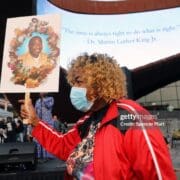
News Americas, NEW YORK, NY, Fri. July 17, 2026: Today, July 17, 2026, marks twelve years since the death of Eric Garner. Twelve years have passed since a cell phone camera captured one of the most haunting moments in recent American history.

We remember the image. We remember the words. We remember the grief that followed. We remember the protests that spread throughout cities, the conversations about policing that reached kitchen tables and classrooms alike, and the movement that gained renewed momentum because one man’s death became a nation’s mirror. Today is not a day of celebration. It is a day of remembrance. A day of reflection. A day to honor a life that ended far too soon. Yet as I reflected on Eric Garner today, my mind wandered to an unexpected place. It wandered into the butterfly effect.

Chaos theory tells us that small changes in the beginning of an event can produce dramatically different outcomes in the future. The flap of a butterfly’s wings does not literally create a hurricane, but the metaphor reminds us that seemingly insignificant events can redirect the course of history in ways that no one could have predicted.

History often feels inevitable when we look backward. It wasn’t. History is fragile. It hangs on moments. It hangs on seconds. It hangs on decisions. And perhaps the greatest illusion we carry is believing that what happened was always destined to happen.

What if it wasn’t? What if history simply followed the path created by countless human choices, some wise, some reckless, and some made within seconds? That question has stayed with me. Not because I want to rewrite history, but because I want to better understand how delicate history really is.

The Butterfly Lands

Imagine Staten Island on July 17, 2014. The officers arrive. The crowd gathers. Voices begin to rise.

But imagine one small detail changing. Eric Garner is not the man being restrained. Instead, he is standing nearby. He notices what is unfolding and steps between two people before the situation escalates.

“Stop!” Someone listens. Someone pauses. Someone chooses another response. The confrontation ends differently. The evening news tells the story of an ordinary father who helped prevent violence rather than becoming its victim.

No marches. No chants of “I can’t breathe.” No international symbol born from tragedy. History changes because one insignificant moment changes. Not because destiny changed. Because people did.

That is the butterfly effect. It is uncomfortable to think this way because it reminds us that history is not always driven by enormous decisions made by presidents or generals. Sometimes it turns because someone arrived thirty seconds later than expected. Sometimes someone answered a phone call. Sometimes someone decided to intervene rather than remain silent.

History is often balanced on moments so small they are invisible until they are gone.

The Lives That Might Have Been

As I continued thinking about Eric Garner, I realized he is not alone. History is filled with futures we never had the opportunity to know. I think about Tamir Rice, a twelve-year-old boy playing in a park with what officers believed was a real firearm.

What if the responding officer had stopped the patrol car farther away? What if there had been one more question before one irreversible decision? What if someone had simply said, “Let’s slow this down.”

Perhaps Tamir grows into adulthood. Perhaps he becomes a father. Perhaps he becomes a teacher. Perhaps, in one of history’s beautiful ironies, he becomes a police officer because one officer once showed him patience instead of fear.

We will never know. I think about Philando Castile. A man remembered by so many for his calm spirit during unimaginable circumstances. What conversations never happened because his life ended? What children never crossed paths with him? What community was never strengthened because one future disappeared in a matter of seconds?

I think about Sandra Bland. How many speeches were never given? How many young women never found encouragement through her voice? How many lives were never influenced because history ended her story before she finished writing it? The same questions echo through generations.

What if Malcolm X had never entered the Audubon Ballroom that afternoon? Perhaps his daughter becomes ill before he leaves home. Perhaps heavy rain delays the meeting. Perhaps someone warns him. Perhaps the people waiting for him never arrive.

Would Malcolm have lived another decade? How much more would his thinking have evolved? How would America have been shaped by ten more years of his leadership? We cannot know.

The same can be asked of Dr. Martin Luther King Jr. What if someone interrupted the assassin’s view from across the street? What if one unexpected distraction delayed everything by sixty seconds? Would the Civil Rights Movement have entered an entirely different chapter under his continued leadership?

President John F. Kennedy presents another reminder. After his assassination, the way presidents travel changed forever. Security evolved. Procedures evolved. Risk assessments evolved. But what if one pedestrian unexpectedly crossed the street? What if the presidential motorcade paused for just a moment? What if one tiny interruption redirected one bullet? Would America have changed differently? Would the decisions that followed his presidency have unfolded another way?

History is full of these unanswered questions. Not because we seek fantasy. Because every life carries possibilities that die alongside the person. When someone dies, we do not only lose who they were. We lose everyone they still had the potential to become. We lose the conversations they never had. The ideas they never shared. The children they never mentored. The inventions they never imagined. The kindness they never extended.

The future dies quietly with them. That may be the greatest tragedy of all.

The Butterfly Within Us

It would be easy to leave the butterfly effect inside history books. But that would miss its greatest lesson. The butterfly effect belongs to all of us. Every one of us can probably identify moments that seemed insignificant at the time but completely redirected our lives.

A phone call we almost ignored; an interview we almost declined; a friendship we almost never started. A relationship we almost walked away from. A conversation we wish we had, or one we wish we never had.

Years ago, actor Mahershala Ali shared a story that fascinated me. Before becoming a two-time Academy Award winner, he received a basketball scholarship to Santa Clara University. He declined it. Eventually, another young man accepted the opportunity.

His name was Steve Nash. He would go on to become one of the greatest point guards in NBA history and a two-time Most Valuable Player.

Think about that for a moment. One scholarship. One decision. Two extraordinary lives moving in completely different directions. Had Mahershala Ali accepted that scholarship, perhaps he would have fallen in love with basketball. Perhaps Steve Nash would have attended another university. Perhaps they both still would have found greatness. Or perhaps history would remember both men entirely differently.

No one knew at the time. That is precisely the point.

The butterfly effect reminds us that the future is being quietly constructed through today’s ordinary decisions. The choices that appear insignificant often reveal themselves years later as life’s defining moments.

That truth extends beyond famous names. It reaches into our own lives. Perhaps there was a job you almost accepted. A city you almost moved to. A degree you almost pursued. A marriage you almost entered. A friendship you almost ended.

Looking back now, you can probably see the butterfly landing. At the time, it looked like an ordinary afternoon. Now it looks like destiny. But perhaps it wasn’t destiny at all.

Perhaps it was simply one decision creating another, and another, until an entirely different future emerged. That realization humbles me. It reminds me to slow down before making decisions. It reminds me that every interaction carries weight. It reminds me that extending grace, choosing patience, speaking with kindness, or simply pausing before reacting may shape futures I will never witness.

Perhaps that is the greatest lesson Eric Garner’s story leaves with us twelve years later. Not simply that tragedy occurred. Not simply that history remembers.

But that history remains fragile because human choices remain powerful. Every officer. Every parent. Every teacher. Every judge. Every politician. Every stranger. Every one of us participates in writing tomorrow’s history through today’s decisions.

We rarely recognize the significance of those moments while we are living them. Only afterward do we realize the butterfly had already landed. Perhaps somewhere today, another butterfly is landing. Perhaps someone is deciding whether to speak or remain silent. Whether to show mercy or anger. Whether to intervene or look away. Whether to choose patience instead of fear.

None of us knows which ordinary moment will become tomorrow’s history. But we do know this.

History has never been shaped only by extraordinary people. It has always been shaped by ordinary people making ordinary decisions during ordinary moments. And sometimes, those moments determine the future of a family, a community, a nation, or even the world.

Perhaps that is the real butterfly effect. Not that history changes because of magic. But that history changes because we do.

EDITOR’S NOTE: Nyan Reynolds is a U.S. Army veteran and published author whose novels and cultural works draw from his Jamaican heritage, military service, and life experiences. His writing blends storytelling, resilience, and heritage to inspire readers.  

RELATED: Fantan Mojah’s Passing Marks The Loss Of More Than A Reggae Artist; It Is the Loss Of A Soul of Rastafari

Two Jamaicans Deported To Eswatini Say They Do Not Wish To Return Home, Ministry Says

By Staff Writer, NewsAmericas Now

News Americas, KINGSTON, Jamaica, Thurs. July 16, 2026: Two of three Jamaican nationals reported to be in the Kingdom of Eswatini have told Jamaica’s Ministry of Foreign Affairs and Foreign Trade that they do not wish to return home at this time, the ministry said.

Senator Kamina Johnson Smith, Jamaica’s foreign affairs minister, said the ministry learned of the men’s situation through Jamaica’s Consulate General in Miamiafter one of the men initiated a phone call. He was joined on the call by his attorney, and a second Jamaican national joined the conversation shortly after.

During that call, the ministry said the men were told what consular assistance is available to them and that the Jamaican government stood ready to help facilitate their return. They were also told Jamaica could not determine their immigration status in the United States or secure their return there. Both men maintained they did not wish to return to Jamaica, according to the ministry.

Jamaica’s High Commission in Pretoria, South Africa, which is also accredited to Eswatini, is continuing efforts to make direct contact with a third Jamaican national believed to be in the country, the ministry said.

The ministry said its outreach followed earlier contact by Jamaica’s Embassy in Washington with U.S. authorities, seeking information on the circumstances of the men’s removal to Eswatini, as well as formal representations by the Pretoria High Commission to the Eswatini government.

The ministry did not name the man but reports say one is Junior Alves, a 64-year-old Jamaican pastor. He was among a group deported to Eswatini in July 2026 and remains in detention facing uncertainty over his legal status. Alves, who has lived in the US for 44 years, was among 11 people flown to the southern African state on Wednesday under Washington’s third-country nationals (TCN) program.  He is a father of eight and grandfather of 11, all born on American soil. He and his wife run a transport business and were preparing to open a new office when ICE swooped him up in Florida.

Part of a wider pattern

The case adds to a string of removals of Jamaican nationals to Eswatini under the Trump administration’s third-country deportation program, under which migrants – including some whose home countries are willing to accept them – have been sent to African nations rather than repatriated directly. Eswatini has received at least 19 deportees under the program since July 2025, according to Jamaica Observer reporting, with 17 held in a maximum-security prison as of earlier this month.

A Jamaican man, Orville Etoria, was among the first group of five men sent to Eswatini in July 2025. He was held in a maximum-security prison for more than seven weeks without charge before being voluntarily repatriated to Jamaica in September, with assistance from the United Nations’ International Organization for Migration. His lawyers said at the time that Jamaica had been willing to accept his return, disputing the U.S. Department of Homeland Security’s characterization that the men sent to Eswatini came from countries that had refused to take them back.

DHS described that first group of deportees as convicted criminals whose home countries would not accept them. Johnson Smith’s ministry has previously said Jamaica has not refused the return of any of its citizens.

Ministry: consular help remains available

The ministry said its consular support “remains available in this matter and more broadly, to Jamaican nationals overseas whose circumstances may require its intervention,” and pledged to continue handling the matter “with care, discretion and respect for the rights and decisions of the individuals concerned.”

Jamaican nationals overseas who are in distress or need consular assistance are asked to contact the nearest Jamaican Embassy, High Commission or Consulate, or email the ministry at consular@mfaft.gov.jm.

NewsAmericasNow will continue following developments in this case, including efforts to reach the third Jamaican national believed to be held in Eswatini.

RELATED: DHS Rescinds Biden-Era Public Charge Rule, Giving USCIS Officers Broader Discretion Over Green Card Applications

Caribbean American Lawmakers Back Continued U.S. Military Aid To Israel; Both Received AIPAC Donations

By Staff Writer, NewsAmericas Now

News Americas, NEW YORK, NY, Thurs. July 16, 2026: Caribbean American Rep. Yvette Clarke, a Brooklyn Democrat representing one of the largest Caribbean communities in the country, and Rep. Adriano Espaillat, a Dominican-born Democrat whose district covers parts of Manhattan and the Bronx, both voted on Wednesday, July 15th, to preserve U.S. military assistance to Israel, siding with a narrow majority of House Democrats against a push from the party’s left flank to cut off the funding.

The vote came Wednesday on an amendment from Kentucky Republican Rep. Thomas Massie that would have eliminated $3.3 billion in annual U.S. military assistance to Israel from the fiscal 2027 State, Foreign Operations and Related Programs appropriations bill. The amendment failed 104-314, with 10 members voting present. Massie was the only Republican to support his own measure.

The overall tally masked a sharp divide inside the Democratic caucus. Of the roughly 211 Democrats who cast a vote, 103 voted to strip the aid, while 98 – including Clarke and Espaillat – voted no, and 10 voted present. The split reached into party leadership: House Minority Leader Hakeem Jeffries opposed the amendment, while Minority Whip Katherine Clark broke with him and voted yes.

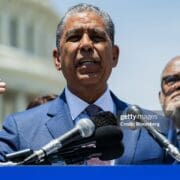
Caribbean American Representative Yvette Clarke, a Democrat from New York, center, seen here at a rally at Brooklyn Borough Hall in the Brooklyn borough of New York, US, on Thursday, July 9, 2026, also voted against the measure to end military aid to Israel. (Photographer: Michael Nagle/Bloomberg via Getty Images)

Both Clarke and Espaillat are listed among New York’s congressional delegation on Track AIPAC, a donor-tracking site run by the advocacy group Citizens Against AIPAC Corruption, as recipients of donations linked to the American Israel Public Affairs Committee and affiliated pro-Israel groups. The group claims Clarke received over $131,000 while Espaillat, who lost his primary election to Avila Chevalier, a democratic socialist and community organizer, received over $3 million. NewsAmericas Now is continuing to confirm the specific dollar figures attributed to each lawmaker against Federal Election Commission records and will update this story once those figures are verified.

In her own statement Wednesday, Clark agreed the amendment was “overly broad” and an attempt by Republicans to “score cheap political points.”

But she came to a far different conclusion on her ultimate vote. “However, it is clear that the status quo is not tenable. We should not provide a blank check for military aid to any country that does not comply with U.S. law, interests, and values,” Clark said. “The Netanyahu government has failed to meet that standard. I will be voting yes, not because I agree with the entirety of the amendment, or the GOP’s cynical motivations for its consideration, but because I believe we must change course.”

A caucus divided

Jeffries told colleagues in a letter ahead of the vote that he considered the amendment “overly broad,” warning it would also limit funding for refugee resettlement and humanitarian programs. Rep. Greg Casar of Texas, chair of the Congressional Progressive Caucus, said after the vote that opposing the billions in military funding is what matters most, even as he acknowledged the amendment’s broader flaws. Former House Speaker Nancy Pelosi also voted for the cut, saying she wanted her vote to send a message despite viewing the amendment itself as flawed.

The vote is widely seen as an early test of where House Democrats stand on Israel heading into the November midterms, following a string of primary losses this year by incumbents seen as too closely aligned with the Netanyahu government’s conduct of the war in Gaza. Israel’s standing with Democrats will be tested again on August 4, when Michigan voters nominate candidates running for ​U.S. Senate, the U.S. House and governor as the state debates U.S. relations with Israel.

Why it matters for Caribbean communities

Clarke and Espaillat represent two of the most heavily Caribbean and Caribbean-immigrant congressional districts in the country – NY-09 in Brooklyn and NY-13 in upper Manhattan and the Bronx. Both lawmakers have built political careers partly on advocacy for Caribbean and Latin American immigrant constituencies, making their votes on a matter this polarizing among the Democratic base a point of scrutiny within the communities they represent.

RELATED: U.S. Says ‘Do Not Travel’ To Haiti – Then Prepares to Send 330,000 Haitians There Anyway

Guyana Oil Revenue In 2025 Was A Drop In The Bucket

By C. Kenrick Hunte

News Americas, NEW YORK, NY, Tues. July 14, 2026: The 2025 Combined Financial Report for the Guyana oil consortium (Exxon, Hess/ Chevron, and CNOOC) show that total revenue is US$17.2 Billion; and the total profit is US$12.1 Billion. Given that profits are to be shared equally between the companies and Guyana, it is clear that Guyana and the companies should each receive US$6.1 Billion. Additionally, with royalties of 2 percent of total revenue, which works out to US$344.3 Million, this means that Guyana total take home is US$6.4 Billion. However, noting that Guyana pays the taxes from its share for the consortium, this amount (US$2.3 Billion) is subtracted from Guyana’s share of benefits (Profits, and Royalties); and it is added to the consortium’s benefits (profits and taxes paid by Guyana). Given these distributional specifications, the total combined benefit for the oil consortium is US$8.4 Billion, or 66.9% of the total Benefits (US$12.4 Billion), compared with US$4.1 Billion (33.1%) for Guyana (Table below).

It should also be stated that this distribution of total benefits of US$ 4.1 Billion for Guyana (33.1% of total benefits of US$12.5 Billion) is overstated. This is because Guyana’s profit is not US$6.1 Billion, but only US$2.1Billion in 2025 (Ram: https://kaieteurnewsonline.com/2026/06/28/part-1-six-to-one-is-not-50-50/). Furthermore, there are additional costs, including amounts for insurance, loss of fishermen’s income, and environmental balance; but the budgets for these cost categories are unknown. When the tax payment for the oil consortium and other cost adjustments are included, along with the other costs, Guyana’s benefit in real terms is reduced from US$4.1 Billion to no more than US$100 Million (Table below).

Another troubling outcome of this arrangement is that the taxes (US$2.3 Billion) paid by Guyana is greater than the profits that Guyana receives (US$2.1Billion). What is also disconcerting with this arrangement is the fact that Guyana’s share of total benefits (US$100 Million) is only 1% of the total benefits (US$12.5 Billion), when compared with the US$12.3 Billion that is captured by the company. Consequently, Guyana’s share of oil revenue in 2025 is no more than a drop of oil in a US$17.2 Billion Revenue Bucket. The underlying cause for this outcome is not only the tax payment made by Guyana for the company; but the cost recovery formula which inflates the average cost of a barrel of oil and reduces the profit that Guyana receives. This issue will be presented in a subsequent letter, where the cost will be analyzed in conjunction with the benefits.

EDITOR’S NOTE: C. Kenrick Hunte is an executive of the Oil and Gas Governance Network (OGGN) Other executive members include Darsh Khusial and Joe Persaud.

The Partnership Dividend: How Small States Can Turn Strategic Cooperation Into Economic Power

By Dr. Isaac Newton

News Americas, NEW YORK, NY, Mon. July 13, 2026: For much of modern economic history, nations have measured their potential by what they possess: land, population, minerals, financial resources, and industrial capacity. That approach explains part of economic success, but it does not fully explain why some small states with limited natural resources have achieved remarkable levels of prosperity while others with greater resources have struggled. The defining advantage of the twenty-first century will increasingly lie in a nation’s ability to build trust, develop talent, strengthen institutions, and form strategic partnerships. For small states navigating a world of geopolitical uncertainty, climate vulnerability, and intense economic competition, partnership itself has become a form of capital.

This article introduces The Partnership Dividend Framework, a development model built on a simple premise: sovereign nations can generate additional economic, diplomatic, and social value when they coordinate their strengths while preserving their political independence. The Partnership Dividend represents the measurable gains created when countries transform cooperation into investment opportunities, shared innovation, stronger institutions, and expanded global influence. It does not replace traditional economic principles. Incentives, entrepreneurship, capital formation, and competitive markets remain essential. It expands the conversation by recognizing that strategic relationships can also produce economic value.

The framework rests on five forms of national capital. Institutional Capital creates confidence through effective governance, transparency, and the rule of law. Human Capital develops the skills, health, and leadership capacity of citizens. Diplomatic Capital uses international relationships to open markets, attract investment, and create influence. Innovation Capital strengthens entrepreneurship, technology, and knowledge creation. Natural Capital protects environmental assets while building climate resilience. When these forms of capital are developed together, strategic partnerships multiply their impact.

The Organization of Eastern Caribbean States offers a compelling opportunity to explore this framework in practice. Small states often face similar challenges: limited domestic markets, high vulnerability to external shocks, and constrained negotiating power. Yet these same characteristics create incentives for deeper strategic coordination. The OECS can demonstrate how sovereign nations can preserve their individual identities while creating shared advantages through coordinated investment promotion, digital transformation, climate adaptation, research partnerships, workforce development, and diplomatic cooperation. The objective is not to weaken sovereignty. The objective is to make sovereignty more effective in a complex global environment.

The Partnership Dividend also requires discipline. Cooperation without accountability can create inefficiency. Investment without strong institutions can create dependency. Growth without environmental responsibility can undermine future generations. Sustainable development requires a balance between market opportunity and public responsibility. Successful small states will combine entrepreneurial energy with credible institutions, foreign investment with national priorities, and global engagement with local empowerment.

The greatest economic discoveries in history have often come from recognizing value where others saw limitations. The next opportunity for small states lies in recognizing that their greatest asset may not be beneath their soil but between their institutions. Trust can become capital. Diplomacy can become enterprise. Cooperation can become competitiveness. The Partnership Dividend Framework offers a pathway for small states to transform strategic relationships into sustainable prosperity while protecting sovereignty, strengthening resilience, and creating opportunities for generations yet to come.

EDITOR’S NOTE: Dr. Isaac Newton is a leadership strategist, governance scholar, and development practitioner. Educated at the University of the Southern Caribbean, Oakwood University, Princeton, Columbia, and Harvard, he writes on leadership, diplomacy, governance, and sustainable development. He is the author of Fix It Preacher, Face Life Squarely, and Intimate Intimacy; coauthor of Steps to Good Governance and Daring to Hope; and coauthor of the forthcoming When Nations Kneel and The Belief Code.

RELATED: Church Hurt

U.S. Says ‘Do Not Travel’ To Haiti – Then Prepares to Send 330,000 Haitians There Anyway

By NAN News Editor | NewsAmericasNow.com

News Americas, NEW YORK, NY, Mon. July 13, 2026: The U.S. government has a warning for its own citizens: stay out of Haiti. The State Department’s Level 4 “Do Not Travel” advisory – its highest risk designation, placing Haiti alongside Iraq, Iran, Afghanistan and North Korea – cites rampant crime, widespread kidnapping, terrorist activity and a national state of emergency that has been in effect since March 2024. At the same time, the Department of Homeland Security is moving to strip legal status from roughly 330,000 Haitian Temporary Protected Status holders across the country, clearing the way to send them back into the very conditions Washington tells its own citizens to avoid entirely.

A Collision Course With the Calendar

The countdown is no longer abstract. Haiti’s TPS designation was set to terminate on February 3, 2026, but a federal judge in the U.S. District Court for the District of Columbia stayed that termination in the case Miot et al. v. Trump et al. That stay held until June 25, 2026, when the U.S. Supreme Court ruled in Mullin v. Doe – a consolidated case covering both Haiti and Syria- that courts do not have the power to review the administration’s decision to end a TPS designation. The Court also rejected a claim that Haiti’s termination was racially motivated, finding insufficient evidence.

Since that ruling, USCIS has issued a series of short-term work authorization extensions: first to July 10, then to July 24, 2026. Legal analysts note the plaintiffs argue the Supreme Court’s mandate takes a minimum of 32 days to formally issue, putting the real-world effective date of termination around July 27 – just days after the current EAD extension runs out.

Unless Congress or the courts intervene again, hundreds of thousands of Haitians who have lived, worked and raised U.S. citizen children in this country for over a decade will lose their legal right to work within weeks.

What Haiti Actually Looks Like Right Now

A U.S. military cargo plane prepares to land at Toussaint Louverture Airport following armed attacks in the Plaine du Cul-de-Sac area of Port-au-Prince, Haiti on May 11, 2026. (Photo by Guerinault Louis/Anadolu via Getty Images)

Former DHS Secretary Kristi Noem’s termination notice acknowledged that conditions in Haiti “remain[ed] concerning,” particularly gang violence, but argued that some areas of the country were suitable for return. The facts on the ground tell a different story – one that’s getting worse, not better, as the deadline approaches.

In the first week of July alone, two separate waves of armed violence displaced more than 7,100 people in Haiti’s Ouest Department. On July 1, 2026, clashes in Pinso and Grand-État in the Ganthier commune displaced 1,328 people. Days later, attacks beginning the night of July 4-5 and spreading through July 8 hit Kenscoff, displacing 5,840 people and forcing the closure of three existing displacement sites – pushing people who were already homeless into homelessness again. The violence included killings, house burnings, and kidnappings. It marked the area’s largest displacement event since February 2025.

This is the country roughly a third of a million Haitians living legally in Florida, New York, Massachusetts and beyond are now at risk of being sent back to – a country the U.S. government itself won’t let its own citizens visit.

The Economic Stakes Nobody’s Talking About Locally

The human cost is only part of the story. Haitian TPS holders contribute an estimated $5.9 billion to the U.S. economy annually and pay a combined $1.56 billion in federal, payroll, state and local taxes each year, according to research compiled by Princeton fellow Dr. Phillip Connor for FWD.us, the Haitian Bridge Alliance and Black Nomad.

That contribution isn’t confined to the big coastal metros usually mentioned in national coverage. It runs through mid-sized American cities most reporting on this story ignores entirely:

Allentown, PA – $197 million annually

Indianapolis, IN – $136 million annually

Port St. Lucie, FL – $134 million annually

Springfield, OH – $91 million annually

Jacksonville, FL – $56 million annually

Columbus, OH – $44 million annually

Roughly 200,000 Haitian TPS holders, according to FWD.US data are already embedded in the U.S. workforce – 22,000 cooks and servers serving 880,000 meals daily, 13,000 nursing assistants caring for 65,000 patients, 15,000 agricultural workers, 8,000 caregivers looking after 12,000 children and elderly Americans. Pulling them out of the workforce doesn’t just hurt Haitian families – it raises costs for everyday Americans in food, care and services across these communities.

An estimated 50,000 U.S. citizen children currently depend on their Haitian TPS parents’ income. Without it, an estimated 25,000 of those children would be pushed into poverty.

A Historic Scale of Loss

Haiti is not an isolated case – it’s part of what immigration researchers are calling an unprecedented dismantling of humanitarian protections. Cato Institute’s David Bier has said the country has never seen this many people lose legal status at once, calling it entirely without precedent. The numbers back him up: the TPS population grew from under 500,000 in 2017 to about 1.3 million by 2025, and the current administration has ended or moved to end designations for 13 of the 17 countries that held them, with at least 700,000 people already having lost status in 2025 alone. Once the pending terminations for countries like Burma, Ethiopia, Somalia and South Sudan take effect, only four TPS designations are expected to remain active nationwide.

Congress Has a Fix. It’s Stalled.

The House of Representatives already passed a bipartisan response. H.R. 1689, which would require the Secretary of Homeland Security to maintain Haiti’s TPS designation for the remainder of the administration, cleared the House on April 16, 2026, by a vote of 224-204, with 10 Republicans and one independent joining Democrats. An identical Senate companion bill, S. 4814, was introduced in June – but as of this writing, it has not attracted a single Republican cosponsor.

That inaction, not just the court fight, is now squarely part of the story. Every senator who has not signed on to S. 4814 is, in effect, allowing a Level 4 “Do Not Travel” country to become the destination for hundreds of thousands of people currently paying taxes, raising U.S. citizen children, and working essential jobs in American communities.

What Happens Next

Barring a last-minute reversal, Haitian TPS holders are expected to lose work authorization around July 27, 2026. From that point, absent another form of relief such as a pending asylum claim, they revert to undocumented status – deportable to a country their own government tells Americans not to set foot in.

RELATED: Venezuela Wants Its Gold Back From The UK But What About The Oil Revenue The US Is Holding?

There Is a US$6.7 Billion Difference Between The Oil Revenues Reported By The Bank Of Guyana And ExxonMobil

By Darsh Khusial

News Americas, NEW YORK, NY, Sun. July 12, 2026: On June 21, 2026, Guyana’s Kaieteur News quoted ExxonMobil Guyana’s Vice President and Business Services Manager, John Colling, as saying: “Through the end of 2025, there was over US$55B in the cost bank, of which US$51B had been recovered. As I mentioned in my prior talking points, US$4.5B was yet to be recovered by ExxonMobil Guyana Limited and its co-venturers.”

The ExxonMobil Guyana offices at 86 Duke Street in Georgetown, Guyana. Photographer: Jose A. Alvarado Jr./Bloomberg via Getty Images

At first glance, this appears to be welcome news. Once most of the accumulated costs have been recovered, Guyana should begin receiving a larger share of the oil revenues, rather than the paltry 14.5% of total revenues it currently receives.

However, there is a major mystery concerning the actual amount of oil revenue generated through the end of 2025. According to the Bank of Guyana’s (BoG) reports, total oil revenue through the end of 2025 was approximately US$61.3 billion. Under the Stabroek Block Production Sharing Agreement, up to 75% of oil revenue may be allocated to cost recovery.

Therefore, if Exxon and its partners recovered US$51 billion in costs, total oil revenue would have had to be at least: US$51 billion ÷ 75% = US$68 billion. This is at least US$6.7 billion more than the US$61.3 billion indicated by the Bank of Guyana’s reports.

Guyana’s current share amounts to approximately 14.5% of total oil revenue. Applying that percentage to the unexplained US$6.7 billion difference produces approximately US$972 million – almost US$1 billion. To put the matter plainly: has Guyana been shortchanged by almost US$1 billion, even under the meager 14.5% share of revenue it currently receives? The public cannot determine whether the Government of Guyana and the oil companies are using different production volumes, different realized oil prices, different accounting periods or different definitions of revenue. Any of these could contribute to the discrepancies.

The Government must explain these differences clearly and publicly. How does the Government’s cost-recovery balance reconcile with ExxonMobil’s US$51 billion figure? What was the total value of oil produced and sold through the end of 2025? What realized oil prices were used? How were Guyana’s royalty and profit-oil entitlements calculated? If the Government cannot establish the correct amount of oil revenue, how can the public verify that the royalty and profit-oil payments received by Guyana are accurate?

EDITOR’S NOTE: Darsh Khusial is an executive of the Oil and Gas Governance Network (OGGN) Other executive members include Kenrick Hunte and Joe Persaud.

RELATED: The Guyana Government Should Immediately Investigate The Accounting Of The Oil Companies

Guyana’s Oil Boom, The President’s Farm And The Case For Transparency

Church Hurt

By Dr. Isaac Newton

News Americas, NEW YORK, NY, Sat. July 11, 2026: An elderly man once stood outside a church long after the doors had closed. He was not wrestling with belief in God. He was wrestling with belief in the people who represent God. It was church hurt. Years earlier, he had entered that space in crisis, expecting refuge. What he encountered instead was distance that felt justified, silence that felt spiritual, and structure that felt more important than suffering. He left with faith intact but trust fractured.

Years later he returned. The building had not changed. The culture had. A child saw him first, walked toward him without hesitation, and said, you can sit here. Nothing was explained. Nothing needed to be. Belonging had already been communicated through action. In that moment, trust began to return through experience, not instruction.

Church hurt is not an event. It is what happens when Christ is proclaimed but culture is not formed to reflect His character. It is not primarily personal offense. It is institutional misalignment between what is believed and what is consistently practiced.

Church hurt is never random. It is produced. Not always intentionally, but always structurally. It emerges where patterns are unexamined, where silence is rewarded, where harm is absorbed rather than addressed, and where love is affirmed more in language than in systems. People are formed more by what is tolerated than by what is taught. Culture is what leadership allows when it is not actively correcting itself. It is revealed in who is believed, who is protected, who is dismissed, and who must repeatedly justify their pain before it is acknowledged.

Church hurt begins long before it is named. It begins in repetition. Repeated experience becomes normal. Normal becomes expectation. Expectation becomes interpretation. Interpretation becomes identity. By the time people speak about hurt, they are describing what a system has already trained them to endure.

Three forces determine whether a church becomes healing or harmful. Character shapes behavior. Culture shapes expectation. Systems shape outcomes. When any one of these is misaligned, trust erodes even when intentions remain sincere. Unaddressed harm becomes institutional memory. This is why church hurt is not corrected through intention but through design. A church can be theologically precise and experientially damaging at the same time when its internal patterns are not corrected.

The deepest fracture appears when confession and culture diverge. Grace is spoken but not structured. Truth is affirmed but not embodied. Unity is declared but not protected. People do not leave because faith collapses. They leave because restoration has no reliable pathway. Healthy churches are not defined by the absence of failure but by the presence of repair. They design culture with intention rather than assumption. Care becomes consistent. Accountability becomes protective. Leadership becomes relational. Trust becomes cumulative. Love ceases to function as language and becomes environment.

Doctrine forms belief. Culture forms experience. Experience, repeated over time, becomes interpretation. This is why behavior will always reveal what belief systems alone cannot guarantee. The measure of a church is not how strongly it speaks in public gatherings, but how faithfully it repairs when harm occurs in private spaces. A healthy church is recognizable when truth can be spoken without fear and dignity is not dependent on proximity to power.

The man who once stood outside eventually returned repeatedly. What changed was not perfection. What changed was pattern. He was no longer managed as a disruption. He was received as a person. That consistency rebuilt trust more than any explanation ever could. Church hurt ends where culture is intentionally designed to reflect Christ in practice rather than in proclamation. Where that alignment exists, church becomes more than an institution people attend. It becomes a living environment where truth and love are no longer in competition and where human beings are given the conditions to become whole.

EDITOR’S NOTE: Dr. Isaac Newton is a leadership strategist, development specialist, theologian, and author of Steps to Good Governance and Fix It, Preacher. He is coauthor of Daring to Hope and When Nations Kneel, and forthcoming author of The Belief Code. Educated at Oakwood University, the University of Southern Caribbean, Harvard, Princeton, and Columbia, he advises leaders across government, business, education, and the church, helping build cultures where people flourish and leadership creates lasting impact.

RELATED: Caribbean Dilemma – Growing Older Before Growing Rich

Antigua And Barbuda Cannot Receive What It Cannot See

By Dr. Isaac Newton

News Americas, NEW YORK, NY, Thurs. July 9, 2026: The Antigua and Barbuda officer pauses at the screen. A file is open. A name is listed. A photo appears. Some details match what is expected. Other details do not match. Some parts are missing completely. Nothing is fully clear. The room is quiet. Another officer waits for the answer. A decision must be made right now. Let the person in, or not.

At that moment, Antigua and Barbuda is not just looking at paperwork. It is deciding something bigger. It is deciding whether it truly knows who this person is. That is the whole issue. Antigua and Barbuda cannot safely accept a person if it does not fully know their history before they arrive.

This is important for one reason. A country can only take responsibility for what it understands. Once someone enters the country, the government becomes responsible for what it knows about them and what it does not know. Both matter. Antigua and Barbuda is a small country. In a small country, problems do not stay distant. They show up quickly. One unclear case can affect police, hospitals, housing, and public safety at the same time. There is no extra space to absorb mistakes. This is why entry is treated as a serious checkpoint, not a simple step. Before anyone arrives, the country needs three things to be clear. Who the person is; what their history is; who will pay for their care and support.

If any of these are missing, the country is being asked to accept a risk it cannot measure. Sometimes records are incomplete. Sometimes countries cannot confirm a person’s full background. Sometimes there is no reliable way to check if someone has a serious criminal history in another place. This does not mean the person is dangerous. It means the country does not have enough information to be sure. When information is missing, the risk is unknown. Once that happens, the rules become simple. If the history is not clear, the country should slow down.

If the risk is not clear, entry cannot be automatic. If entry cannot be automatic, it cannot be a standing agreement. Each step follows the one before it. Big countries can spread out uncertainty. They have more systems, more space, and more resources. If something goes wrong, they can respond differently over time. Antigua and Barbuda does not have that flexibility. When something is unclear, it becomes visible right away. There is no place for it to disappear.

So the idea becomes very simple. Antigua and Barbuda cannot receive what it does not fully know. Once a person enters, they are no longer just a name on a file. They are real; and the country must live with the full result of what it chose to accept or what it could not fully see. Everything in the White Paper leads back to that moment at the desk, when a decision must be made without complete information. And in that moment, the country can only be as safe as what it can see.

EDITOR’S NOTE: Dr. Isaac Newton is a governance and leadership strategist who advises governments and public institutions across the Caribbean and internationally. He specializes in how countries make decisions under uncertainty, especially where law, risk, and public responsibility overlap. He was educated at Harvard, Princeton, and Columbia.

RELATED: Windfall Tax Or Nation Building? The Question Antigua and Barbuda Must Answer