Posts

Rethinking Foreign Policy – The Case for Tech Diplomacy

By Deodat Maharaj

News Americas, Gebze, Türkiye, Fri. Jan. 23, 2026: The drivers of economic growth, innovation, and societal change are no longer solely wealthy nation-states and global institutional actors, but increasingly the technology companies. The so-called “Magnificent Seven”-Nvidia, Microsoft, Apple, Amazon, Meta, Tesla, and Alphabet (Google) – now dominate the global economy, redefining traditional thinking of economic power and influence. By the end of 2025, these seven companies had an estimated market value of US$22.2 trillion.

U.S. President Donald Trump (R) speaks to Apple CEO Tim Cook (L) as he attends a reception for business leaders at the World Economic Forum (WEF) Annual Meeting on January 21, 2026 in Davos, Switzerland. The annual meeting of political and business leaders comes amid rising tensions between the United States and Europe over a range of issues, including Trump’s vow to acquire Greenland, a semi-autonomous Danish territory. (Photo by Chip Somodevilla/Getty Images)

NVIDIA alone stood at US$5 trillion. This is more than Japan’s GDP, the world’s third-largest economy, which is US$4.4 trillion according to the International Monetary Fund. In terms of global reach, Meta, formerly Facebook, has more than 3 billion users. Over 2 billion people use it every day.  

This concentration of wealth has profound implications. Breakthrough technologies – artificial intelligence, cloud computing, digital platforms – are reshaping industries, creating new value chains, and generating immense opportunities. Yet, most developing countries, especially the Least Developed Countries, (LDCs), are being left out.

The scale of this digital divide reveals a critical gap: the world’s poor, small, and vulnerable countries are not just lagging in access to technology; they lack meaningful influence in how these technologies are governed, deployed, and regulated. Their exclusion from the emerging architecture for global technology governance will only deepen the already stark divide between rich and poor countries.

Addressing this imbalance requires innovative approaches. Traditional diplomacy and development strategies, while indispensable, are no longer sufficient on their own. To truly harness frontier technologies and ensure their people benefit from global innovation, technology must be an integral part of the diplomatic arsenal of any developing country. Tech diplomacy represents a holistic framework that integrates technology engagement, governance, and investment directly into a country’s foreign policy thrust.

Some countries have already embraced Tech Diplomacy.  Denmark was the first to formally recognize the technology industry as a foreign policy priority in 2017. By appointing a dedicated Tech Ambassador, it acknowledged that engagement with major technology companies requires the same diplomatic attention and strategic seriousness as with traditional state and multilateral actors.  

Brazil, through the appointment of a Tech Ambassador and the creation of more than 70 technology-focused sections across its embassies worldwide, has built a global network designed to facilitate technology transfer, attract investment, and strengthen international innovation cooperation.

Kenya offers a great African example. Through initiatives such as the TechPlomacy Connective and the appointment of a Special Envoy on Technology, Kenya has positioned itself as an active participant in global AI and digital governance. This approach has secured Kenya a leadership role in key international technology fora and enabled direct engagement with both global technology companies and multilateral institutions. Kenya’s example underscores how developing countries can shape technological change rather than simply respond to it.

So, what are the lessons learnt and a reasonable approach for developing countries, especially the 44 LDCs and capacity-constrained island states like those in the Caribbean and Pacific?

To start with, there must be a clear recognition of the importance of integrating Tech Diplomacy in the existing foreign policy architecture with a dedicated focal point and team. This facilitates participation in global technology governance, and ensures meaningful engagement on the standards, norms, and regulatory frameworks that shape emerging technologies. Without their presence at the table, the rules governing artificial intelligence, cross-border data flows, digital platforms, and digital trade will continue to be defined primarily by those who already hold economic and technological power. This will further entrench existing inequalities.

Second, engagement with technology companies is essential. Governments need structured, sustained, and strategic dialogue with global tech firms. Such engagement allows countries to build trust; co-design solutions tailored to local needs; and leverage innovation in support of national development priorities. Most importantly, getting information at the earliest will help place you at the front of the line in accessing opportunities.

Third, investment in digital futures must go beyond basic connectivity. Developing countries, including LDCs, require targeted investment in digital infrastructure, human capital, and innovation ecosystems. In a challenging financial environment, the technology companies have the requisite financing. Here again, Tech Diplomacy can help. With a forensic focus on making investment cases to businesses in the technology and innovation space, countries can create jobs, stimulate entrepreneurship, and begin to effectively compete in the global digital economy. India is a great example of success in attracting massive private investments in this space.

In summary, a world where technological leadership is becoming a defining factor of economic and geopolitical influence, poor, small, and weak countries need to lift their game by recognising this reality and becoming active participants. Tech Diplomacy, once leveraged effectively, gives these countries and their people the chance they deserve.

EDITOR’S NOTE: Deodat Maharaj is a national of Trinidad and Tobago and is presently the Managing Director of the United Nations Technology Bank for the Least Developed Countries. He can be contacted at: deodat.maharaj@un.org

RELATED: The AI Revolution And Least Developed Nations

Against The Odds: A Guyana Born Centenarian And Current Health Care

By Ron Cheong

News Americas, TORONTO, Canada, Fri. Jan. 23, 2026: Giving birth in a developing nation a hundred years ago was an act of quiet bravery. In British Guiana in the 1920s, childbirth carried an ever-present risk: infant mortality stood at a staggering 159 deaths per 1,000 live births. Mothers laboured without modern diagnostics, antibiotics, blood banks, or neonatal care. Survival often depended on little more than resilience, luck, and the skill of a handful of dedicated doctors. Against those odds, my aunt Pauline (Irma) Persaud was born and survived, along with three of her siblings.

Guyana-born Centenarian Pauline (Irma) Persaud, c. (contributed image)

This week, she reached the extraordinary age of 100. Frail in body now, her mind remains remarkably sharp. Even in her late nineties, she could correct me when I misremembered a family detail. At 100, her mental clarity endures, though the energy to converse has understandably waned.

Yet, when I asked her what she could recall of her earliest years, she surprised me. She believes the attending physician at her birth was Dr. Bissessar. She remembers him fondly, especially an image that has stayed with her for nearly a century: the doctor placing her younger sister – my mother – on a swing and gently rocking her. My mother, she said, adored him.

What my aunt did not know is that Dr. Bissessar’s grandson and I have been lifelong close friends. For decades, neither of us was aware of this earlier connection. It is a coincidence that quietly bridges generations – one life, one family, and one country’s long arc of medical progress.

A Century Later: Measuring The Distance Traveled

Fast-forward to 2025. Guyana’s infant mortality rate stands at approximately 24 deaths per 1,000 live births. While still higher than in developed countries, the difference from a century ago is profound. Behind that single statistic lies improved antenatal care, trained midwives, vaccination programs, emergency obstetric services, and access – however uneven – to modern medical facilities.

Healthcare progress, of course, is never linear. Guyana’s system has experienced periods of neglect, underinvestment, and uneven leadership. But the past five years mark a notable inflection point.

Rebuilding The Foundations: Infrastructure And Access

One of the most visible changes has been the rapid expansion of healthcare infrastructure. Several new regional hospitals have been brought on stream or advanced significantly, including facilities in Kato, Lethem, and Moruca – areas long underserved due to geography and historical neglect. These are not symbolic projects; they are functional hospitals intended to reduce the need for dangerous and costly medical travel.

In communities such as Mahdia, improved health facilities have dramatically improved access to primary and emergency care. Across the country, dozens of health posts and clinics have been built or rehabilitated, bringing services closer to hinterland and rural populations where outcomes were once predictably poor.

For a nation still grappling with vast distances and uneven population distribution, bricks and mortar matter. But buildings alone are not enough.

Leadership And Stewardship: A Stark Contrast

Under the stewardship of Minister of Health Dr. Frank Anthony, the health sector has demonstrated coherence, urgency, and a clear sense of direction. This stands in sharp contrast to the dismal performance under a previous administration.

That earlier period was marked by shortages, industrial unrest, deteriorating facilities, and a worrying absence of strategic planning. Morale among healthcare workers sank, and public confidence eroded. The system did not merely stagnate – it regressed.

Dr. Anthony’s return to the ministry brought immediate stabilization and a longer-term reform agenda. Procurement improved, staffing challenges were addressed more systematically, and partnerships that had long been discussed but never realized were finally activated.

COVID-19: A Defining Stress Test

Nothing tested Guyana’s healthcare leadership more severely than the Covid-19 pandemic. The contrast between administrations could not have been clearer.

Dr. Anthony’s response was swift, science-driven, and largely transparent. Guyana moved quickly to secure vaccines, expand testing capacity, and communicate public-health guidance. Mistakes were inevitable, but course corrections were made.

Covid exposed weaknesses everywhere, but it also demonstrated what competent leadership could achieve under pressure.

Vision 2030: Leapfrogging Into Modern Care

Today’s reforms are framed within a broader national blueprint: Vision 2030. The ambition is unapologetically bold: to transform Guyana’s public health system into a modern, accessible, and resilient one.

Central to this vision is “leapfrogging”: using digital health tools and targeted investments to bypass outdated systems entirely. Initiatives include electronic health records, telemedicine for hinterland communities, and dramatically faster diagnostics. The national pathology laboratory, for example, has reduced test turnaround times from months to days – a change that saves lives quietly but decisively.

Partnerships underpin this effort. Collaborations with Mount Sinai, the World Bank, and others are helping modernize infrastructure, train healthcare workers, and strengthen pandemic preparedness through a “One Health” approach that integrates human, animal, and environmental health.

Maternal and child health, cancer care, and workforce development are explicit priorities. Immunization rates have improved significantly, malaria cases have fallen sharply, and diagnostic capacity has expanded nationwide.

One Life, One Century, One Measure Of Progress

My aunt was born into a world where survival itself was uncertain. That she reached adulthood -let alone 100 – is a testament to personal resilience and the quiet dedication of doctors like Dr. Bissessar, working with limited tools but immense commitment.

Her life also offers a human measure of national progress. From an era when infant death was tragically common to one where modern healthcare is increasingly expected, Guyana has traveled far, but there is more to do – the work continues, and my aunt continues to be an inspiration.

EDITOR’S NOTE: Ron Cheong, born in Guyana, is a community activist and dedicated volunteer with an extensive international background in banking. Now residing in Toronto, Canada, he is a fellow of the Institute of Canadian Bankers and holds a Bachelor of Science degree from the University of Toronto. His comments are his own and do not reflect those of News Americas or its parent company, ICN.

RELATED: Hollow Projected Confidence No Substitute For Societies’ Self Discipline & Competent Realistic Governance

The Mahogany That Built Britain And Bankrupted the Caribbean

By Nyan Reynolds

News Americas, NEW YORK, NY, Fri. Jan. 22, 2026: Walk into any Britain manor house built in the eighteenth century, and your eyes will almost inevitably find it. Along the doors, curling up the stair rails, lining the walls, and framing mirrors, a deep reddish-brown glow catches the light. Mahogany!

The Countess’ Bedroom at Florence Court. The view shows the mid eighteenth century Irish four poster mahogany bed with the Queen Anne chest at the end & a chest of drawers by the side.

For Britain’s elite, it was never just wood. It was a symbol of wealth, power, and permanence. Yet the story behind that polished glow is far more complicated, and far more devastating, than the walls of any country house can reveal.

Mahogany did not simply arrive in Britain. It was cut from forests in Jamaica and Haiti, from landscapes where people would never see the true value of what was taken from beneath their feet. These places are now regularly described as developing nations. Yet for generations they supplied some of the finest hardwood in the world, only to watch that resource leave their shores and enrich distant markets.

This is a chapter of Caribbean history that rarely appears in schoolbooks. It should.

The Wood that changed British Rooms

Before Caribbean mahogany entered British workshops in any serious quantity, furniture makers relied on oak, walnut, and pine.

Oak had dominated for centuries. It was strong, familiar, and durable, but it carried a heavy and somewhat muted appearance. Walnut rose in fashion toward the end of the seventeenth century. It offered a more attractive grain, but it could split and was vulnerable to insects. Pine was plentiful and cheap. It was often used for hidden structures or for less expensive furniture, but it lacked the prestige needed for elite interiors.

Mahogany transformed that craft world. The West Indian species described by botanists at the Royal Botanic Gardens in Kew combined strength with beauty. It resisted rot, worked smoothly under tools, and could be polished to a deep glow that looked almost like still water. It was tough enough for shipbuilding and yet refined enough for the finest drawing rooms.

The turning point came in the early seventeen hundreds, when captured Spanish ships brought mahogany planks into British hands. Shipbuilders noticed how well the timber withstood saltwater. Cabinetmakers noticed how stunning it looked indoors. Within a few decades mahogany was no longer a novelty material. It had become the preferred wood of the British upper class and an essential part of Georgian taste.

Britain’s Hunger for Timber and the Turn to the Caribbean

Mahogany’s rise cannot be separated from a wider imperial strategy.

By the early eighteenth century, Britain’s forests were under intense pressure from shipbuilding, construction, and iron production. The island simply could not provide all the timber a growing empire demanded. Parliament answered that problem by looking outward.

In seventeen twenty-one the Naval Stores Act removed import duties on timber and other materials coming from the colonies. That incentive encouraged merchants and shipbuilders to look west rather than toward European forests. Colonial hardwoods became strategic resources, and mahogany quickly moved to the center of this new supply system.

A few decades later, the Free Ports Act of seventeen sixty-six opened select Jamaican harbors to foreign ships, including French traders from Saint Domingue, present day Haiti. This legal change allowed timber from non-British colonies to pass through Jamaican ports and then on to Britain. On paper this looked like commercial flexibility. In practice it deepened Jamaica’s role as a processing and redistribution hub for West Indian hardwoods rather than a place where that wealth stayed and multiplied.

Jamaica and Haiti at the Center of the Trade

By the middle of the eighteenth-century Jamaica had become the most important supplier of mahogany to Britain.

Customs data examined by furniture historian Adam Bowett show that between seventeen sixty-four and seventeen seventy-four Jamaica provided more than ninety percent of Britain’s recorded West Indian mahogany imports. In some years the share was even higher.

Behind those figures was relentless and dangerous labor. Logging crews made up largely of enslaved Africans cut enormous mahogany trees that had taken centuries to grow. They dragged logs that could stretch twenty feet and weigh several tons through dense forest, often with the help of oxen. In interior regions they were forced to build rough roads simply to move the timber to rivers or coastal inlets. From there the logs were floated or hauled to ports such as Kingston and Montego Bay, where they were loaded onto ships bound for the Atlantic crossing.

Haiti, then the French colony of Saint Domingue, entered the British mahogany system in a more indirect way. The Free Ports Act permitted mahogany from Hispaniola to be shipped into Jamaica and then re-exported. As historian Neville Hall has noted, by the seventeen eighties a significant share of the timber listed in British records as Jamaican actually originated elsewhere in the Caribbean and simply passed through these free ports.

The ledgers suggest a single source. The reality was a wider Caribbean of extraction.

The Numbers that Reveal the Scale

The trade in mahogany was not a minor sideline. It was huge.

British customs records and Bowett’s research reveal a dramatic rise in imports.

In seventeen twenty-four Britain brought in a little over one hundred and fifty tons of mahogany. In seventeen twenty-five that figure had nearly tripled to more than four hundred tons. By the late seventeen eighties annual imports were measured in many tens of thousands of tons. Between seventeen eighty-four and seventeen ninety Britain imported more than one hundred twenty-four thousand tons of mahogany. In seventeen eighty-five alone more than ten thousand tons came from Jamaica.

Prices rose along with demand. In the seventeen thirties London prices averaged only a few pence per foot. By the middle of the century, they had roughly doubled. Around eighteen hundred the finest logs could command about two shillings per foot, an increase of several times the original price in less than a human lifetime.

Even after paying for freight and insurance, merchants made handsome profits. Freight typically added a small amount per foot, and marine insurance in peacetime ran only a few percent of the cargo’s value, although it spiked during war. Once those costs were covered, the profit margin on prized hardwood remained high.

Translated into present terms, Britain was importing timber worth the equivalent of millions of pounds each year. Much of it came from Jamaica and through Jamaica from Haiti and other islands.

Chart 1 – British Mahogany Imports: Jamaica vs Total (1724–1790)

Resource stripping and ecological loss

The ecological cost became visible even to observers within the colonial system.

By the seventeen sixties, planter and historian Edward Long was already warning that easily accessible coastal mahogany in Jamaica had been exhausted. Loggers had to push further and further inland. That meant greater labor costs, more roads cut through forest interiors, and more disruption of soils and watersheds. What had once been large continuous forest became scattered stands separated by clearings, paths, and erosion.

In Haiti the story continued into the nineteenth century under a new and cruel pressure. After the Haitian Revolution and independence in eighteen hundred and four, France forced the new Black republic to accept an independence debt in eighteen twenty-five under threat of renewed war. To service this obligation Haiti expanded exports of timber and other cash commodities, including precious woods such as mahogany. Environmental historian Richard Grove and others have shown how this debt driven extraction accelerated deforestation and entrenched economic dependency.

In both islands, forests that might have supported long term local industries and ecological resilience were sacrificed to meet the demands of foreign creditors and distant markets.

Who Gained and Who Lost

Chart 2 – Jamaica’s Share of British Mahogany Imports (%) (1724–1790)

If you stood in a London showroom in the late eighteenth century, the benefits of this trade would have seemed obvious.

Mahogany underpinned a thriving furniture industry, furnished the homes of the wealthy, and helped shape an image of British taste and refinement. Shipbuilders valued its durability for naval and merchant vessels. Merchants, shipowners, and investors profited at every stage of the process.

On the Caribbean side of the equation the picture looked very different.

The value of the timber flowed outward. Local economies saw little structural development from this steady extraction. Enslaved laborers endured the backbreaking work of felling, hauling, and loading vast logs without any share in the profits. Even free people of color who participated in parts of the trade operated inside a system that channeled the greatest returns to Britain and other European centers.

Postcolonial economist Walter Rodney described this pattern as a central mechanism of underdevelopment. Resources are taken from a region without equivalent reinvestment, leaving behind economies that are structurally weak, dependent, and vulnerable. The story of mahogany in Jamaica and Haiti follows this pattern with painful clarity.

Why we Rarely Hear This Story

Sugar, coffee, and bananas dominate the usual narrative of Caribbean economic history. Timber, and mahogany in particular, often appears only in passing or not at all.

This absence matters. It narrows how Caribbean history is understood. When resource extraction is presented mainly through plantation agriculture, we miss how deeply colonial economies reached into forests, mountains, and coastal ecosystems.

Historian Verene Shepherd and others have argued that colonial narratives often highlighted commodities that supported a certain image of the plantation system while minimizing industries that revealed a broader and more flexible web of exploitation. Timber was essential for ships, buildings, and luxury goods, yet its role in the exploitation of Caribbean environments and people has remained relatively obscure in public memory and in many school curricula.

That silence is itself part of the legacy of empire.

A Jamaican Childhood in the Long Shadow of Mahogany

For me this history is not just an intellectual interest. It connects directly to my own life.

My Jamaican family was poor. Not simply living on a tight budget but living with real and constant deprivation. We counted every dollar. We stretched every meal. We watched possibilities slip away because the entry costs were always out of reach.

Many of my friends lived the same way. My grandparents had lived that way for most of their lives. At the time it felt like an unfortunate normal, something we simply had to endure.

Only later, as I began to study the economic history of Jamaica and Haiti, did I start to see those personal experiences as links in a much longer chain. When mahogany and other resources were stripped from our landscapes and shipped abroad, the profits were not used to build broad based prosperity at home. They built estates, institutions, and industries elsewhere.

So, when I ask what my ancestors might have built if the wealth of their forests had been harnessed for their benefit, I am not indulging in fantasy. I am asking a question that belongs at the center of any honest conversation about global inequality.

Too often the modern poverty of countries like Jamaica and Haiti is treated as though it sprang from nowhere or from purely internal failures. In truth it is deeply connected to histories of extraction in which mahogany played a significant role.

The Past is Not Finished Business

People sometimes talk about the past as if it lived only in museums or in carefully bound history texts. Yet history is also present in very concrete ways.

It appears in under-resourced schools and hospitals. It appears in eroded hillsides where forests once stabilized soil and climate. It appears in national budgets shaped by old debts and unequal trading relationships.

The underdevelopment that I saw growing up was not a random misfortune. It was part of a pattern that stretches back to the colonial period, when land and labor were organized around the enrichment of distant powers. Mahogany is one thread in that pattern and following that thread helps us see how the past has been carried into the present.

Why this story still matters

The journey of mahogany from Caribbean forests to British drawing rooms is about far more than beautiful furniture.

It is about power, about who gets to decide how land and labor are used. It is about wealth, about where profits accumulate and where they do not. It is about memory, about whose experiences are recorded and whose are omitted.

Today Jamaica and Haiti are still labeled developing nations. Policy makers and commentators discuss their challenges in terms of governance, crime, education, and external shocks. All of those factors matter. But any analysis that ignores centuries of structured resource extraction is incomplete.

To tell the story of mahogany honestly is to restore part of what has been missing from that wider conversation. It helps explain how magnificent paneling in English houses is connected to exhausted forests and intergenerational poverty in the Caribbean.

Reclaiming the narrative

Mahogany’s legacy in Britain is easy to see. It sits in antiques showrooms and museum galleries, in paneled libraries and sweeping staircases, polished and preserved as part of the nation’s cultural inheritance. The wood is admired for its craftsmanship and beauty, rarely for the conditions under which it was obtained or the worlds it passed through before reaching those rooms.

Its legacy in Jamaica and Haiti is far harder to recognize, precisely because it is not displayed. It survives in altered landscapes, in hillsides where forests once stood thick and continuous, in river systems reshaped by erosion, and in rural interiors stripped of resources that might have supported lasting local industries. It also lives in economies that exported immense value yet retained little of it, leaving behind patterns of poverty and dependency that have proven remarkably durable.

Restoring this history is not simply an academic exercise or a matter of adding footnotes to the past. It is a step toward historical justice. By naming the exploitation, tracing the movement of wealth from Caribbean forests to British drawing rooms, and linking those processes to present economic realities, we begin to confront what was taken and how its absence continues to be felt.

For me, reflecting on mahogany’s story is inseparable from reflecting on my own life and on the lives of those who came before me. It is an act of remembrance and of responsibility. We cannot regrow every tree that was felled, nor can we rewrite the ledgers that recorded extraction while erasing human cost. But we can refuse the silence that has long surrounded this trade. We can insist that these histories be told clearly, honestly, and widely.

Only then can new chapters be written on a foundation of recognition rather than erasure. Only then can the forests and communities that remain be valued not merely as reservoirs of exportable resources, but as places with their own histories, their own dignity, and their own right to thrive.

EDITOR’S NOTE: Nyan Reynolds is a U.S. Army veteran and published author whose novels and cultural works draw from his Jamaican heritage, military service, and life experiences. His writing blends storytelling, resilience, and heritage to inspire readers.  

Who Speaks After Babatunde: The Work That Did Not End

By Nyan Reynolds

News Americas, NEW YORK, NY, Thurs. Jan. 22, 2026: “Unno nuh tired fi pressure poor people? Well, Babatunde have a message fi you.” Those words, spoken by Babatunde, open the song ‘Anytime,’ by Bounty Killer, setting the tone for a message that confronts power, accountability, and social pressure head on.

Former Jamaican Radio Host Winston Babatunde Witter.

When I was younger, there was a Jamaican man whose voice carried a kind of authority that could not be ignored. It was not authority rooted in position or power, but authority shaped by conviction. He called himself Babatunde, a name that sounded exactly like what he represented. Strength. Presence. Purpose. His given name was Winston “Babatunde” Witter, but to the people who tuned in daily, Babatunde was far more than a radio host. He was a conscience that refused to sleep.

Babatunde hosted a daily talk show in Jamaica at a time when speaking openly about social conditions was not without consequence. He addressed issues that made those in power uncomfortable. Not because discomfort was the goal, but because truth, when spoken plainly, has a way of disrupting comfort. In many ways, he was the voice for the voiceless. When others were silent out of fear of social isolation, political retaliation, or threats to life and property, he chose to speak. He was the exception in moments when exceptions mattered.

His voice was raspy, weathered, and unmistakable. It was the kind of voice that demanded attention even before the message landed. When Babatunde spoke, people listened, not because they were entertained, but because they were being addressed. He sounded like a parent who was not afraid to scold you when you were wrong, but who cared deeply about teaching you how to do better. There was discipline in his words, but also love. Correction without contempt. Urgency without chaos.

As the years have passed, I find myself thinking often about men like him. About what it means to stand up consistently for what is right. About what happens to a society when those voices begin to disappear. History has taught us repeatedly that progress is not self sustaining. It requires vigilance. The moment we take our foot off the pedal, momentum does not simply slow. It begins to erode. Like an engine that has lost steam, the loss may not feel immediate, but over time the power fades. Eventually, the significance of the mission becomes harder to connect to the urgency that once drove it.

Today, as I look around and listen within our society, I sit with uncomfortable questions. Where are the voices for the homeless. Where are the voices for the underserved. Where are the voices for starving children. Where are the voices for those who wake up each morning on concrete and call the streets home. Who is willing to speak for them without condition, without branding, without expectation of applause.

I ask these questions not as an outsider, but as someone who has lived between worlds. I was educated here. I have lived here for many years. I understand the language of progress, of opportunity, of achievement. I also understand how easily those narratives can obscure what remains unresolved. As a writer, I find myself constantly questioning where we are today and whether we have confused improvement with completion.

There is a growing tendency in our society to declare the race over. We are told that progress has been made, therefore urgency is no longer required. That we no longer need voices that push, challenge, or unsettle. That running slower is acceptable because we will still cross the finish line. But life does not work that way. When effort slows, problems do not disappear. They accumulate. Neglect compounds quietly until it becomes impossible to ignore.

I fear that many of the glaring issues we see today are the result of this slow accumulation. Not because people stopped caring entirely, but because they were convinced that caring loudly was no longer necessary. That silence could now be mistaken for peace. That comfort was evidence of justice.

One of the most dangerous narratives of our time is the belief that social issues are now purely individual problems rather than collective responsibilities. Poverty is framed as a personal failure. Homelessness is treated as a choice. Inequality is dismissed as outdated rhetoric. These conclusions are rarely reached through deep engagement. They are the product of surface level observation. And surface level observation has never been sufficient to diagnose systemic reality.

Babatunde did not operate at the surface. He walked within communities. He listened to people whose stories rarely made headlines. He understood that lived experience reveals truths statistics alone cannot capture. When he sensed something was wrong, he did not wait for validation from institutions or approval from those in power. He trusted his discernment. He picked up the microphone and said plainly that something was wrong.

There is a difference between being politically charged and being substantively grounded. Some voices are loud but empty, fueled more by outrage than understanding. Others speak with restraint, but their words carry weight because they are informed by observation, empathy, and accountability. Babatunde belonged to the latter. He was not interested in spectacle. He was interested in responsibility.

He inspired people to speak. To call into radio shows and share their lived realities. To pick up pens and pencils and name what mattered. He reminded them that silence was not neutrality. Silence was often complicity. Through his work, people learned that using one’s voice was not about attention, but about stewardship.

Today, writers, broadcasters, and communicators face a different kind of resistance. Not always direct threats, but dismissal. There is a subtle pressure to move on, to stop asking difficult questions, to accept that certain conversations are no longer necessary. People are quick to say that equality exists everywhere now. That freedom has been achieved. That social issues are relics of the past. These statements are often delivered with confidence, as if repetition alone makes them true.

But confidence without examination is not wisdom. If one is willing to dig beneath the surface, to listen carefully, to observe honestly, it becomes clear that the race is far from over. Progress has occurred, yes, but progress does not negate responsibility. It increases it. The more we know, the more accountable we become.

The lesson from Babatunde’s life is not that everyone must shout. It is that everyone must be willing to speak when substance demands it. There is a difference between noise and conviction. Between performance and purpose. He understood that moral clarity requires restraint as much as it requires courage.

This article is not written to romanticize the past. It is written to acknowledge legacy. To give credit to a man who carried the voice of the people with integrity. Winston Witter took his bow years ago, but his absence leaves a question that time alone cannot answer.

Where do we go from here.

Because voices like his do not automatically replace themselves. They must be taken up intentionally. They must be carried by individuals willing to listen deeply, speak carefully, and act courageously even when it is inconvenient. The mantle does not disappear when a life ends. It waits.

Time has a way of making people forget. That is not cruelty. It is human nature. But forgetting does not erase responsibility. If anything, it makes remembrance an act of leadership. To remember voices like Babatunde is to recommit to the values they embodied. Moral consistency. Intellectual honesty. Courage rooted in care.

We live in an era saturated with communication and yet, it is starving for conscience. Platforms are abundant, but conviction is scarce. Everyone has a microphone, but few are willing to use it responsibly. Babatunde reminds us that voice without purpose is just sound. Purpose without voice is unfinished work.

The question before us is not whether society needs voices for the voiceless. The evidence answers that clearly. The question is whether we are willing to become them. Not for recognition. Not for legacy. But because silence has consequences.

The race continues. The work remains. The voice of the core is still needed.

EDITOR’S NOTE: Nyan Reynolds is a U.S. Army veteran and published author whose novels and cultural works draw from his Jamaican heritage, military service and life experiences. His writing blends storytelling, resilience and heritage to inspire readers.  

CARICOM’s Animal Farm? – Why The Caribbean Is United in Rhetoric, Divided In Reality

By Keith Bernard

News Americas, NEW YORK, NY, Weds. Jan. 21, 2026: For years, Caribbean leaders have insisted that CARICOM is a unified bloc – one region, one people, one destiny. Yet the region continues to function less like a cohesive community and more like a heterogeneous animal farm, where each member state is a different creature with its own instincts, vulnerabilities, and survival strategies.

An aerial view shows the US SLake Erie (front), a US Navy Ticonderoga-class guided-missile cruiser, and the USS Iwo Jima, a US Navy Wasp-class amphibious assault ship, docked at the port of Ponce, Puerto Rico, on January 15, 2026. (Photo by Ricardo ARDUENGO / AFP via Getty Images)

The recent decision by the United States to pause immigrant visa processing for selected CARICOM states is a perfect illustration of this unevenness. On a truly homogeneous farm, external actors would treat all animals the same. But Washington’s selective restrictions exposed the uncomfortable truth: some CARICOM members are seen as low‑risk partners, others as high‑risk; some are treated with diplomatic leniency, others with suspicion.

The region’s response was equally fragmented – some governments protested loudly, others remained silent, and a few quietly calculated how the pause might shift migration flows in their favor. A homogeneous bloc would have spoken with one voice; instead, each animal reacted according to its own fears and interests.

These disparities run deeper than immigration policy. They shape trade negotiations, climate diplomacy, security cooperation, and even the pace of economic reform. Larger economies push for liberalization that suits their scale; smaller ones cling to protective measures to avoid being trampled. Resource‑rich states speak confidently about regional energy security, while import‑dependent ones worry about exposure. Political stability varies widely, as do fiscal capacities and institutional strength. To pretend these differences do not exist is to ignore the very anatomy of the farm.

This is why CARICOM so often moves in fits and starts. A homogeneous animal farm could march in one direction because its creatures share the same instincts. But a heterogeneous one pulls in multiple directions, each animal tugging toward its own feeding trough. Integration becomes less about unity and more about managing asymmetry – balancing the ambitions of the strong with the anxieties of the weak.

None of this means CARICOM is unworkable. It simply means the region must abandon the comforting fiction of uniformity. Real progress requires acknowledging the heterogeneity of the farm: different capacities, different vulnerabilities, different political economies. Only then can institutions be designed to reflect reality rather than rhetoric.

Until that honesty emerges, CARICOM will continue to resemble Orwell’s farm – full of noble slogans, but governed by the quiet truth that some animals are always more equal than others.

EDITOR’S NOTE: Keith Bernard is a Guyanese-born, NYC-based analyst and a frequent contributor to News Americas. 

RELATED: Venezuela’s Crisis Is A Warning: When Ideology Replaces Governance, Nations Fail

The UWI Toronto Benefit Awards Announces This Year’s Honorees

News, Americas, Toronto, ON, January 21, 2026: The highly anticipated University of the West Indies, (UWI), Toronto Benefit Awards is proud to announce its 2026 honorees for the 17th annual evening of recognition in support of scholarships for students in the Caribbean. The prestigious event will take place on Saturday, April 25, 2026, at The Ritz-Carlton Hotel, 181 Wellington Street West, Toronto, beginning at 5:30 p.m. EST.

L to R: Ayesha Curry, Tonya Williams, The Honourable Marci Ien, The Honourable Justice McLeod, Sam Ibrahim

Hosted by The University of the West Indies (UWI) – consistently ranked among the world’s top universities – this year’s theme, Unlocking Brilliance, reflects UWI’s enduring commitment to nurturing talent, leadership, and opportunity across the Caribbean and its global diaspora.

“This is a powerful night of purpose and pride,” says Dr. Donette Chin-Loy Chang, Patron of the UWI Toronto Benefit Awards. “For 16 years, Canadians have supported the cause of ensuring that students in the Caribbean are afforded the chance to fulfill their dreams of education.  We have met the moment, built bridges of hope, and lit the way.  This year, with great fervour, we will ‘unlock the brilliance of students’ whilst celebrating once again leaders who, by their works, have demonstrated the results of how unlocking potential transforms communities.  Now more than ever, with several existential threats worldwide, we must stand firm in unity in the belief that education will change the world.”

A signature event on Toronto’s social and philanthropic calendar, the UWI Toronto Benefit Awards attracts a distinguished audience of corporate executives, cultural leaders, public figures, and community champions united by a shared commitment to giving back.

2026 UWI Toronto Benefit Awards Honourees

• Luminary Award: Mrs. Ayesha Curry– Renowned entrepreneur, philanthropist, and wellness advocate whose work centres on community upliftment, cultural empowerment, and purpose-driven leadership.

• Luminary Award: Ms. Tonya Williams, O.C. – Award-winning actress, producer, and founder of initiatives supporting diversity in media and film and has been a driving force for inclusion and cultural representation.

• G. Raymond Chang Award: Mr. Sam Ibrahim – Esteemed business leader and philanthropist recognized for his dedication to community advancement and social impact initiatives.

• Chancellor’s Award:
Black Opportunity Fund – A transformative organization investing in economic, educational, and leadership opportunities for Black communities.
Lifelong Leadership Institute – A pioneering institution committed to leadership development and lifelong learning.

• Vice-Chancellor’s Award:
The Honourable Marci Ien – Former Member of Parliament and award-winning broadcaster, recognized for her advocacy, public service, and community leadership.
The Honourable Justice Donald F. McLeod – Distinguished jurist recognized for decades of service to justice, equity, and civic leadership.

• Patron’s Award: Sagicor – Honoured for its longstanding commitment to education, community investment, and scholarship support.

Mrs. Elizabeth Buchanan-Hind, Chair of the UWI Toronto Benefit Awards noted, “In addition to its core mission of funding scholarships for Caribbean students, a portion of the proceeds from the 2026 UWI Toronto Benefit Awards will be directed toward Hurricane Melissa relief efforts, supporting recovery and rebuilding initiatives in affected Jamaican communities.”

The UWI Toronto Benefit Awards has awarded more than 1,000 scholarships to Caribbean students to date. The event continues to play a vital role in ensuring access to higher education while responding to the evolving needs of the region.

Media Availability: 6:00 p.m. – 6:30 p.m. (Honourees, Patrons, and select VIPs)
Red Carpet Cocktail Hour: 5:30 p.m. – 7:00 p.m.
Dinner, Awards Program & Entertainment: 7:00 p.m. – 10:00 p.m.
After Party: 10:00 p.m. – Midnight

Website | Instagram |

About The University of the West Indies
The University of the West Indies has been a driving force in Caribbean development for more than 75 years, producing global leaders across medicine, law, science, culture, business, and public service. Today, UWI is an internationally respected institution with nearly 50,000 students across five campuses and global centres worldwide, consistently ranked among the world’s top universities for impact, innovation, and excellence.

Former Jamaican Ambassador Curtis A. Ward To Be Remembered In Maryland

News Americas, WASHINGTON, D.C., Tues. Jan. 20, 2026: A memorial service to celebrate the life of former Jamaican ambassador to the United Nations, Curtis A. Ward, will be on Saturday, January 24, 2026, in Silver Spring, Maryland.

Late Jamaican AMBASSADOR CURTIS WARD

Ambassador Ward, who made Montgomery County his home, passed away on January 11 at the age of 76. He was widely respected as a diplomat, attorney, academic, and tireless advocate for Caribbean diaspora communities in the United States.

Ward served as Jamaica’s deputy permanent representative to the United Nations and represented the country on the UN Security Council from January 1, 2000, to December 31, 2001. During his diplomatic career, he traveled to more than 30 countries on behalf of the UN Counter-Terrorism Committee, engaging with heads of government and senior officials on counter-terrorism capacity building and international security cooperation.

In 2023, Wes Moore, Governor of Maryland, appointed Ward as chair of the Maryland Caribbean Community Council. In that role, Ward received a Governor’s Citation for his work elevating the contributions of Caribbean immigrants and their descendants across the state.

Montgomery County Council at-large member Laurie-Anne Sayles described Ward as a source of inspiration. In a statement, she said he encouraged her “to believe in the transformative power of public service and in the enduring strength of our island’s motto, Out of Many, One People.”

BORN

Born and raised in Treasure Beach on Jamaica’s south coast, Ward later moved to Washington, D.C., where he earned a Bachelor of Arts in Economics from Howard University. He went on to receive his Juris Doctor degree from Howard University School of Law and a Master of Laws from Georgetown University Law Center.

Ward practiced immigration and business law in Washington, D.C., for nearly two decades, operating his own firm and working with the Law Offices of Gabriel J. Christian and Associates. He was admitted to the District of Columbia Bar in 1978 and to the U.S. District Court for the District of Columbia in 1980.

Beyond law and diplomacy, Ward was deeply engaged in academia. He served as an adjunct professor in the Homeland Security Graduate Program at the University of the District of Columbia and as an adjunct professorial lecturer at George Washington University Elliott School of International Affairs. He also guest-lectured internationally, including in Jamaica, Germany, the United Kingdom, and Ghana.

An international consultant, Ward advised organizations including the UN Counter-Terrorism Committee, the Economic Community of West African States (ECOWAS), and multiple governments and non-governmental organizations. He also founded The Ward Report, through which he wrote extensively on Caribbean and global policy issues.

Ward served as chairman of the Caribbean Research and Policy Center, a Washington-based think tank, and remained active in leadership roles throughout Jamaican and Caribbean diaspora communities nationwide.

“Curtis Ward worked passionately to ensure that the Caribbean community in Montgomery County was seen, heard, and represented,” said Venice Mundlee-Harvey, past chair of the Montgomery County Caribbean American Advisory Group. “His legacy of service and leadership will not be forgotten.”

A memorial Mass will be held on Saturday, January 24, at St. Andrew Apostle Catholic Church, located at 11600 Kemp Mill Road, Silver Spring, Maryland.

YOU MAY LIKE: Another Of Third World’s Defining Sounds Has Gone Silent – Stephen “Cat” Coore Dead At 69

Cuba Mourns 32 Soldiers As U.S.–Caribbean Tensions Deepen

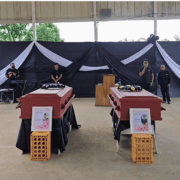
News Americas, NEW YORK, NY, Mon. Jan. 19, 2026: Relatives wept openly last Thursday at Havana’s mass burial of 32 Cuban soldiers killed during the U.S. operation in Venezuela. The killing is being widely interpreted not only as a moment of national mourning, but as a signal of escalating geopolitical tension with potential ripple effects across the Caribbean.

Relatives of some of the 32 Cuban soldiers killed during the US incursion in Venezuela pay respects at their graves during their funeral at Colon cemetery in Havana on January 16, 2026. The capture by US forces of Venezuelan leader Nicolas Maduro on January 3, 2026, and the killing in the operation of 32 Cubans assigned to protect him represent a major blow for the island’s revered intelligence services, experts say. (Photo by ADALBERTO ROQUE / AFP via Getty Images)

The soldiers’ bodies were returned to Cuba in small boxes. They were assigned to Venezuelan President Nicolás Maduro’s security detail under bilateral protection agreements and were killed during the January 3rd U.S. raid that resulted in Maduro’s capture. Their deaths mark one of the most serious direct losses for Cuba’s security apparatus in decades and underscore the expanding regional footprint of U.S. enforcement actions in Latin America.

Relatives of the 32 Cuban soldiers killed during the US incursion in Venezuela attend their funeral at Colon cemetery in Havana on January 16, 2026. The capture by US forces of Venezuelan leader Nicolas Maduro on January 3, 2026, and the killing in the operation of 32 Cubans assigned to protect him represent a major blow for the island’s revered intelligence services, experts say. (Photo by ADALBERTO ROQUE / AFP via Getty Images)

While Cuban authorities framed the funeral as an act of honor and resistance, analysts say the scale of the ceremony reflects broader concern in Havana over Cuba’s vulnerability amid renewed U.S. pressure. The presence of President Miguel Díaz-Canel, former leader Raúl Castro, and senior military officials highlighted the political weight attached to the losses.

Relatives of some of the 32 Cuban soldiers killed during the US incursion in Venezuela pay respects at their graves during their funeral at Colon cemetery in Havana on January 16, 2026. The capture by US forces of Venezuelan leader Nicolas Maduro on January 3, 2026, and the killing in the operation of 32 Cubans assigned to protect him represent a major blow for the island’s revered intelligence services, experts say. (Photo by ADALBERTO ROQUE / AFP via Getty Images)

The episode has also reignited debate over the role of Caribbean and Latin American states in U.S. security operations, particularly as Washington intensifies efforts against governments it deems hostile. The deaths of Cuban personnel operating outside their borders raise questions about how far regional alliances can stretch before becoming flashpoints for wider conflict.

At the same time, the timing of the funerals – coming just as Washington announced humanitarian aid to Cuba following Hurricane Melissa – has fueled diplomatic friction. Cuban officials accused the U.S. of using aid as leverage, while U.S. officials rejected claims of politicization, insisting assistance would be delivered through independent channels.

Cuban soldiers carry the remains of some of the 32 Cuban soldiers killed during the US incursion in Venezuela during their funeral at Colon cemetery in Havana on January 16, 2026. The capture by US forces of Venezuelan leader Nicolas Maduro on January 3, 2026, and the killing in the operation of 32 Cubans assigned to protect him represent a major blow for the island’s revered intelligence services, experts say. (Photo by ADALBERTO ROQUE / AFP via Getty Images)

For many observers, the juxtaposition of military confrontation and humanitarian outreach illustrates a contradictory U.S. posture that is reshaping relations across the Caribbean basin. As public demonstrations unfold in Havana and rhetoric hardens on both sides, regional governments are watching closely, aware that today’s Venezuela operation could set precedents affecting security, sovereignty, and diplomacy throughout the Caribbean.

RELATED: Drama As Diplomacy And Power In The Age Of Spectacle

Drama As Diplomacy And Power In The Age Of Spectacle

By Dr. Isaac Newton

News Americas, NEW YORK, NY, Mon. Jan. 19, 2026: A single image can ignite a movement. A short video can topple governments. A carefully staged event can shift public opinion across continents before most of us even notice. Power is no longer only armies, laws, or treaties. Power is performed. Power is felt. In the age of spectacle, it is often orchestrated long before it is negotiated.

A US Air Force F22-Raptor takes off from José Aponte de la Torre Airport, formerly Roosevelt Roads Naval Station, in Ceiba, Puerto Rico, on January 4, 2026. US President Donald Trump threatened Sunday that Venezuela’s new leader will pay a “big price” if she does not cooperate with the United States, after US forces seized and jailed her former boss Nicolas Maduro. If interim president Delcy Rodriguez “doesn’t do what’s right, she is going to pay a very big price, probably bigger than Maduro,” Trump told The Atlantic in a telephone interview. (Photo by Miguel J. Rodriguez Carrillo / AFP via Getty Images)

For nations in Africa, Latin America, and the Caribbean, this is real. Public opinion can be moved, policies influenced, and leaders cornered without a single formal discussion. Chaos can be designed. Drama can be weaponized. Understanding the performance of power is as vital as understanding its rules.

Small nations face a particular challenge. They cannot always outshine great powers in spectacle, but they can choose when and how to respond. Silence becomes strategy. Timing becomes leverage. Coordination with neighbors, reliance on treaties, and measured messaging turn restraint into influence. Leaders who resist the urge to react to every viral moment transform composure into power.

Citizens face a similar battlefield. Every post, tweet, and trending video competes for attention. Separating what matters from what provokes is essential. Slow down. Question. Reflect. Think beyond the scroll. Democracy thrives not only on protest or outrage but on informed, grounded, and clear-minded participation.

Some nations are already showing the way. Barbados and Jamaica amplify their voices in climate negotiations by speaking together through CARICOM. Rwanda and Ghana use regional media and digital diplomacy to ensure their perspectives on trade and security are heard. Soon, ministries may deploy teams to monitor viral events, plan measured responses, and coordinate regional messaging. Citizens can join media literacy campaigns, fact-checking initiatives, and civic forums. Together, disciplined leadership and an informed public turn attention into real influence.

Seeing through the spectacle is itself a form of power. Small nations and engaged citizens who blend vigilance with restraint, insight with action, and principle with flexibility do more than survive. They shape the stage on which global drama unfolds. In a world where chaos is designed and drama is diplomacy, clarity, focus, and patience are the new instruments of influence.

Will you watch the spectacle unfold, or will you step onto the stage with eyes wide open and shape its story?

Editor’s Note: Dr. Isaac Newton is a strategist trained at Harvard, Princeton, and Columbia. He advises governments and international institutions on governance, transformation, and global justice, helping nations turn vision into lasting progress.

RELATED: The Caribbean’s Moment Of Choice In A Shifting World

When Immigration Policy Meets Tourism Economies: The Caribbean’s New Reality

The Caribbean’s Moment Of Choice In A Shifting World

By Dr. Isaac Newton

News Americas, NEW YORK, NY, Thurs. Jan. 15, 2026: Professor C. Justin Robinson’s, ‘An Existential Moment for the Caribbean,’ is a timely and important response to the challenges facing the region in today’s changing world. One of its greatest strengths is that it speaks honestly about how power really works. Instead of relying on polite diplomatic language, the article explains power as it is used in practice.

By placing current United States foreign policy within a long history of dominance, racial inequality, and unequal economic relationships, Robinson shows why small Caribbean states are especially vulnerable when global politics move toward one-sided decision-making. His warning is clear: a country can lose real control not only through war, but through economic pressure, security dependence, and powerful international institutions. This message is uncomfortable, but it is also realistic and necessary.

MV-22 Osprey aircraft are parked on the tarmac at Mercedita Airport in Ponce, Puerto Rico, on January 15, 2026. (Photo by Ricardo ARDUENGO / AFP via Getty Images)

However, the article may place too much emphasis on the idea that American power will remain dominant forever. The belief that the United States can continue to control global outcomes without serious pushback overlooks how quickly power can change. History offers many lessons. The British Empire once believed it would last indefinitely, but it weakened because of economic strain and changing global alliances. The Soviet Union appeared militarily strong, yet internal economic and technological problems eventually led to its collapse. These examples show that power based mainly on force often fails to recognize resistance, innovation, and long-term change.

The article also gives limited attention to how the nature of power itself has evolved. Military strength alone no longer guarantees control in a world shaped by cyber warfare, artificial intelligence, global finance, and supply chains. Countries like China, along with other technologically advanced middle-level powers, are not simply reacting to U.S. decisions.

They are actively shaping new global rules through trade networks, development loans, and digital infrastructure. At the same time, political division within the United States makes it harder to maintain clear and consistent long-term strategies. New technologies also reduce the gap between powerful nations and smaller ones. Together, these trends suggest a world that is unstable and changing, rather than one controlled by a single dominant power.

For the Caribbean, the years ahead will require careful thinking, not just survival. The region’s future cannot depend on passively following powerful allies or relying on old relationships. Caribbean nations must make deliberate choices. This means building partnerships with a wider range of countries, strengthening regional cooperation, and improving diplomatic skill. Governments must move beyond reacting to global events and instead plan strategically across economic, security, and technological areas.

Regional institutions should be strengthened so Caribbean states negotiate together rather than alone. Investment in education, digital skills, and economic resilience is no longer optional; it is essential to real independence in the modern world. The Caribbean must also use its shared voice to influence global rules, not just accept them. This is a moment of decision. With unity and foresight, the region can turn global uncertainty into opportunity. Without them, its future will be shaped by others.

EDITOR’S NOTE: Dr. Isaac Newton is a strategist and scholar trained at Harvard, Princeton, and Columbia. He advises governments and international institutions on governance, transformation, and global justice, helping nations and organizations turn vision into sustainable progress.

RELATED: The Caribbean And Strategic Diplomacy In A Constrained World