
US Revokes Visas Of Two Members Of Haiti’s Presidential Council
News Americas, NEW YORK, NY, Sun. Jan. 26, 2026: The U.S. Department of State has imposed visa restrictions and revocations on two members of Haiti’s Transitional Presidential Council, (TPC), and their immediate family members, citing alleged involvement in the operations of gangs and other criminal organizations. The move underscores a blunt message: political authority entangled with gang power will no longer be tolerated.
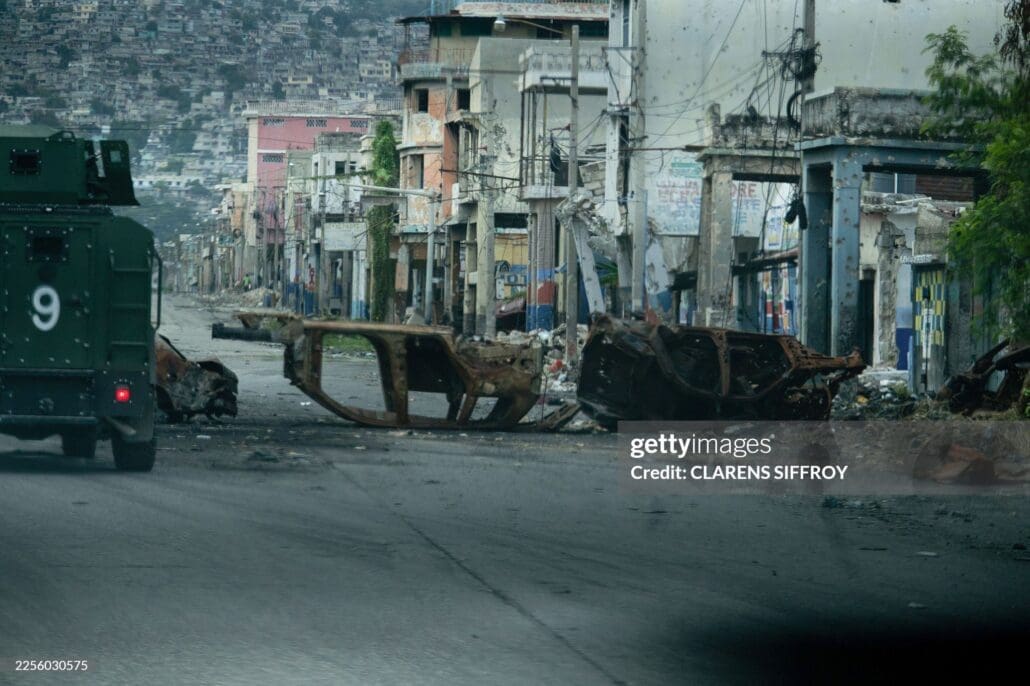
A police vehicle drives around cars burned by armed gangs and used as a barricade during clashes last week with Haitian security forces on a deserted street in the city center, seen from an armored police vehicle during a patrol, in Port-au-Prince on January 16, 2026. An operation on January 14 by the Haitian National Police, conducted jointly with the army, the Gang Repression Force (FRG) and a mercenary unit, took place in the stronghold of Jimmy Chérizier, known as “Barbecue,” leader of the “Viv Ansanm” gang, in one of his residences in the Delmas 6 district, 6km (4 miles) west of downtown Port-au-Prince, although he was absent at the time of the operation. (Photo by Clarens SIFFROY / AFP via Getty Images)
“These actions are being taken due to the TPC members’ involvement in the operation of gangs and other criminal organizations in Haiti,” said State Department spokesman Thomas Pigott, pointing specifically to interference with Haiti’s efforts to combat gangs designated by the U.S. as Foreign Terrorist Organizations (FTOs).
No names were officially released. No evidence was detailed. But the timing – and the context – spoke loudly.
Power, Pressure, and a Fracturing Council
Over the past 24 hours, some council members have reportedly attempted to use their votes as leverage against Prime Minister Alix Didier Fils-Aimé, while a well-known gang figure posted a TikTok video voicing support for the council. The overlap between political maneuvering and gang signaling has become harder to dismiss.
The security situation on the ground continues to deteriorate. On Sunday afternoon, two Brazil-bound charter planes were hit by gunfire as they approached Toussaint Louverture International Airport from Croix-des-Bouquets, east of Port-au-Prince. No injuries were reported – but the message was unmistakable. Armed gangs, already controlling large swaths of the capital, are expanding their reach.
The visa action brings the number of TPC figures who have lost U.S. visas or green cards in the past two months to at least three. Previously, the State Department revoked the visa of former central bank governor and council member Fritz Alphonse Jean, who confirmed he was barred from entering the United States after an alleged attempt in November to remove Prime Minister Fils-Aimé. Jean has denied accusations of gang ties.
Washington Signals the End of Patience
The legal authority for the move – INA 212(a)(3)(C) – allows the U.S. to bar entry to individuals whose presence could have “potentially serious adverse foreign policy consequences.” In practical terms, it is a diplomatic red card.
Tensions within Haiti’s transitional leadership have been escalating since November. With the council’s mandate set to expire on Feb. 7, and no elected president in place, five of the council’s seven voting members recently voted to remove Fils-Aimé and install a new government. The Trump administration has described that move as illegal and warned of consequences.
On Friday, Jan. 23rd, U.S. Secretary of State Marco Rubio personally called Fils-Aimé to reaffirm U.S. support and to underscore that the council’s authority ends on Feb. 7, according to U.S. officials.
“We are the ones who appointed Didier Fils-Aimé,” council member Leslie Voltaire said at a press conference, insisting the council has the right to replace him. Washington disagrees.
A Country Running Out of Time
Haiti’s crisis extends far beyond political infighting. Armed gangs now dominate much of the country, hollowing out the state’s ability to govern and deliver basic services. Presidential elections have not been held in nearly a decade. Humanitarian needs have reached unprecedented levels, with millions struggling to meet daily necessities.
“Violence has intensified and expanded geographically, exacerbating food insecurity and instability, as transitional governance arrangements near expiry and overdue elections remain urgent,” said UN Secretary-General António Guterres in his latest report on the UN’s political mission, BINUH.
More than one in ten Haitians have been displaced by violence. Migration pressures are rising. Regional stability is increasingly at risk.
The Signal Behind the Sanctions
This is not just about visas. It is about legitimacy.
The U.S. move reframes Haiti’s crisis in stark terms: the problem is no longer only gangs versus the state – it is the blurring of lines between the two. By targeting senior political figures, Washington is signaling that stability cannot be built on compromised authority.
“The Haitian people have had enough with gang violence, destruction, and political infighting,” the State Department said, adding that the Trump administration “will pursue accountability for those who continue to destabilize Haiti and the region.”
Elections are tentatively projected for early 2027. Whether Haiti reaches that moment with functioning institutions – or slides deeper into fragmentation – may depend on whether this line drawn by Washington holds.




Leave a Reply
Want to join the discussion?Feel free to contribute!