
The Weight Of A Word: Rethinking “Minority” In America
By Nyan Reynolds
News Americas, NEW YORK, NY, Fri. Dec. 12, 2005: “In our country, we believe there should be no minority and no majority, just people.” – Steve Biko
The South African activist Steve Biko used these words to highlight how language itself can be a tool of division. Though Biko was speaking in the context of apartheid, his words hold relevance in the United States, where the categories of “minority” and “majority” remain central to how race is discussed and understood.
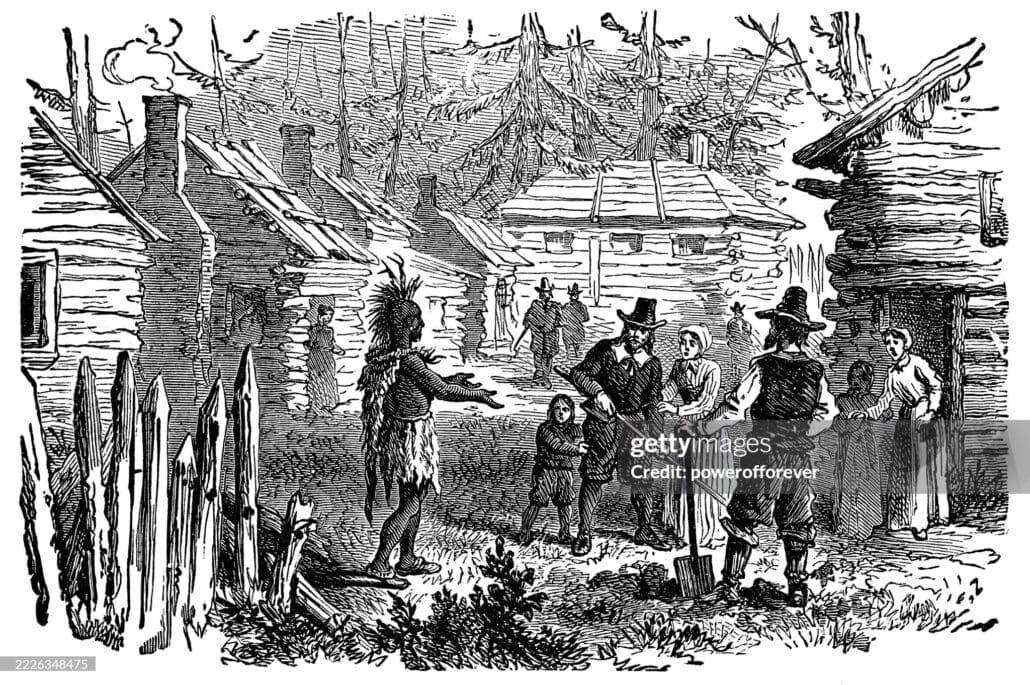
Samoset sagamore of the Abenaki people, greeting the pilgrims of the Plymouth Colony in Massachusetts, USA (circa 17th century). Vintage etching circa 19th century.
Few words in American racial discourse are as common or as unexamined as minority. The term appears in government reports, census categories, school curricula, corporate diversity statements, and daily conversation. Black Americans, along with Latinos, Asians, Indigenous people, and immigrants, are routinely described as “minorities.” The word is so deeply ingrained in the national vocabulary that it often goes unquestioned. Yet its history and social implications reveal a different story. Beneath its surface neutrality, minority operates as a marker of marginalization.
From Numbers To Status
The English word minority originally referred to being smaller in number or lesser in status. In political contexts, it described groups with less representation or less authority, such as a minority party in a legislature. In this setting, the meaning was both numerical and hierarchical: fewer members translated into less influence.
In the United States, this logic made its way into racial discourse. By the early to mid-twentieth century, as government agencies and social scientists studied racial and ethnic groups, “minority” became a shorthand for those outside the white mainstream. The U.S. Census, for example, tracked populations according to racial categories, but policy discussions increasingly referred to these communities collectively as “minorities.” The label appeared in debates on education, employment, and voting rights.
This was more than description. It was categorization. To call Black Americans a minority was not only to note their numbers but also to assign them a social position. It implied less power, less visibility, and less belonging. Over time, the word solidified into a label that carried assumptions of inferiority.
The Social Implications
The implications of this language extend far beyond statistics.
Defining by deficit. To be labeled a minority is to be defined by lack. It frames identity in terms of what is missing, population size, influence, resources, rather than what is present. For Black Americans and Caribbeans individuals, this framing compounds the legacy of slavery, segregation, and systemic exclusion, reinforcing a narrative of limitation.
Masking diversity. The category also obscures difference. By grouping together Black Americans, Latinos, Asians, those of Caribbean decent, Native peoples, and others under one label, the word erases the distinct histories and struggles of each. Black Americans, whose presence in the U.S. is rooted in enslavement and centuries of systemic discrimination, are placed in the same category as immigrant populations with very different experiences. The flattening of identity that results prevents deeper recognition of each community’s unique realities.
Sustaining hierarchy. The persistence of the word minority also reinforces a symbolic hierarchy. Even in places where Black and brown communities form the majority, cities like Detroit, Houston, or Atlanta, they are still labeled minorities. Nationally, demographic projections show that by mid-century, nonwhite populations will collectively outnumber whites, yet the label persists. This demonstrates that minority is less about numbers and more about social status.
Historical Usage In Policy And Education
The institutional use of “minority” has reinforced these implications. Civil rights legislation of the 1960s, while groundbreaking, often used the term “minority groups” to identify those entitled to protection. Affirmative action programs in higher education and employment were designed with “minorities” in mind. These policies addressed real inequities but also embedded the label into the structure of law.
In education, textbooks routinely referred to Black, Latino, and Asian students as minorities. For generations of children, growing up meant encountering a narrative that positioned them as small, lesser, and outside the center of American identity. The repetition of the label in classrooms normalized the idea of difference as deficiency.
In the workplace, “minority hiring” became a standard phrase. While meant to promote inclusion, it often created the impression that employees of color were tokens, exceptions granted space within institutions rather than central contributors. Again, the word framed belonging in terms of scarcity.
The Danger Of Internalization
Perhaps the most damaging effect of the word minority is its internalization. Many Black Americans refer to themselves as minorities without questioning the label. Over time, this acceptance can subtly reinforce a sense of smallness.
Research in social psychology has shown that repeated exposure to deficit-based language can shape self-concept. Children labeled as minorities may come to see themselves as outsiders in their own country. Adults who internalize the term may carry an unspoken sense of limitation, even as they succeed. This is not because they lack confidence or capability, but because the language itself imposes boundaries on how they are imagined.
The damage here is not always visible. It operates quietly, through the drip of repetition, until it feels natural. When people embrace the label for themselves: “I’m a minority in this country,” they may unknowingly reinforce the very hierarchy that the term was designed to describe.
Why The Word Persists
Despite its baggage, the term remains widespread. Bureaucracy plays a role. Government agencies and corporate diversity programs are still organized around categories like “minority representation.” Habit plays another role. Once embedded in textbooks, policies, and popular speech, words are difficult to uproot. Convenience also contributes. “Minority” is a single word that groups together diverse populations, offering an easy shorthand.
But convenience is not harmless. The continued use of minority allows the underlying hierarchy to remain unchallenged. It ensures that entire communities continue to be described, and therefore imagined in terms of what they are not.
Rethinking The Vocabulary
Reconsidering the word is not about semantics for their own sake. It is about disrupting the ways language sustains inequality. Several alternatives have been proposed. “Marginalized groups” highlights the active process of exclusion rather than suggesting an inherent lack. “Communities of color” emphasizes shared experiences of racialization, though it still groups diverse populations together. “Underrepresented populations” draws attention to gaps in visibility and influence.
Some advocates use the phrase “global majority,” noting that people of African, Asian, Indigenous, and Latin descent make up most of the world’s population. This term flips the perspective, reminding us that Black Americans and other groups are not minorities in any global sense.
None of these terms is perfect, but each offers a way of framing identity without reducing communities to symbols of smallness.
Beyond Language
Of course, changing language alone will not dismantle racial inequity. The structural barriers that Black Americans face, economic inequality, disparities in education and healthcare, systemic discrimination—require more than new vocabulary. But words matter because they shape the framework through which these realities are understood. Language is both a mirror and a mold. It reflects existing power structures while also helping to reinforce them.
Questioning the word minority is part of questioning the assumptions that sustain inequality. If Black Americans continue to be labeled as minorities, they are continually positioned at the margins of a society they helped build. Rejecting the term does not solve the problem, but it begins to shift the lens through which the problem is seen.
Conclusion
Steve Biko’s vision that there should be no minority and no majority, just people remains unfinished business in America. The word minority may appear neutral, but its history shows otherwise. For Black Americans, it has been less a description of numbers and more a marker of marginalization. It defines by deficit, erases diversity, sustains hierarchy, and quietly shapes self-perception.
The persistence of the word is a reminder of how deeply systems of inequality are embedded in everyday life. To keep using it uncritically is to accept a worldview where some people are always smaller, lesser, or secondary. To challenge it is to recognize that no group’s worth can be measured by numbers alone.
Reconsidering minority is not about erasing history or denying demographic reality. It is about refusing to let language dictate value. If the United States is to move toward genuine equality, it must begin with the recognition that no community is inherently minor.






Leave a Reply
Want to join the discussion?Feel free to contribute!