
Bridges Under Strain: Diplomacy, Due Process And The Caribbean U.S. Compact
By Dr. Sheila Newton Moses
News Americas, NEW YORK, NY, Thurs. Dec. 18, 2025: The United States’ recent expansion of travel restrictions to 39 countries has quietly but significantly drawn several small Caribbean states, including Antigua and Barbuda and Dominica, into a policy framework justified by security, documentation integrity, and immigration compliance. Their inclusion raises a fundamental question for diplomacy. By what measurable standards were these countries assessed, and how were those standards applied?
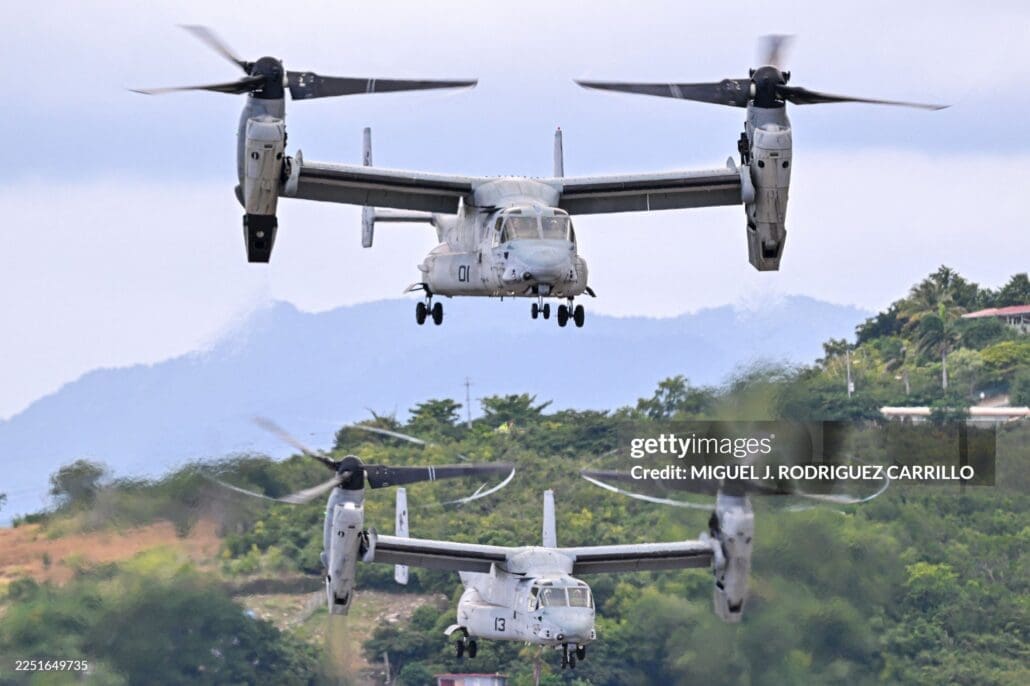
Two US Marine Corps MV-22 Ospreys depart at Mercedita International Airport on December 16, 2025 in Ponce, Puerto Rico. Aircraft movements and coordinated exercises were observed throughout the day as part of heightened regional military readiness linked to ongoing operations at US military bases and maritime security efforts in the Caribbean. President Donald Trump administration is conducting a military campaign in the Caribbean and eastern Pacific, deploying naval and air forces for what it calls an anti-drugs offensive. (Photo by Miguel J. Rodriguez Carrillo / AFP via Getty Images)
Categorized under partial restrictions, these nations are neither deemed hostile nor unstable. Yet their placement alongside vastly different geopolitical contexts invites scrutiny of both the criteria used and the transparency of the process. In international affairs, ambiguity itself carries consequence.
For Antigua and Barbuda and Dominica, the implications extend beyond travel. Their economies are deeply interconnected with the United States through tourism, education, financial services, and remittances. Even a technical perception of elevated risk can undermine investor confidence, disrupt travel flows, and weaken diaspora engagement.
Antigua and Barbuda shares a particularly strong human bond with the United States. Many Antiguans and Barbudans are second and third generation American citizens, woven into U.S. civic, professional, and cultural life. Restrictions that complicate travel for family, study, or business risk straining not only economic ties but the social fabric linking these nations.
This moment also prompts diplomatic inquiry. Were bilateral consultations undertaken before the restrictions were imposed? Was there technical engagement or remediation to address U.S. concerns in advance? Historically, U.S. Caribbean relations have rested on cooperation and shared security interests, including counter narcotics efforts, maritime safety, disaster response, and regional stability. These are not distant partners but neighbors connected by maritime borders, economic interdependence, and decades of coordinated security dialogue.
At its core, this development tests the strength of a long standing relationship. While every sovereign nation has the right to secure its borders, effective diplomacy depends on clarity, engagement, and proportionality, especially among trusted partners. The central question is not whether security matters, but how it is pursued. Collaborative benchmarks and transparent dialogue can address concerns without eroding goodwill.
As Caribbean governments seek clarification and the United States advances its objectives, the durability of this relationship will depend on whether diplomacy once again leads the process, ensuring that longstanding bridges of partnership are preserved rather than weakened.





Leave a Reply
Want to join the discussion?Feel free to contribute!