Venezuela’s Crisis Is A Warning: When Ideology Replaces Governance, Nations Fail
By Keith Bernard
News Americas, NY, NY: Venezuela stands as the clearest warning of what happens when ideology replaces governance. Caught between neoconservative interventionism and neo-Bolivarian defiance, the country has become less a sovereign state than an ideological battlefield – one its people did not choose.
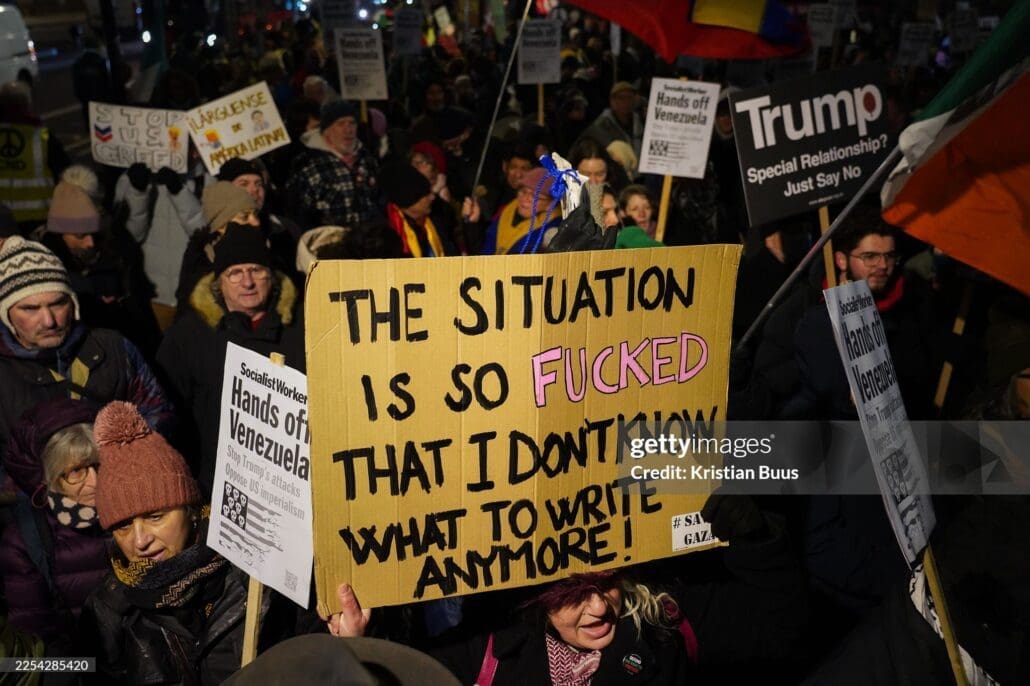
Hundreds of protesters turned out at the Hands Off Venezuela demonstration in response to the United States of America’s actions in Venezuela on the 5th of January 2026, London, United Kingdom. The US attacked Venezuela on the 3rd of January and captured President Maduro and his wife Celia Flores in a highly controversial military action, which critics have suggested is illegal and in breach of international conventions. (photo by Kristian Buus/In Pictures via Getty Images)
Neoconservatism, as reflected in U.S. policy toward Venezuela, rests on the belief that economic pressure and diplomatic isolation can force democratic change. Years of sanctions and international pressure, however, have failed to dislodge the ruling elite. Instead, they have deepened economic collapse, fueled mass migration, and hardened authoritarian rule. Leverage became punishment, with ordinary Venezuelans paying the price.
The neo-Bolivarian movement, born under Hugo Chávez and sustained by Nicolás Maduro, presented itself as an anti-imperial alternative—one promising sovereignty, equality, and social justice. In practice, it centralized power, dismantled institutions, and reduced accountability. Oil wealth masked mismanagement until it vanished, leaving scarcity, corruption, and repression in its wake. Revolutionary rhetoric became a substitute for policy.
Venezuela exposes the shared flaw of both doctrines. Neo-conservatism assumes coercion produces reform. Neo-Bolivarianism assumes ideology can replace institutions. Both are wrong.
The fallout is regional. Millions of Venezuelans have fled, straining neighbors across Latin America and the Caribbean. Trade has suffered, diplomacy has stalled, and external powers have filled the vacuum left by ideological deadlock.
The lesson is not about choosing the “right” ideology. It is about rejecting ideological certainty altogether. Sustainable democracy is built on credible institutions, economic diversification, political pluralism, and pragmatic engagement—not sanctions alone, and not slogans wrapped in sovereignty.
Venezuela’s crisis is not inevitable. But its warning is unmistakable: when ideology becomes destiny, nations fail – and citizens pay the cost.






Leave a Reply
Want to join the discussion?Feel free to contribute!