
From Aristotle To Algorithms: Democracy’s Perilous Retreat
By Ron Cheong
News Americas, TORONTO, Canada, Mon. Jan. 12, 2025: For more than 2,500 years, human societies have moved – unevenly but persistently – toward greater democracy. Yet today, that trajectory appears to be reversing. Increasingly, modern political and technological systems echo a long-discredited thesis of the fourth-century BCE Greek philosopher Aristotle, who was deeply suspicious of rule by the many.
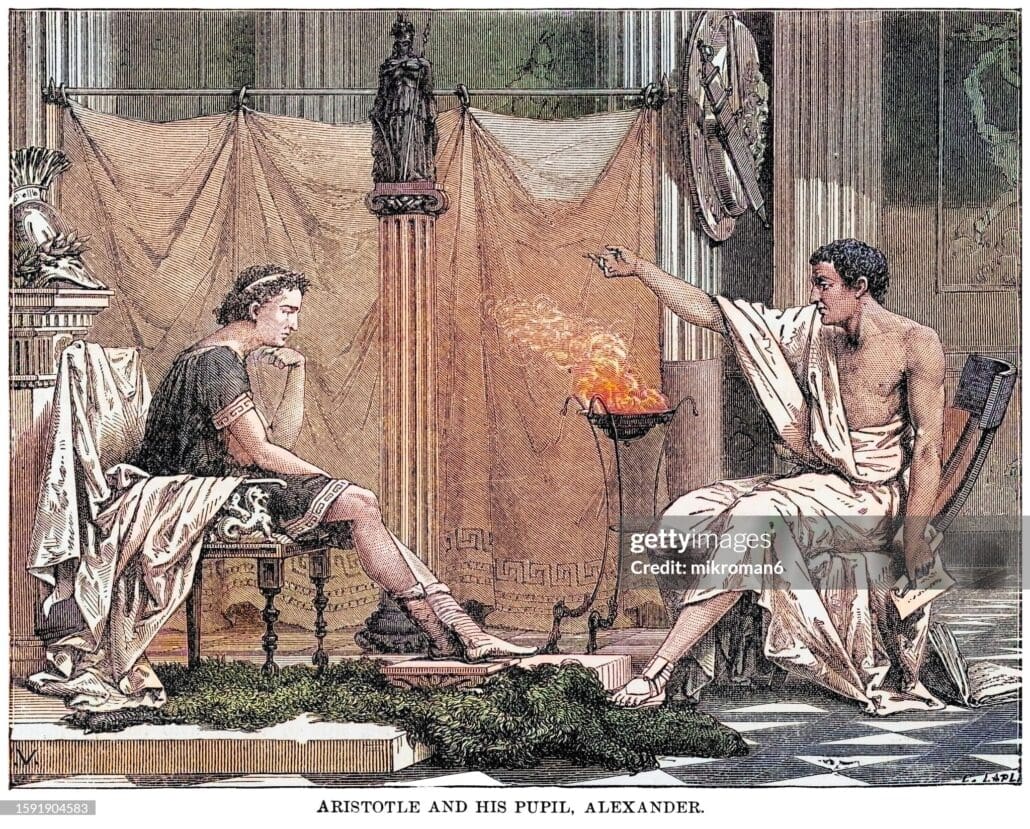
Old engraved illustration of Aristotle (Greek philosopher and polymath) teaching Alexander The Great
In politics, Aristotle argued that society functioned best as a hierarchy. Some people, he claimed, were naturally suited to rule, while others were naturally suited to be ruled. The ideal polis resembled a living organism: rulers exercised reason, warriors enforced order, and laborers sustained the whole. He even defended slavery, asserting that certain individuals were “slaves by nature,” lacking the rational capacity for self-governance. Justice, in this view, was not equality but each person remaining in their “proper” place.
Despite Aristotle’s towering contributions to philosophy, this aspect of his thought has rightly been rejected. It rests on a denial of moral equality and legitimizes permanent domination. History since has largely been a repudiation of that worldview.
The emergence of “demokratia” in Athens around 508 BCE marked a radical departure from aristocratic rule, even if limited to free adult males. Later milestones reinforced the principle that power must be constrained and justified by consent. The Magna Carta of 1215 established that even kings were subject to the law. The American Revolution of 1776 and the French Revolution of 1789 asserted popular sovereignty and civic equality, embedding the idea that legitimacy flows upward from the people, not downward from elites.
Checks, Balances, And The Distribution Of Power
Modern democracy rests on a simple but demanding premise: political equality is a moral good. Each person, regardless of birth or status, has an equal claim to self-government. Where Aristotle feared the masses as irrational, democracy assumes that collective decision-making – though imperfect – is preferable to rule by a self-appointed few. It rejects the notion that wisdom or virtue is the monopoly of any class.
This commitment is institutionalized through checks and balances. The separation of powers among executive, legislative, and judicial branches exists precisely to prevent the concentration of authority that Aristotle saw as natural. Legislatures deliberate, executives act within constraints, and courts limit both. The resulting friction is slow and often frustrating, but it is essential. It restrains abuses, protects minorities, and allows societies to correct errors without violence.
Democratic Backsliding in the Modern Era
Yet, over the past decade, many democracies have shown clear signs of erosion. Political polarization has intensified, trust in institutions has declined, and executive power has expanded under the banners of crisis management and efficiency. Civil liberties have been weakened incrementally, often justified by security threats, public health emergencies, or technological necessity. Each step appears modest; collectively, they represent a significant retreat.
At the same time, a new concentration of power has emerged outside traditional democratic structures. Large technology corporations now exercise influence rivaling that of states. Vast quantities of personal data are extracted under the promise of convenience and personalization. In practice, this data enables behavioral prediction, manipulation, and surveillance on a scale previously unimaginable. Power quietly shifts from citizens to opaque systems governed by profit motives and insulated from democratic accountability.
Crucially, these technologies do not merely coexist with authoritarianism – they actively enable it. Surveillance tools developed for advertising seamlessly translate into tools for social control. Algorithmic content curation can suppress dissent without overt censorship. Data analytics allow governments to identify, track, and pre-empt opposition. What once required secret police and informants can now be automated, outsourced, and normalized.
Elite Skepticism Of Democracy
That this development appeals to elites is no secret. Billionaire investor Peter Thiel has been unusually candid in his skepticism of democracy. In a 2009 essay, he wrote, “I no longer believe that freedom and democracy are compatible.” Elsewhere, he argued that expanding the franchise undermines liberty and that mass participation weakens effective governance. These views echo Aristotle’s ancient distrust of the many – reframed in the language of markets, efficiency, and technological inevitability.
Artificial intelligence intensifies these dangers. AI systems increasingly mediate access to information, shaping what people see, believe, and ignore. Deepfakes, automated propaganda, and algorithmic echo chambers erode shared reality. When citizens cannot agree on basic facts, democratic deliberation becomes impossible. Truth itself loses authority, replaced by competing, emotionally optimized narratives.
Authoritarian systems are well suited to this environment. They benefit from AI’s capacity to flood the information space, obscure responsibility, and enforce compliance invisibly. Democracies, by contrast, depend on transparency and trust—both of which AI can quietly undermine. The threat is not only that AI will be used to lie, but that it will make truth indistinguishable from fiction.
Losing The Moral High Ground – Prosperity Without Contentment
As democracies increasingly adopt authoritarian practices – mass surveillance, censorship by proxy, emergency powers without clear limits – they forfeit the moral authority that once distinguished them. This loss has global consequences. When established democracies bend their own rules, they signal that principles are optional. Authoritarian regimes eagerly exploit this hypocrisy to justify repression, claiming that liberal values are merely instruments of power rather than genuine commitments. The international rules based order collapses.
All of this has occurred during a period of unprecedented material prosperity. Yet higher living standards have not produced more cohesive or content societies. Rising inequality, social fragmentation, and a pervasive sense of powerlessness undermine well-being. When decisions are made by distant political, financial, or technological elites, prosperity feels hollow. Aristotle himself believed that virtue required participation in public life; stripped of agency, citizens become subjects, regardless of wealth.
If current trends continue, the future may resemble a technologically enhanced version of Aristotle’s hierarchical polis: a small governing class, aided by intelligent machines, managing populations deemed incapable of meaningful self-rule. Democracy may survive as a label, but emptied of substance.
The alternative remains possible – but not automatic. It requires renewed commitment to democratic constraints on power: robust data rights, transparent and accountable AI governance, and institutions capable of restraining both states and corporations. The choice is not between order and chaos, as Aristotle feared, but between shared self-government and a return to rule by the few. History suggests that once equality is surrendered as a principle, it is rarely regained without struggle.
EDITOR’S NOTE: Ron Cheong, born in Guyana, is a community activist and dedicated volunteer with an extensive international background in banking. Now residing in Toronto, Canada, he is a fellow of the Institute of Canadian Bankers and holds a Bachelor of Science degree from the University of Toronto. His comments are his own and does not reflect those of News Americas or its parent company, ICN.






Leave a Reply
Want to join the discussion?Feel free to contribute!