
Against The Odds: A Guyana Born Centenarian And Current Health Care
By Ron Cheong
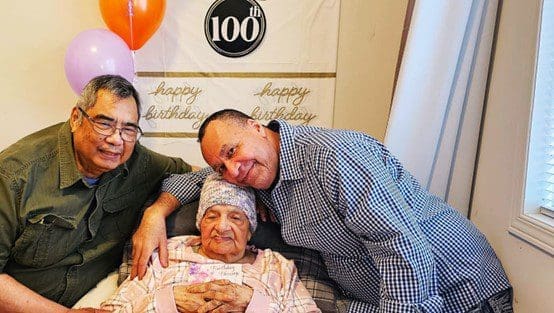
News Americas, TORONTO, Canada, Fri. Jan. 23, 2026: Giving birth in a developing nation a hundred years ago was an act of quiet bravery. In British Guiana in the 1920s, childbirth carried an ever-present risk: infant mortality stood at a staggering 159 deaths per 1,000 live births. Mothers laboured without modern diagnostics, antibiotics, blood banks, or neonatal care. Survival often depended on little more than resilience, luck, and the skill of a handful of dedicated doctors. Against those odds, my aunt Pauline (Irma) Persaud was born and survived, along with three of her siblings.
Guyana-born Centenarian Pauline (Irma) Persaud, c. (contributed image)
This week, she reached the extraordinary age of 100. Frail in body now, her mind remains remarkably sharp. Even in her late nineties, she could correct me when I misremembered a family detail. At 100, her mental clarity endures, though the energy to converse has understandably waned.
Yet, when I asked her what she could recall of her earliest years, she surprised me. She believes the attending physician at her birth was Dr. Bissessar. She remembers him fondly, especially an image that has stayed with her for nearly a century: the doctor placing her younger sister – my mother – on a swing and gently rocking her. My mother, she said, adored him.
What my aunt did not know is that Dr. Bissessar’s grandson and I have been lifelong close friends. For decades, neither of us was aware of this earlier connection. It is a coincidence that quietly bridges generations – one life, one family, and one country’s long arc of medical progress.
A Century Later: Measuring The Distance Traveled
Fast-forward to 2025. Guyana’s infant mortality rate stands at approximately 24 deaths per 1,000 live births. While still higher than in developed countries, the difference from a century ago is profound. Behind that single statistic lies improved antenatal care, trained midwives, vaccination programs, emergency obstetric services, and access – however uneven – to modern medical facilities.
Healthcare progress, of course, is never linear. Guyana’s system has experienced periods of neglect, underinvestment, and uneven leadership. But the past five years mark a notable inflection point.
Rebuilding The Foundations: Infrastructure And Access
One of the most visible changes has been the rapid expansion of healthcare infrastructure. Several new regional hospitals have been brought on stream or advanced significantly, including facilities in Kato, Lethem, and Moruca – areas long underserved due to geography and historical neglect. These are not symbolic projects; they are functional hospitals intended to reduce the need for dangerous and costly medical travel.
In communities such as Mahdia, improved health facilities have dramatically improved access to primary and emergency care. Across the country, dozens of health posts and clinics have been built or rehabilitated, bringing services closer to hinterland and rural populations where outcomes were once predictably poor.
For a nation still grappling with vast distances and uneven population distribution, bricks and mortar matter. But buildings alone are not enough.
Leadership And Stewardship: A Stark Contrast
Under the stewardship of Minister of Health Dr. Frank Anthony, the health sector has demonstrated coherence, urgency, and a clear sense of direction. This stands in sharp contrast to the dismal performance under a previous administration.
That earlier period was marked by shortages, industrial unrest, deteriorating facilities, and a worrying absence of strategic planning. Morale among healthcare workers sank, and public confidence eroded. The system did not merely stagnate – it regressed.
Dr. Anthony’s return to the ministry brought immediate stabilization and a longer-term reform agenda. Procurement improved, staffing challenges were addressed more systematically, and partnerships that had long been discussed but never realized were finally activated.
COVID-19: A Defining Stress Test
Nothing tested Guyana’s healthcare leadership more severely than the Covid-19 pandemic. The contrast between administrations could not have been clearer.
Dr. Anthony’s response was swift, science-driven, and largely transparent. Guyana moved quickly to secure vaccines, expand testing capacity, and communicate public-health guidance. Mistakes were inevitable, but course corrections were made.
Covid exposed weaknesses everywhere, but it also demonstrated what competent leadership could achieve under pressure.
Vision 2030: Leapfrogging Into Modern Care
Today’s reforms are framed within a broader national blueprint: Vision 2030. The ambition is unapologetically bold: to transform Guyana’s public health system into a modern, accessible, and resilient one.
Central to this vision is “leapfrogging”: using digital health tools and targeted investments to bypass outdated systems entirely. Initiatives include electronic health records, telemedicine for hinterland communities, and dramatically faster diagnostics. The national pathology laboratory, for example, has reduced test turnaround times from months to days – a change that saves lives quietly but decisively.
Partnerships underpin this effort. Collaborations with Mount Sinai, the World Bank, and others are helping modernize infrastructure, train healthcare workers, and strengthen pandemic preparedness through a “One Health” approach that integrates human, animal, and environmental health.
Maternal and child health, cancer care, and workforce development are explicit priorities. Immunization rates have improved significantly, malaria cases have fallen sharply, and diagnostic capacity has expanded nationwide.
One Life, One Century, One Measure Of Progress
My aunt was born into a world where survival itself was uncertain. That she reached adulthood -let alone 100 – is a testament to personal resilience and the quiet dedication of doctors like Dr. Bissessar, working with limited tools but immense commitment.
Her life also offers a human measure of national progress. From an era when infant death was tragically common to one where modern healthcare is increasingly expected, Guyana has traveled far, but there is more to do – the work continues, and my aunt continues to be an inspiration.
EDITOR’S NOTE: Ron Cheong, born in Guyana, is a community activist and dedicated volunteer with an extensive international background in banking. Now residing in Toronto, Canada, he is a fellow of the Institute of Canadian Bankers and holds a Bachelor of Science degree from the University of Toronto. His comments are his own and do not reflect those of News Americas or its parent company, ICN.




Leave a Reply
Want to join the discussion?Feel free to contribute!