
Caribbean Watch: Anticipation and Uncertainty Ahead of High-Profile Talks With Washington
NEWS AMERICAS, NY, NY, Mon. Mar. 2, 2026: If ever there were a moment in recent Caribbean and hemispheric history where one would desperately wish to be a fly on the wall, it is now — on the eve of the anticipated meeting between the Presidents of Guyana, Trinidad and Tobago, and the United States of America. At a time when the Middle East continues to burn with a ferocity that is reshaping global alliances, energy markets, and the very architecture of international order, such a gathering carries implications that stretch far beyond the walls of whatever room these three leaders occupy.
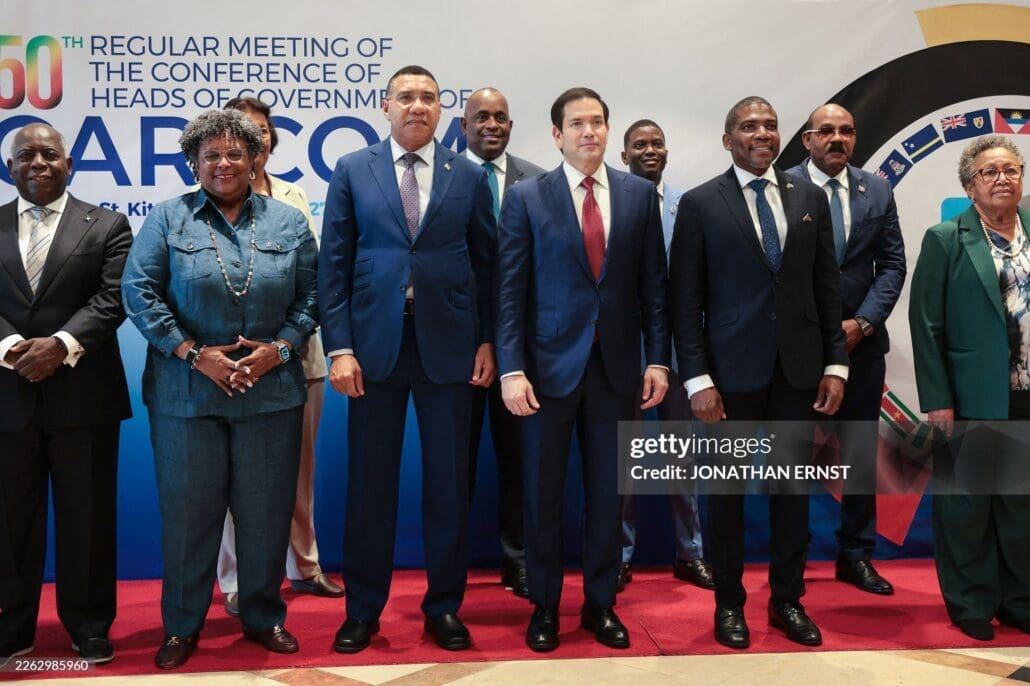
US Secretary of State Marco Rubio participates in a family photo with Caribbean Community (CARICOM) heads of government in Basseterre, Saint Kitts and Nevis, February 25, 2026. Rubio is meeting with Caribbean leaders seeking a common line on Venezuela and pressure on Cuba. He’s also addressing President Donald Trump’s priorities, including combating illegal immigration, drug trafficking and regional security. (Photo by Jonathan Ernst / POOL / AFP via Getty Images)
The world in which this meeting takes place is not the world of even five years ago. The ongoing conflict in the Middle East — with its cascading effects on oil prices, shipping routes, global food security, and the re-alignment of geopolitical loyalties — has elevated the strategic importance of the Western Hemisphere’s energy producers to a degree that would have seemed extraordinary in calmer times. Guyana, sitting atop one of the most significant oil discoveries of the twenty-first century, and Trinidad and Tobago, a seasoned natural gas exporter with decades of energy diplomacy under its belt, are no longer peripheral players in conversations that Washington must have. They are, increasingly, central to them.
And so, as a Caribbean citizen watching all of this unfold, I confess I would give much to hear what is truly said — not the polished communiqués that will emerge for public consumption, but the frank exchanges that happen between statesmen who know the weight of what they carry. What does Washington really want from Guyana and Trinidad? Is this a conversation about energy security — redirecting supply chains away from volatile Middle Eastern sources — or is there a broader strategic ask being made, perhaps regarding regional security architecture, the posture toward Venezuela, or the management of China’s deepening footprint in the region?
I would want to hear how our leaders push back — or whether they do. Will Guyana’s President articulate a vision for how this oil wealth serves Guyanese first, even as global powers circle with their interests? Will Trinidad’s leader bring to the table the voice of a small island state that has survived the boom-and-bust cycles of hydrocarbon dependence and has something honest to say about the terms of these relationships? The Middle East crisis has a way of making powerful nations suddenly generous — but generosity from the powerful rarely arrives without strings.
There is also the humanitarian dimension to consider. As the Middle East conflict has deepened divisions within international institutions — the United Nations rendered increasingly impotent, Western consensus fractured, and the Global South watching with a mixture of anger and calculation — small states like ours face real choices about which version of the international order we wish to inhabit and uphold. I would want to hear whether anyone in that room speaks to this, or whether the conversation stays safely within the language of investment, trade, and strategic partnership.
History is being made in real time, and the Caribbean — often spoken about as an afterthought in global affairs — now finds itself in a peculiar and powerful position. I would want to know, in that room, whether our leaders recognise this fully and are negotiating accordingly; or whether old habits of deference and dependency are quietly reasserting themselves under the pressure of a superpower’s invitation.
A fly on the wall would hear the truth of it. The rest of us will have to read between the lines of whatever statement follows. I trust that our leaders understand that the people of this region are watching — and hoping — that they negotiate not just for today’s headlines, but for the long arc of our sovereignty and wellbeing.





Leave a Reply
Want to join the discussion?Feel free to contribute!