
What Now After Davos
By Dr. Isaac Newton
News Americas, NEW YORK, NY, Sat. Jan. 24, 2026: Davos is the annual meeting of the World Economic Forum in Switzerland, where political leaders, CEOs, central bankers, and global influencers gather to discuss where the world is headed. No binding decisions are made, but signals are sent. What is said there often shapes policies that later touch everyday lives.
This year, Canada’s Prime Minister Mark Carney used that stage to name a reality many already feel. He described the moment as “a rupture, not a transition,” warned that “the strong do what they can and the weak suffer what they must,” and reminded middle powers that “if we’re not at the table, we’re on the menu.” His message was simple and unsettling. Power is again setting the rules.
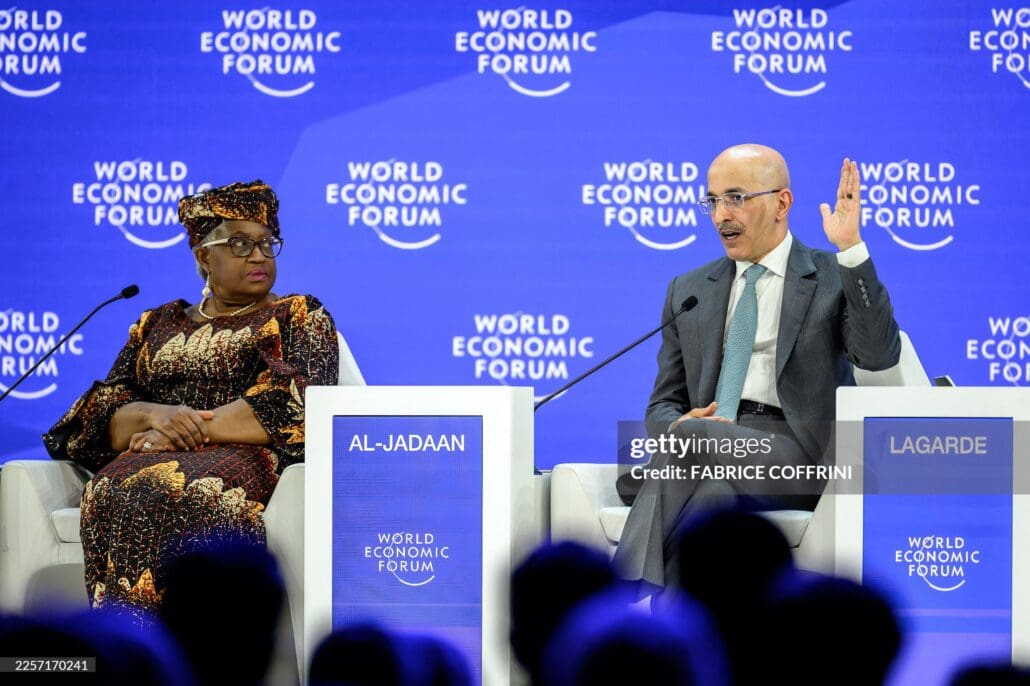
Saudi Arabia’s Finance Minister Mohammed Al-Jadaan (R) gestures next to World Trade Organization (WTO) Director-General Ngozi Okonjo-Iweala during a session during the final day of the World Economic Forum (WEF) annual meeting in Davos on January 23, 2026. (Photo by Fabrice COFFRINI / AFP via Getty Images)
That shift does not stay in conference rooms. When large economies clash, prices rise at local markets. When alliances tighten or loosen, jobs and investments follow. Davos speeches still sound polished, but outcomes now track interest more than intent. Smaller states feel the squeeze first, caught between decisions made elsewhere and consequences felt at home. The language of cooperation remains familiar, yet pressure has become the quiet driver.
In this environment, influence comes from preparation. Policymakers need sharp priorities that guide every negotiation. Foreign ministries must focus on trade, debt, and security with technical skill, not ceremony. For ordinary citizens, foreign policy shows up in fuel costs, food supply, and internet access. Countries that plan well, coordinate internally, and act decisively earn respect even without size.
For African and Caribbean nations, the response must be practical. Work together to buy food and fuel at better prices. Enter debt talks as groups, not single voices. Strengthen local energy, agriculture, and digital systems to soften global shocks. Keep partnerships balanced so no one relationship defines the future. In a world where order feels uncertain, clarity and cooperation remain powerful tools.
EDITOR’S NOTE: Dr. Isaac Newton is an international strategist trained at Harvard, Princeton, and Columbia. He advises governments and global institutions on governance and development, helping leaders turn ideas into practical and lasting results.






Leave a Reply
Want to join the discussion?Feel free to contribute!