
China – Caribbean Policy: China Deepens Caribbean Engagement With New Policy Pledges
By NAN Business Editor
News Americas, NEW YORK, NY, Mon. Dec. 15, 2025: China has signaled a renewed and expanded commitment to the Caribbean with new China – Caribbean Policy, positioning small island states as strategic partners in its evolving Global South diplomacy, according to its newly released Policy Paper on Latin America and the Caribbean.
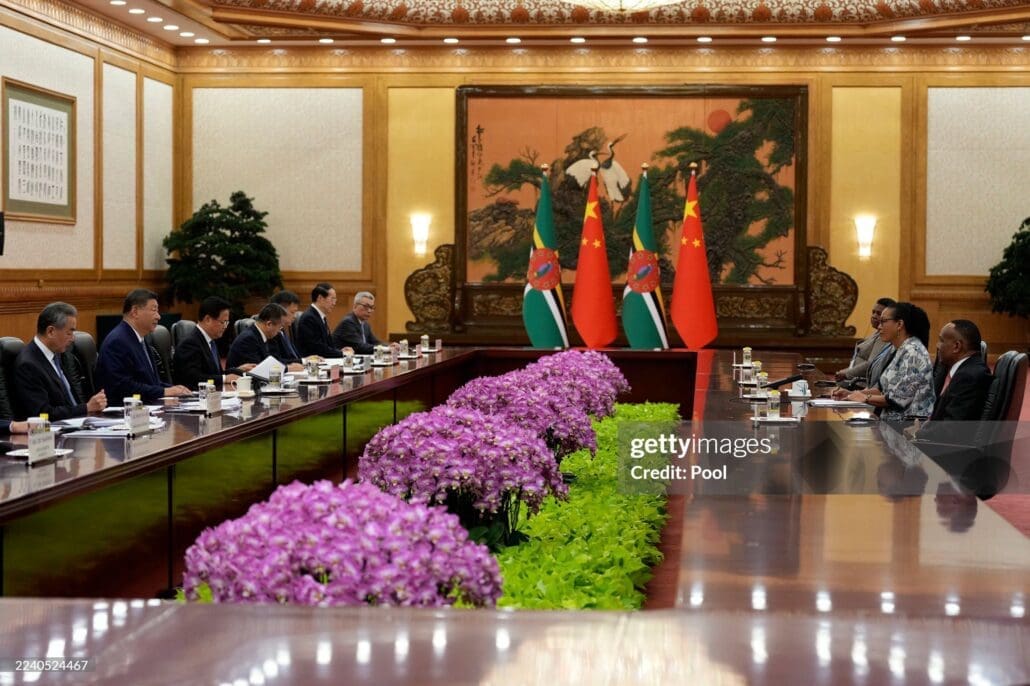
Chinese President Xi Jinping (L-2) speaks during a meeting with Dominica’s President Sylvanie Burton (R-2) at the Great Hall of the People on October 14, 2025 in Beijing, China. (Photo by Ichiro Banno – Pool/Getty Images)
While much global attention has focused on China’s ties with major Latin American economies, the policy document makes clear that Caribbean nations are central beneficiaries of Beijing’s long-term development, climate, and infrastructure agenda – particularly in areas where island states face acute vulnerability and capital constraints.
A Strategic Shift Toward Small Island States
China explicitly acknowledges the Caribbean’s unique status as Small Island Developing States, (SIDS), committing to tailor cooperation frameworks that reflect climate exposure, limited fiscal space, and reliance on external trade and tourism.
Rather than a one-size-fits-all approach, the policy outlines support mechanisms designed to accommodate smaller economies, including concessional financing, development assistance without political conditionality, and targeted infrastructure investment.
This positioning signals an effort by China to distinguish its engagement from traditional Western development models, which Caribbean leaders have often criticized as restrictive or slow-moving.
Climate Resilience and Disaster Response Take Center Stage
One of the most consequential pledges for the Caribbean lies in climate adaptation and disaster resilience.
China commits to expanded cooperation in:
Disaster prevention, early warning systems, and post-disaster reconstruction
Climate-resilient infrastructure
Coastal and marine ecosystem protection
Renewable energy development, including solar, wind, and hydropower
For hurricane-prone Caribbean states facing mounting reconstruction costs and insurance gaps, these pledges could translate into tangible relief if executed at scale.
China also signals openness to supporting Caribbean climate initiatives within global frameworks, reinforcing SIDS advocacy on climate finance and loss-and-damage mechanisms.
Infrastructure, Ports and Digital Connectivity
China’s policy reinforces its interest in Caribbean infrastructure — not only roads and utilities, but also ports, logistics, digital networks, and smart city development.
The document highlights cooperation in:
Transportation and port logistics
Telecommunications and digital infrastructure
Energy grids and water systems
Housing and urban development
For Caribbean economies seeking to modernize ports, reduce shipping costs, and improve regional connectivity, Chinese-backed infrastructure could play a transformative role – particularly where traditional financing remains limited.
Trade, Investment and Market Access
On the economic front, China pledges to expand trade with Caribbean nations, especially in:
Agricultural products
Specialty goods
Energy and resource-related exports
Beijing also encourages Caribbean participation in major Chinese trade expos and investment forums, offering potential market access for Caribbean exporters seeking diversification beyond North America and Europe.
Additionally, China expresses interest in expanding financial cooperation, including local currency settlements and partnerships with regional financial institutions – a move that could reduce foreign exchange pressures for Caribbean economies.
Education, Training and People-to-People Exchanges
China’s commitments extend beyond economics into human capital development.
The policy outlines:
Scholarships and training programs for Caribbean students and professionals
Cooperation in vocational education and digital skills
Media, cultural, and academic exchanges
Support for tourism cooperation and two-way travel facilitation
For Caribbean states grappling with skills shortages and youth unemployment, these programs may offer long-term workforce benefits.
Geo-political Implications for the Caribbean
China’s expanded engagement comes as Caribbean nations navigate a shifting global order, balancing longstanding ties with the United States and Europe while exploring South-South partnerships.
By emphasizing sovereignty, non-interference, and unconditional development assistance, China positions itself as an alternative partner at a time when Caribbean governments are seeking greater diplomatic and economic autonomy.
However, the scale and impact of these pledges will depend on implementation — a point regional analysts note will be critical in distinguishing policy ambition from practical outcomes.
What Comes Next
The policy paper signals intent, not timelines. For Caribbean governments, the next phase will involve translating these pledges into:
Project-level agreements
Financing structures
Transparent procurement frameworks
Sustainable debt management
If executed effectively, China’s commitments could reshape Caribbean development pathways over the next decade, particularly in climate resilience, infrastructure modernization, and economic diversification.
For now, the message from Beijing is clear: the Caribbean is no longer peripheral in China’s Global South strategy — it is firmly on the map.





Leave a Reply
Want to join the discussion?Feel free to contribute!