
The US$55 Billion Cost-Recovery Milestone: Bank Of Guyana Missing Details
By Darsh Khusial
News Americas, NY, NY, Sun. Oct. 3, 2026: If you have a large mortgage, you know how much it can shape every major financial decision. Do you replace a refrigerator that is on its last legs or a noisy washing machine? Do you keep the car for one more year to avoid straining the monthly budget? A large mortgage constrains financial flexibility. When it is finally paid off, the change is significant: a major obligation disappears, making it easier to plan future spending. Guyana is in a similar position with oil.
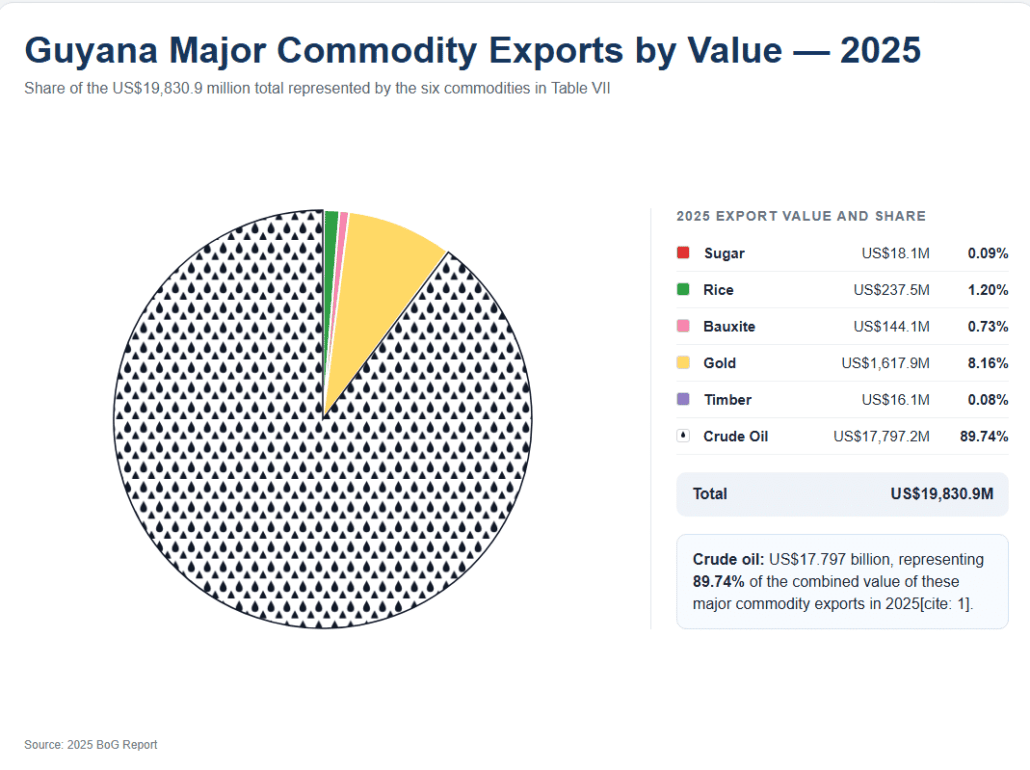
From 2023 through 2025, crude oil accounted for roughly 90% of exports. In 2025, Guyana exported about US$17.8 billion in crude oil, compared with roughly US$1.6 billion in gold, while sugar exports were comparatively small; see the 2025 export-value pie chart. In the first half of 2026, the Mid-Year Report states that 163.3 million barrels of oil were produced and that crude oil averaged US$92.50 per barrel. If those first-half figures were simply annualized, the gross value would be about US$30.2 billion – nearly twice the 2025 oil-export figure. That is an illustration, not a full-year forecast.
Against that backdrop, Exxon stated during its Q2 2026 investor conference call that US$55 billion in capital and operating costs had been recovered for the Stabroek Block. The statement did not provide a project-by-project breakdown. For purposes of this discussion, we assume the figure relates to seven projects, including the four currently producing about 900,000 barrels per day, with a fifth project expected to add roughly 250,000 barrels per day.
For perspective, US$55 billion is an extraordinary sum in relation to Guyana’s historical public finances. From independence to when the Stabroek Block contract was signed in 2016, let’s call that 50 years, the combined annual budgets did not come close to US$55 billion. Yet the Ministry of Finance’s 2026 Mid-Year Report does not state that US$55 billion has been recovered, or identify which Stabroek projects are included in that figure, or provide a project-by-project breakdown of recovered costs. Nor does it quantify how much future projects – including the eighth, ninth, and tenth developments – could add to the cost bank and how those additions could affect Guyana’s share of gross oil revenue.
The Mid-Year Report vaguely explains how the cost bank affects Guyana’s revenue. Section 3.63 (p. 21) states: “However, it must be emphasized that clearing the historical cost bank balance does not by itself deliver a 50 percent share of gross revenue to Government. The Stabroek Block partners will continue to recover current costs, lower than 75 percent of gross revenue, and Government will receive more than 12.5 percent of gross revenue in profit oil. As additional projects are approved, and their development costs enter the cost bank, the profit-oil ratio will move again.”
On August 18th, 2026, President Ali said, “Stabroek Block oil has increased from 12.5% to 39.8%.” However, the BoG report published 10 days later, dated August 28th, 2026, does not mention that Guyana’s profit share of the Stabroek Block has increased from 12.5% to 39.8%. Nor does the BoG report mention the overall take has moved from 14.5% to 41.8% of oil revenues. Instead, the BoG report states that the Government will receive more than 12.5% of gross revenue in profit oil while the Stabroek partners continue to recover current costs. That is astounding given that, at current production of 900,000 barrels per day and US$100 a barrel, the monthly amounts are about US$392 million (14.5%) and US$1.129 billion (41.8%), a difference of US$737 million.
In President Ali’s address (9:53), he further states with respect to the 39.8%, “This has occurred as I said because the cost bank has been recovered two years earlier than originally expected.” Without the underlying cost-bank figures and assumptions, readers cannot readily reconcile the President’s claim with what is stated in the BoG report.
The mortgage analogy is useful because paying down a large obligation improves forecasting. Once a household mortgage is substantially reduced or paid off, the family can estimate more accurately when it can afford major purchases. The same principle applies here: if US$55 billion in costs have been recovered, then the size and composition of the remaining cost bank are central to understanding how much oil profit Guyana may receive in the years ahead.
In the Bank of Guyana’s 119-page 2026 Half-Year Report, rice and sugar combined are mentioned almost as many times as oil. Yet, as the pie chart above shows, rice and sugar together accounted for just 2% of Guyana’s exports in 2025, compared with oil’s 90% share. The BoG is obviously misguided in its focus and priorities, but why?
This raises a straightforward transparency question: why does the 2026 Mid-Year Report not provide the US$55 billion figure, the projects to which it relates, the remaining cost bank, and the expected additions from future projects? Without those details, readers cannot independently assess how the cost bank feeds into the Government’s petroleum-revenue projections.
EDITOR’S NOTE: Darsh Khusial is an executive of the Oil and Gas Governance Network (OGGN) a 501(c)(3). See more here
RELATED: President Ali Claims Guyana’s Oil Share Is 39.8%, But BOG Data Suggests Less Than 30%
Advertisements



Leave a Reply
Want to join the discussion?Feel free to contribute!