
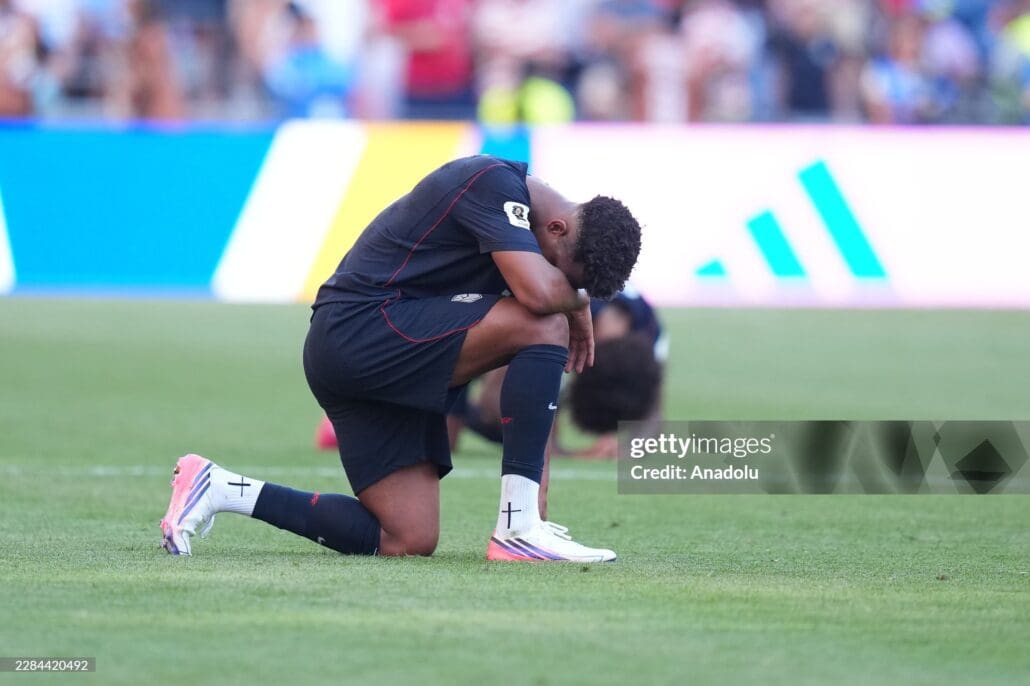
Should Folarin Balogun Have Stood Down For America?
Commentary By Felicia J. Persaud
News Americas, NEW YORK, NY, Tues. July 7, 2026: Folarin Balogun had every legal right to take the field for the United States against Belgium. The harder question is whether he should have.
Days before the United States’ World Cup Round of 16 match, President Donald Trump personally called FIFA President Gianni Infantino and asked for a review of the red card that threatened to keep Balogun out of the match. FIFA later lifted the one-match suspension, placing Balogun on probation and allowing him to face Belgium. Trump said he sought a review but did not dictate the outcome; FIFA has maintained that its judicial bodies operate independently. The reversal nevertheless triggered international criticism and questions about political influence over the sport’s disciplinary process.
Then came an uglier intervention from Trump’s own political universe. Former Trump adviser Steve Bannon called Balogun an “anchor baby,” questioned whether he was truly an American citizen and asked whether the U.S. national team genuinely represented the United States.
“I’m not sure that he’s an American citizen,” Bannon said during the July 6 edition of War Room, before broadening his attack to question the racial and immigrant composition of both the American and French national teams. The remarks were not merely offensive noise from the sidelines. They went directly to the constitutional contradiction surrounding Balogun’s presence in an American jersey.
A Birthright Citizen Playing For America
Rudi Garcia manager of Belgium talks to Folarin Balogun of the United States after the FIFA World Cup 2026 Round of 16 match between USA and Belgium at Seattle Stadium on July 6, 2026 in Seattle, Washington. (Photo by MB Media/Getty Images)
Balogun was born in New York City to Nigerian parents and raised largely in England. His birth on American soil made him a U.S. citizen, and he later chose to represent the United States internationally. That fact became especially significant during this World Cup because the Trump administration had been fighting to restrict birthright citizenship for some children born in the United States to parents who are unlawfully or temporarily present.
On June 30, the U.S. Supreme Court rejected that effort in Trump v. Barbara, preserving the constitutional guarantee at the center of the national debate. The Court’s ruling came just days before Trump intervened with FIFA on behalf of a U.S. soccer star whose own American story begins with birthright citizenship.
The irony is difficult to miss. The President who sought to narrow birthright citizenship personally intervened to help a birthright citizen return to the field for America. Then one of the most influential voices in the MAGA movement used a slur to question whether that same player was American enough to represent the country.
So perhaps the question is larger than whether Balogun deserved to play against Belgium. Perhaps the question is whether he should have chosen not to.
Should Balogun Have Stood Down?
Imagine the statement Balogun could have made if he stood down. He could have said that while he welcomed a fair review of the red card, he would not accept extraordinary political intervention on his behalf while the citizenship principle underlying his own American identity remained under attack.
He could have said that if his American birth was good enough when the country needed goals, it should be good enough when the country writes its laws. He could have said that no politician gets to celebrate the usefulness of a birthright citizen on Monday while political allies question that citizen’s legitimacy on Tuesday.
And then he could have stood down. Not because Belgium demanded it; not because FIFA ordered it; not because he was admitting the red card was correct. But because sometimes the most powerful act available to an athlete is refusing to allow his body, talent and identity to be used as a convenient symbol by people unwilling to defend the principle that made his American story possible.
He did not.
But Are We Asking Too Much Of Balogun?
This is where the argument becomes uncomfortable. Of course, Balogun did not create America’s immigration crisis. He did not write Trump’s executive order. He did not ask Bannon to attack his citizenship. He did not call the FIFA president. And no Black and immigrant heritage athlete should automatically be required to become a civil-rights spokesman simply because powerful men decide to politicize his existence.
There is a long and troubling history of expecting Black athletes to carry moral burdens that institutions, politicians and governing bodies refuse to carry themselves. Muhammad Ali paid dearly for refusing induction into the U.S. military during the Vietnam War. Tommie Smith and John Carlos were vilified after raising gloved fists at the 1968 Olympics. Colin Kaepernick became a national target after kneeling during the anthem to protest racial injustice.
History often celebrates courage long after punishing the people who displayed it. So it may be unfair to sit comfortably outside Balogun’s locker room and declare what sacrifice he should have made in the middle of the biggest tournament of his life. He is a footballer.; he had trained for this moment; his teammates needed him; his country expected him to play.
And yet the question remains.
America Wanted His Goals
The United States wanted Balogun on that field. Trump wanted the red card reviewed. American fans wanted their striker restored. The national team wanted one of its most dangerous attacking players available against Belgium.
FIFA’s decision made that possible, though the reversal drew criticism from European football authorities and Belgium, and Belgium later defeated the United States 4-1. But while America debated whether Balogun could help it win, Bannon was debating whether Balogun belonged to America at all. That is the contradiction.
America wanted his speed; America wanted his goals; America wanted his body in the national jersey. But when a prominent political figure reduced him to an “anchor baby” and questioned his citizenship, where was the equally forceful national defense of his right to belong?
Where were the voices saying that Balogun was not an accidental inconvenience to America, but an American citizen?; Where was the outrage from those who were so eager to get him back onto the field?
Maybe The Failure Was Not Balogun’s
Perhaps Balogun should not have stood down or perhaps America should have stood up. Perhaps the greater failure belongs to a political culture that can treat immigrants and their children as threats in one context and national assets in another.
The country cannot celebrate a birthright citizen when he scores and then remain silent when his citizenship is demeaned. It cannot ask him to wear the crest, sing the anthem, absorb the tackles, carry the expectations of millions and represent the nation before the world – while influential voices question whether someone with his biography is authentically American.
And it cannot ignore the timing. Just days before Balogun took the field against Belgium, the nation’s highest court had ruled on a direct challenge to the meaning of citizenship by birth in America. The same constitutional debate that can seem abstract in a courtroom was suddenly standing in boots on a World Cup field.
Balogun was not merely a striker. Whether he wanted the role or not, he had become a living illustration of the argument.
The Stand That Was Missed
There would have been extraordinary power in Balogun saying no. Not no to America but no to hypocrisy. No to being useful when goals were needed and suspect when immigration politics demanded a target.
No to presidential intervention without presidential consistency; no to the idea that citizenship can be celebrated selectively depending on whether the citizen is helping the country win.
But there is also something deeply unfair about demanding that a 25-year-old athlete solve a contradiction created by presidents, courts, political operatives, and a nation still fighting over who belongs. So I will not call Balogun a coward for playing. I will not blame him for taking the field; I will not join those mocking him or the rest of the U.S. team after the loss to Belgium.
Instead, I will ask the question America should be asking itself: why was Folarin Balogun expected to prove his value to America on a soccer field when America still struggles to prove that it values people whose citizenship stories look like his?
Maybe Balogun should have stood down. Maybe he should have seized the moment and said something history would remember long after the scoreboard faded. But perhaps the more damning truth is this: America – and Donald Trump – wanted Balogun to stand up for the national team even as his own American identity was attacked and questioned. That is the issue that survives the final whistle.
EDITOR’S NOTE: Felicia J. Persaud is a Guyana-born media entrepreneur, founder of News Americas Now, Hard Beat Communications, Invest Caribbean, CaribPR Wire, and AI Capital Exchange.




Leave a Reply
Want to join the discussion?Feel free to contribute!