
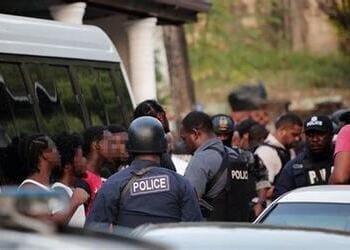
Caribbean Crime – More Than A Public Health Crisis
By Dr. Isaac Newton
News Americas, NEW YORK, NY, Weds. May 20, 2026: At sixteen, a boy in Kingston leaves school hungry and comes home with gang money in his pocket. In Port of Spain, a fisherman shut out of legal work turns to trafficking guns instead of fish. In Bridgetown, a mother working two jobs still cannot fully shield her son from the pull of the streets. In St. Kitts and Nevis, one violent incident can reshape how an entire generation of young people understands safety. Across the region, Caribbean crime is no longer confined to law enforcement. It encompasses public health, broken opportunity, and lost hope.
Violence spreads like sickness. It moves through homes, schools, and neighborhoods where fear becomes normal and trauma goes untreated. The research of Harvard scholars Deborah Prothrow-Stith and Felton Earls makes this clear. In the book Deadly Consequences, Prothrow-Stith explains that violence behaves like a contagious disease. Earls demonstrates that when trust breaks down, families weaken, and communities lose hope, crime rises. A child in St. Vincent who grows up surrounded by conflict may begin to see violence as normal. A young person in Antigua and Barbuda exposed to gang influence may start to associate respect with fear rather than character.
But violence is not only a public health issue. It is also a systemic issue shaped by history and structure. Slavery, colonial inequality, corruption, weak institutions, political division, and global criminal networks all shape today’s reality. In St. Lucia, domestic instability can affect school performance and emotional development. In Dominica, even talented students may feel pressure to migrate when local opportunities seem too limited. In Guyana, rapid development can still leave some communities behind, creating space for criminal recruitment. Crime grows where opportunity feels inaccessible or unjust.
This is why the Caribbean must ask both how to punish crime, and how to prevent it before it begins. Sports must become one of the region’s strongest crime fighting tools. A football field or cricket pitch is more than recreation. It provides structure, discipline, identity, and protection. In Trinidad and Tobago, organized sports can redirect energy away from street conflict. In Jamaica, athletics programs can become daily anchors that keep young people engaged, focused, and supported during vulnerable hours.
While sports are part of the solution, there must also be a clear bridge from sports to education and from education to opportunity. Schools must prepare students with academic knowledge, emotional intelligence, conflict resolution skills, digital competence, and entrepreneurship. In St. Kitts and Nevis, structured training linked to tourism and robotics services can turn learning into income. In Antigua and Barbuda, apprenticeships in hospitality and digital industries can create direct pathways into employment. In St. Lucia, technical and small business training can transform potential into livelihood. In Dominica, agriculture and ecotourism can connect local talent to sustainable futures without making migration seem like the only option.
Nothing works in isolation. Police cannot do it alone. Schools cannot do it alone. Churches, governments, healthcare systems, and families cannot do it alone. Together, however, they can form a prevention network that identifies risk early and responds before violence takes hold. This is the real choice facing the Caribbean: continue reacting to crime after lives have already been broken, or build systems that protect life before it breaks. In the end, crime is not only a law enforcement issue. It is equally a public health emergency, an education emergency, and an opportunity emergency. The real question is how many children we are willing to allow to believe that violence is their only option.






Leave a Reply
Want to join the discussion?Feel free to contribute!