
How Many More Must Die In Haiti Before The US Stops Sending People Back?
By NAN Staff Writer, NewsAmericas Now
News Americas, PORT-AU-PRINCE, Haiti, Tues. Aug. 25, 2026: Gang members in Haiti stormed a church sheltering displaced families in Kenscoff, in the hills above Port-au-Prince, late Sunday night, killing as many as 47 people, some execution-style, in one of the deadliest single attacks Haiti has seen in months. The massacre lands after the United States resumed deportation flights to the same country it warns Americans not to travel to.
Kenscoff Mayor Massillon Jean described “a night of terror” as members of the Viv Ansanm gang coalition, designated a foreign terrorist organization by the U.S. government last year, raided the town’s center, torched homes and vehicles, and opened fire inside a church where families displaced by earlier violence had taken refuge. “We have counted around 40 bodies. Searches are continuing. Some people are still missing,” Jean said. A UN-cited report put the toll as high as 47; earlier reporting from Al Jazeera cited at least 30. The mayor himself acknowledged “it is still impossible to establish a definitive death toll due to access difficulties and communication problems.”
“They killed my son!”
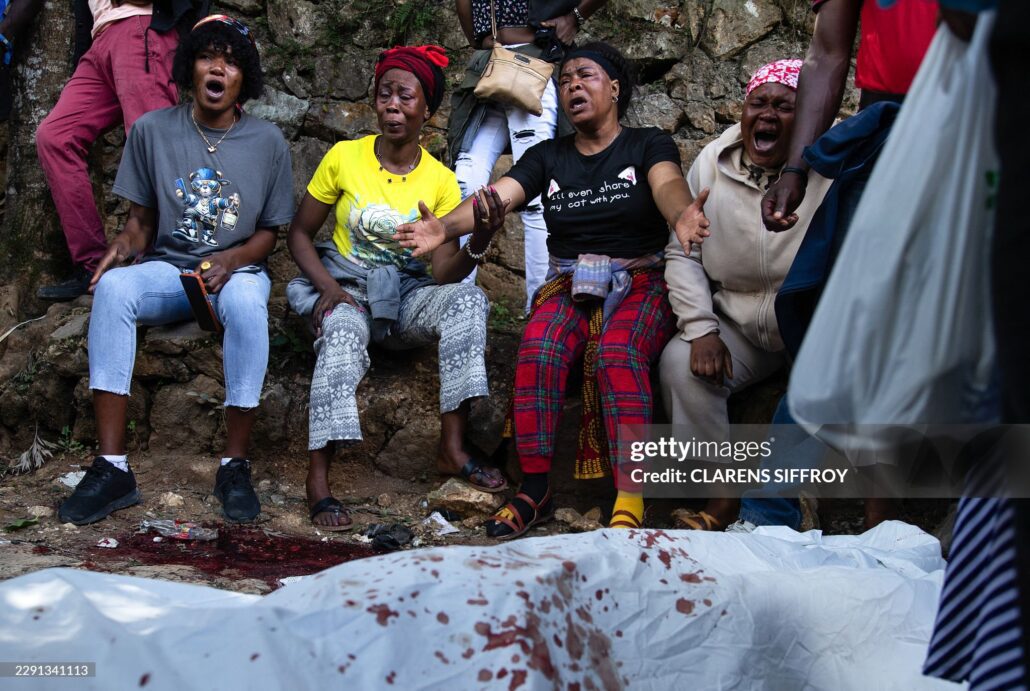
Bodies are covered up on the ground following overnight violence where more than twenty people were killed by armed gangs in Kenscoff, a neighborhood near Port-au-Prince, Haiti, on August 24, 2026. Gang members attacked displaced people huddling inside a church near Haiti’s capital, killing around 40, some of them execution-style, the mayor told AFP on Monday. (Photo by Clarens SIFFROY / AFP via Getty Images)
Farmer Mathurin Pierre, 41, told the Associated Press he lost 14 loved ones, with an unknown number still missing. Survivors described bludgeoned bodies lying in pools of blood along the community’s paths as wails rang out through the night. “They killed my son!” one woman repeated as neighbors tried to comfort her. Among the homes targeted was that of Dr. Jean William “Bill” Pape, one of the Caribbean’s most prominent epidemiologists and AIDS researchers, whose nonprofit serves patients with HIV and tuberculosis across Haiti.
It was the second major gang incursion into Kenscoff since early July, when the same coalition massacred scores of residents there over several days, and marks what the Miami Herald described as an “ominous turning point” in gangs’ push to seize nearby Pétion-Ville, one of the last areas of Haiti’s West department not already under complete gang control.
The deportations continue regardless
This is the reality more than 350,000 Haitians who lost Temporary Protected Status this month are being sent back to. The U.S. DHS resumed deportation flights to Haiti last week, even as the State Department’s own travel advisory keeps Haiti at its highest “Do Not Travel” level, and even as the same advisory recommends Americans traveling there leave DNA samples with their doctors in case their remains need identifying.
Gangs now control an estimated 70% of Port-au-Prince. Nearly 1.5 million of Haiti’s 11 million people are internally displaced by violence, according to the International Organization for Migration, and more than 5 million face severe food insecurity, per UN figures. Haiti’s electoral council has set December 13 for the country’s first elections in a decade, contingent on establishing “an acceptable security environment,” a condition that, after Sunday night, looks further away than ever. Tens of thousands of people have been killed in Haiti due to escalating gang violence and political instability following the assassination of President Jovenel Moïse in July 2021.
According to the Office of the UN High Commissioner for Human Rights (OHCHR), more than 16,000 people have been killed and 7,000 injured in systemic gang violence since January 2022. Violence spiked heavily in subsequent years, with over 5,600 people reported killed in 2024 alone, at least 4,384 documented killed through the first nine months of 2025, and over 8,200 killed between January 2025 and March 2026.
Haiti hasn’t held any elections since 2016. Its CEP electoral council last month scheduled the first presidential elections in a decade for December, with a runoff in February, after plans to hold the vote in August with a December runoff were postponed over security concerns.
NewsAmericasNow will continue tracking the violence in Haiti and its impact on TPS holders facing deportation.




Leave a Reply
Want to join the discussion?Feel free to contribute!