
Guyana’s Oil Boom, The President’s Farm And The Case For Transparency
Commentary By Felicia J. Persaud
News Americas, NEW YORK, NY, Mon. July 6, 2026: A country can post spectacular GDP growth while ordinary households still struggle to make the numbers work. It can export billions of dollars in oil while wages lag behind the cost of food, housing, transport and daily survival. It can celebrate billion-dollar infrastructure while families quietly recalculate what they can afford each month. That is the contradiction at the heart of Guyana today. It is why the explosive claims now swirling around its president, Irfaan Ali, and his private agricultural operation cannot be dismissed as merely another political quarrel between the government and the opposition.
In a country where citizens are being asked to celebrate historic national prosperity while many households remain under intense financial pressure, questions about wealth, access and transparency at the highest levels of power inevitably carry greater weight. But this story demands care – because it cuts in more than one direction.
What Is Alleged
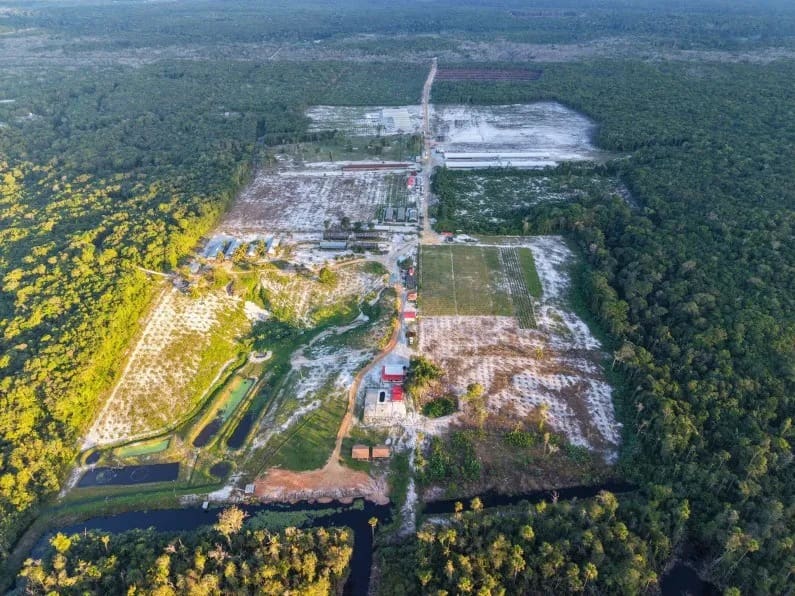
On Sunday, July 5, Opposition Leader Azruddin Mohamed released a 24-minute video on his Team Mohamed Facebook page claiming President Ali owns a GY$2.2 billion “ranch” investment off the Soesdyke-Linden Highway – a 150-acre estate he claims was developed in just three years and could “never” be substantiated by a presidential salary of roughly GY$3.7 million per month, according to reporting by both the Demerara Waves and Kaieteur News.
Mohamed’s video described poultry tunnel houses feeding 80,000 chickens, Brazilian cattle, black belly sheep, aquaculture, a two-storey concrete ranch house, a swimming pool, a GY$75 million road and a GY$55 million electricity network. He contrasted it pointedly with the nearby village of St. Cuthbert’s Mission, which he said has for decades received electricity only a few hours a day.
What The President Says
President Ali then firmly denied any wrongdoing but confirmed he owns the farm. According to the Guyana Chronicle and News Room, Ali says the property was acquired long before he assumed office in 2020 – a claim he states is verifiable through banking records and official documentation – that it was properly declared to the Integrity Commission, and that it has never received state funds, public resources, or preferential government treatment.
The President has gone further, alleging that the accusations are themselves the product of an attempted shakedown. He says he holds text messages from Nazar “Shell” Mohamed – the Opposition Leader’s father – as recently as last week, indicating that recordings about his farm would be released unless “amends” were made between him and the Mohamed family. Ali has said he is willing to make those communications public.
It is a critical piece of context that Azruddin and Nazar Mohamed have themselves been sanctioned and criminally charged by the United States for alleged wire fraud, mail fraud, and money laundering tied to their gold-trading business. Nazar Mohamed has rejected the blackmail allegation outright, telling Kaieteur News: “I categorically reject the president’s claim that I attempted to blackmail him,” and challenging Ali to release the full communication.
In other words, the opposing sides are accusing each other. Both insist they have nothing to hide. Both are inviting the public to judge.
Where The Answer Should Live
The President’s own defense points to exactly where the truth can be found. Ali says the farm predates his 2020 presidency – that he acquired it before assuming office, financed it in part through loans, and declared it to the Integrity Commission as the law requires. He has said the acquisition and the source of funds are “capable of verification through the relevant financial and regulatory records.”
If that is so, then the central question ordinary Guyanese are asking – how a private estate of this scale was financed – already has a documented answer sitting in official files. Making the relevant evidence available for credible independent verification would be the fastest way to answer the central questions.
The Integrity Commission is the body legally responsible for holding and verifying public officials’ asset declarations. At the time of writing, however, the Commission’s public website (integritycommission.gov.gy) was returning a server error and could not be accessed – a small but telling illustration of how difficult independent verification can be for an ordinary citizen who simply wants to check the record for themselves.
That is the deeper issue beneath the political theatre. In a nation newly awash in oil money, transparency cannot be a matter of competing Facebook videos. It has to be a matter of accessible, verifiable public record. Both the President and his accusers say they welcome scrutiny. The documents – loan records, the declaration on file, the paper trail Ali says is robust – are how that scrutiny is satisfied.
The Bigger Question
Here is why this matters beyond the political theatre.
The President’s accusers have made serious claims that remain allegations and must be tested against evidence – not accepted because they are loud, nor dismissed because their source is compromised. Equally, the President’s denials are detailed and specific, and if the paper trail is as robust as he says, it should be a straightforward matter to place it before credible, independent eyes.
Public office in an oil-rich nation demands a higher standard of transparency than a Facebook video on one side and a Facebook rebuttal on the other.
Guyana is one of the world’s most extraordinary economic growth stories. Offshore oil production from the Stabroek Block has transformed the country’s fiscal position, accelerated public investment and produced growth rates that have made Guyana the envy of much of the hemisphere. ExxonMobil is on track to fully recover its entire $55 billion investment program before this year is over. But GDP is not a household budget.
The more revealing comparison is between what people earn and what it costs them to live. Wage.is estimates Guyana’s minimum wage at approximately GY$347 an hour, or about US$1.66, with average gross monthly earnings of roughly GY$100,000 and median monthly income estimated at about GY$50,000. These figures should be read as estimates rather than a complete official portrait of household income across the country.
Against that, Numbeo’s latest cost-of-living data estimates monthly expenses for a single person at approximately GY$192,000, excluding rent. Its rental data places a one-bedroom apartment at roughly GY$183,571 per month in a city center and GY$128,282 outside the center. Numbeo is crowdsourced, so the figures should be treated as indicators rather than official measures. Even with that caveat, the affordability question is difficult to avoid: how does a worker earning GY$50,000, GY$100,000 or even somewhat more absorb the combined cost of housing, food, transport, utilities and basic necessities?
That is the arithmetic many Guyanese are doing every month. And it is against that backdrop that they are now reading allegations about a private agricultural estate, said by an opposition leader to be worth GY$2.2 billion – an estimate the President disputes through his broader denial of wrongdoing and his account of prior ownership, financing, and lawful declaration.
The contrast does not prove corruption. It proves why transparency matters. When citizens experience a widening distance between spectacular national wealth and their own household purchasing power, questions about asset accumulation at the highest levels of public office become inevitable. Those questions should not be treated as evidence of guilt. But neither should they be dismissed as impertinence.
Whether the farm was acquired before the presidency, financed through legitimate loans or private investors, expanded through lawful private investment, and properly declared are questions capable of documentary answers. The President says those records exist. If so, credible independent verification would serve both the public interest and his own defense.
This is not about resenting private success. Nor is it about pretending that a presidential salary is necessarily the only lawful source of wealth available to a public official. It is about recognizing the political reality of an oil-boom economy in which many citizens still feel that their wages cannot keep pace with the cost of living.
A nation can become richer on paper while its people feel poorer at the checkout counter. That gap – between macroeconomic triumph and household reality – is where distrust grows. That is the context in which Guyanese are now weighing competing claims about the President’s farm. Whether the explanation is prior ownership, bank financing, lawful private enterprise, or something else entirely, the public should not be asked to choose between accusation and denial when documentary evidence can answer the central questions.
A nation cannot ask its people to celebrate world-leading growth while household incomes struggle to keep pace with the cost of basic living, and then suggest that questions about wealth at the highest levels of power are out of bounds. Nor should serious allegations be accepted uncritically simply because they are politically explosive – particularly when those making them face significant legal controversies of their own.
The way out is the same for everyone involved: disclosure, documentation and independent verification. Let the lenders, the Integrity Commission and the records speak. Guyanese citizens should not be forced to choose between competing political narratives when evidence can establish the facts.
The truth, whatever it is, should survive the daylight.
EDITOR’S NOTE: Felicia J. Persaud is a Guyana-born media entrepreneur, founder of News Americas Now, Hard Beat Communications, Invest Caribbean, CaribPR Wire, and AI Capital Exchange.
RELATED: Guyana At 60: The Oil Is Flowing. So Why Are Guyanese Buying Tennis Rolls On Credit?





Leave a Reply
Want to join the discussion?Feel free to contribute!