
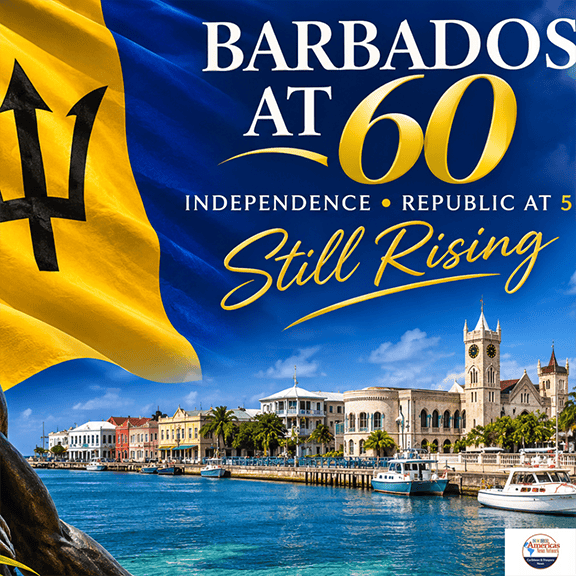
Barbados At 60: Independence, Republic And A Legacy Still Rising


By Rhoda Green
News Americas Now, CHARLESTON, S.C., Fri. Nov. 27, 2026: Barbados celebrates 60 years of Independence and five years as a Republic on on Nov. 30, 2026. Pushed up from the bowels of the Atlantic crust and the Caribbean plate, Barbados is still rising – both literally and figuratively. Did its unusual formation and emergence shape its atypical trajectory – its unfolding history and relevance in the Atlantic region?
The English settled the 166-square-mile island, which Barbadians endearingly call the Rock or Bim, in 1627. Native inhabitants left clues that they had been there, although island history said it was left uninhabited. Late in the competition for new land, the English focused on creating a profitable enterprise on Barbados.
They claimed, ruled, and retained it from 1627 until 1966, when the island gained Independence. Barbados, later called ‘Little England,’ became the hub of English expansion in the Americas. Partly shielded from turbulence and conquest by its geography, Barbados saw the English flag planted. Jews, fleeing persecution in Brazil, arrived in Barbados and introduced sugar cane. Barbados struck gold – white gold: sugar. England inscribed its signature and imprint on every segment of Barbadian society and gained a new status across the Old and New Worlds. The Barbados Model they contrived was built on the subordination and suppression of millions of enslaved Africans transported to toil on plantations in the Americas. The enslaved were used as both collateral and labor – vital to the economy and to the power, wealth, and dominance that changed the world.
ENGLAND
England used Barbados as a staging area to test and implement English governance – a system it later transported to other colonies. The Charter of Barbados, set out in the Treaty of Oistins (January 1652), articulated the principle of “no taxation without representation.” In 1776, the US Declaration of Independence also enshrined that principle. Yet in the same era, between 1661 and 1667, Barbados also produced the first slave code in the English Atlantic World: the Barbados Slave Code. Barbados has been called the Original Slave Colony, the Cultural Hearth of the Americas, and a Plantation Society. The vicissitudes of slavery, emancipation, and later self-governance have left Barbados as custodian and steward of a transformative period that is now the subject of frequent forensic discourse.
THE CAROLINA CONNECTION

The Barbados-Carolina connection gained contemporary interest in Barbados and South Carolina in the late 1970s. Barbados’ colonial history had long been known and perceived from the victor’s vantage point, and fate and circumstance had relegated the island and its citizenry to a legacy of third-world status. Two books carried the story forward: The Barbados-American Connection by May Lumsden, and, about a decade later, Markly Wilson organized an expedition to South Carolina that resulted in The Barbados-Carolina Connection by the late Warren Alleyne and Sir Henry Fraser. Two Barbadians—one in New York, Markly Wilson, and the other in South Carolina, Rhoda Green—were motivated by Barbados’ pivotal role in the Americas, particularly in South Carolina. He came from the tourism sector; I came from the legal world as a court stenographer.
In many ways, Barbados and South Carolina seem like relics of the past; their buildings, aesthetics, and culture are reminders. Historians argue that, during the colonial period, South Carolina resembled a Caribbean colony more than one of the 13 mainland colonies. The split came with the American Revolution (1775-1783): the British Caribbean colonies stayed loyal to England, while South Carolina joined the other mainland colonies. Historic Bridgetown and its Garrison are a stark reminder of an English medieval town. Parishes, churches, alleys, and gaps distinguished its main town and serpentine streetscape. Historic Bridgetown and its Garrison were designated a UNESCO World Heritage Site, and the island has become a focal point for research and analysis of its colonial past.
In 1670, English settlers, indentured servants, and enslaved people from Barbados established Charles Towne, later Charleston. Its street layout, street names, parishes, parish churches, cobblestones, and hidden gardens bear an unmistakable resemblance to Barbados. John Culpeper, one of Barbados’ earliest surveyors, was engaged to map the Charles Towne grid, and its architecture, including the Single House, echoes Barbadian design. Trade was vital to the relationship: as sugar plantations took priority over food and other crops on the island, Charles Towne became known as Barbados’ ‘breadbasket.’ Both ports bustled in what one historian called ‘a colony of a colony.’
The Barbados And The Carolinas Legacy Foundation
The Barbados and the Carolinas Legacy Foundation (B&CLF) was founded by Rhoda Green. It was conceived as a bridge between the two regions. It has forged relationships and partnerships with Historic Charleston, its people, and its governments and institutions. The City of Charleston and Speightstown were twinned in 1997 and later designated as Sister Cities. There are now MOUs between Barbados and eminent organizations such as the South Carolina National Heritage Corridor (SCNHC), the Gullah Geechee Cultural Heritage Corridor, the International African American Museum (IAAM), the Carolina Lowcountry and Atlantic World Program (CLAW) at the College of Charleston, the South Carolina Aquarium, and Charles Towne Landing, dubbed the birthplace of South Carolina. Most important of all are the people of Barbados and South Carolina who promote interaction between themselves.
INDEPENDENCE
As Barbados celebrates these two milestones, it is worth recalling that, after emancipation, the island’s majority population in time elected leaders who crafted a path forward and saw its people as assets. The journey was long and tortuous. Change came after the masses endured hardship, unrest, and suffering in the 1930s. Migration, born of necessity, robbed the island of many of its people. Yet Barbadians learned to appreciate education and developed an ethic and ethos they carried to new destinations over the centuries. Barbados has distinguished itself and its people by its performance on the world stage. It continues to perform ‘above its weight,’ representing its people and respecting its neighbors while staying focused on maintaining integrity and the goals it has set for itself and its people. It has succeeded as a democratic nation, with values rooted in justice and freedom for all.
This article posed a question, and I will try to answer it. My family’s story resembles that of many Barbadians in the diaspora who are celebrating these dual milestones. As we reflect on Barbados’ historical path, this is a time to revisit, reclaim, and reframe our history. From an unusual beginning, we have the capacity to meet the challenges before us – come what may!
Barbados is independent, yet its history continues to intersect with that of its Caribbean neighbors and of the United States, which this year celebrates the 250th anniversary of its own independence.
Congratulations, Barbados! “This is a time to revisit, reclaim, and reframe our history.”
About the author: Rhoda Green is the Founder and Board Chair of the Barbados and the Carolinas Legacy Foundation and Honorary Consul of Barbados to South Carolina. barbadoscarolinas.org


Leave a Reply
Want to join the discussion?Feel free to contribute!