
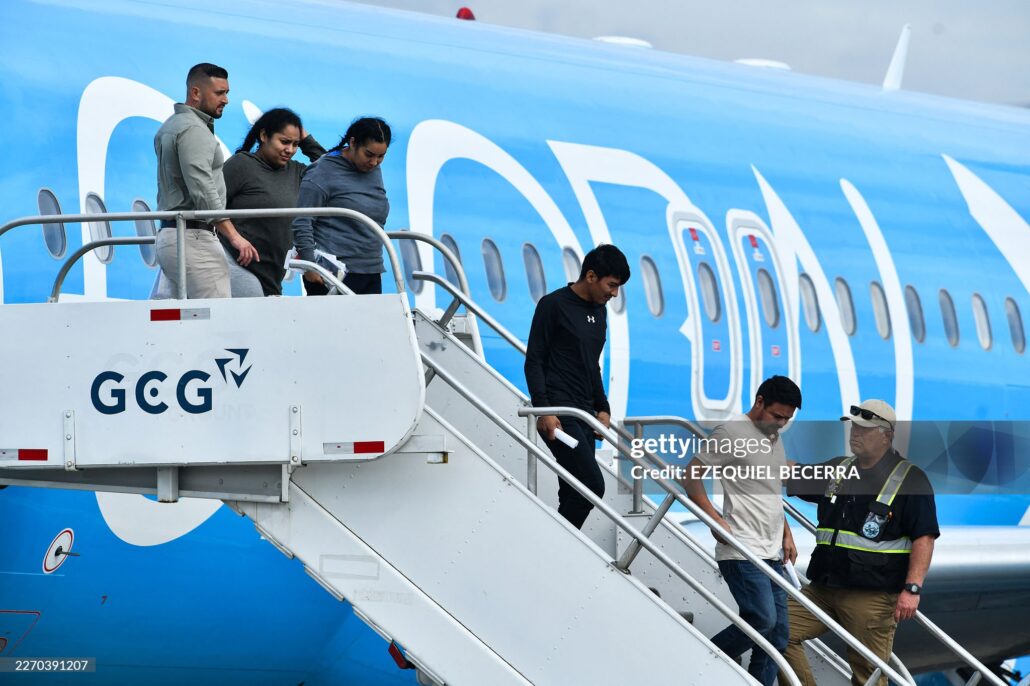
US Paid Guyana $7.7 million To Take In Third-Country Deportees
News Americas, NEW YORK, NY, Sat. Sept. 19, 2026: The U.S. State Department reportedly paid Guyana $7,740,215 to support the resettlement and reintegration of third-country nationals deported from the United States. That’s according to a U.S. official who confirmed this to the Kaieteur News, as Guyana President Irfaan Ali pushed back against mounting public criticism over the arrangement’s financial terms and secrecy.
The International Organization for Migration is administering the payout, earmarked for financial and technical support over a two-year period. Under IOM’s oversight, individuals receive counseling on their options to return to their countries of origin, along with temporary accommodation, food, clothing, and household items for those choosing to return. Ali said “neither Guyana nor IOM will facilitate forced removal.”
No member of the Guyanese government has publicly detailed the arrangement’s operational scope, administrative costs or local resource allocations. Instead, Ali’s administration has focused public statements on border sovereignty, labor needs and human rights vetting.
At a news conference Monday, Ali said Georgetown’s participation hinges on US financial backing. “It must be a joint effort,” he said, stressing Guyana should not be expected to shoulder the costs of receiving and integrating deportees. He also pushed back on what he called social media mischaracterizations, clarifying that the agreement is limited strictly to third-country nationals with expedited or final removal orders who have received medical clearance from the Department of Homeland Security. Explicitly barred are unaccompanied minors, Guyanese nationals, individuals with pending US asylum claims, and those with known violent criminal records.
“The Government of Guyana retains complete discretion to approve or deny individuals proposed for removal,” Ali said. According to US officials who spoke with Kaieteur News, Guyana selects candidates from a list, and no one is transferred without explicit approval from Georgetown; final flight manifests must be supplied before departure, transfers are accompanied by US Homeland Security personnel, and Guyana can refuse entry to anyone not previously approved.
“Not a dumping ground,” Ali says, against a starkly different tone from Rubio
In a separate interview with Al Jazeera, Ali rejected the suggestion that Guyana is serving as a dumping ground for Washington’s immigration backlog or compromising its human rights standing. “I don’t see this as a business. Of course, everything in life has an element of risk,” Ali said. “We do our own vetting to our own satisfaction… This is not a situation where the U.S. turns up with a plane and just throws people off on your shores.”
Those assurances stand in sharp contrast to earlier remarks by Secretary of State Marco Rubio, who said: “We are actively searching for other countries to take people from third-world countries… We are working with other countries to say we want to send you some of the most despicable human beings to your countries, would you do that as a favour to us. And the further away from America, the better so they can’t come back across the border. I’m not apologetic about it.”
The first cohort, and what comes next
The funding disclosure follows the September 4 arrival of Guyana’s first cohort of six deportees, four Cuban and two Afghan nationals. Foreign Secretary Robert Persaud confirmed all six underwent background checks confirming no criminal histories, and said accepting skilled, vetted migrants aligns with Guyana’s labor shortage, estimated at 70,000 to 80,000 workers amid the country’s oil-driven economic expansion. The US has made no further requests for additional transfers at this time, according to Persaud, and US Ambassador to Guyana Nicole Theriot expressed gratitude for Guyana’s assistance.
The framework operates under a strictly temporary one-year window and explicitly excludes permanent resettlement; admitted individuals will ultimately return to their country of origin or relocate to a third country, retaining the right to seek international protection through local civil society, the IOM and the UNHCR.
Guyana joins an expanding list of CARICOM nations receiving non-citizen deportees under similar US arrangements. Global rights groups including Amnesty International, Refugees International and Human Rights First have warned that third-country removals carry serious risks of unlawful repatriation. According to a Congressional Research Service document dated August 24, ICE estimates more than 21,000 individuals have been removed to third countries under the policy to date, despite ongoing legal challenges in US federal courts.
NewsAmericasNow will continue tracking Guyana’s third-country deportation arrangement. Reporting from Kaieteur News contributed to this story.
YOU MAY ALSO LIKE: By The Numbers: The Global Third-Country Deportation Deal CARICOM Nations Are Joining






Leave a Reply
Want to join the discussion?Feel free to contribute!