
China Accuses US Official Of “Malicious” Attack Over Guyana Infrastructure Criticism
By Staff Writer, NewsAmericas Now
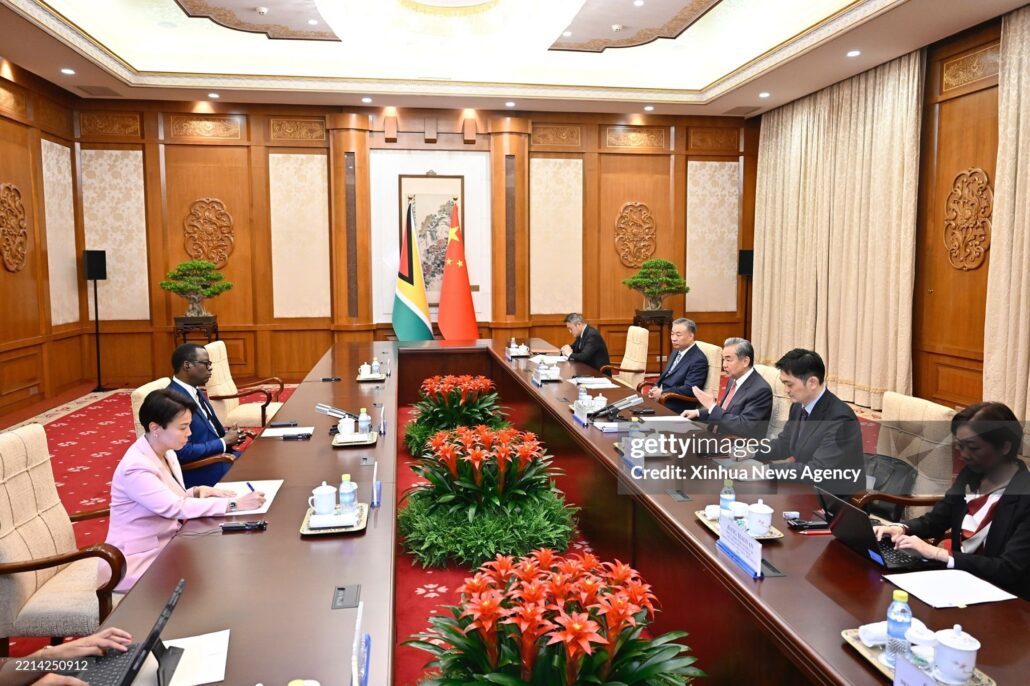
News Americas, GEORGETOWN, Guyana, Weds. Sept. 2, 2026: China’s embassy in Guyana has sharply rejected criticism from a US State Department official over Chinese-built infrastructure projects in the country, calling the remarks “malicious” and politically motivated, in a diplomatic exchange unfolding as bilateral China-Guyana trade approaches $2.9 billion.
The dispute began after Juan Pablo Segura, Assistant Secretary of State for Western Hemisphere Affairs, used his personal account on X to criticize Chinese state-owned companies operating across Latin America and the Caribbean, citing “a costly, poorly built, and failing hydroelectric dam in Ecuador,” “abandoned construction projects and corrupt efforts to manipulate bidding processes in Peru,” and an airport project in Guyana he said “was plagued by more than a decade of construction delays and cost overruns.”
“Our region is riddled with projects led by Chinese State-owned companies such as the Sinohydro Corporation and China Railway Group Limited where corners were cut, contracts were broken, governments saddled with debt, and the local environment suffered,” Segura wrote.
The Chinese Embassy responded forcefully. “We have noted that a certain U.S. State Department official recently used his personal social media account to smear and attack projects undertaken by Chinese companies in Guyana,” a spokesperson said. “Such remarks disregard the facts and constitute political manipulation and malicious smears against normal China-Guyana economic and trade cooperation.”
The embassy pointed instead to delays plaguing Guyana’s Gas-to-Energy project, being built by American firm Lindsayca Guyana Inc. The company was awarded a $759 million contract to deliver 300 megawatts of electricity by the end of 2024, but has repeatedly missed its deadlines, with the project now expected to deliver only a fraction of that power by the end of 2026, a delay the embassy said has cost Guyana multiple millions of dollars as the country’s electricity demand continues to grow.
China defends its record
The embassy defended Chinese companies’ contributions to Guyana’s development, citing the Bharrat Jagdeo Demerara River Bridge, the China-Guyana Friendship Joe Vieira Park, and six regional hospitals as examples that have “helped to improve infrastructure, create jobs and support economic and social development, earning broad recognition across Guyanese society.”
The embassy also pushed back on the broader implications of Segura’s remarks, arguing Guyana should be free to choose its own development partners without outside pressure. “A true friend is not someone who stands at a distance and tells you who you should or should not work with,” the spokesperson said. “A certain country might be better served by reflecting on itself rather than pointing fingers at others.”
“Guyana and other countries in Latin America and the Caribbean have every right to choose their own partners and pursue the path of development that works best for them, free from outside interference,” the spokesperson added.
Rapidly expanding trade ties
The exchange comes as economic ties between Guyana and China continue to grow quickly. Chinese Ambassador to Guyana Yang Yang said earlier this year that bilateral trade between the two countries surged to nearly $2.9 billion in 2025, more than doubling within a year and cementing China’s position as one of Guyana’s major trading partners.
Yang said the relationship has entered a “fast track” of development under President Irfaan Ali and Chinese President Xi Jinping, pointing to the completion of the Demerara River Bridge, which she called a “Bridge of Friendship and Development,” and the six Chinese-built regional hospitals as flagship symbols of cooperation under Beijing’s “Health Silk Road” initiative. She also noted more than 200 Guyanese professionals traveled to China for training programs in 2025.
“Facts have shown, and will continue to show, that China is a trustworthy friend and partner of Guyana, and that Chinese companies are important participants in and contributors to Guyana’s development,” the embassy spokesperson said.
Juan Pablo Segura
The response came after US Assistant Secretary of State for Western Hemisphere Affairs Juan Pablo Segura referred to an airport in Guyana that was affected by “more than a decade of construction delays and cost overruns.” Segura grouped the project with troubled developments in Ecuador and Peru, arguing that some Chinese-backed infrastructure projects in the region have involved broken contracts, increased public debt and poor construction practices.
However, the US official’s social media statement was a political assessment rather than an independent audit of the airport project.
The original contract was signed in November 2011 between Guyana’s then PPP/C government and China Harbour Engineering Company for US$138 million. Guyana was expected to contribute a further US$12 million, bringing the initial project value to approximately US$150 million.
The original plan included a new terminal building, an extended runway and expanded passenger-boarding and apron facilities. Construction was expected to be completed within 32 months. When the APNU+AFC coalition entered office in 2015, the project was already behind schedule. Then Public Infrastructure Minister David Patterson said only about nine per cent of the work had been completed, while the new administration also faced a US$46 million contractual dispute with the Chinese company.
The APNU+AFC government subsequently altered the project’s scope to keep it within the existing financial limit. Plans for an entirely new terminal were replaced with renovations to the existing building and construction of a smaller arrivals terminal. The runway design and other facilities were also revised.
Those decisions later became part of a political dispute over why Guyana received an airport that differed substantially from the one outlined in the original agreement. When the PPP/C returned to office in 2020, it demanded that the Chinese contractor undertake additional work and correct outstanding defects.
China Harbour later agreed to finance approximately US$9 million in additional work at no further cost to Guyana. Major works reached practical completion in June 2022, almost a decade after construction began. Segura’s remarks come amid growing competition between Washington and Beijing for economic influence in Guyana and the wider Caribbean, where Chinese financing and companies have played a major role in infrastructure development.
NewsAmericasNow will continue tracking developments in Guyana’s international partnerships.
YOU MAY ALSO LIKE: U.S., China Tensions Rise Over Bahamas Hospital Project





Leave a Reply
Want to join the discussion?Feel free to contribute!