
On The Ground In Haiti: The War Zone US Deportees Are Being Sent Back To
By Staff Writer, NewsAmericas Now
Gangs now control up to 90% of Port-au-Prince, and even senior Haitian security officials are not safe from them, according to a firsthand report from Council on Foreign Relations fellow Sam Vigersky, published as the Trump administration moves forward with deporting up to 350,000 Haitians back to the country.
Vigersky, who last visited Haiti as a UN aid worker after the 2010 earthquake, described a capital “hollowed out by years of deliberate and indiscriminate armed conflict,” with Mine-Resistant Ambush Protected police vehicles stationed at the few intersections where the government still maintains a presence. Days before his June visit, gang members disguised as police kidnapped James Boyard, inspector general of the Haitian National Police, along with his wife and their six-year-old daughter, a US citizen, while the family was on a routine trip to the doctor. As of the report, Boyard and his daughter remain held despite ransom payments; his wife’s status has not been reported.
Henry Wooster, the US embassy’s chargé d’affaires in Haiti, described the situation to the Senate Committee on Appropriations in February as “full-scale urban warfare.” The State Department maintains a Level Four “Do Not Travel” advisory for the country over crime, terrorism and kidnapping risk.
Three public figures were kidnapped in Haiti within a day, including journalist Wesly Renaud Jean, lawyer Caleb Jean-Baptiste and Stéphanie Paultre, director general of the National Office of Partnership in Education (ONAPE).
Jean, a journalist with Radio Télé Métropole, was kidnapped in Delmas 31 on Sunday, Sept. 6. The following day, Paultre and Jean-Baptiste were abducted in the Gros-Morne area of the Artibonite department, according to multiple local news reports. Two police officers assigned to Paultre’s security were also reportedly taken in the Artibonite incident.
The United Nations Integrated Office in Haiti (BINUH) reported that at least 81 people were kidnapped for ransom between April and June, up from 57 during the first quarter of 2026 – a 42% increase.
A policy at odds with the ground reality
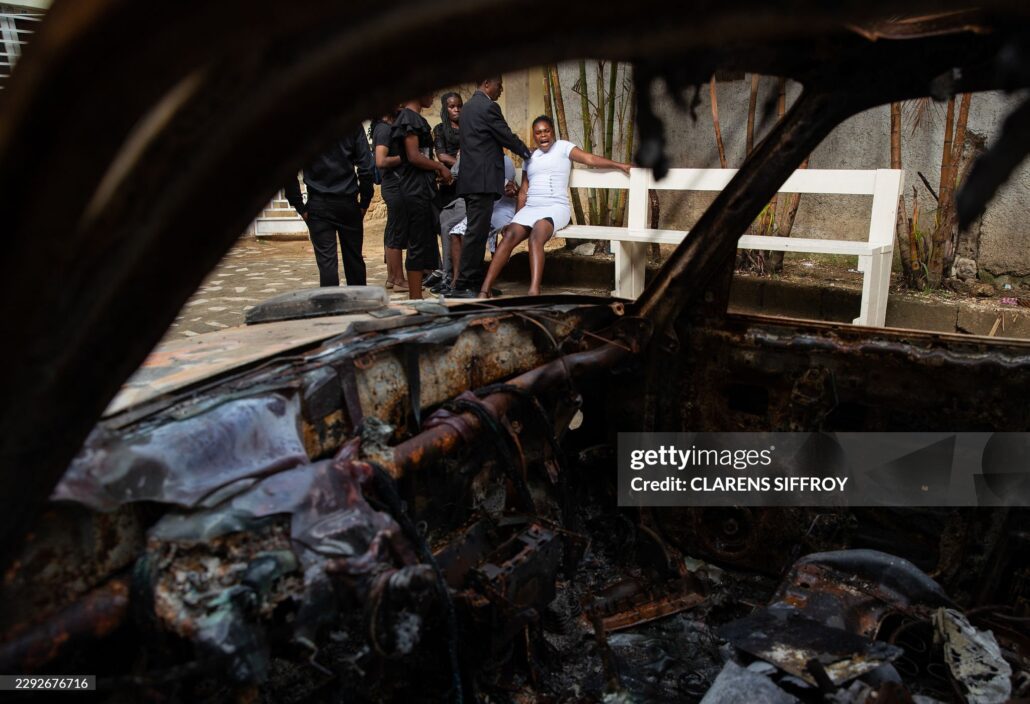
An overwhelmed man is attended to as people attend a collective funeral service for more than twenty people killed by armed gangs last week in Kenscoff, a neighborhood near Port-au-Prince, on September 2, 2026. Gang members attacked displaced people huddling inside a church near Haiti’s capital, killing around 40, some of them execution-style, the mayor told AFP on August 24. (Photo by Clarens SIFFROY / AFP via Getty Images)
In June, the US Supreme Court allowed the Trump administration to terminate Temporary Protected Status for Haitians, clearing the way for mass deportations of a population that has held legal status since the 2010 earthquake. Even as it moves forward with those deportations, the administration is simultaneously backing an aggressive counter-gang offensive within Haiti built around a 5,500-troop UN-authorized Gang Suppression Force, and has indicated plans to work with a drone operation run by Erik Prince’s private military company, Vectus Global — an acknowledgment, Vigersky notes, that the security situation remains dire even as protections for people fleeing it are stripped away.
Asked in July whether the State Department had a plan to address humanitarian funding gaps, Ambassador Michael Kozak told the House Foreign Affairs Committee he was “not aware that there is a big gap.” The UN’s 2026 humanitarian response plan for Haiti was only 47% funded as of early September, and the Trump administration cut US aid to Haiti by 48% in its first year in office, according to the Center for Global Development.
A health system in collapse
Vigersky documented hospitals repeatedly forced to suspend operations under direct gunfire. At Fontaine Hospital Center in Cité Soleil, staff evacuated eleven newborns from an intensive care unit by car during a gun battle in May, the second such evacuation in two months. At an MSF hospital nearby, acting field coordinator Max Kowalski activated the organization’s mass-casualty contingency plan that same morning after hearing gunfire approach within roughly 660 feet of the facility; by evening, the hospital had treated more than 40 gunshot wounds with just five emergency room beds, alongside more than 800 civilians seeking overnight shelter from the fighting. MSF suspended services at the hospital the next day, its third such suspension in three years.
The World Health Organization found only 37 of the capital’s 100 inpatient health facilities remain functional. At the state-run Hôpital Universitaire de la Paix, medical director Dr. Jean Philippe Lerbourg told Vigersky that emergency case loads have doubled in recent years even as funding cuts forced the termination of 25 staff.
Sexual violence has also surged; MSF’s clinic for survivors treated more than 2,300 people between January and September 2025 alone, with cases doubling again since February 2026, according to Nicholas Tessier, who heads MSF’s Haiti mission.
A city under siege, a strategy struggling to keep pace
Over the past four years, 1.5 million people, roughly 12% of Haiti’s population, have been displaced by gang violence, according to the International Organization for Migration. The violence accelerated after the 2021 assassination of President Jovenel Moïse, when rival gangs eventually united under a coalition called Viv Ansanm, led by former police officer Jimmy “Barbecue” Chérizier, for whom the US is offering a $5 million bounty.
Colonel Justin Gorkowski, who co-leads the Pentagon’s Haiti Gang Suppression Force effort, testified that stabilizing the country would require roughly 30,000 security personnel using standard peacetime policing ratios, or significantly more under a counterinsurgency framework comparable to the Iraq War. Haiti’s combined national police and armed forces are projected to reach just 10,000 in 2026 and 19,000 by 2028.
Meanwhile, drone strikes by Haitian security forces and private contractors, including Vectus Global, killed at least 1,243 people between March 2025 and January 2026, including 43 civilians and 17 children, according to Human Rights Watch. Chérizier remains at large despite a January drone strike on his stronghold. On August 23, gang members massacred 47 people in the rural community of Kenscoff, dozens of them sheltering inside a church, and kidnapped 52 others.
Asked whether Haiti was safe for returning deportees, White House deputy chief of staff Stephen Miller told reporters: “For Haitians? Absolutely.” Yet the US State Department itself is warnings Americans not to travel there.
NewsAmericasNow will continue tracking the situation in Haiti and its impact on TPS holders and deportees. Reporting from the Council on Foreign Relations contributed to this story.
YOU MAY ALSO LIKE: Stranger Raises Funds For Pierre Damas Bel’s Family After Husband Witnessed His Death






Leave a Reply
Want to join the discussion?Feel free to contribute!