
The 2030 US Census Raises A Bigger Question: Who Counts In America?
By Felicia J. Persaud
News Americas, NY, NY, Sun. Sept. 20, 2026: For 12 years, I fought to make Caribbean immigrants and those of Caribbean ancestry count in the United States Census. But after reading the Trump administration’s sweeping proposals to reshape the 2030 US Census, I realized the question confronting America today is much bigger than the Caribbean immigrant community.
The U.S. Census Bureau has proposed changes to the rules governing who would be included in the population used to apportion the 435 seats in the U.S. House of Representatives. The proposed residence criteria could exclude undocumented immigrants and certain other noncitizens whose status is not considered sufficiently permanent.
At the same time, the administration has proposed prohibiting the collection of race and ethnicity information on the decennial enumeration questionnaire, along with questions concerning sexual orientation. One proposal changes who counts for congressional apportionment. The other changes what the government would know about many of the people who are counted.
The Bureau’s proposed residence rule argues that certain foreign citizens lack a sufficient connection to the United States to establish “usual residence” for apportionment purposes. These are proposals, not final rules, and substantial legal challenges could follow if they are adopted. But their direction should concern anyone who understands what Census data mean.
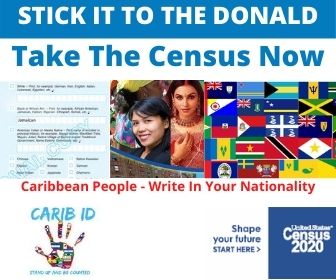
I certainly do. For 12 years, through CaribID, I fought to convince Caribbean immigrants and Caribbean Americans that being properly counted mattered. Simply checking “Black” did not tell America who we are. We are Guyanese, Jamaican, Haitian, Trinidadian, Barbadian, Grenadian, Vincentian, St. Lucian, Dominican and much more. We are people of different races and backgrounds connected by one region and a shared Caribbean culture.
After years of advocacy by communities across America, the 2020 Census made significant progress. For the first time in decennial Census history, the Black or African American race question included a write-in area that allowed respondents to provide detailed identities, with examples including Jamaican and Haitian.
The result was significant. The Census Bureau was able to publish data for 62 detailed Black or African American groups, including Caribbean identities such as Jamaican, Haitian and Grenadian. Nearly two-thirds of Black respondents provided a detailed response to the race question.
That is what better data can accomplish. And this was never simply about ethnic pride.
Data is power.
Census population data determine congressional representation and play a major role in redistricting, government planning, civil-rights enforcement and decisions involving public resources. When immigrants and Black communities become less visible in detailed data, our children do not disappear from schools. Our elderly do not disappear from hospitals. Our families do not disappear from neighborhoods.
What becomes harder to see is precisely who is there. And now there is an even larger issue.
The proposed residence rules could exclude not only undocumented immigrants from the population used for congressional apportionment, but also some immigrants who are lawfully present yet do not have permanent resident status. Think about what that means.
A person could live in Florida, Texas, California or New York. They could rent an apartment, buy groceries, send children to school, travel on local roads and contribute to the economic life of their community.
Yet under the proposed approach, that person may not be included when determining the state’s representation in Congress. At the same time, the federal government is considering collecting less information about the racial and ethnic identities of the people who are counted.
That would mark a major change in the nation’s demographic data collection. Race has been recorded in some form since the first U.S. Census in 1790. More recently, the Census Bureau spent years researching ways to allow Americans to more accurately describe increasingly complex racial and ethnic identities.
The Bureau’s own work following the 2020 Census demonstrated the value of that detail, producing data on nearly 1,500 racial and ethnic groups, tribes and villages.
Now America is considering moving in a different direction. To be clear, removing race and ethnicity questions from the decennial Census would not make all federal race and ethnicity data disappear. The Census Bureau also collects demographic information through the American Community Survey and other programs.
But the philosophical question remains: after decades spent improving America’s ability to understand the people who comprise this nation, why would we now choose to know less?
There is also a constitutional question that is certain to loom over this debate. The 14th Amendment says representatives are to be apportioned among the states according to their respective numbers, “counting the whole number of persons in each State.” How the courts would apply that language to any final 2030 Census rules remains to be seen.
For 12 years, I told Caribbean immigrants and Caribbean Americans: “Stand Up and Be Counted.”
I believed then, as I do now, that visibility matters. But this fight is no longer simply about whether a Jamaican, Haitian, Guyanese or Trinidadian can be seen in America’s demographic portrait. It is about something much more fundamental.
Who gets to count as America?
The 2030 Census is still four years away. These proposals are not final, and the debate is only beginning. But communities should pay attention now. Because when America debates whether millions of people who actually live here should count toward political representation, while also questioning whether the identities of those who do count are worth recording, we are no longer simply debating boxes on a Census form.
We are debating who America chooses to see.
EDITOR’S NOTE: Felicia J. Persaud is the founder and publisher of NewsAmericasNow.com, the only daily syndicated newswire and digital platform dedicated exclusively to Caribbean Diaspora and Black immigrant news across the Americas.
YOU MAY ALSO LIKE: Carib ID Welcomes Ruling On Census Extension






Leave a Reply
Want to join the discussion?Feel free to contribute!